
Schmidt Cassegrain Telescopes

Not sure which telescope suits you? We are stargazers ourselves and happy to help.
Send us a WhatsApp messageWe reply on weekdays between 9:00 and 17:00.
Showing all 19 resultsSorted by popularity
 Price range: 2.049,00 through 2.849,00 Select options This product has multiple variants. The options may be chosen on the product page
- Price range: 1.295,00 through 2.089,00 Select options This product has multiple variants. The options may be chosen on the product page


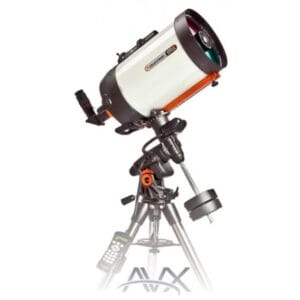


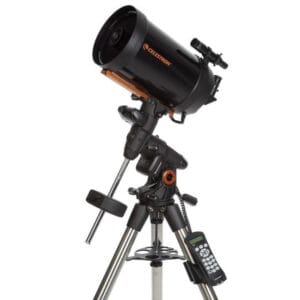

Showing all 19 resultsSorted by popularity
Schmidt-Cassegrain telescope: Celestron's all-rounder
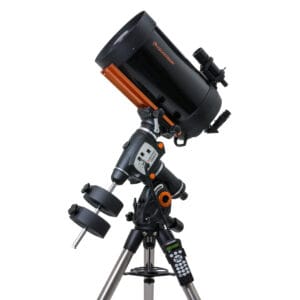
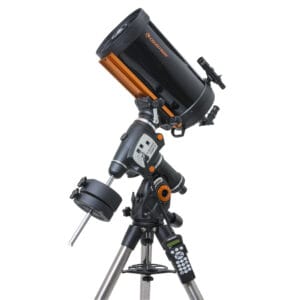
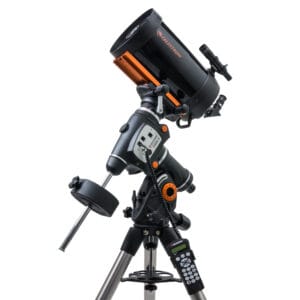
A Schmidt-Cassegrain telescope (SCT) bends the light using a thin corrector plate and two mirrors, allowing a 2000 mm focal length to fit into a 45 cm tube. At f/10, the design is sharp on the Moon and planets, and with a 0.63x reducer, it becomes an f/6.3 deep-sky instrument. No other type of telescope offers such versatility per kilogram. In Europe, Schmidt-Cassegrain is almost synonymous with Celestron, and we carry that entire line, from the NexStar 5SE to the C11 on a CGEM II mount.
Which series suits you?
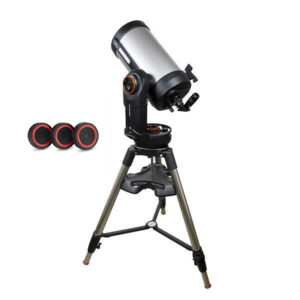
- NexStar SE (5, 6, and 8-inch). Fork mount with GoTo, single arm, set up in five minutes. Visual and for planetary photography. The 8SE is the classic.
- NexStar Evolution (6, 8 and 9.25 inch). Same fork mount with built-in battery and WiFi. Control via the SkyPortal app. No more cables in the field.
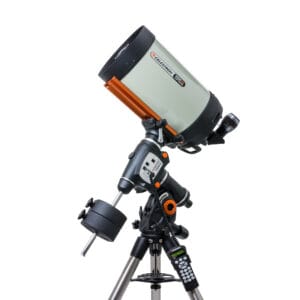
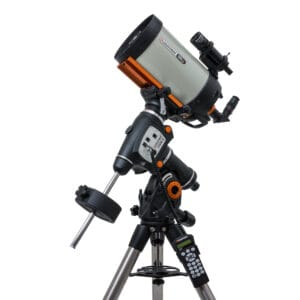
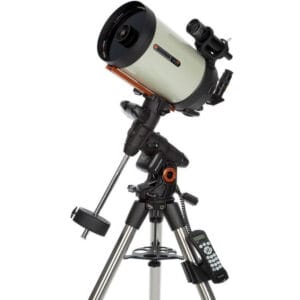
- Advanced VX-sets. The same tubes on an equatorial GoTo mount: C6, C8, C9.25 and C11. For those who want to create long exposures.
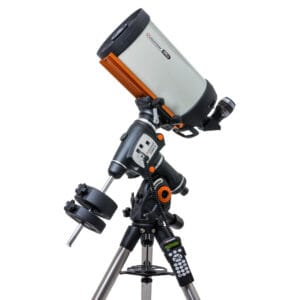
- CGEM II sets. The heavier mount for the C8 to C11 in a fixed observatory.
- EdgeHD. The same tubes with built-in field correction, for photography right into the corners of a large sensor.
Our recommendations
- Visual and entry-level: NexStar 6SE. 150 mm, GoTo, two-handed carry.
- The classic: NexStar 8SE. 203 mm opening in a package that fits in a small car.
- Photography: C8 on Advanced VX, with a 0.63x reducer for deep-sky.
For whom yes and for whom no
Well: anyone who wants one telescope for everything, who needs to stay compact with a large aperture, and who wants to do astrophotography later. Not: anyone looking for the cheapest route to a large aperture (choose a Dobson) or those who primarily want to shoot wide-field deep-sky (choose a short APO refractor).
Accessories: A dew shield is required; a 0.63x reducer widens the field of view and shortens the focal length; and a 2-inch zenith mirror with a wide-angle eyepiece gets the most out of a C8 and larger telescopes. Everything about the brand on the Celestron brand page. Shipping throughout Europe.