
EdgeHD Telescopes
Not sure which telescope suits you? We are stargazers ourselves and happy to help.
Send us a WhatsApp messageWe reply on weekdays between 9:00 and 17:00.
Showing all 6 resultsSorted by popularity

Showing all 6 resultsSorted by popularity
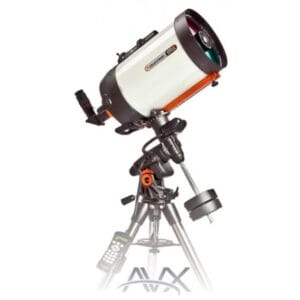
Celestron EdgeHD: Schmidt-Cassegrain with a flat field of view
A standard Schmidt-Cassegrain produces sharp stars in the center and slightly stretched stars at the edges. For visual observation, you hardly notice this; on a large camera sensor, however, you do. Celestron EdgeHD solves this with a correction group in the baffle behind the primary mirror. The result is an aplanatic, flat field of view extending all the way to the corners of a full-frame sensor, plus mirror clamps that hold the image steady during long exposures and ventilation openings for faster cooling.
Three formats
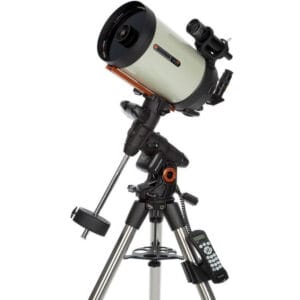
- EdgeHD 800 on Advanced VX: 203 mm, 2032 mm brand. The entry-level model and the most popular size. With a 0.7x reducer, the aperture becomes f/7.
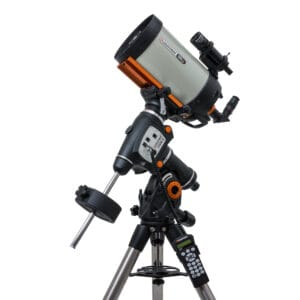
- EdgeHD 925 on Advanced VX: 235 mm. More aperture for galaxies and planetary nebulae, still portable on the Advanced VX.
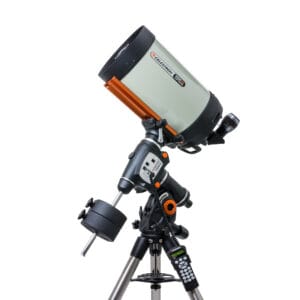
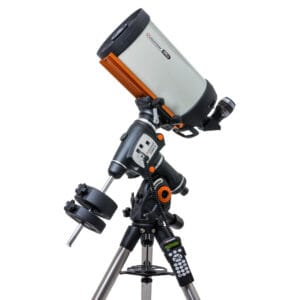
- EdgeHD 1100 on Advanced VX and OP CGEM II: 279 mm to 2800 mm. For a permanent setup, the CGEM II is the mount we recommend for this.
Who is EdgeHD for?
For astrophotographers who want to photograph galaxies, planetary nebulae, and small emission nebulae with a large sensor, and who want a single tube that is also strong visually and for planets. Count on a mount with ample load capacity, autoguiding, and a Hyperstar or reducer option for faster exposure. For visual use only, the standard Schmidt-Cassegrain the more economical choice.
All EdgeHD models come with Celestron StarBright XLT coating and are suitable for the StarSense Autoguider. More about the manufacturer at Celestron brand page.