


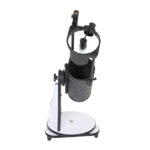
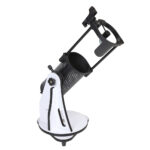
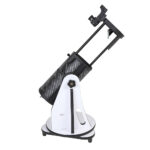
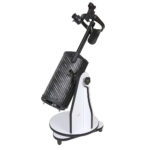
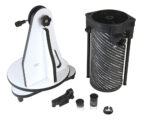


Sky-Watcher Heritage-130P FlexTube: lots of mirror in a small package
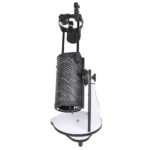
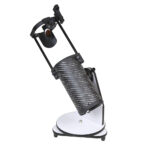
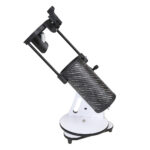
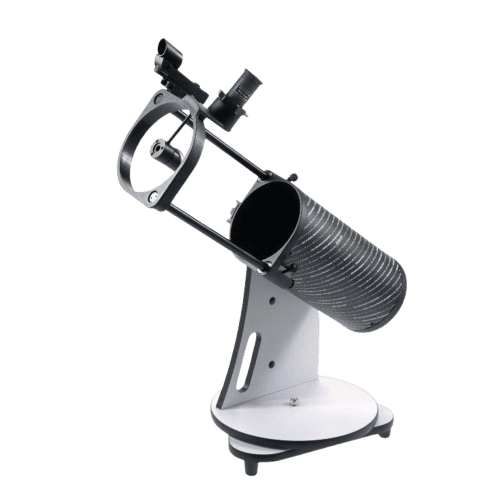
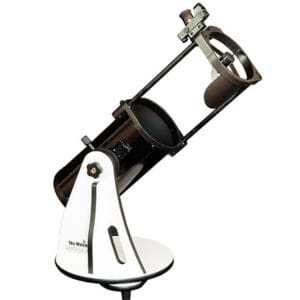
The Sky-Watcher Heritage-130P FlexTube is a tabletop Dobsonian with a 130mm (5.1 inch) parabolic primary mirror and a focal length of 650mm (f/5). This aperture gathers approximately 345 times more light than the naked eye. This places the telescope optically in a different class than most entry-level models with a thin tripod, while it is only 37 cm (14.5 inches) tall when collapsed and weighs 6.1 kg. It has been one of our best-selling telescopes for years. Dobson assortment, and not without reason.

What do you see through the Heritage 130P?
On the Moon, you can see sharp craters, mountain ranges, and the terminator, the line between day and night. Jupiter shows its cloud bands and its four large moons. Saturn's rings are clearly visible. Under a reasonably dark sky, you can also observe bright deep-sky objects: the Orion Nebula, the Pleiades, and the Andromeda Galaxy as a luminous patch with a bright core. Don't expect color photos like those from NASA; visual observation shows deep-sky objects as gray structures. What you will get is real light that reaches your eye after traveling for thousands of years.

FlexTube: compact without a smaller mirror
The FlexTube system slides the tube into two parts. When retracted, the telescope fits into a backpack or suitcase, and when extended, it's ready in seconds. You place it on a garden table or other sturdy surface, aim with the red dot finder, and look. No counterweights, no power, no alignment procedure. This makes the threshold for a quick half-hour observation very low, and the telescope that's outside most often always wins over the telescope that's inside.

This is how to get the most out of this telescope
These tips come from our own experience and from what buyers tell us:
- Place it on a firm surface. A wobbly camping table ruins the view at higher magnifications. A sturdy table, stool, or even an overturned crate works excellently.
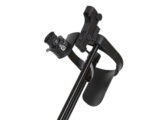
- Shield the open tube. Due to the open FlexTube design, stray light from streetlights can fall on the mirror. A light shroud made of foam rubber or fabric around the open section increases the contrast merkbar. This is the most common DIY upgrade for this telescope.
- Give the mirror a cooling time. Place the telescope outside 20 to 30 minutes before observing. A mirror at ambient temperature provides a steadier and sharper image.
- Align the red dot finder during the day. Aim at a distant object, such as a church steeple, and focus the viewfinder on it. In the evening, you will find objects immediately.
- Check the collimation after transport. Like any Newtonian reflector, the 130P works best with well-aligned mirrors. With the included collimation cap, that's a two-minute check. In our guide to collimation We'll explain step by step how that works.
- Stay realistic with magnification. The 10mm eyepiece gives 65x. With an extra 6 mm planetary eyepiece (108x) or a 2x Barlow lens (130x with the 10mm eyepiece) will bring out planetary details. Above 150x to 200x, the Dutch atmosphere rarely offers extra detail, despite what other stores' packaging might promise.

For whom yes and for whom no
Hello beginners who want a serious first telescope without a technical learning curve, families with children, observers with little storage space or a balcony, and advanced users looking for a light travel telescope to complement their larger instrument. Still unsure about the right starter model? Our Telescope Buying Guide for Beginners List all the options.
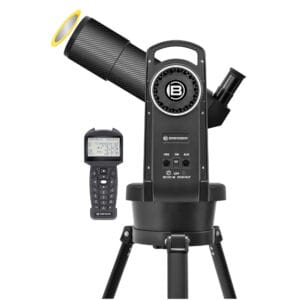
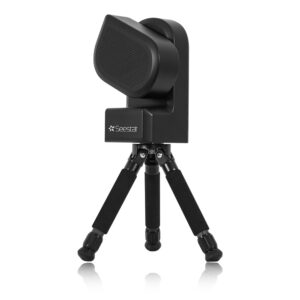
Not Do you want to take long exposures of nebulae and galaxies? Then this is not the right choice. The manual Dobson mount does not automatically track the night sky. In that case, look at the smart telescopesThe photographer is fully automatic. What does work well and is a lot of fun: quick photos of the moon with a smartphone adapter on the eyepiece. The moon is bright enough for short shutter speeds, so the lack of tracking is not a problem. Craters and the terminator line come out surprisingly sharp, and bright planets are also a fun challenge. For many buyers, such a first own moon photo is the moment the hobby truly begins. Do you want maximum deep-sky detail? Then consider its big brother: in Heritage 130P vs 150P Let's compare both models fairly.
Featured accessories
The set is complete to start tonight. These accessories add the most afterwards:
- Moon Filter 25%: the moon is bright through a 130 mm mirror. The Omegon Moon Filter 25% (1.25 inches) dims the light and increases the contrast. Which filter suits which telescope, you can read in our Moon filter guide.
- A 6mm planetary eyepiece: the Sky-Watcher 6mm Planetary UWA Eyepiece offers 108x magnification: the logical step for more detail on Jupiter and Saturn, with a wide field of view of 58 degrees.
- Smartphone adapter: clamp your phone to the eyepiece and take your own moon photos. The Sky-Watcher SmartPhoto+ adapter comes with a special 20mm photo eyepiece. For many observers, the most enjoyable accessory of all.
- Cheshire eyepiece the Sky-Watcher Cheshire Eyepiece Aligning the mirrors is more accurate than the included collimation cap.
- Carrier bag protects the optics on the way to a dark spot. View the carrier bags and choose the size that fits this model.
Technical specifications
| Specification | Details |
|---|---|
| Optical design | Newton reflector (parabolic mirror) |
| Mirror opening | 130 mm (5.1 inches) |
| Focal length | 650 mm (f/5) |
| Mount | Dobson, tabletop, manual |
| Focuser | 1.25 inch helical focuser |
| Tube | Retractable (FlexTube), 37 cm (14.5 inches) retracted |
| Mirror Material | Borosilicate glass with RAQ™ coating |
| Total weight | Approximately 6.1 kg |
| Maximum useful magnification | Around 260x (practical advice: up to 150x to 200x) |

Included in the box
- Sky-Watcher Heritage-130P FlexTube with Tabletop Dobsonian Mount
- 25 mm eyepiece (26x magnification) for viewing nebulae and star fields
- 10mm eyepiece (65x magnification) for Moon and planets
- Red dot sight for quick aiming
- Collimation cap for aligning the mirrors
- Integrated accessory tray for your eyepieces
Honest advice from observers
We have been selling the Heritage-130P for years and use it ourselves as a travel telescope. You can read our complete experience, including the drawbacks, in our Sky-Watcher Heritage 130P review. Want to learn more about the merk? In our Sky-Watcher merk Guide We'll explain which series are strong and which you'd rather skip. View the full range on our Sky-Watcher merk Page. Order before 11:59 PM for fast delivery, in the Netherlands and Belgium.

Anneke Van Riesen-Pap (verified owner) -
Not yet tried but as I have heard it should be
Bas (verified owner) -
Super nice, simple and quality telescope.
Sjors (verified owner) -
Haven't been able to test it yet. Looks to be of good quality.
Laurens van Walsem (verified owner) -
After some waiting, I received my Sky-Watcher Heritage 130P. Assembly was straightforward, and the Dobsonian mount is a pleasure to use. My first observation of the moon immediately revealed a lot of detail and sharp craters. The telescope is compact but collects a surprising amount of light. For beginners who want to see more than what's possible with a small entry-level telescope, this is an excellent choice. I am very satisfied and look forward to observing planets, nebulae, and galaxies.