


Sky-Watcher Explorer-200PDS (OTA): Opening for finer targets
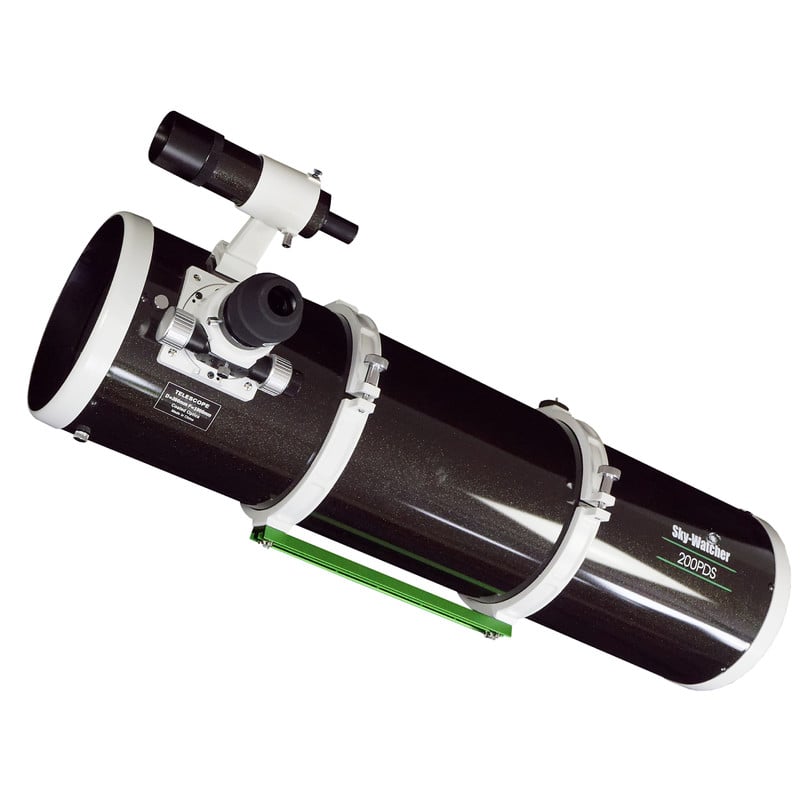
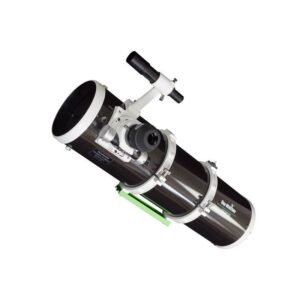
The Sky-Watcher Explorer-200PDS is a 200/1000mm imaging Newtonian (f/5) with a low-expansion primary mirror. An eight-inch aperture and one-meter focal length bring smaller galaxies and planetary nebulae within photographic reach, while the 8.75 kg tube can still be handled by a sturdy mid-range mount.
What can you do with it?
Photographically, this is the class where smaller galaxies, planetary nebulae, and fine structures come within reach: plenty of aperture, plenty of resolution, plenty of signal. Visually, you get a full-fledged deep-sky telescope: globular clusters resolve, nebulae show structure, and planets are razor-sharp. These are tubes that serve two hobbies at once.
Why a PDS?
The PDS versions are the photo versions of the Explorer line: the focal point is further out so that a camera comes into focus in prime focus, the tube is internally blackened to prevent stray light, and the focuser is built for the weight of a camera. Visually, you don't lose anything: with the included.
This is how to get the most out of this telescope
- Collimation is a fixed ritual at f/5: check for each photoshoot. Our guide to collimation It takes two minutes.
- Include the comma corrector: For sharp stars all the way to the corners of the sensor, this fast optic requires a corrector. Ordering it at the same time saves you a second waiting period.
- Mounting choice: Count on HEQ5 class or heavier; with camera and guiding, that's the comfortable minimum.
- Guiding Loon With this focal length, a small guide scope makes the difference between 60 and 300 second exposures.
- Give the mirror some cooling time (30 to 60 minutes depending on the size) for the sharpest image, visually and in photos.
- Visual planetary work: a 6 mm eyepiece gives 167x.
For whom yes and for whom no
Hello The growing photographer who wants more resolution after a small tube, and the demanding visual viewer.
Not If you want deep-sky photos without a mount, guiding, and post-processing, the smart telescopes the shorter route; ours Telescope Buying Guide for Beginners explain the trade-off.
Featured accessories
These accessories add the most after purchase:
- Coma corrector At f/5, stars at the edge of the frame appear comet-shaped on the sensor. The Sky-Watcher 2 inch Coma Corrector 1.0x solves this and is the most important first purchase for serious photography with this tube.
- Cheshire eyepiece An imaging Newton only performs with tight collimation; a Cheshire makes the adjustment accurate and fast.
- Light Pollution Filter (2 inch) Under Dutch or Belgian skies, it brings out significantly more contrast in your images and your eyepiece view.
- Moon Filter 13%: with this opening, the moon is blindingly bright; the Omegon Moon Filter 13% (1.25 inches) The light fades. More explanation in our Moon filter guide.
Technical specifications
| Specification | Details |
|---|---|
| Optical design | Newtonian reflector (parabolic, low-expansion glass), imaging version |
| Opening | 200 mm |
| Focal length | 1000 mm (f/5) |
| Ocular | 28 mm (1 inch) |
| Seeker | 9x50 optical with crosshair |
| Ocular Adapters | 1.25 and 2 inches |
| Tube weight | 8.75 kg |
| Mount | No (OTA) |
Included in the box
- Sky-Watcher Explorer-200PDS optical tube
- 28mm LET-ocular (2-inch)
- 9x50 optical finder scope with crosshairs
- 1.25 and 2 inch eyepiece adapters
- Free: Stargazer's Handbook by Telescoop.nl (16 pages, Dutch language)
Free Stargazers' Handbook
Every Sky-Watcher telescope from Telescoop.nl comes with our own Stargazer’s Handbook in the box. It’s a 16-page booklet that helps you get started on your first few nights: how to align the finder scope, what magnification to start with, why the image sometimes wobbles, and when a telescope does or doesn’t need to be collimated. It’s not a thick book—just the essentials you really need when you’re starting out.
Honest advice from observers
We sell and use the Sky-Watcher line ourselves. In our Sky-Watcher brand guide We'll explain which series are strong and which you'd rather skip. View the full range on our Sky-Watcher brand page. Order before 11:59 PM for fast delivery, in the Netherlands and Belgium. Uncertain about mounting, guiding, or coma corrector? Call or email us: we're happy to help with photo setups.
Reviews
There are no reviews yet.