


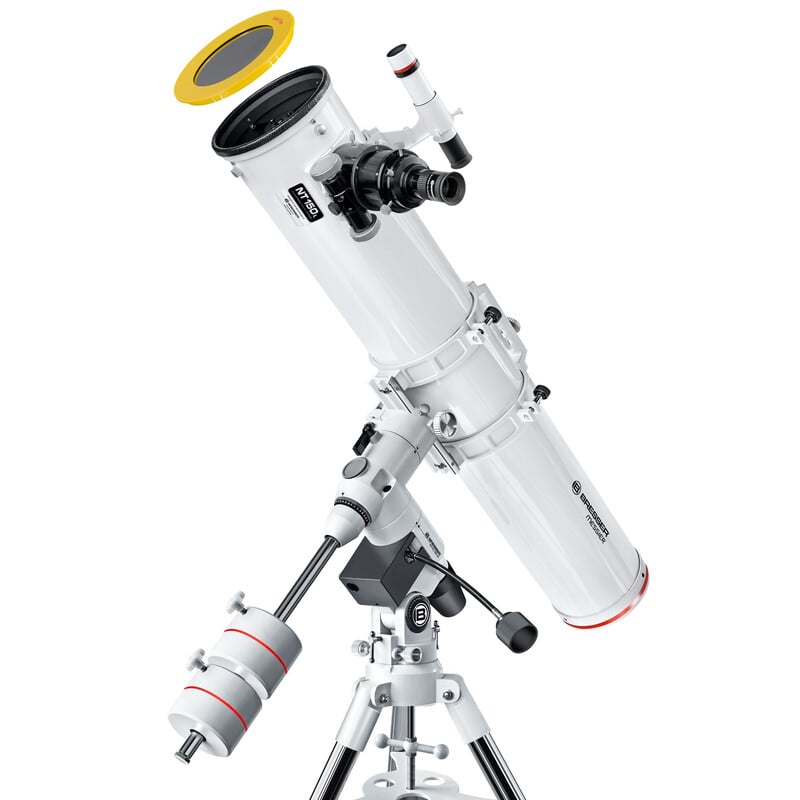
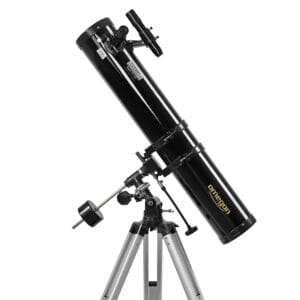
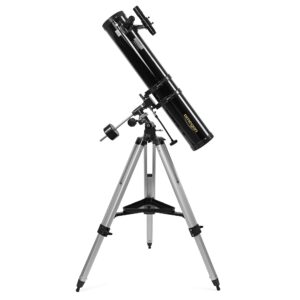
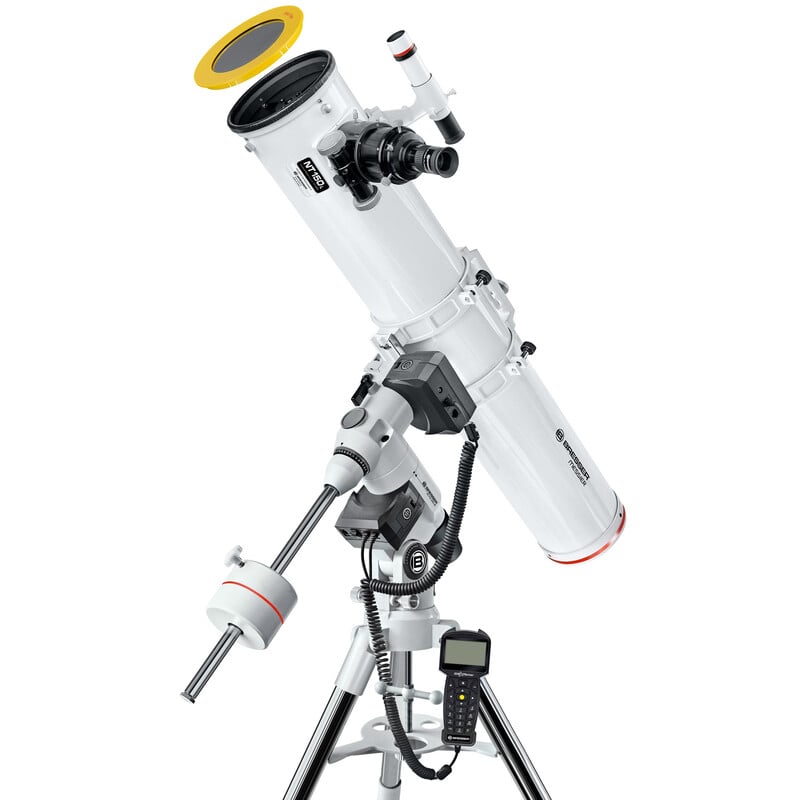
The Messier 150/1200 EXOS-2 is a Newton reflector with a 150 mm mirror and a focal brandlength of 1200 mm (f/8) on the EXOS-2, a German equatorial mount with ball bearings on both axes, 13 kg load capacity and a polariscope, on a stainless steel tripod from 69 to 109.5 cm. The 112 cm aluminum tube has a 2.5 inch Hexafoc lens with an adapter for 2 inch eyepieces and a 1.25 inch adapter with T2 thread for a camera. In the Bresser Messier line, this is the 150 mm with the longest brandpoint on this mount: a 10 mm eyepiece gives 120x magnification, and the 6.5 kg tube has 6.5 kg carrying capacity for motors, a camera or heavy eyepieces. How an equatorial mount works is explained in Tripods and mounts explained.
What do you see through the Messier 150/1200 EXOS-2?

Moon: with the 26 mm eyepiece (46x), the entire Moon is in view with craters, mountain ranges, and the shadow line; with the 10 mm eyepiece (120x), part of the Moon fills the frame, with the central peaks in large craters and the ridges along the lunar seas. Jupiter: the two dark bands with color differences and the four large moons, at quiet nights with 120 to 185x the Great Red Spot and the shadow of a Moon passing over the planet. Saturn: the ring apart from the sphere, the Cassini division at good nights, and Titan as a weak point next to the ring. Mars: around an opposition the white polar cap and dark areas on the orange disk. Double stars: Albireo in orange and blue, and at 120x the double star in the Pleiades as four separate stars. Sun: with the filter on the tube, sunspots with a dark core and a gray rim. Deep Sky: The Ring Nebula as a small grey ring, the Orion Nebula with the four stars of the Trapezium, globular cluster M13 with detached stars at the edge, and from a dark spot the Andromedan Nebula as an oval blob. With the 26 mm eyepiece you see about 1.1 degrees of sky, twice the Moon; the Pleiades do not quite fit in there. Nebulae and star clusters are seen with the eye in gray tones, not in color. From a city or village with street lighting, only the sun, the Moon, planets, double stars, and star clusters remain; nebulae and star clusters require a dark spot. The highest meaningful magnification is about twice the aperture, 300x; in practice, 150 to 200x is the limit for the sky over the Netherlands and Belgium. What you can expect per object is stated in What do you see through a telescope?, Jupiter through a telescope, Saturn through a telescope, Mars through a telescope and The Moon through a telescope.
Photos: A DSLR or system camera with a T2 ring screws onto the T2 thread of the 1.25-inch adapter. At 1200 mm focal brandpoint, the moon is 11 mm across on the sensor, well over two-thirds of the short side of an APS-C sensor; planets are filmed with a planet camera in the eyepiece hole. For fog, f/8 is too shallow: a shot takes 2.5 times as long to expose as with a 150 mm lens at f/5, and that requires the motor drive and precise polar alignment. How to connect a camera is explained in Connecting camera to telescope.
How is the Messier 150/1200 EXOS-2 different from other 150 mm telescopes?
- Optics: The Messier 150/1200 EXOS-2 has a 150 mm mirror with a 1200 mm focal brandpoint (f/8) and a 45 mm viewfinder, 30% of the aperture. With separate eyepieces you get 120x (10 mm) and 185x (6.5 mm) without a Barlow, and the mirrors are less likely to come out of alignment during transport than at f/5. This is offset by a field of view of 1.1 degrees with the supplied eyepiece and a tube of 112 cm.
- Mounting: German equatorial mounting with ball bearings and fine adjustments on both axes, 13 kg load capacity, a polar finder in the polar axis (optional lighting) and a counterweight of 4.5 kg. With the 6.5 kg tube, half of the load capacity remains free, and you can later build an RA and DEC motor set or the GoTo kit from Bresser on top of it.
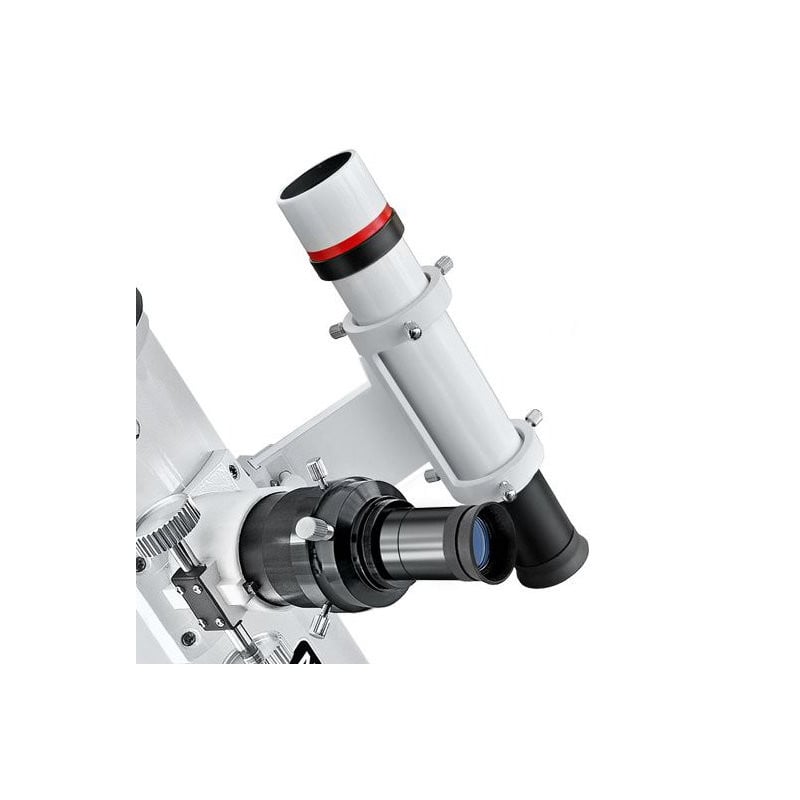
- Included: 2.5 inch Hexafoc with 65 mm diameter, an adapter for 2 inch eyepieces and an adapter from 2 to 1.25 inch with T2 thread; Bresser makes it a fine adjustment of 1:8. Also included: a 26 mm Super Plössl (46x), a 6×30 optical viewfinder, an objective-sun filter, a tube clamp with handle and camera holder (1/4 inch thread) on a prism rail (the eagle-shaped bracket that clamps the tube into the mount) and a smartphone holder for a star map app on the tube.
For whom yes and for whom no
Hello who especially wants to see the Moon, planets and double stars at 120 to 200x magnification and keep them in focus with the fine adjustment of one axis; who is looking for a mount that later can accommodate motors, GoTo or a camera, with a carrying capacity of 6.5 kg; who can carry 21.3 kg in four parts and has room for a tube of 112 cm. If you are unsure between an EQ mount and a Dobson, please read the Telescope Buying Guide for Beginners.
Not For those who primarily look for nebulas and star clusters in a wide field of view; then same mirror size with 750 mm brandpoint on this mounting, With a 1.8 degree field of view with the same ocular and a tube of 69 cm, where this 1200 mm version compares with 120x with a 10 mm ocular. If you want the telescope to zoom in on objects itself, choose The GoTo version of this telescope, This set does not require batteries or a battery pack and can be expanded with motors later on. If you want to see it without the pole shaft and counterweight, then it is shown here. the 150/1200 Dobson model from Bresser ready with the same brandpoint directly, but follow with two hand movements instead of one dial. For long exposures of weak clouds, f/8 is too underexposed; then look at the smart telescopes, which themselves follow and accumulate.
What's in the box
- Messier 150/1200 aluminum Newton tube with 2.5 inch Hexafoc lens and dust caps
- Adapter for 2 inch eyepieces and adapter from 2 to 1.25 inch with built-in T2 wire
- Socket plug with handle and camera holder (1/4 inch thread), on prismatic rail with stainless steel clamping surface
- EXOS-2 equatorial mounting with ball bearings and fine movements on both axes
- Adjustable pool finder (lighting sold separately)
- Counterweight of 4.5 kg
- Stainless steel tripod, 69 to 109.5 cm, with accessory platform
- 26 mm Super Plössl ocular (46x), 1.25 inch
- 6×30 optical viewfinder
- Objective sun filter for the tube
- Smartphone holder on the tube for a star map app
- Rotatable star map, Stellarium as download
Not included: planetarium eyepiece, moon filter, motors. With the 26 mm eyepiece you can still see at 46x; a 10 mm eyepiece (120x) is the magnification for which you buy this tube. At full moon the light through the 150 mm is bright, a 13% mm moon filter softens that. Without the motor, you turn the viewfinder by hand; the RA and DEC motors do that automatically. All three are included here in the accessories.
Looking safely at the sun
The supplied lens sun filter covers the full 150 mm aperture and shows sunspots and the edge distortion of the sun disk. Six rules that always apply:
- The filter is only located in front of the tube, over the entire opening.
- Never a filter in the eyepiece: the light is already bundled there and branda eyepiece filter is included.
- Never use an eclipse glasses behind the viewer; they are made for the naked eye, not for the beam of light from a telescope.
- Cover the 6×30 viewfinder or remove it; focus on the shadow of the tube on the ground. Never look through the polar viewfinder at the sun.
- Check the foil for holes, tears, and loose edges before each use; a damaged filter will fall off.
- This filter is tailored to this tube. If you ever buy a separate filter, measure the circumference of the front of the tube (outside diameter 180 mm) and divide by 3.14 for the size.
Secure the filter so that the wind cannot take it off the tube, and let children look at the sun only under supervision. ISO 12312-2 is a standard for eclipse glasses, not for telescope filters. More about observing the sun can be found here. The sun through a telescope and Sun filter for your telescope. On August 2, 2027, there will be a partial solar eclipse to be seen.
Format and weight
21.3 kg in four parts: the tube with clamps and accessories weighs 6.5 kg, the EXOS-2 mounting weighs 5.6 kg, the stainless steel tripod weighs 4.7 kg, and the counterweight weighs 4.5 kg. The aluminum tube is 112 cm long and 18 cm thick; in the car it fits lying down. The tripod stands at 69 to 109.5 cm; when assembled, it reaches a height of 180 cm, and the legs measure about a meter in diameter. At a Newton, the eyepiece is located on the side of the tube: for objects high in the sky it is high and you view standing, for objects low in the horizon it is lower and you view from a stool. The shipping box measures 136 x 33 x 33 cm.
First evening with the Messier 150/1200 EXOS-2
- Take off the tube cap (and the sun filter, which is only for daytime use), place the tripod on a flat surface, attach it to the mounting bracket on the axis, and then clamp the tube prism rail onto the saddle.
- Line the 6×30 viewfinder at day time on a distant object, for example a church tower or chimney, with the 26 mm eyepiece in the viewfinder.
- Point the polar axis towards the north: set the elevation scale to your latitude (52 degrees in the Netherlands, 51 in Belgium) and rotate the entire assembly until the Pole Star is in the polar viewfinder. For viewing with the eye, that is accurate enough; for photos, place the Pole Star in the location indicated by the scale in the polar viewfinder.
- Balance: Unclip the uaras clamp and slide the counterweight until the tube remains in place; then insert the tube into the clamp until the declination axis is also balanced. With a 112 cm tube, good balance makes the difference between a smooth and a shaky image at 120x.
- Do not look through a window. Start with the 26 mm eyepiece (46x) and look for the moon; follow it with the fine adjustment of the eyepiece and then switch to a shorter eyepiece.
- Rotate the Hexafoc until the image is small and sharp; a large blurry disc is not sharp. Set the telescope 30 to 45 minutes before viewing outside, so that the 150 mm mirror reaches outside temperature.
- An unsharp image almost never results from collimation; at f/8 the mirrors shift less quickly during transport. How to control it is described in the Collimation guide.
Which accessories are suitable?
- Vela Optics 10 mm Super Plössl eyepiece, 1.25 inch: with a 1200 mm brandfocal length 120x without Barlow, the magnification for which this f/8 lens is made: the Cassini division, the bands of Jupiter and the double double star in the Pleiades; fits into the 1.25 inch adapter.
- Bresser RA and DEC motors for EXOS-2Stepper motors for both axes of this assembly with manual control at 1x, 8x and 32x speed settings, so that Jupiter remains centered in the image at 150x. Works on 8 D batteries, which are not included.
- Bresser 1:8 Microfocuser for Messier HexafocThe fine adjustment that Bresser provides for the Hexafoc of this set; at 120 to 200x, you can adjust in small increments to the focus point without the image vibrating with every touch.
- Vela Optics Moon Filter ND96 13%, 1.25 inch: screw into the filter thread at the bottom of a 1.25 inch eyepiece and let 13% of the light through so that the moon is not dazzled.
Messier 150/750 EXOS-2, Messier 150/1200 EXOS-2 or Messier 203/1200 EXOS-2?
| Messier 150/750 Hexafoc EXOS-2 | Messier 150/1200 Hexafoc EXOS-2 (this page) | Messier 203/1200 Hexafoc EXOS-2 | |
|---|---|---|---|
| Mirror | 150 mm parabolic, 750 mm brandspot (f/5) | 150 mm, 1200 mm brandfocal length (f/8) | 203 mm parabolic, 1200 mm focal brandpoint (f/6) |
| Included 26 mm eyepiece | 29x, field of view about 1.8 degrees | 46x, field of view about 1.1 degrees | 46x, field of view about 1.1 degrees |
| Seeker | 6x30 optical | 6x30 optical | 8×50 optical |
| Tube | 69 cm long, 18 cm thick, 5.5 kg | 112 cm long, 18 cm thick, 6.5 kg | 106 cm long, 25 cm thick, 11.9 kg |
| Counterweights | one of 4.5 kg | one of 4.5 kg | two of 4.5 kg |
| Total weight | 20.3 kg | 21.3 kg | 31.2 kg |
| Choose this as | You want to see your nebulae and star clusters in a wide field of view with a 69 cm tube | You want to view your planets and double stars at 120 to 200x with a 6.5 kg tube | You want 83% more light at the same brandpoint and you can set up 31.2 kg |
Frequently asked questions about the Messier 150/1200 EXOS-2
- Is it suitable for a child? From the age of 8, together with an adult; from the age of 12, independently; assembling the seat in four parts and clamping a tube of 112 cm in the saddle takes an adult, and orienting the pole axis requires explanation. A child looks only under supervision at the sun.
- Can I take photos with it? Of the moon, the sun (with the filter) and the planets: a camera with a T2 ring on the T2 thread of the 1.25 inch adapter, a planet camera in the eyepiece hole or a phone holder on the eyepiece. Clouds require long exposures at f/8, with the motor set and a precise polar alignment via the polar viewfinder.
- How can I safely look at the sun? Only with the filter included in the box, before the 150 mm mirror. Check the film before each use, cover the viewfinder and never use an eclipse glasses behind the viewfinder or a filter in the eyepiece. If the filter needs to be replaced, the 180 mm tube fits onto this 150 mm tube. Omegon Helievo in sizes 173 to 193 mm.
- Is there a servo motor on it? No, you follow the fine motion of the spindle; at 120x, you rotate a little bit every half minute. The RA and DEC motorset above allows the assembly to rotate; with the GoTo Upgrade Kit for the EXOS-2 he also searches for objects himself.
- Do I need to collimate it? Rarely. At f/8 and a 45 mm viewfinder, the image remains sharp at 120x with a slight deviation that would already make a f/5-Newton lens soft; check it after a drive, at a star or with a collimation aid (which isn't included in the box). The steps are listed in the Collimation guide.
- Do 2 inch eyepieces fit? Yes. The Hexafoc takes them with the supplied 2 inch adapter, and with the 6.5 kg tube there is room on the EXOS-2 for a heavy 2 inch eyepiece; at 1200 mm focal brandpoint a 30 mm eyepiece gives 40x magnification.
Specifications
| Optical design | Newton reflector |
| Opening | 150 mm |
| Focal length | 1200 mm |
| Opening ratio | f/8 |
| Mirror | Main mirror 150 mm, rear mirror 45 mm; separation ability 0.86 arcseconds |
| Highest meaningful magnification | about 300x, in practice 150 to 200x |
| Mount | EXOS-2 German equatorial mounting, ball bearings and fine motion on both axes, 13 kg load capacity, polar finder, counterweight 4.5 kg; motor set or GoTo kit as option |
| Tripod | Stainless steel, 69 to 109.5 cm, with accessory tray; assembled to 180 cm high |
| Reporter | 2.5 inch Hexafoc (65 mm), adapter for 2 inch eyepieces and adapter to 1.25 inch with T2 thread for a camera |
| Dovetail | Prismarail with stainless steel clamp surface, hose clamp with handle and camera holder (1/4 inch thread) |
| Seeker | 6×30 optical; polarizer in the polar axis |
| Included eyepieces | 26 mm Super Plössl (46x), 1.25 inch |
| Solar filter | Objective sun filter for the tube, included |
| Total weight | 21.3 kg (tube 6.5 kg, mounting 5.6 kg, tripod 4.7 kg, counterweight 4.5 kg) |
| Tube length | 112 cm, tube diameter 18 cm |
| Packed | 136 x 33 x 33 cm |
Shipping and assistance
Orders with multiple items are shipped from multiple warehouses and may arrive in parts; each package will have its own tracking number. More information about this can be merk found on the Bresser 1TP5 Page. Help with choosing or on the first evening: WhatsApp or call on weekdays from 9:00 to 17:00, or come by appointment in Sneek. 30 days' cooling-off period.
Reviews
There are no reviews yet.