Seeing Jupiter through a telescope is, for many people, the moment when stargazing comes alive. But what does the gas giant really look like through your telescope? What is possible with post-processing? And what magnification do you need to see Jupiter well? In this blog we give clear answers, supported with real images from realistic observations to stacked astrophotos.
What do you see when you view Jupiter live?
Without trickery or editing, you see Jupiter as a bright disk with one or two brown bands. These are giant storm belts stretching across the planet. Even with a simple 76 mm Dobsonian and an enlargement of around 100x these bands become visible, along with the four largest moons: Io, Europa, Ganymede and Callisto. These look like tiny points of light in a straight line around the planet.

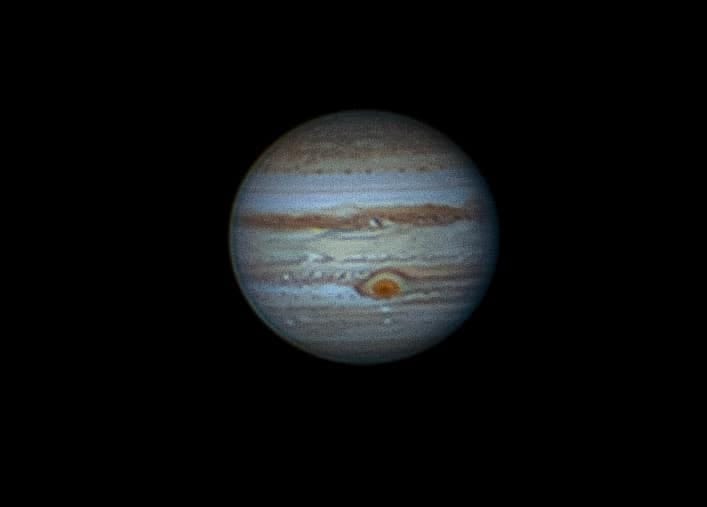
The first and second images in this blog shows such a visually realistic image. It is what you can expect with a reasonable telescope without digital post-processing. The colors are subtle, the details limited, but the feeling of really looking at another world remains magical.
How does Jupiter look with post-processing?

The sharper, higher-contrast photos in this blog were taken using multiple techniques:
- High frame rate video recording
- Image selection and stacking (for example, in AutoStakkert or Pixinsight)
- Color correction and sharpening
Examples are these images: Jupiter there shows multi-colored cloud bands, a clear Big Red Spot, and even shadows of moons on the planet's surface. You achieve this level with:
- A telescope with 150-200 mm opening
- A camera such as the ZWO ASI Series or a smartphone + adapter
- Patience, software and good seeing (i.e., good atmospheric conditions... and that in turn means, not just a clear sky, but a ‘ clean’ sky!)
The result is impressive, but so not what you see directly with the naked eye through an eyepiece. Still, it is bizarre that you are looking at another world, millions of miles above us.
At what magnification do you see Jupiter well?
For a useful, detailed image of Jupiter applies:
- Minimum magnification: 60x (disk and moons visible)
- Ideal magnification: 100x-150x
- Maximum usable magnification: 2x aperture in mm
A telescope with 76 mm aperture thus offers a maximum of approx. 150x magnification and that is just enough to see Jupiter well. With larger telescopes (150 mm or more) you can go up to 250x-300x, which allows finer details provided the atmosphere cooperates.
Note that more magnification without sufficient aperture will produce a dark and blurry image. A good combination of optical quality, stable mounting and the right magnification is essential.
What is the best time to observe Jupiter through a telescope?
The best period is in opposition, which is when Jupiter is directly opposite the sun and therefore closest to Earth. The next opposition is on November 6, 2025 a perfect time to get your telescope ready.
In addition:
- Observe when Jupiter high in the sky state (around midnight, but not a hard requirement. This is only for the best ‘seeing’ ).
- New moon (so no full moon/little moonlight)
- Have your telescope acclimatize to the outside temperature
Additional fact: For planets, light pollution makes little difference. This is because planets are relatively bright and close to Earth. Their light is hardly obstructed by city lights, unlike faint deep-sky objects such as nebulae or galaxies.
What can you improve with filters?
For visual observations and photography, color filters are valuable:
✓ #82A light blue: enhances contrast in cloud bands
✓ #58 green: makes the Great Red Spot more visible
✓ Methane filter (CH4): for advanced photographers, shows deep structures in the atmosphere
Note that filters help especially with larger telescopes with high light output. Check out our collection of filters here.
See also this NASA page on Jupiter for more scientific background.
Which telescope is suitable for Jupiter?
Recommendations for realistic yet detail-rich viewing are:
- GSO Dobson 152/1200: excellent value for money, visually powerful
- GSO Dobson 200/1200 Deluxe: more aperture = more details on planets
- Celestron StarSense Explorer 130 mm: for those who want help finding Jupiter
- Sky-Watcher Heritage Collection: sharp image at lower magnifications
The choice guide for planetary observations on Telescoop.nl will help you make the right choice.
What do you see with a 76 mm telescope?
A common question: is a small telescope like the Celestron FirstScope or a 76 mm Dobson sufficient? Answer: yes, for an initial introduction. Expected:
✓ Sharp image of Jupiter as disk
✓ Two cloud bands at 100x magnification
✓ The four great moons
✗ No fine details or colors
✗ No Red Spot unless in exceptionally good conditions
Perfect as a stepping stone, or as a gift for your child... but those who really want to look deeper should choose a telescope with at least 130-150 mm aperture.
Conclusion
Seeing Jupiter through a telescope is not a static moment. The moons change position, the bands shift, and on good nights even the Great Red Spot looms. The images in this blog show the difference between what you see with your own eyes and what astrophotographers get out with technique and patience.
Getting started yourself?
Check out our range of suitable telescopes.. So you can discover for yourself how impressive Jupiter really looks, live, in your backyard or in a field.