Connecting camera to telescope Sounds like one action, but there are four ways to do it. Which one you choose depends on the camera you have and what you want to photograph. On this page you will read about each method, what you need, how to connect it, and what to do if your camera doesn't focus properly.
What are the ways to connect a camera to your telescope?
| Fashion | How it works | What you need | Suitable for |
|---|---|---|---|
| Phone behind the eyepiece | Your phone photographs through the eyepiece, just like your eye | A smartphone adapter | The Moon, and with patience the bright planets |
| Camera in the brandpoint | The telescope is the lens: the camera is on the focus ring without a lens. | A T2 ring and a T2 adapter | The moon, the sun with a solar filter, and on a rotating mount also nebulas |
| Camera with Barlow lens | As above, with a Barlow lens in between for more magnification | A T2 ring and a Barlow lens with T2 connection | Craters up close and planets |
| Astro camera | A small camera that you insert into the viewfinder as an eyepiece and connect to your laptop | An astro camera and a laptop | Planets and moons, or with a cooled camera nebulas and galaxies |
How do you connect a smartphone to your telescope?
With a smartphone adapter, you clip your phone right behind the eyepiece. That’s the cheapest and fastest way: you don’t need an extra camera and the photo is immediately on your phone.
- First, focus your eye on the moon with the telescope using the eyepiece with the largest magnification.
- Clamp the adapter to the eyepiece and insert your phone into it.
- Slide the phone so that the camera lens is exactly above the center of the eyepiece. You will then see a circular image that fills the screen.
- Only then fine-tune the focus and take the photo with the self-timer.
There are adapters that only clamp your phone in place, and adapters with a built-in eyepiece inside. Check out the Smartphone adapters For the differences, read the settings and tips for your first photos. astrophotography with smartphone.
How do you connect a DSLR or a system camera?
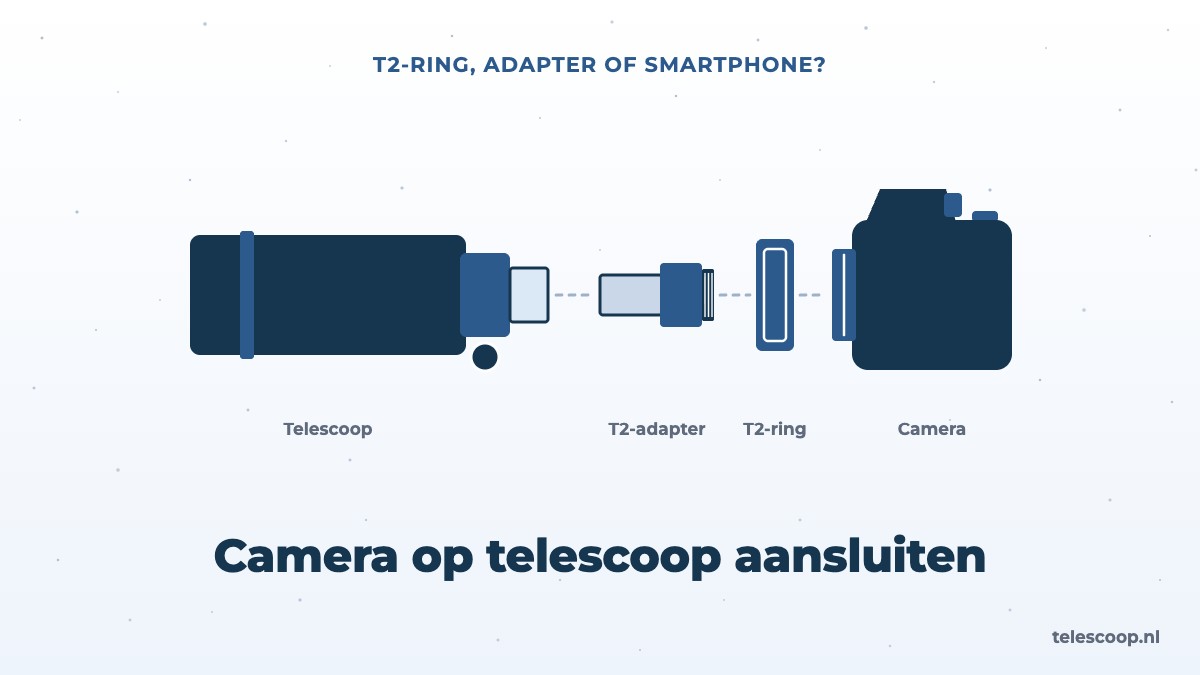
You take the lens off your camera and use the telescope as a lens. That’s called photographing in the brandpoint of view. A telescope with a focal brandlength of 650 mm then works as a 650 mm telephoto lens. You need two parts:
- A T2 ring for your camera. You click on the spot where the lens normally sits. Each camera model has its own ring: Canon EF is different from Canon RF, Nikon F is different from Nikon Z, and Sony E is different again. A T2 ring costs around 20 to 30 euros.
- A T2 adapter those in the focuser fits, with a 1.25 or 2 inch thread. On this adapter you screw on the T2 ring. On some telescopes this is not necessary: there is a T2 threaded screw directly on the focuser.
You can find both at the telescope adapters. There you can also read more about the different screw threads and about the correct distance from the sensor when working with a corrector or field flattener.
This is how you connect it:
- Get the zenith mirror whether the ocular is out of focus.
- Click the T2 ring on your camera and screw the T2 adapter onto it.
- Slide the whole thing into the focus ring and secure it.
- Switch your camera to live view, zoom in on the image on the screen, and focus using the focus ring.
Pay attention to three things:
- Relaxing without an objective: Many system cameras refuse to take a photo by default if no lens is attached. Set the setting in the menu that allows the shutter to operate even without a lens.
- Balance: A camera weighs quickly a half to a whole kilo. Slide the tube into the clamps forward or add extra weight to the mounting, so that the telescope does not tilt on its own.
- Full frameWith a full-frame camera, the narrow opening of a T2 connection can cause dark corners. A wider M48 adapter solves that problem.
Why isn't my camera sharp?
A telescope is designed for an eyepiece. The sharp image therefore does not always fall on the spot where your camera's sensor is located. Whether you experience this depends on the type of telescope.
With a mirror telescope or a Dobson
With many Newton telescopes intended for close-up viewing, the sharp point is too close to the tube. Your camera's sensor is a few centimeters behind the eyepiece and therefore does not get far enough into the tube, even when you turn the focus ring all the way in. You will only see a blurry spot no matter how you turn the focus ring.
There are two solutions:
- A Barlow lens in between. A Barlow lens shifts the sharp point outwards, so the camera gets a better focus. This gives you more magnification, which is especially useful for the moon and planets. See the Barlow lenses to a model on which you can screw a T2 ring.
- A telescope designed for photography. In Newton telescopes designed for photography, such as the Sky-Watcher models with PDS in the name, the main mirror is positioned slightly further forward. A camera will not be sharp without a Barlow lens attached.
With a lens telescope
Here it is often the other way around. When you look, there is a zenith mirror between, and that makes the beam of light longer. If you remove it before your camera, the sharp point is further back. Then you rotate the focus ring further out, and sometimes you need an extension tube.
With a Maksutov or Schmidt-Cassegrain
These telescopes focus by moving the main mirror, which means they have a wide range of focus settings. A camera is almost always in focus. At the back there is a threaded hole that you can use a suitable adapter to attach your T2 ring to, or on some models directly.
Which telescope works best with a camera?
Almost every telescope works for the moon and planets because you are shooting with short shutter speeds. Even a Dobson without a motor is then useful. For nebulae and galaxies, it is a different story: there you expose for minutes, and then the telescope must accurately follow the rotation of the sky. That requires an equatorial mount with a motor. Which telescopes are suitable for this, you can see in the telescopes for astrophotography.
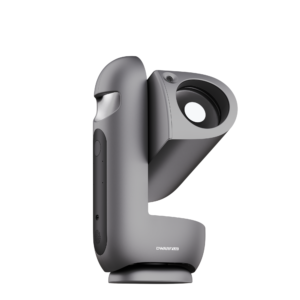
If you mainly want to photograph clouds and galaxies without having to set up an exposure setup yourself, then a smart telescope often the easiest way: the camera, telescope and tracking motor are all in one device.
What do you need per camera?
| Your camera | What you need | Price indication |
|---|---|---|
| Smartphone | A smartphone adapter | 11 to 30 euros |
| Mirrorless or system camera | A T2 ring for your barrel and a T2 adapter | together 40 to 60 euros |
| Same thing, on a Newton where the camera doesn't focus | In addition, a Barlow lens with T2 connection | depending on the model |
| Astro camera | Usually nothing extra: the 1.25 inch sleeve is included. However, a laptop and free recording software are included. | no additional costs |
Frequently asked questions about a camera on your telescope
Which camera should I use: DSLR, system camera, full frame or crop?
They all work. A system camera has the advantage that no mirror is needed, so there is less vibration in your photo, especially with the electronic shutter. A crop camera (APS-C) has a smaller sensor, which allows the moon and planets to fill a larger part of the frame. A full-frame camera has more field of view, but you should preferably use a wider M48 adapter to avoid dark corners. If you have multiple cameras, start with the one for which you can easily find a T2 ring.
Do I have to unscrew the attachment of my focus lens?
With some telescopes, yes. With the Sky-Watcher Explorer 150PDS, for example, there is a T2 threaded screw on the extension tube under the eyepiece adapter for 1.25-inch eyepieces. If you remove the adapter, you can immediately attach your camera with the T2 ring on it. This is more sturdy than an adapter with a sleeve and brings the camera closer to the sharp point.
Does every adapter fit every astro camera?
No. Brands use different screw threads and distances. A filter holder or adapter set from one brand may not always fit a camera from another brand. Look at the screw thread on each part, for example M42, M48 or M54. If you are unsure, email your camera and telescope to [email protected], Then we'll watch it with you.
Read more
The moon is the easiest first target for your camera. Read how to get the most out of it in Photographing the Moon. How a Barlow lens works is explained in our explanation about the Barlow lens. And if you want to photograph planets, Wido Oerlemans explains in his Planetary Imaging Masterclass which camera fits which telescope. You can find that on our page about planetary imaging. online course in astrophotography.