
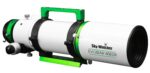
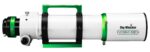
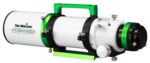
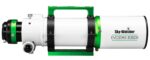
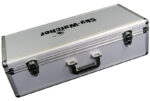


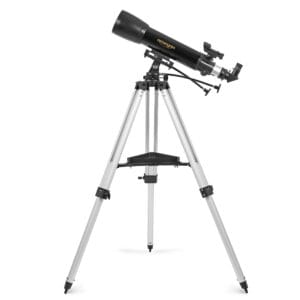
The Evostar 80EDX is a separate achromatic refractor from Sky-Watcher: a doublet with an 80 mm aperture and 600 mm focal brandlength (f/7.5), one of which is an Ohara FPL-53 ED glass lens. This type of glass keeps the color fringes around bright stars small, which is important for photos and planets. At the rear is a dual-speed Crayford corrector (11:1) with a 2.8 inch extension tube and a 360 degree rotatable adapter; the tube weighs 4 kg and comes with tube rings, dovetail screws and a case. In the Evostar line, it is between the 72 mm and 150 mm ED models; the separate lens viewfinders are located at the Refractor OTA’s.
What do you see or photograph with the Evostar 80EDX?

Photography: A camera with an APS-C sensor (23.5 mm wide) sees approximately 2.2 degrees of sky at 600 mm brandfocal length, with the 0.85x reducer (510 mm) seeing approximately 2.6 degrees. This includes the Orion Nebula with the Running Man Nebula next to it, the Pleiades with their nebular jets, the Rosette Nebula, the Double Star Cluster in Perseus, and the pair of galaxies M81 and M82 in one shot. The Andromedan Nebula is over 3 degrees long and with the reducer fits almost entirely on an APS-C sensor. With the reducer, the opening ratio is f/6.4, so each shot receives almost 40% more light per pixel than at f/7.5. The corrected image field given by the manufacturer with the reducer is 30 mm, enough for an APS-C sensor (28 mm diagonal) and not for a full-frame sensor. How to start is stated in Connecting the camera to a telescope and Stacking in astrophotography.
Visually: with a 25 mm eyepiece (24x), the Pleiades and the Double Star Cluster fit entirely into the frame. Moon: craters and the shadow line at 60x with a 10 mm eyepiece; at 100x with a 6 mm eyepiece, the small craters and the rills. Jupiter: the two main bands and the four moons, on calm nights the Great Red Spot. Saturn: the ring apart from the planet. The highest meaningful magnification is about 160x. Nebulae and systems are seen with the eye in gray tones, not in color, and require a dark spot; from the city, the moon, planets, double stars, and star clusters are visible. What you can expect per object is listed in What do you see through a telescope? and Observing deep-sky objects.
Which mounting fits?
The tube weighs 4 kg with rings and is mounted on a Vixen-type dovetail of 45 mm diameter, which fits into any Vixen saddle. For visual use, expect a mounting with about one and a half times the tube weight in load capacity (6 kg), and for photos, two times that plus the camera (about 8 to 9 kg). For photos of clouds, an equatorial mounting with follow motor is required, because an alt-azimuthal mounting rotates the image during long exposures. Two mounts from Sky-Watcher that fit:
- Sky-Watcher EQ5 Pro SynScan GoToEquatorial with GoTo, carrying capacity approximately 9 kg; for wide-angle photography, suitable for photos taken with a light camera.
- Sky-Watcher HEQ-5 Pro SynScan GoToEquatorial with GoTo, load capacity 13.7 kg; space for tube, camera, follow-up camera and dew heater together.
The difference between the assemblies is shown in Tripods and mounts explained.
How does the Evostar 80EDX differ from the other models in the series?
- Optics: 80 mm doublet with one Ohara FPL-53 element, 600 mm brandfocal length and f/7.5, with multilayer coatings; with the 0.85x reducer at 510 mm and f/6.4. That brandfocal length gives 2.2 to 2.6 degrees of sky coverage on an APS-C sensor, between the 72 mm model (420 mm) and the 150 mm model (1200 mm).
- Focusing system: dual-speed Crayford with a fine adjustment of 11:1, a 2.8 inch extension tube with scale division and a 360-degree rotatable adapter, so you can rotate the camera without losing focus.
- Mechanics and accessories: extendable dew cap, tube rings with a top rail that serves as a carrying handle, a 45 mm dovetail, a finder shoe for Sky-Watcher finders and an aluminum case.

For whom yes and for whom no
Hello Anyone who wants to take photos of nebulae, star clusters, and galaxies using a tube that doesn’t need to be collimated and requires little cooling time; anyone who visually seeks a lightweight telescope for star fields, the moon, and planets; and anyone who takes the telescope into a dark place. If you’re unsure about the steps in astrophotography, then read Photographing stars.
Not For those who don't have any mounting yet and want one set; check the Refracting telescopes with mounting. For those who are looking for the most light per kilogram visually for weak clouds and systems: a Dobson has more opening. For photos of fog without mounting, camera and post-processing are included. smart telescopes made.
What's in the box

- Evostar 80EDX optical tube with extendable dew cap
- Dual-speed Crayford lens (11:1) with 2.8 inch extension tube and 360-degree rotatable adapter
- Tube rings with upper rail as support handle
- 45 mm long owl tail (Vixen type)
- Finderscope shoe for Sky-Watcher finderscopes
- Aluminum case
- Handbook for Star Gazers (16 pages, Dutch)
Not included: mounting and tripod, diagonal mirror, ocular, viewfinder, reducer, camera adapter. For visual use, a 2-inch diagonal mirror, an ocular, and a viewfinder are required; for photos, the 0.85x reducer and an M48 adapter for your camera are required. Mounting, diagonal, viewfinder, reducer, and camera adapter are listed below under mounting and accessories; you choose an ocular by magnifying: 600 divided by the brandpoint of the ocular.
Connecting the camera
The Sky-Watcher 0.85x reducer is made for this tube: it screws onto the extension tube with M56 thread and has M48 thread on the camera side. Between that M48 thread and the sensor is 55 mm (the backfocus). An M48 adapter for a DSLR or system camera keeps that 55 mm; an astro camera requires extenders to the same distance. With the reducer, the brandfocal length is 510 mm and the aperture is f/6.4, with a corrected field of view of 30 mm. Without the reducer, a doublet forms a slightly curved image plane, causing stars at the edge of a large sensor to extend; therefore, the reducer is included for photos. With the rotatable adapter on the extension tube, you choose the cut by rotating the camera. More about connecting is available here. Connecting the camera to a telescope.
Format and weight
The tube weighs 4 kg and is 47.5 cm long with the extended dew cap and 55.7 cm with the extended dew cap. With the top rail as a handle, you can lift it up with one hand on the mounting. It comes in an aluminum case, in which it can also be transported and stored. For photos, about 1 kg of reducer, adapter and camera are required; choose the mounting accordingly.

Building and balancing

- Swallowtail: Insert the 45 mm swallowtail into the Vixen mounting saddle and secure the clamp screw while holding the tube.
- Finder: Insert a Sky-Watcher finder in the finder shoe and point it at a distant object during the day, for example a church tower; never look at the sun.
- Balance: first set the diagonal and ocular or reducer and camera on the tube. Then balance the polar axis with the counterweight and the second axis by moving the tube into the rings or the dovetail into the saddle, until the tube remains in each position when you release the clamps.
- Dew cap: remove the dew cap before you start; it keeps stray light and dew off the front lens longer.
- Cooling: an 80 mm refractor is ready for outdoor use in 15 to 20 minutes. No collimation is required; the lenses are fixed in the cell.
- Focusing: Use the coarse button to get closer and the fine adjustment of 11:1 for the final bit; secure the extension tube with the clamp screw when taking photos.
- Do not look through a window; the glass and the temperature difference make the image blurry.
Which accessories are suitable?
- Sky-Watcher 0.85x Focal Reducer and Field Flattener for Evostar-80ED: The reducer for the 80 mm Evostar tubes, with M56 thread for the extension tube and M48 thread on the camera edge; brings the focal brandpoint to 510 mm and f/6.4.
- Sky-Watcher M48x0.75 camera adapter for Canon EOSIt screws onto the M48 thread of the reducer and has the bayonet of a Canon EOS SLR; for Nikon there is the M48 adapter for Nikon.
- Sky-Watcher 2 inch Deluxe Dielectric Zenith Mirrorfits into the 2 inch connection of the extension tube, for visual viewing with 2 inch and 1.25 inch eyepieces.
- Sky-Watcher 9×50 viewfinder with holderfits in the viewfinder eyepiece tube; 9x magnification and 50 mm opening to bring an object into view before you look through the eyepiece.
Evostar 72ED, Evostar 80EDX or Evostar 150ED?
| Evostar 72ED DS Pro | Evostar 80EDX (this page) | Evostar 150ED | |
|---|---|---|---|
| Objective | 72 mm ED doublet, 420 mm brandfocal length (f/5.8) | 80 mm doublet with Ohara FPL-53, 600 mm brandfocal length (f/7.5) | 150 mm ED doublet, 1200 mm brandfocal length (f/8) |
| Tube weight | about 2 kg | 4 kg | 9.5 kg |
| Image field with an APS-C camera | about 3.2 degrees | about 2.2 degrees | about 1.1 degrees |
| Reducer (discontinued) | 0,85x | 0.85x, 510 mm and f/6.4 | 0,85x |
| Mounting capacity for photos | from about 4 kg | from about 8 kg | from about 19 kg |
| Highest meaningful magnification | about 144x | about 160x | about 300 times |
| Choose this as | you want the largest field of view and have a light mounting | You want a 2.2-degree field of view and an EQ5-class mount | You want small nebulae and planets to be big, and you have a heavy setup |
Frequently asked questions about the Evostar 80EDX
- Which mounting do I need? An equatorial mount with a Vixen saddle and about 8 to 9 kg of carrying capacity for photos, such as the EQ5 Pro or HEQ5 Pro; for visual use from about 6 kg.
- Can I also view it visually? Yes, with a 2-inch diagonal mirror and eyepieces: a 25 mm eyepiece gives 24x and approximately 2 degrees of field of view, a 6 mm eyepiece gives 100x for the moon and planets.
- What is the backfocus? With the 0.85x reducer, 55 mm between the M48 thread of the reducer and the sensor; an M48 adapter for a DSLR camera keeps that distance.
- Does it cover the lens? On humid evenings, the front lens gets covered; the retractable dew cap prevents that. For photo sessions lasting several hours, a dew cap keeps the lens dry.
- Which diagonal fits? A 2-inch diagonal mirror in the 2-inch connection of the pull-out tube; 1.25-inch eyepieces are used with the 1.25-inch diagonal adapter.
- Which sun filter fits it? A filter that fits on the windshield before the defroster. Measure the circumference of the windshield, divide by 3.14 and choose on the page of the Omegon Helievo The size that this outcome falls into. Cover the viewfinder and check the film before each use. Never use an eclipse glasses behind the viewfinder or a filter in the eyepiece.
Specifications
| Specification | Value |
|---|---|
| Optical design | Apochromatic refractor, doublet |
| Lens Design | Two lenses with air gap, one element made of Ohara FPL-53 ED glass; multilayer coatings |
| Opening | 80 mm |
| Focal length | 600 mm (510 mm with 0.85x reducer) |
| Opening ratio | f/7.5 (f/6.4 with reducer) |
| Reporter | Dual-speed Crayford (11:1), 2.8 inch extension tube with scale division, 360-degree rotatable adapter |
| Dovetail | 45 mm, Vixen type, on tubular rings with carrying handle |
| Tube diameter | diameter about 12.3 cm |
| Tube length | 47.5 cm with extended dew cap, 55.7 cm extended |
| Tube weight | 4 kg |
| Backfocus | 55 mm with the 0.85x reducer (from the M48 thread) |
| Camera connection | Reducer with M56 thread on the extension tube and M48 thread on the camera edge |
| Highest meaningful magnification | about 160x |
| Packed | in aluminum case |
Shipping and assistance
Orders with multiple items are shipped from multiple warehouses and may arrive in parts; each package will have its own tracking number. More information about this can be merk found on the Sky-Watcher brand page. Help with choosing or on the first evening: WhatsApp or call on weekdays from 9:00 to 17:00, or come by appointment in Sneek. 30 days' cooling-off period.
Reviews
There are no reviews yet.