


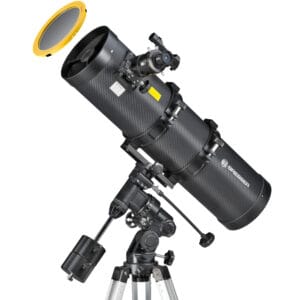
The Omegon 114/500 Newton EQ-1 is a Newton reflector with a mirror of 114 mm and a focal brandlength of 500 mm (f/4.4) on a parallax EQ-1 mount with an aluminum tripod. In the Omegon Newton line this is the model with the shortest brandfocal length: with the supplied 25 mm eyepiece you can see about 2.5 degrees of sky at 20x, five times the diameter of the Moon. The N 114/900 EQ-1 from the same line has the same mirror size with a 900 mm brandfocal length and is therefore the choice for planets; this model is the choice for star fields and nebulae. More about the series can be found in Omegon merkguide.
What do you see through the 114/500?

Moon: at 20x the entire moon fits neatly into the frame; at 100x (10 mm eyepiece with Barlow) you see craters, mountain ranges, and the shadow line. Jupiter: a small disk with two dark bands of clouds and the four large moons as dots in a row. Saturn: the ring detached from the planet at 100x; the Cassini division in the ring requires a quiet night and more magnification than the box offers. Deep-sky is where this brandpoint was created: the Pleiades fit into the image in their entirety at 20x, the Orion Nebula shows the two wings and the Trapezium at 50x, the globular cluster M13 is grainy at the edge, and the Andromeda Nebula is from a dark spot an oval smudge of a few degrees. Nebulae and galaxies are seen with the eye in gray tones, not in color. From a city or village with street lighting, the moon, planets, double stars, and star clusters remain; nebulae and galaxies require a dark spot. The highest meaningful magnification is approximately 228x, twice the opening; due to the air above the Netherlands and Belgium, 150x is practically the limit, and that requires a separate eyepiece of 3 to 4 mm. What you can expect per object is stated in What do you see through a telescope?, Jupiter through a telescope, Saturn through a telescope and The Moon through a telescope.
How does the 114/500 differ from other 114 mm telescopes?
- Focus point and field of view: 500 mm at f/4.4, with the 25 mm eyepiece at 20x and approximately 2.5 degrees of field; the 900 mm model from the same line gives 36x and 1.4 degrees with the same eyepiece at f/4.4. At f/4.4, the alignment of the mirrors is precise and stars at the edge of the field are slightly stretched (coma); in the center of the field, this is not the case.
- Mounting and tripod: EQ-1 parallax mounting with fine adjustment on both axes and counterweight, on an aluminum tripod that extends from 70 to 120 cm and has an accessory platform; a tracking motor for the hour-hand axis is provided by the manufacturer as a separate upgrade.
- Supplied and included: 25 mm and 10 mm oculars plus 2x Barlow, for a total of 20x to 100x magnification, and a red dot viewfinder; the dovetail eyepiece holder accepts 1.25 inch eyepieces and filters.

For whom yes and for whom no
Hello For those who want to see the constellations, the Pleiades and the Orion Nebula in their entirety; for those who want to quickly find an object from their balcony or garden, because at 20x the search field is five lunar diameters; for those who want to learn to track on a parallax mount without power. If in doubt, read the Telescope Buying Guide for Beginners.
Not For those who want to view Jupiter and Saturn at a magnification of 150x, choose The 114 mm model with a 900 mm brandtip from this line, That provides 36x to 180x magnification with the same eyepieces. For long exposures of nebulas and galaxies, a mounting is required that follows the motion of the camera; please see the smart telescopes. Photos of the moon and the planets are possible with a smartphone adapter attached to the eyepiece.
What's in the box

- Newton tube 114/500 with 1.25 inch tooth gauge holder
- EQ-1 parallax mounting with fine movement on both axes and counterweight
- Aluminum tripod, 70 to 120 cm, with accessory platform
- 25 mm eyepiece (20x) for star fields and nebulae
- 10 mm eyepiece (50x) for the Moon and planets
- 2x Barlow lens (40x and 100x)
- Red dot sight
Not included: smartphone adapter, moon filter, collimation aid. A smartphone adapter clamps onto the eyepiece for photos of the moon; the moon is bright enough at 114 mm for a 30% mm moon filter; at f/4.4, check the mirrors after every drive, and a laser or collimation eyepiece is included in all three of these items. All three are listed below as accessories.
Format and weight
11.5 kg complete according to the manufacturer, in three parts: tube, mounting with counterweight and tripod. The box measures 62 x 29 x 29 cm. The tripod slides out from 70 to 120 cm; the eyepiece is located at the top of the tube, so you view it standing or on a high stool.
First evening with the 114/500
- Set the tripod on a flat surface, attach the counterweight to the axis and mount the tube on the mounting bracket. Align the polar axis with the North Pole, at about 52 degrees latitude; then follow an object with only the flexible axis of the hour hand.
- Balance the tube: slide the counterweight until the mounting with loose clamps remains in place in each position.
- Line the red dot finder across to a distant object during the day, for example a church tower or chimney, and remove the cap from the tube.
- Do not look through a window; the glass and the temperature difference make the image blurry.
- Start with the 25 mm eyepiece (20x) and look for the moon; then switch to the 10 mm eyepiece (50x) and only insert the Barlow between them (100x).
- Rotate the focus lever until the image is small and sharp; a large blurry disc is not sharp.
- Set the telescope outside 30 minutes before viewing, so that the mirror reaches outdoor temperature. A blurry image almost never results from collimation; with f/4.4, check it after every drive; how it works is explained in the manual. Collimation guide.

Which accessories are suitable?
- Omegon Laser Collimator 1.25 inch for Newtonfits in the 1.25 inch viewfinder; at f/4.4, you check the alignment of the mirrors after each transport, and with a laser you can immediately see if the main mirror is in good condition.
- Omegon Premium Moon Filter 1.25 inch: screws into the filter thread at the bottom of a 1.25 inch eyepiece; 30% holes, the appropriate damping for mirrors up to 150 mm.
- Omegon Smartphone Adapter for Eyepieces 25 to 48 mmClamps on the eyepiece, for phones 54 to 90 mm wide; for photos of the moon at 50x magnification.
- Omegon UWA 6 mm eyepiece, 1.25 inch: 83x with a field of view of 66 degrees; the fixed magnification for Jupiter and Saturn on this telescope.
114/900, 114/500 or 150/750?
| N 114/900 EQ-1 | 114/500 EQ-1 (this page) | 150/750 EQ-3 | |
|---|---|---|---|
| Mirror | 114 mm, 900 mm, f/7.9 | 114 mm, 500 mm, f/4.4 | 150 mm, 750 mm, f/5 |
| Image field with the 25 mm eyepiece | 36x, approximately 1.4 degrees | 20x, approximately 2.5 degrees | 30x, approximately 1.7 degrees |
| Mounting a tripod | EQ-1, aluminum tripod 70 to 120 cm | EQ-1, aluminum tripod 70 to 120 cm | EQ-3, aluminum tripod with accessory platform |
| Finder and eyepieces | 6×30 optical viewfinder; 25 mm and 10 mm with 2x Barlow | red dot; 25 mm and 10 mm with 2x Barlow | red dot; 25 mm and 6.5 mm Plössl with 2x Barlow |
| Weight according to the manufacturer | 12 kg | 25.35 pounds | 12.9 kg, tube 4.3 kg |
| Strengths | Moon and planets at 90x to 180x with the box | star fields and clear nebulae in one image | 73% more light than 114 mm, fog and ball clouds |
| Choose this as | You especially want to view Jupiter, Saturn and the moon | you want to see the Pleiades and the Orion Nebula in their entirety and want to focus quickly | you want the most light and don't mind a heavier mounting |
Frequently asked questions about the 114/500
- Is it suitable for a child? From 8 years old with an adult; from 10 years old independently; the set weighs 11.5 kg in three parts, and the parallax mounting requires one explanation about the polar axis and the counterweight.
- Can I take photos with it? Of the moon and the planets, using a smartphone adapter on the 25 mm or 10 mm eyepiece (20x or 50x); how to do that is explained in the instructions. Astrophotography with a smartphone. Long exposures of fog require a mounting that follows a motorized motion.
- Which sun filter fits it? A filter that fits on the tube before it. Measure the circumference of the front of the tube, divide by 3.14 and choose on the page of the Omegon Helievo The size that this outcome falls into. Cover the viewfinder and check the film for each use. Never use an eclipse glasses behind the viewfinder or a filter in the eyepiece.
- Do I need to collimate it? At f/4.4, more often than at a long brandfocal length: check the alignment after each drive with a laser or collimation ocular; the steps are listed in the Collimation guide.
- Is it placed on a table or on a tripod? On the included aluminum tripod with accessory tray, extendable from 70 to 120 cm; a table is not required.
- Can a follow motor be attached? The manufacturer provides a separate follow motor for the hour-hand axis of the EQ-1; without the motor, you can keep an object at 100x magnification by rotating the flexible axis of the hour-hand every half minute.
Specifications
| Specification | Value |
|---|---|
| Optical design | Newton reflector, closed tube |
| Opening | 114 mm (4.5 inch) |
| Focal length | 500 mm |
| Opening ratio | f/4,4 |
| Highest meaningful magnification | about 228x |
| Mount | EQ-1 parallax, fine motion on both axes, counterweight |
| Tripod | Aluminium, 70 to 120 cm, with accessory tray |
| Reporter | Rack, 1.25 inch |
| Seeker | Red dot |
| Included eyepieces | 25 mm (20x) and 10 mm (50x), 2x Barlow (40x and 100x) |
| Total weight | 11.5 kg according to the manufacturer |
| Packed | 62 x 29 x 29 cm |
Shipping and assistance
Orders with multiple items are shipped from multiple warehouses and may arrive in parts; each package will have its own tracking number. More information about this can be merk found on the Omegon brand page. Help with choosing or on the first evening: WhatsApp or call on weekdays from 9:00 to 17:00, or come by appointment in Sneek. 30 days' cooling-off period.
Reviews
There are no reviews yet.