


Bright Newton telescope for those who already have a mount
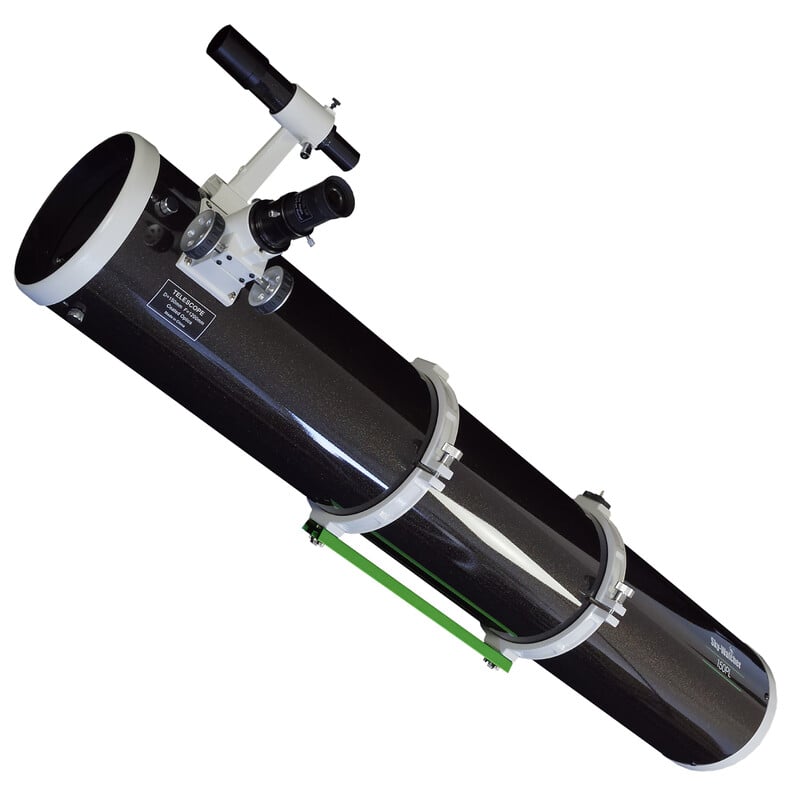
The Sky-Watcher Explorer-150P is a 150/750mm Newtonian (f/5) that captures a lot of light in a short, manageable tube. Deep-sky objects like the Ring Nebula and the Dumbbell Nebula are within reach, globular clusters like M13 resolve into individual stars, and you'll clearly see detail on Saturn, Jupiter, and Mars. The f/5 ratio makes the tube exceptionally fast: you'll find extended nebulae and star fields faster and see structure in them sooner than with a slower tube of the same aperture.
Please note: this is a loose optical tube assembly (OTA), without a mount. You need an equatorial mount of at least EQ3 class to use it.
Compact and easy to use
With 5.9 kg, the tube is light and portable. Thanks to the included tube rings and Vixen dovetail, you can easily mount it on your existing mount. The small secondary mirror on thin 0.5 mm supports keeps contrast high and diffraction spikes minimal. The 1.25 inch focuser is stable and has a built-in T-thread, so you can directly attach a DSLR.
The mirrors are finished with Sky-Watchers RAQ coating (Radiant Aluminum Quartz): multiple layers of aluminum, dielectric tantalum pentoxide, and silicon dioxide, which together provide 94% reflectivity that will last for years.
Included are 10 mm and 20 mm eyepieces (1.25 inch), a 2x Barlow lens with camera adapter, a 6x30 finder scope, and a universal smartphone adapter for devices between 54 and 90 mm wide. This gives you 37.5x, 75x, and 150x magnification so you can get started right away.
This is how you get the most out of this tube
Allow 20 to 30 minutes for the mirror to cool down to ambient temperature; on cold evenings, it's worth putting the tube outside beforehand. Collimation is not optional at f/5: check it after every transport; it only takes two minutes with a collimation eyepiece. For planets, a 5 mm eyepiece provides 150x magnification, which this mirror size can handle well on good nights.
What to expect
- ✓ Moon: sharp craters and mountains
- ✓ Planets: cloud bands, rings and polar caps visible
- ✓ Deep-sky: bright nebulae and galaxies, wide field of view
- Astrophotography: the optics are suitable for it, but then you need a motorized mount and guiding
- ✗ Sun: only with a suitable solar filter for the opening
Specification sheets
Optics
| Feature | Description |
|---|---|
| Design | Newton |
| Type | Reflector |
| Aperture (mm) | 150 |
| Focal length (mm) | 750 |
| Focal Ratio (f/) | 5 |
| Resolution | 0,77″ |
| Limit value (mag) | 12,7 |
| Light output | 459× |
| Max. useful magnification | 300× |
| Tube weight (kg) | 5,9 |
| Tube construction | Full tube |
| Main mirror | Parabolic |
| Vangspiegel | Train, 0.5 mm supports |
| Coating | RAQ, 94% Reflection |
| Focuser | Rack and pinion, 1.25″ with T-thread |
Mount
| Feature | Description |
|---|---|
| Design | OTA |
| Type of mount | Without mount |
| GoTo steering | No |
Included accessories
| Section | Description |
|---|---|
| Eyepieces | 10 mm & 20 mm, 1.25″ |
| Barlow lens | 2x, with camera adapter |
| Seeker | 6×30 |
| Smartphone adapter | Universal, 54 to 90 mm |
| Assembly | Tube rings + Vixen swallowtail |
Free Stargazers' Handbook
Every Sky-Watcher telescope from Telescoop.nl comes with our own Stargazer’s Handbook in the box. It’s a 16-page booklet that helps you get started on your first few nights: how to align the finder scope, what magnification to start with, why the image sometimes wobbles, and when a telescope does or doesn’t need to be collimated. It’s not a thick book—just the essentials you really need when you’re starting out.
Reviews
There are no reviews yet.