


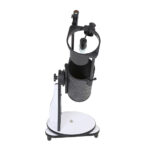
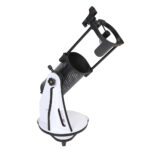
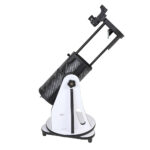
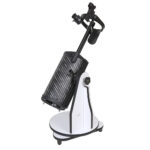
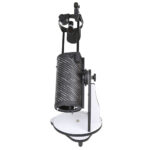
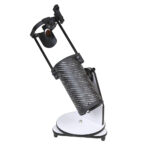
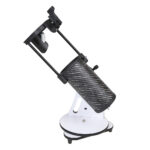
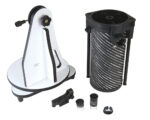


The Heritage-130P is a tabletop Dobson telescope with a 130 mm parabolic mirror and a focal brandlength of 650 mm (f/5). The mirror captures approximately 345 times as much light as the naked eye. The tube slides to 37 cm for transport and storage. The Heritage-150P has the same design with 33% more light and 1.3 kg more weight; in Heritage 130P vs 150P they are both side by side, and our experience with this model is in the Heritage 130P review.
What do you see through the Heritage-130P?

Moon: craters, mountain ranges and the shadow line along the day-night boundary, at 65x with the 10 mm eyepiece. Jupiter: two dark cloud bands and the four large moons. Saturn: the ring detached from the planet. Deep sky: the Orion Nebula with structure, the Pleiades, the Andromedan system as a spot with a bright core and globular clusters like M13 as grainy spots, the edge of which at 130 mm in loose stars begins to fall apart. Clouds and systems are seen with the eye in gray tones, not in color. From a city or village with street lighting, only the moon, planets, double stars and star clusters remain; clouds and systems require a dark spot. The highest meaningful magnification is approximately 260x; due to the air over the Netherlands and Belgium, 150 to 200x is in practice the limit. What you can expect per object is stated in What do you see through a telescope?, Jupiter through a telescope, Saturn through a telescope and The Moon through a telescope.
How does the Heritage-130P differ from other 130 mm telescopes?
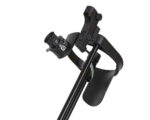
- Mounting, tube and sharpener: the Heritage-130P stands on a tabletop Dobson with accessory platform, movable by hand; the tube slides in to 37 cm and clicks into place when extended; the sharpener is 1.25 inch helical (rotates instead of a rack).
- Optics and included: 130 mm parabolic mirror made of borosilicate glass with RAQ coating, f/5; in the box are a 25 mm and a 10 mm eyepiece, a red dot finder, a collimation cap and the Starry Sky Guide.
- The same series with automatic search and tracking: only on the 150 mm, the Heritage-150P Virtuoso GTi.

For whom yes and for whom no
Hello For anyone looking for a first telescope without power or alignment, a family with children aged 8 and up, and for those with limited storage space or who are looking at a balcony: it folds up to 37 cm high. If you're in doubt, read the Telescope Buying Guide for Beginners.
Not for long exposures of nebulas and galaxies; an assembly is required for that that follows the sky; look for it smart telescopes. Photos of the moon and the planets are fine: with a smartphone adapter on the eyepiece you can take short shots. If you want more light on the same table, choose The 150 mm model from this series; if you want the telescope to search for and follow objects by itself, then The GoTo version of it.
What's in the box
- Heritage-130P FlexTube with table-Dobson mounting and accessory tray
- 25 mm eyepiece (26x) for star fields and nebulae
- 10 mm eyepiece (65x) for the Moon and planets
- Red dot finder
- Collimation cap
- Handbook for Star Gazers (16 pages, Dutch)
Not included: moon filter, 6 mm planetarium eyepiece, bag. A moon filter is welcome on a full moon; the 6 mm eyepiece is the step up to 108x; a bag is only necessary if you take it with you often.
Format and weight

6.2 kg in total, easy to lift at once. Tube inserted 37 cm; with foot it is inserted 46 cm high and extended 69.5 cm. The box measures 78 x 31 x 31 cm. It stands on a table, box, or stool; sitting on the ground is too low to see through the eyepiece.
First evening with the Heritage-130P
- Take off the cap from the tube and slide the tube all the way out until it clicks into place.
- Line the red dot finder over an distant object during the day, for example a church tower or chimney.
- Do not look through a window; the glass and the temperature difference make the image blurry.
- Start with the 25 mm eyepiece (26x) and look for the moon; then switch to the 10 mm eyepiece.
- Rotate the focus lever until the image is small and sharp; a large blurry disc is not sharp.
- Set the telescope outside 30 minutes before viewing, so that the mirror reaches outdoor temperature.
- An unsmoothed image almost never results from collimation. Check that after transport using the supplied cap; how it works is described in the manual. Collimation guide.
Which accessories are suitable?
- Sky-Watcher 6 mm Planetary UWA eyepiece, 1.25 inch: 108x for the Moon and planets; with a 16 mm eye distance, it is also suitable for use with glasses.
- Sky-Watcher SmartPhoto+ smartphone adapterfits in the 1.25 inch viewfinder, photos of the moon with your phone, with a 20 mm photo eyepiece included (33x).
- Sky-Watcher Cheshire Collimation Eyepiece, 1.25 inch: more accurate alignment than with the supplied cap.
- Omegon Moon Filter 25%, 1.25 inch: screws at the bottom of the supplied eyepieces, which reduces the moonlight; 25% is the diameter of the mirrors up to 150 mm.
All the appropriate accessories for this series are listed in accessories for the Heritage 130P and 150P.
Heritage-100P, Heritage-130P or Heritage-150P?
| Heritage-100P | Heritage-130P (this page) | Heritage-150P | |
|---|---|---|---|
| Mirror | 100 mm, f/4 | 130 mm, f/5 | 150 mm, f/5 |
| Magnification with the included eyepieces | 16x and 40x, with the 2x Barlow 32x and 80x | 26x and 65x | 30x and 75x |
| Highest meaningful magnification | about 200x, in practice 80 to 100x | about 260x, in practice 150 to 200x | about 300x, in practice 150 to 200x |
| Weight and size | 2.8 kg, tabletop model, fixed tube that fits on a photo tripod separate from the base | 6.2 kg, tabletop model, tube inserted 37 cm | 7.5 kg, tabletop model, retractable tube |
| Moon and planets | crater, the four moons and the rings of Jupiter, Saturn's ring | Same objects, sharper and with more detail at 150 to 200x magnification | the same objects, with 150 mm more detail in the tires and the ring |
| Nebulae and star clusters | Orion Nebula and Pleiades in a wide field of view, globular clusters as a blob | Orion nebula with structure, globular clusters as grainy spots | star clusters break apart into individual stars, weaker systems from a dark spot |
| Choose this as | he has to go on a trip or for a child | you want a first telescope that fits in a cabinet and weighs 6.2 kg | You want 33% more lights on the same table |
Frequently asked questions about the Heritage-130P
- Is it suitable for a child? From about 8 years old, together with an adult; from 10 years old, independently: you can then focus and find the moon yourself.
- Can I take photos with it? Of the moon and the planets, of course: with a smartphone adapter on the eyepiece you can take short shots. Long exposures of nebulas and galaxies are not possible; for that you need a mount that follows the sky.
- Which sun filter fits it? A filter that fits on the tube before it. Measure the circumference of the front of the tube, divide by 3.14 and choose on the page of the Omegon Helievo The size that this fits. Cover the viewfinder and check the film for each use. Never use an eclipse lens or a filter in the eyepiece.
- Do I need to collimate it? After transport, check with the supplied cap; usually there’s nothing to do. At f/5, the alignment is tighter than with an f/8 telescope; that’s why the cap is included.
- Does the open tube get scattered light? Yes, if there is a streetlamp nearby. A light shield (shroud) of fabric or foam rubber around the open part of the tube prevents that; it is not included in the box.
- Table or tripod? Table: the foot is designed to stand on a sturdy table, chest of drawers, or stool; sitting on the ground is too low to view through the eyepiece. A tripod is not necessary.
Specifications
| Specification | Value |
|---|---|
| Optical design | Newton reflector, parabolic mirror |
| Opening | 130 mm (5.1 inches) |
| Focal length | 650 mm |
| Opening ratio | f/5 |
| Mirror | Borosilicate glass with RAQ coating |
| Highest meaningful magnification | about 260x |
| Mount | Dobson, tabletop, manual, with accessory tray |
| Reporter | 1.25 inch helical |
| Seeker | Red dot finder |
| Included eyepieces | 25 mm (26x) and 10 mm (65x) |
| Total weight | 6.2 kg |
| Tube inserted | 37 cm; height with foot inserted 46 cm, extended 69.5 cm |
| Packed | 78 x 31 x 31 cm |
Shipping and assistance
Orders with multiple items are shipped from multiple warehouses and may arrive in parts; each package will have its own tracking number. Help choosing or first night: WhatsApp or call on business days from 9:00 to 17:00, or come by appointment in Sneek. 30-day return period.
Anneke Van Riesen-Pap (verified owner) -
Not yet tried but as I have heard it should be
Bas (verified owner) -
Super nice, simple and quality telescope.
Sjors (verified owner) -
Haven't been able to test it yet. Looks to be of good quality.
Laurens van Walsem (verified owner) -
After some waiting, I received my Sky-Watcher Heritage 130P. Assembly was straightforward, and the Dobsonian mount is a pleasure to use. My first observation of the moon immediately revealed a lot of detail and sharp craters. The telescope is compact but collects a surprising amount of light. For beginners who want to see more than what's possible with a small entry-level telescope, this is an excellent choice. I am very satisfied and look forward to observing planets, nebulae, and galaxies.
Mike (verified owner) -
Great telescope to start with, I've had a lot of fun with it since I got it.
Kayleigh van der Lee (verified owner) -
I love photography, and wanted to combine stargazing with photography. Via ChatGPT (yes, yes, bad...) I asked for some help, and this telescope was recommended. I can also use this one in combination with the camera I have. I watched some reviews via YouTube, because I found the manual itself quite unclear. But with the help of the videos, I put the telescope together and was able to configure it. And how cool it is to see the moon this way! First got the moon in frame with the 25mm lens, then switched to the 10mm lens. You can really see the craters well then. My
Ferdi Van den Toorn (verified owner) -
Good and meets expectations.