


Please note: This model was previously named Sky-Watcher Explorer-190MN DS Pro. Sky-Watcher now markets it under the name Starlux 190MN. It is the same instrument.
Sky-Watcher Starlux 190MN: The Coma-Free Specialist
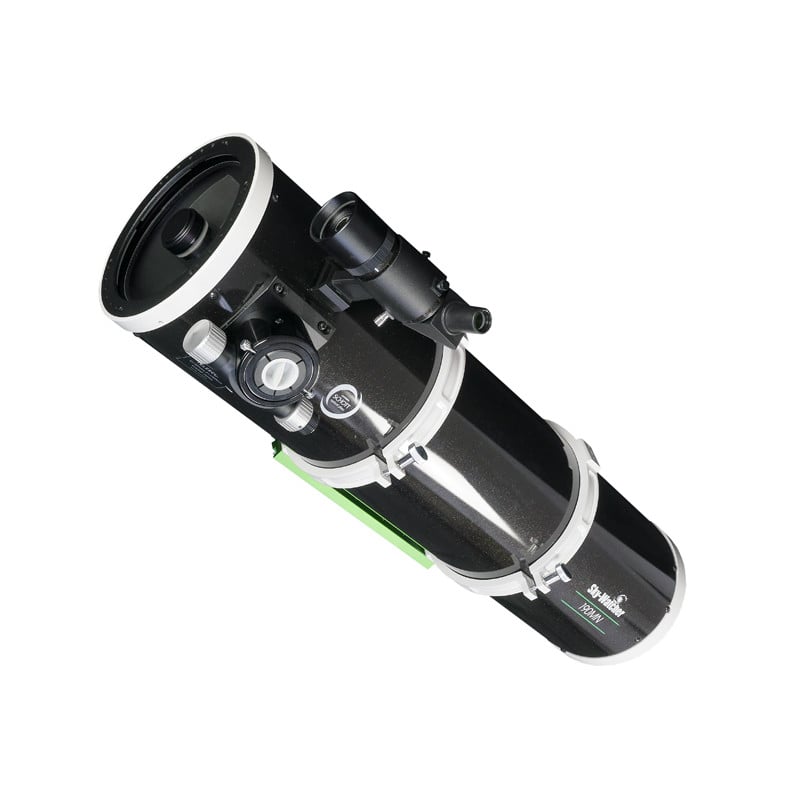
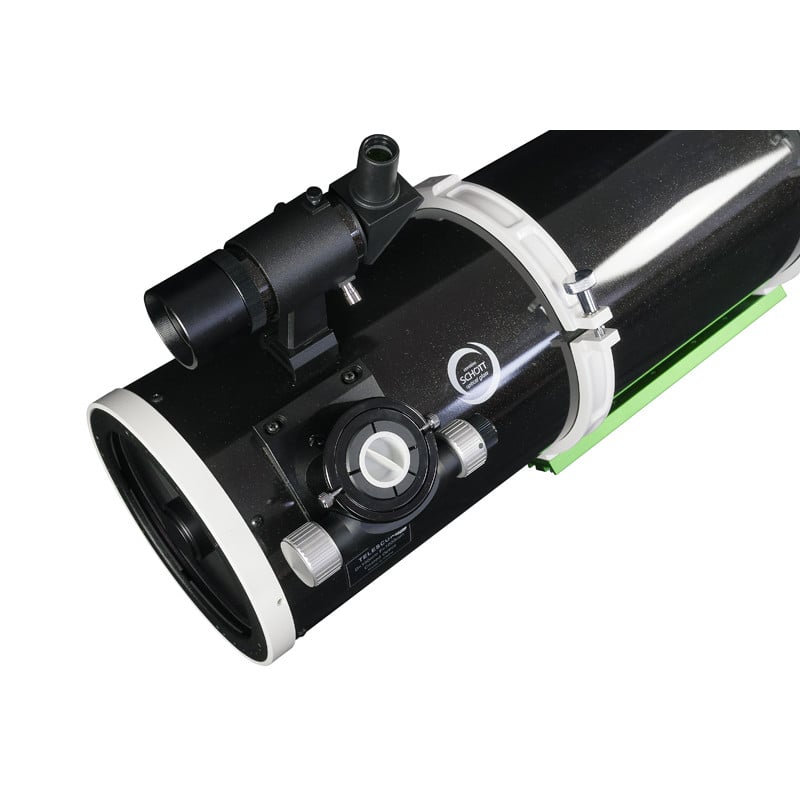
The Sky-Watcher Starlux 190MN is a 190/1000mm (f/5.3) Maksutov-Newton: the meniscus lens at the front corrects the coma that afflicts ordinary f/5-Newtons, without a corrector. The result is a flat, sharp star field all the way to the edges and refractor-like contrast on planets. A cult classic among discerning photographers.
What can you do with it?
Photographically, this is the class where smaller galaxies, planetary nebulae, and fine structures come within reach: plenty of aperture, plenty of resolution, plenty of signal. Visually, you get a full-fledged deep-sky telescope: globular clusters resolve, nebulae show structure, and planets are razor-sharp. These are tubes that serve two hobbies at once.
The best of two designs
The closed tube keeps the optics dust-free and stable, the Newton configuration provides brightness, and the meniscus takes care of the correction. So you're photographing without a coma corrector, with an obstruction small enough for high-level planetary work. Do expect cool-down time: the thick lens requires patience, and an EQ6-class mount will best carry the 10 kg tube.
This is how to get the most out of this telescope
- Allow the meniscus lens one hour of cooling time.; a fan significantly speeds up the process.
- Dew control is essential: The front lens fogs up faster than an open Newtonian; a dew shield or dew heater is part of the standard equipment.
- No comma corrector needed: That budget can go towards a guiding set, which directly yields results at a 1000 mm focal length.
- Collimation is more stable than with an open Newtonian., but check after transport; see our guide on collimation.
- Visual planetary work: a 6 mm eyepiece gives 167x with a refractory contrast.
For whom yes and for whom no
Hello the demanding photographer who wants flat fields without a corrector, and the dual-role observer who values planetary contrast as much as deep-sky.
Not Whoever seeks maximum mobility is better off with a lighter PDS; If you want deep-sky photos without a mount, guiding, and post-processing, then the smart telescopes the shorter route; ours Telescope Buying Guide for Beginners explain the trade-off.
Featured accessories
These accessories add the most after purchase:
- Cheshire eyepiece An imaging Newton only performs with tight collimation; a Cheshire makes the adjustment accurate and fast.
- Light Pollution Filter (2 inch) Under Dutch or Belgian skies, it brings out significantly more contrast in your images and your eyepiece view.
- Moon Filter 13%: with this opening, the moon is blindingly bright; the Omegon Moon Filter 13% (1.25 inches) The light fades. More explanation in our Moon filter guide.
Technical specifications
| Feature | Description |
|---|---|
| Type | Reflector |
| Design | Maksutov-Newton |
| Aperture (mm) | 190 |
| Focal length (mm) | 1000 |
| Focal Ratio (f/) | 5,3 |
| Resolution | 0,61″ |
| Limit value (mag) | 13,2 |
| Light output | 740× |
| Max. useful magnification | 380× |
| Tube weight (kg) | 12,3 |
| Tube construction | Full tube |
| Main mirror | Pyrex glass |
| Scatter light baffle | Yes |
Included in the box
- Sky-Watcher Starlux 190MN Optical Tube Assembly (OTA, telescope tube only)
- Crayford focuser
- Oculai adapter
- Free: Stargazer's Handbook by Telescoop.nl (16 pages, Dutch language)
Free Stargazers' Handbook
Every Sky-Watcher telescope from Telescoop.nl comes with our own Stargazer’s Handbook in the box. It’s a 16-page booklet that helps you get started on your first few nights: how to align the finder scope, what magnification to start with, why the image sometimes wobbles, and when a telescope does or doesn’t need to be collimated. It’s not a thick book—just the essentials you really need when you’re starting out.
Honest advice from observers
We sell and use the Sky-Watcher line ourselves. In our Sky-Watcher brand guide We'll explain which series are strong and which you'd rather skip. View the full range on our Sky-Watcher brand page. Order before 11:59 PM for fast delivery, in the Netherlands and Belgium. Uncertain about mounting, guiding, or coma corrector? Call or email us: we're happy to help with photo setups.
Manufacturer's additional specifications
- Manufacturer model name: Starlux 190MN (formerly Explorer-190MN DS Pro)
- Maximum useful magnification: 570x
- Venturi / center obstruction: 64 mm
- Mirror material: Low-expansion borosilicate glass
- Mirror coating: RAQ (Radiant Aluminum Quartz), 94% reflectance
- Finder scope: 9x50 right-angle
- Five internal knife-edge baffles against internal reflections
- Supplied without eyepieces
Reviews
There are no reviews yet.