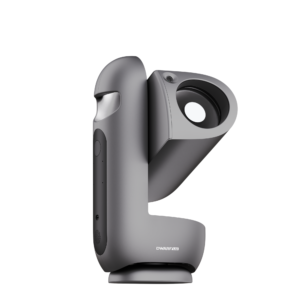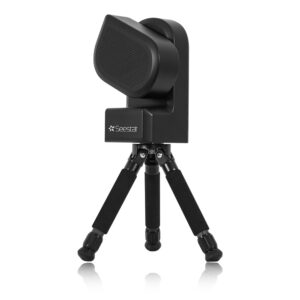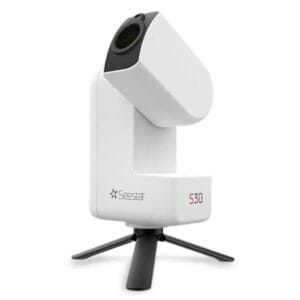
The Seestar S30 Pro vs Vespera II: It’s a comparison between two smart cameras that share surprisingly many features but target a very different audience. Both use the same Sony IMX585 sensor, both operate fully automatically, and yet the one costs €699 and the other a minimum of €1590. In this comparison you’ll find out what the difference is and which one is right for you.
Still unsure between these models? We are stargazers ourselves and happy to help.
Send us a WhatsApp messageWe reply on weekdays between 9:00 and 17:00.
The specifications side by side
| ZWO Seestar S30 Pro | Vaonis Vespera II | |
|---|---|---|
| Optics | Quadruplet APO, 30mm, f/5.3 (160mm) | Quadruplet APO, 50 mm, f/5 (250 mm) |
| Sensor | Sony IMX585, 4K (8.3 MP) | Sony IMX585, 4K (8.3 MP), up to 24 MP via CovalENS |
| Extra camera | Wide-angle camera (63°) with autofocus | No |
| Filters | Internal filter wheel (UV/IR-cut, duo-band, dark) | Optional purchase (dual band, CLS) |
| Solar filter | Included (magnetic) | Sold separately |
| Weight | 1.65 kg | Approximately 5 kg |
| Price | €699 | €1590 (standard) to €1790 (High Carbon tripod) |
Same sensor, different optics: this merk proves it
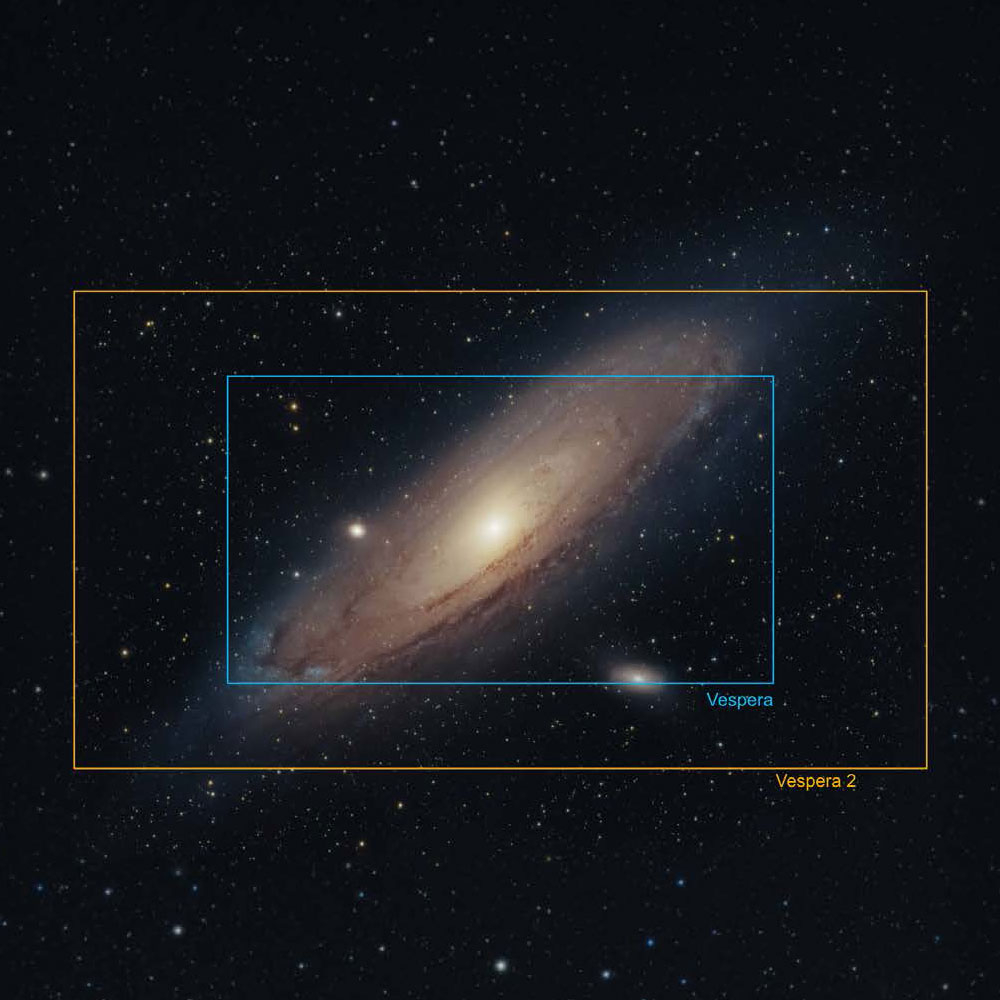
That both telescopes use the IMX585 sensor does not mean the images are the same. The Vespera II does a 50 mm lens compared to a 30 mm lens at the Seestar S30 Pro, and captures almost three times as much light with it. In practice, you can see this in shorter exposure times for the same result, more detail in faint nebulae, and a quieter image under light-polluted skies. Added to this is CovalENS: by shifting, the Vespera builds up a mosaic of up to 24 megapixels over a field of view of 4.33° by 2.43°, large enough for complete nebula complexes in a single final image.
The S30 Pro has its own answers to that. The internal filter wheel switches effortlessly between UV/IR-cut and dual-band, whereas with the Vespera you purchase filters separately and place them manually. The second wide-angle camera takes Milky Way photos and star trails that the Vespera cannot capture. And the included solar filter makes it immediately complete for sunspots; with the Vespera that is a individual purchase.
Format and ease of use
At 1.65 kg, the S30 Pro fits in any backpack and is up and running within minutes: this is the telescope you take on vacation or quickly set up in the garden on a weeknight. The Vespera II weighs around 5 kg and, with its tripod, requires a bit more setup time. Still compact compared to a traditional telescope, but the difference in portability is real. In terms of operation, there is little to choose between them: both apps select objects from a database, stack them automatically, and display the result live on your phone or tablet.
For whom is which?
The Seestar S30 Pro is right for you if: You want to get into astrophotography without investing heavily right away, you’re looking for a compact travel camera, or you value the versatility of the filter wheel, the wide-angle camera, and the sun mode. For €699 you get no more functionality for every euro. Also read our extensive review. Seestar S30 Pro review.
The Vespera II is right for you if: image quality is your most important criterion and the budget allows for it. The larger lens and CovalENS demonstrably deliver deeper and wider final images, and the French design is quite something. Do expect to pay the extra cost for filters and possibly the solar filter to complete the system.
Good to know: Vaonis now also has the Vespera III (€2490) with updated f/4.9 optics, and of the Vespera II there is a X edition (€2290) with an open-worked case, built-in hygrometer and extras. Anyone shopping in the Vaonis segment after all can include those two in their consideration.
Frequently Asked Questions
Is the Vespera II worth twice the money compared to the S30 Pro?
That depends on your priority. Purely on image quality and field of view: yes, the difference is visible. On functionality per euro, the S30 Pro wins easily, with a filter wheel, wide-angle camera, and solar filter included.
Can I look through an eyepiece with both visually?
No. Both are pure photo telescopes without an eyepiece: you view via your smartphone or tablet. If you want to observe with your own eye, look at a classic telescope, for example via our Buyer's guide for beginners.
Which one is better for planets?
Neither is a planet-viewing specialist; these short brand focal lengths simply aren't designed for that purpose. The Vespera II shows planets slightly larger, but if you're primarily looking for planetary detail, you're better off with a different class of telescope.
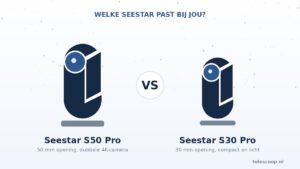
Still hesitating? Check out both in our category smart telescopes, Or come by appointment in Sneek for advice. We advise honestly, even if the cheapest option is the best for you. If you are considering a DWARF in addition to the S30 Pro, please read DWARF 3 vs Seestar S30 Pro. If you want more openness within the Seestar line, then the decision is up to you. Seestar S50 Pro vs S30 Pro.
All models and accessories as of merk: the ZWO merk page for the Seestar line and the Vaonis merk Page for the Vespera II, Pro and III with tripods, filters and the hygrometer.