Update October 2026: The DWARF 3 is no longer being manufactured and is no longer available. If you are looking for a compact DWARF next to the Seestar S30 Pro, check out the DWARF Mini; you can read that comparison in Dwarf Mini vs. Seestar S30. If you want more detail, then the DWARF Draco The step up. For those who already have a DWARF 3 or are considering a second-hand one, we leave the comparison to the bottom.
DWARF 3 vs Seestar S30 Pro: two compact smart telescopes of around one and a half kilograms, both with a telephoto lens and a wide-angle camera, both with 4K image on the main camera. Yet they make different choices. The DWARF 3 (€529) opts for more aperture and more detail, the Seestar S30 Pro €699 for a larger field of view and a complete package with tripod. In this article we put them side by side.
How we arrived at this comparison. We have both personally used the DWARF 3 and the Seestar S30 Pro, but not simultaneously under the same sky. Therefore, what we write about image quality is based on the specifications and our experience with each device separately. As soon as we have tested them side by side, we will add photos of the same object to this article. Last updated: October 6, 2026.
Still unsure between these models?Message us on WhatsApp · weekdays 9:00–17:00The differences at a glance
| DWARF 3 | Seestar S30 Pro | |
|---|---|---|
| Price | €529, with tripod €619 | €699, tripod included |
| Opening | 35 mm | 30 mm |
| Focal length | 150 mm | 160 mm |
| Brightness | f/4.3 | f/5.3 |
| Main sensor | Sony IMX678, 8.3 MP, pixels of 2.0 µm | Sony IMX585, 8.3 MP, pixels of 2.9 µm |
| Field of view | Approximately 2.9° × 1.7° | Approximately 4.0° × 2.2° (4.6° diagonally) |
| Sampling | Approximately 2.8″ per pixel | Approximately 3.7″ per pixel |
| Wide-angle camera | Full HD (1920 × 1080) | 4K with autofocus, field of view 63° |
| Built-in filters | Visual filter, astrofilter, dual-band (OIII, Hα and Hβ) | UV/IR cut, dual band (Hα and OIII), dark filter |
| Solar filter | Included | Magnetic, included |
| EQ mode | Yes, up to 4 times longer exposure time, on a tripod with polar alignment | Yes, up to 60 s, with a detachable wedge |
| During the day | AI object tracking, panoramas, 4K video | Landscape mode for photos, videos and time-lapse |
| Battery | 10,000 mAh | 6,000 mAh, up to approx. 6 hours |
| Storage | 128 GB | 128 GB |
| Connection | Wifi, Bluetooth, NFC | Wifi 2.4 and 5 GHz, Bluetooth, NFC |
| Files | FITS, TIFF, JPEG, PNG | FITS, JPEG, ASCOM Alpaca support |
| Weight | 1.3 kg | 1.65 kg |
| Included | Carry bag, sunscreens, cleaning cloth, USB-C cable | Tripod, magnetic solar filter, carrying case, USB-C cable |
| App | DWARFLAB app | Seestar app |
Which one shows more detail?
On paper, the DWARF 3. Its 35 mm aperture captures about 36 percent more light than the 30 mm of the S30 Pro, and thanks to the smaller pixels, one pixel corresponds to 2.8 arcseconds in the sky, compared to 3.7 for the S30 Pro. On the Moon, the Sun, and smaller deep-sky objects, that results in sharper detail. We saw that in our Comparison of the DWARF 3 and the DWARF Mini: In the case of the Moon and the Sun, the craters and sunspots on DWARF 3 are sharper when zoomed in.
Which one gives a calmer picture at the same time?
Probably the S30 Pro. The DWARF 3 captures more light overall, but distributes it over smaller pixels. The pixels of the S30 Pro are larger and each see a larger part of the sky, which means that approximately a third more light enters per pixel. At the same exposure time, this results in a quieter background on weak clouds. In our test of the DWARF 3 and the DWARF Mini, we saw exactly that effect: the device with the larger pixels showed a quieter background, the device with the smaller pixels showed more detail on clear objects. How big the difference between the DWARF 3 and the S30 Pro is in practice, we will take into account in our test side by side.
What fits in one shot?
Here the S30 Pro is clearly wider: approximately 4.0° × 2.2° compared to 2.9° × 1.7° in the DWARF 3. In the DWARF 3 the Andromedan nebula almost fills the entire frame; in the S30 Pro it fits within it with space around it. Also large nebulae in the Swan, such as the North American nebula, fit more easily into a single shot with the S30 Pro. Both devices can create mosaics if an object does not fit into a single image.
For the Milky Way and landscapes, you use the wide-angle camera. It is included with the S30 Pro 4K with autofocus and a field of view of 63°, with a separate starry sky mode for Milky Way panoramas and star trails. In our review of the Seestar S30 Pro We called that one of the biggest improvements compared to the regular S30. The wide-angle camera on the DWARF 3 works in Full HD.
Which is better for daytime use?
The DWARF 3. It has a separate computing chip for AI object tracking, which recognizes and captures birds, aircraft, and other moving subjects. In addition, it creates panoramas that it assembles itself and films in 4K. The S30 Pro has a landscape mode for photos, video, and time-lapse videos, but is less focused on moving subjects. If you want one device for both astronomy and nature photography, the DWARF 3 has the edge.
What do you get for your money?
The DWARF 3 cost €529, without the tripod. If you buy it as a set with the tripod, the price goes up to €699. DWARFLAB tripod, Then you pay €619. The S30 Pro costs €699 and has a tripod, magnetic solar filter and carrying bag in the box. With a tripod, it costs €80 less. For the EQ mode, you need something extra with both: a tripod with which you can align it on the pole with the DWARF 3, and a wedge with the S30 Pro.
How do the apps differ?
Both apps do the heavy lifting for you: choosing an object, the telescope searches for it, focuses, and stacks the shots while you watch. The Seestar app is the simplest. You choose an object from the night plan, and after a quarter of an hour you see, with a clear nebula like the Orion Nebula, that color and structure are already growing. The DWARFLAB app offers more settings and modes, which fits the broader use of the DWARF 3, but requires a little more research in the beginning. Those who want to minimize setup are well suited to the Seestar. Those who like to fiddle with knobs feel at home with the DWARF.
Which telescope is for whom?
- Choose the DWARF 3 if you want to photograph birds, nature and panoramas in addition to the starry sky, and you value sharp photos of the moon and the sun.
- Choose the DWARF 3 if you are looking for the smallest and lightest device, or already have a suitable tripod.
- Choose the Seestar S30 Pro if you want to shoot mainly clouds and the Milky Way and want to capture large objects at once.
- Choose the Seestar S30 Pro if you want a complete package that you can use right out of the box, with the simplest app.
- Neither of these is suitable for detailed planetary observations. With a 30 to 35 mm aperture, you can see Saturn's rings and Jupiter's moons, but they remain small.
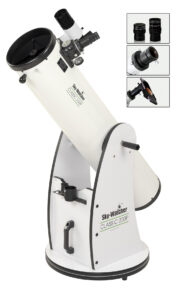
- If you want to view the object yourself through a telescope, a smart telescope is not the right choice. Please see the Dobson telescopes.
Our advice
If you prefer to shoot nebulae, galaxies and the Milky Way at night without hassle, then the Seestar S30 Pro is the more logical choice: larger field of view, better wide-angle camera and everything in the box. If you want one device that can also take great photos during the day, with sharper detail on the moon and the sun, then the DWARF 3 fits better, especially if you already have a tripod. After our test side by side, we supplement this advice with photos of the same object.
Read more
You can read about our experience with the DWARF 3 in DWARF 3 vs DWARF Mini, which comes with the S30 Pro Seestar S30 Pro review. If you want more opening than both, then we will place the larger Seestar next to the DWARF. Seestar S50 Pro vs DWARF 3, and next to his younger brother in Seestar S50 Pro vs S30 Pro. The step above that is the DWARF Draco with a 90 mm opening; how that compares on paper to the S50 Pro you can read in Seestar S50 Pro vs DWARF Draco. All models are displayed side by side on our page. smart telescopes.