


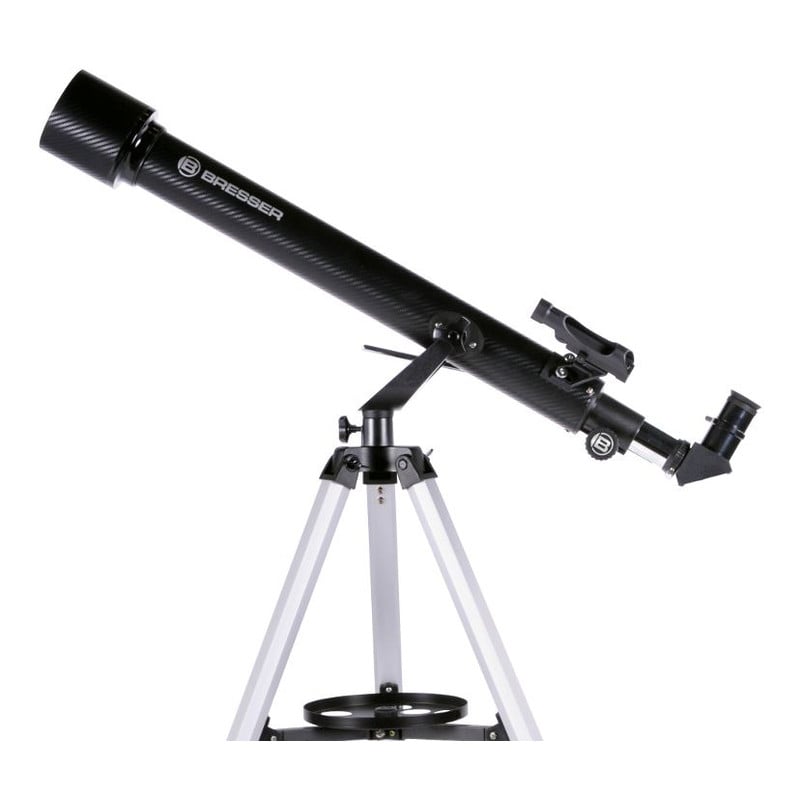
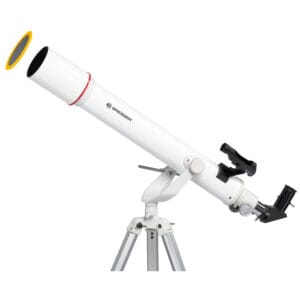
The Arcturus 60/700 AZ is an achromatic refractor (lens telescope with a lens of two elements) with a 60 mm aperture and 700 mm focal brandlength (f/11.7) on an alt-azimuthal mount: you rotate and tilt the tube by hand, without counterweight and without power. The set weighs 2.35 kg with tripod and accessories. Bresser supplies this version with an objective-sun filter for sunspots during the day and a smartphone adapter for a first moon photo. See also telescopes for children And in the Telescope Buying Guide for Beginners.
What do you see through the Arcturus 60/700?
Moon: at 35x with the 20 mm eyepiece, the entire Moon with craters, mountain ranges and the shadow line; with the 3x Barlow on the 20 mm eyepiece (105x), smaller craters and the walls of the larger ones; Jupiter: the four large moons as light points on a line, and at 105x the two dark main bands; Saturn: the ring detached from the planet, small in the image. Venus: the disk shape, as a small moon halo. Double stars like Albireo (a yellow and a blue star) and Mizar: two separate star points. Deep-sky: the bright core of the Pleiades, the Orion Nebula as a gray smudge with the four Trapezium stars, globular clusters like M13 as a fuzzy round smudge and from a dark spot the Andromedan system as a long glowing line. Nebulae and galaxies are seen with the eye in gray tones, not in color. From a city or village with streetlights, the Moon, planets, double stars and star clusters remain; nebulae and galaxies require a dark spot. Sun: with the supplied filter before the tube, sunspots. At f/11.7, the purple-blue border around the moon and Venus is faint. The highest meaningful magnification is about twice the aperture, so about 120x; the 4 mm eyepiece (175x) is above that and gives a dark, rough image. The highest usable combination from the box is the 20 mm eyepiece with the Barlow (105x). What you can expect per object is stated in What do you see through a telescope?, Jupiter through a telescope, Saturn through a telescope and The Moon through a telescope.
How does the Arcturus 60/700 differ from other 60 mm refractors?
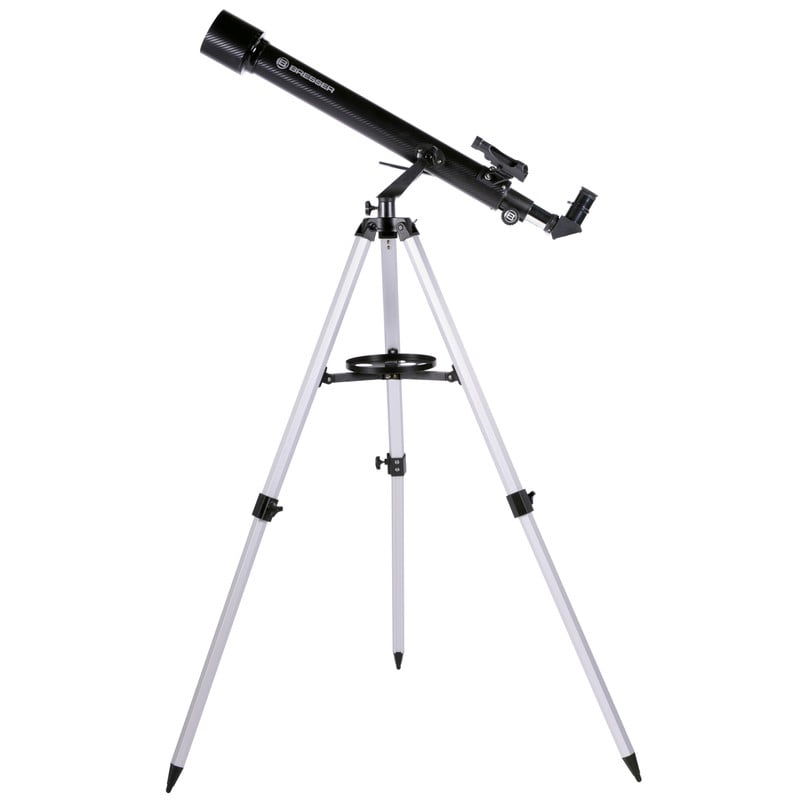
- Mounting: The Arcturus 60/700 is mounted on an alt-azimuthal mount with an aluminum tripod and accessory platform, set at 120 cm high. You focus manually like with a photo tripod, without a polar axis or counterweight, and the entire set weighs 2.35 kg.
- Optics and viewfinder: achromatic lens of 60 mm at f/11.7 in an aluminum tube of about 70 cm; the lens is fixed aligned; collimation is not required. The viewfinder is an LED red dot (a red dot on a window, without magnification); the ocular holder is 1.25 inch.
- Included: two eyepieces (20 and 4 mm) and a 3x Barlow, for a total of 35x, 105x and 175x; an objective-sun filter for sunspots; a smartphone adapter that allows you to take a moon photo with your phone above the eyepiece.
For whom yes and for whom no
Hello families with children aged 8 and over who are looking for a lightweight telescope for the moon and the planets; who wants to safely track sunspots with the same instrument during the day; who wants to put a set of 2.35 kg in a corner or take it with them on vacation. Read also astronomy for children.
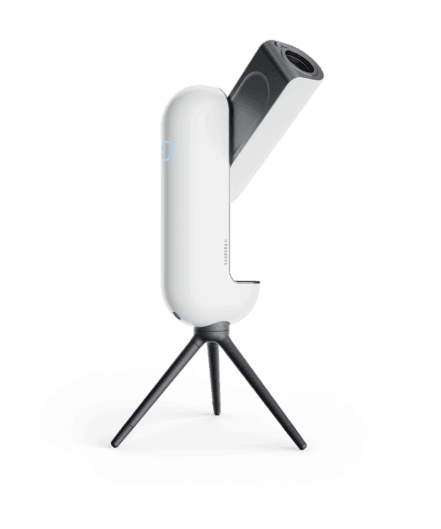
Not for nebulae and star clusters with structure; that requires an opening, choose then the Bresser 130 mm tabletop Dobson, which captures 4.7 times as much light but stands on a table. If you want to stay on a tripod with more light, then The 80 mm refractor on the Nano-montering by Bresser The step: 78% more light, also with solar filter, but weighing 5.3 kg, more than twice as heavy as this set. Long exposures of fog require a mounting that follows the sky; look at the smart telescopes.
What's in the box
- Optical tube 60/700, aluminum
- Alt-azimuth mounting
- Aluminum tripod with accessory platform, height-adjustable
- 20 mm eyepiece (35x), 1.25 inch, for the moon, star fields and searching
- 4 mm eyepiece (175x), 1.25 inch; above the highest meaningful magnification, usable only on the quietest nights
- 3x Barlow, 1.25 inch: with the 20 mm eyepiece 105x
- 90-degree zenith mirror, 1.25 inch
- LED red dot finder
- Objective solar filter
- Smartphone adapter
- Astronomical software (download) and manual
Not included: 10 mm eyepiece, moon filter, prism for a upright image. A Plössl of 10 mm (70x) gives a calmer image than the 4 mm eyepiece; a moon filter softens the light around full moon; the zenith mirror reflects the image to the left and right, which is not important for the sky but important for the ground during the day. All three are included here as accessories.
Looking safely at the sun
The supplied lens sun filter covers the full 60 mm aperture and shows sunspots and the edge distortion of the sun disk. Six rules that always apply:
- The filter is only located in front of the tube, over the entire opening.
- Never a filter in the eyepiece: the light is already bundled there and branda eyepiece filter is included.
- Never use an eclipse glasses behind the viewer; they are made for the naked eye, not for the beam of light from a telescope.
- Cover the red dot viewfinder or remove it; you should focus on the shadow of the tube on the ground.
- Check the foil for holes, tears, and loose edges before each use; a damaged filter will fall off.
- This filter is tailored to this tube. If you ever buy a separate filter, measure the circumference of the front of the tube and divide by 3.14 to get the size.
Secure the filter so that the wind cannot take it off the tube, and let children look at the sun only under supervision. ISO 12312-2 is a standard for eclipse glasses, not for telescope filters. More about observing the sun can be found here. The sun through a telescope and Sun filter for your telescope. On August 2, 2027, there will be a partial solar eclipse to be seen.
Format and weight
2.35 kg for the tube, mounting, tripod and accessories combined. The tube is approximately 70 cm long; when assembled, the total size is 90 x 90 x 120 cm. The box measures 84 x 24 x 24 cm. It stands on the supplied tripod; a table is not required; the tripod is height-adjustable so that a child can also look through the zenith mirror into the eyepiece.
First evening with the Arcturus 60/700
- Take off the lens cap (and the sun filter, which is only for daytime use) and place the zenith mirror with the 20 mm eyepiece in the viewfinder.
- Switch on the red dot viewfinder and line it up with a distant object during the day, for example a church tower or chimney: place the object in the center of the viewfinder and adjust the viewfinder until the red dot appears on it.
- Do not look through a window; the glass and the temperature difference make the image blurry.
- Start with the 20 mm eyepiece (35x) and look for the moon. If you want to get closer, place the Barlow between the zenith mirror and the 20 mm eyepiece (105x); keep the 4 mm eyepiece for the quietest nights.
- Rotate the focus lever until the image is small and sharp; a large blurry disc is not sharp.
- Set the telescope outside 10 minutes before viewing; a 60 mm lens is ready for outdoor use in a few minutes.
- No need to adjust the collimation: the lens is fixedly aligned. A blurred image is caused by focusing, by a window or by turbulent air (seeing, the trembling of the atmosphere). If the lens is clouded on a wet night, do not wipe it; point the tube downwards at intervals and let it dry inside.
Which accessories are suitable?
- Bresser Plössl Oculair 10 mm, 1.25 inch: 70x on this tube, for lunar craters and the bands of Jupiter, with a more relaxed image than the 4 mm eyepiece.
- Omegon Premium Moon Filter, 1.25 inch: screws into the 20 mm eyepiece and lets through about 30% of the light; the mildest attenuation, suitable for 60 mm.
- Bresser Amici prism 45 degrees, 1.25 inch: is mounted in the viewfinder instead of the zenith mirror and provides a straight and good image during the day for birds and landscapes.
Arcturus 60/700 with case, Arcturus 60/700 AZ or Stellar 60/800 AZ?
| Arcturus 60/700 with case | Arcturus 60/700 AZ (this page) | Stellar 60/800 AZ | |
|---|---|---|---|
| Optics | 60 mm lens, 700 mm brandfocal length (f/11.7) | 60 mm lens, 700 mm brandfocal length (f/11.7) | 60 mm lens, 800 mm brandfocal length (f/13.3) |
| Oculars and magnification | 20, 12.5 and 4 mm (35x, 56x and 175x), 1.5x zoom lens | 20 and 4 mm (35x and 175x), 3x Barlow (105x with 20 mm) | 20 and 4 mm (40x and 200x), 3x Barlow (120x with 20 mm) |
| Seeker | 5×24 with cross wire | LED red dot | LED red dot |
| Supplied further | hard suitcase, compass, star chart | objective sun filter, smartphone adapter | objective sun filter, smartphone adapter |
| Weight | about 2 kg | 2.35 kg | 2.3 kg |
| Choose this as | you want to take the set in a suitcase and want a cross-wire viewfinder | You also want to view sunspots during the day and take a moon photo with your phone | you want the same package with a longer brandfocal length and 40x with the 20 mm eyepiece |
Frequently asked questions about the Arcturus 60/700
- Is it suitable for a child? From the age of 8 with a parent, from 10 years old independently: the set weighs 2.35 kg, the assembly does not require alignment and finding and focusing the moon is then done by the user themselves. The solar filter remains the responsibility of the parent.
- Can I take photos with it? Of the moon, of course, using the supplied smartphone adapter on the 20 mm eyepiece. Jupiter and Saturn remain small at 60 mm in the photo; long exposures of clouds require a mount that follows the sky.
- How can I safely view the sun? Only with the supplied filter mounted on the tube, over the entire opening. Check the foil before each use; cover the viewfinder and never use eclipse glasses behind the viewfinder or a filter in the eyepiece.
- Which magnification is useful? Up to about 120x. The 20 mm eyepiece (35x) and that eyepiece with the Barlow (105x) provide a sharp image; 175x with the 4 mm eyepiece is too much for a 60 mm aperture.
- Do I need to collimate it? No. The lens is fixedly aligned in the tube; there is nothing to adjust, not even after transport.
- Tripod or table? The aluminum tripod is included in the box and is height-adjustable; when set up, it is 120 cm high and you don't need a table.
Specifications
| Specification | Value |
|---|---|
| Optical design | Achromatic refractor |
| Opening | 60 mm |
| Focal length | 700 mm |
| Opening ratio | f/11,7 |
| Lens | Achromatic, two elements, without ED glass |
| Highest meaningful magnification | about 120x |
| Mount | Alt-Azimuthal, manual |
| Tripod | Aluminium, height-adjustable, with accessory tray |
| Reporter | 1.25-inch eyepiece holder |
| Seeker | LED red dot |
| Included eyepieces | 20 mm (35x) and 4 mm (175x), plus 3x Barlow |
| Additional | 90 degree zenith mirror, lens-sun filter, smartphone adapter |
| Total weight | 2.35 kg |
| Tube length | approx. 70 cm; assembled 90 x 90 x 120 cm |
| Packed | 84 x 24 x 24 cm |
Shipping and assistance
Orders with multiple items are shipped from multiple warehouses and may arrive in parts; each package will have its own tracking number. More information about this can be merk found on the Bresser 1TP5 Page. Help with choosing or on the first evening: WhatsApp or call on weekdays from 9:00 to 17:00, or come by appointment in Sneek. 30 days' cooling-off period.

Reviews
There are no reviews yet.