


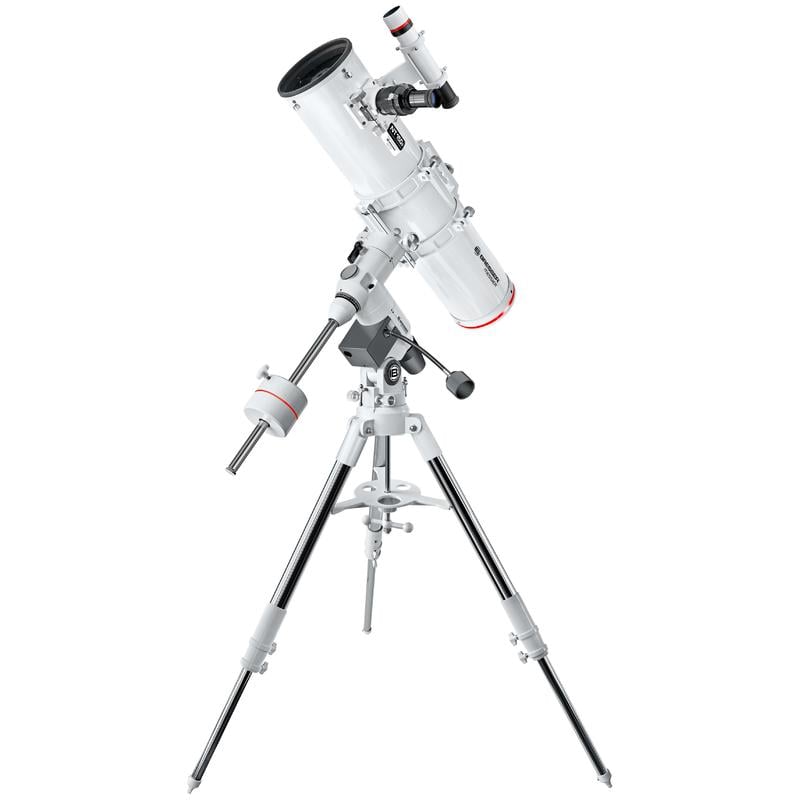
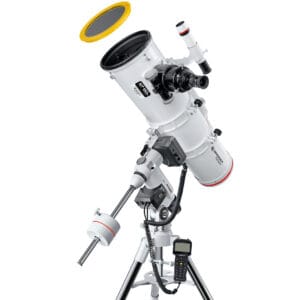
The Messier 150/750 EXOS-2 is a Newtonian reflector with a 150 mm parabolic mirror and a focal brandlength of 750 mm (f/5) on the EXOS-2, a German equatorial mount with ball bearings on both axes, 13 kg of load capacity and a polariscope, mounted on a stainless steel tripod from 69 to 109.5 cm. The 69 cm tube has a 2.5 inch Hexafoc lens with an adapter for 2 inch eyepieces and a 1.25 inch adapter with T2 thread for a camera. The same tube is also used on the lighter Messier 150/750 EXOS-1 with a load capacity of 7 kg; on the EXOS-2, in addition to the 5.5 kg tube, there is still 7.5 kg left for the camera, heavier eyepieces and motors. How an equatorial mount works is explained in Tripods and mounts explained.
What do you see through the Messier 150/750 EXOS-2?
Moon: craters, mountain ranges and the shadow line; at 29x with the 26 mm eyepiece as a whole disk; at 75x with a 10 mm eyepiece the small craters at the bottom of the large one; at 150x with a 5 mm eyepiece the grooves along the rim of the craters; Jupiter: the bands of clouds with color differences, the four large moons; on quiet nights the Great Red Spot and the shadow of a moon on the planet during a transit. Saturn: the ring detached from the planet and on good nights the Cassini division in the ring; Sun: with the tube filter, sunspots with core and gray rim; deep sky: the Orion nebula with structure in the nebular wings, the Pleiades at 29x in a single image, the core of the Andromeda nebula as an oval spot, globular clusters like M13 that break off from the edge into loose stars, and from a dark spot the brightest star systems as a spot with a core. With the 26 mm eyepiece you see about 1.8 degrees of sky, more than three times the Moon; with a 2 inch wide-angle 30 mm eyepiece that is more than two degrees. Nebulae and galaxies are seen with the eye in grayscale, not in color. From a city or village with street lighting, sun, moon, planets, double stars, and star clusters remain; nebulae and galaxies require a dark spot. The highest meaningful magnification is approximately twice the opening, 300x; in practice, 150 to 200x is the limit due to the air above the Netherlands and Belgium. What you can expect per object is stated in What do you see through a telescope?, Jupiter through a telescope, Saturn through a telescope, The Moon through a telescope and The Orion Nebula through a telescope.
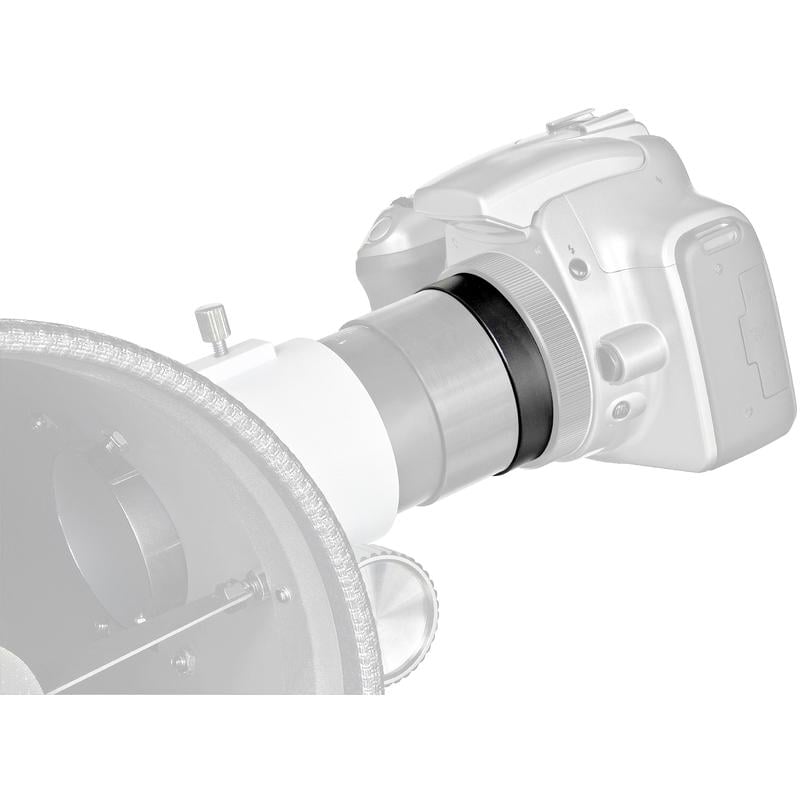
Photos: A camera with a T2 ring screws onto the T2 thread of the 1.25-inch adapter, for shots of the moon, the sun (with the filter), and the planets. With the RA and DEC motorset and a polar alignment via the polar viewfinder, the assembly follows the sky, and then short exposures of bright clouds are possible. At f/5, stars in the corners of a large sensor are comet-shaped (coma); a coma corrector corrects that. How to connect a camera is explained in Connecting camera to telescope.
How does the Messier 150/750 EXOS-2 differ from other 150 mm telescopes?
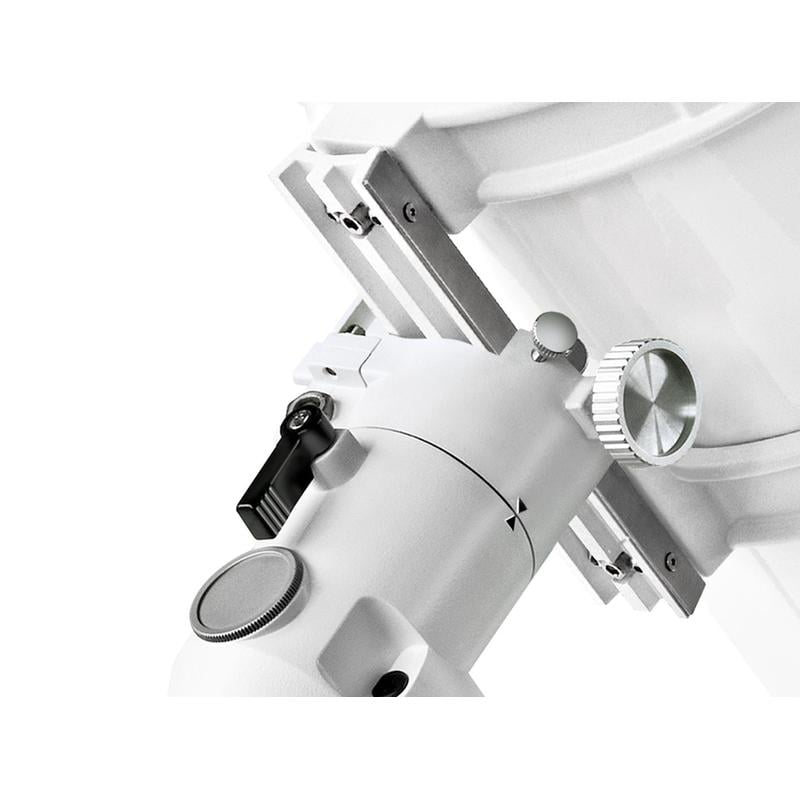
- Mounting: The Messier 150/750 EXOS-2 is mounted on a German equatorial mount with ball bearings and fine adjustments on both axes, 13 kg load capacity, a polar viewfinder in the polar axis (lighting as an option) and a counterweight of 4.5 kg; with the 5.5 kg tube, 7.5 kg remains. It can be extended later with an RA and DEC motor set or with the GoTo kit from Bresser.
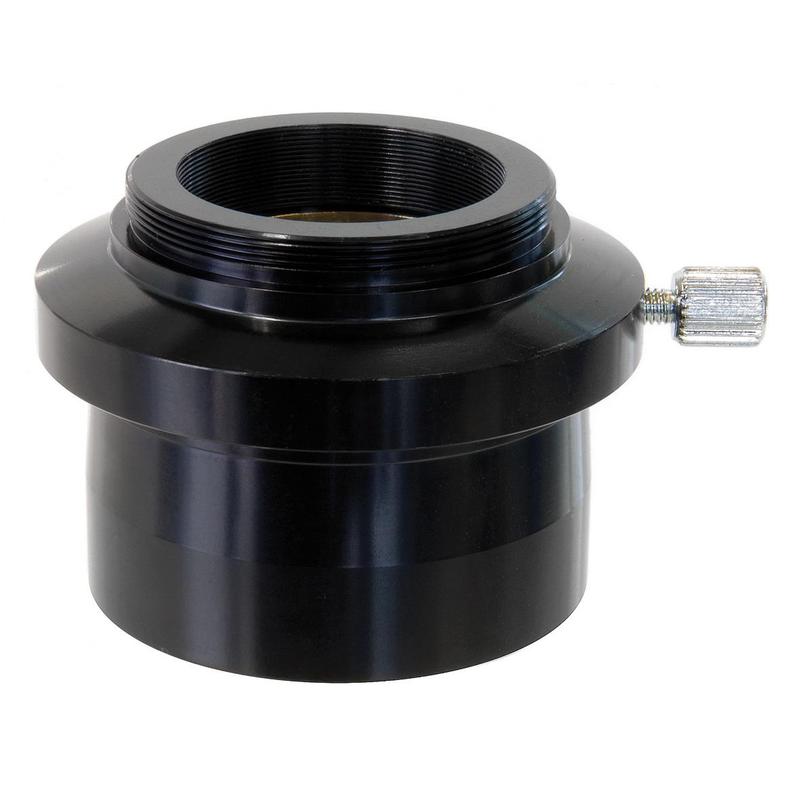
- Focusing eyepiece: 2.5 inch Hexafoc with 65 mm diameter, an adapter for 2 inch eyepieces and an adapter from 2 to 1.25 inch with T2 thread; a camera with a T2 ring screws on the focusing eyepiece without additional parts, and heavy 2 inch eyepieces also fit.
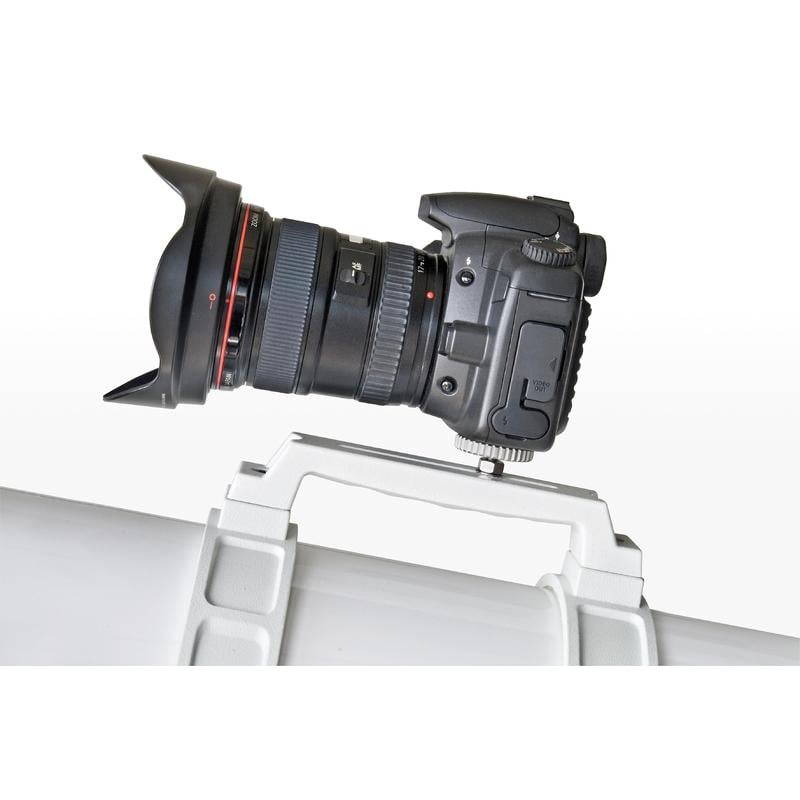
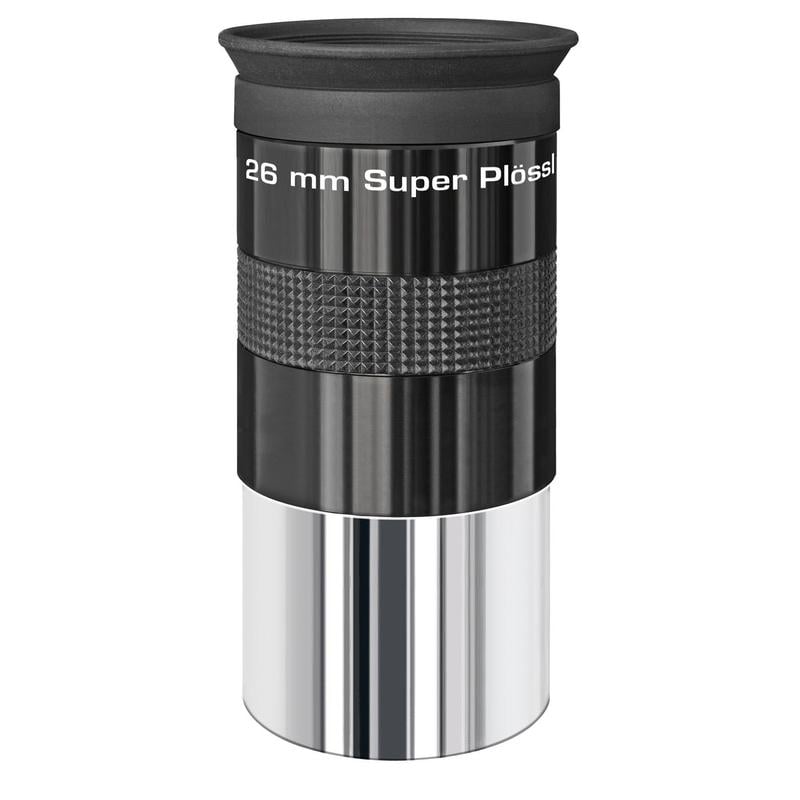
- Optics and included: 150 mm parabolic mirror with 55 mm catch mirror, f/5; 26 mm Super Plössl (29x), 6×30 viewfinder, objective-sun filter, tube clamp with handle and camera holder (1/4 inch wire) on a prism rail (the falcon-shaped bracket that clamps the tube into the mount), and a smartphone holder for a star map app on the tube.
For whom yes and for whom no
Hello Anyone starting with a 150 mm telescope and wanting to use the same mount later for photos; anyone who wants to add motors or GoTo to a mount with a load capacity of 13 kg and a polar viewfinder; anyone who can carry 20.3 kg in four parts and has room for a setup up to 170 cm high. If you’re unsure between an EQ mount and a Dobson, read the Telescope Buying Guide for Beginners.
Not for those who only look visually and want to wear less; the same tube on the lighter mounting with 7 kg load capacity weighs 1.6 kg less. If you want the telescope to automatically zoom in and follow objects, please The GoTo version of this telescope. If you want to see without the pulley and counterweight, choose the 150/750 tabletop Dobson from Bresser with the same mirror size. For long exposures of fog, no tracking is possible without a motor unit; please also refer to the smart telescopes, which themselves follow and accumulate.
What's in the box
- Messier 150/750 Newton tube with parabolic primary mirror and 2.5 inch Hexafoc eyepiece
- Adapter for 2 inch eyepieces and adapter from 2 to 1.25 inch with built-in T2 wire
- Socket plug with handle and camera holder (1/4 inch thread), on prismatic rail with stainless steel clamping surface
- EXOS-2 equatorial mounting with ball bearings and fine movements on both axes
- Adjustable pool finder (lighting sold separately)
- Counterweight of 4.5 kg
- Stainless steel tripod, 69 to 109.5 cm, with accessory platform
- 26 mm Super Plössl ocular (29x), 1.25 inch
- 6×30 optical viewfinder
- Objective sun filter for the tube
- Smartphone holder on the tube for a star map app
- Rotatable star map, Stellarium as download
Not included: 10 mm eyepiece, motors, collimation aid. Without just 29x you miss the 75x to 150x for moons and planets; a 10 mm eyepiece (75x) is the first purchase. Without the motor, assembly does not come automatically; the RA and DEC motorset allows it to spin. A Cheshire collimation eyepiece checks the mirrors after transport; at f/5 that is very precise. All three are included here in the accessories.
Looking safely at the sun
The supplied lens sun filter covers the full 150 mm aperture and shows sunspots and the edge distortion of the sun disk. Six rules that always apply:
- The filter is only located in front of the tube, over the entire opening.
- Never a filter in the eyepiece: the light is already bundled there and branda eyepiece filter is included.
- Never use an eclipse glasses behind the viewer; they are made for the naked eye, not for the beam of light from a telescope.
- Cover the 6×30 viewfinder or remove it; focus on the shadow of the tube on the ground. Never look through the polar viewfinder at the sun.
- Check the foil for holes, tears, and loose edges before each use; a damaged filter will fall off.
- This filter is tailored to this tube. If you ever buy a separate filter, measure the circumference of the front of the tube (outside diameter 180 mm) and divide by 3.14 for the size.
Secure the filter so that the wind cannot take it off the tube, and let children look at the sun only under supervision. ISO 12312-2 is a standard for eclipse glasses, not for telescope filters. More about observing the sun can be found here. The sun through a telescope and Sun filter for your telescope. On August 2, 2027, there will be a partial solar eclipse to be seen.
Format and weight
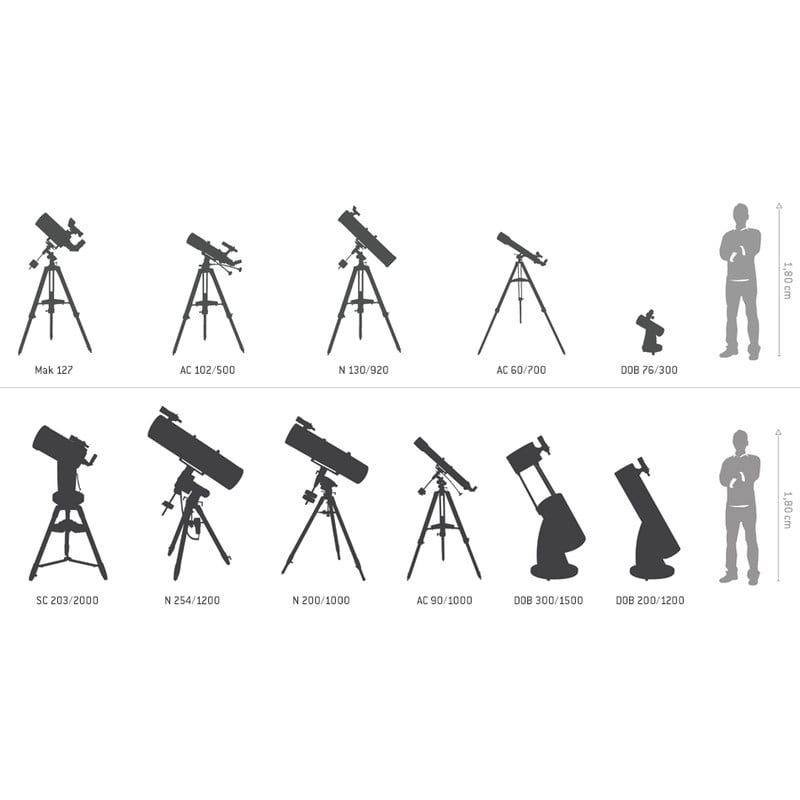
20.3 kg in four parts: the clamp-mounted tube and accessories 5.5 kg, the EXOS-2 mounting 5.6 kg, the stainless steel tripod 4.7 kg and the counterweight 4.5 kg. The tube is 69 cm long and 18 cm thick. The tripod stands at 69 to 109.5 cm; when assembled, it reaches a height of approximately 170 cm, and the footprint is about one meter wide. You view it standing or on a stool, depending on where the tube is directed. Packaged in a box of 89 x 33 x 33 cm, shipping weight 23 kg.
First evening with the Messier 150/750 EXOS-2
- Take off the tube cap (and the sun filter, which is only for daytime use), set the tripod on a flat surface, attach it to the mounting bracket, place the counterweight on the axis, and clamp the prism rail of the tube onto the saddle.
- Line the 6×30 viewfinder at day time on a distant object, for example a church tower or chimney, with the 26 mm eyepiece in the viewfinder.
- Point the polar axis towards the north: set the elevation scale to your latitude (52 degrees in the Netherlands, 51 in Belgium) and rotate the entire assembly until the Pole Star is in the polar viewfinder. For viewing with the eye, that is accurate enough; for photos, place the Pole Star in the location indicated by the scale in the polar viewfinder.
- Balance: loosen the clamp on the arm and slide the counterweight of 4.5 kg so that the tube remains in place; then insert the tube into the clamp until the declination axis is also balanced.
- Do not look through a window. Start with the 26 mm eyepiece (29x) and look for the moon; follow it with the fine adjustment of the eyepiece and then switch to a shorter eyepiece.
- Rotate the Hexafoc until the image is small and sharp; a large blurry disc is not sharp. Set the telescope 30 to 45 minutes before viewing outside, so that the 150 mm mirror reaches outside temperature.
- An unsmooth image almost never results from the collimation. Check this after a drive; how it works is described in the Collimation guide.
Which accessories are suitable?
- Vela Optics 10 mm Super Plössl eyepiece, 1.25 inch: 75x, the first step after the supplied 26 mm eyepiece, for the entire Moon, the bands of Jupiter and the planetoids; fits the 1.25 inch adapter of the Hexafoc.
- Bresser RA and DEC motors for EXOS-2motors for both axes of this hand-operated assembly (1x, 8x and 32x), so that a planet remains in view at 150x and you can adjust it with buttons; operates on 8 D-cells, which are not included.
- Bresser 1:8 microfocuser for Messier Hexafoc: comes on the axis of this Hexafoc and slows down focusing eight times, for planets at 150x and for a camera.
- Vela Optics Cheshire collimation eyepiece: goes into the 1.25 inch adapter instead of an eyepiece; at f/5, the alignment of the mirrors is very precise; check it after every drive.
Messier 150/750 EXOS-1, Messier 150/750 EXOS-2 or Messier 203/1000 EXOS-2?
| Messier 150/750 Hexafoc EXOS-1 | Messier 150/750 Hexafoc EXOS-2 (this page) | Messier 203/1000 Hexafoc EXOS-2 | |
|---|---|---|---|
| Mirror | 150 mm parabolic, f/5 | 150 mm parabolic, f/5 | 203 mm parabolic, f/5 |
| Ocular and magnification | 26 mm Super Plössl (29x) | 26 mm Super Plössl (29x) | 26 mm Super Plössl (38x) |
| Seeker and photographer | 6×30, 2.5 inch Hexafoc | 6×30, 2.5 inch Hexafoc | 8×50, 2.5 inch Hexafoc |
| Mount | EXOS-1, 7 kg carrying capacity, one counterweight of 4.5 kg, pole finder included | EXOS-2 with ball bearings, 13 kg load capacity, one counterweight of 4.5 kg, pole finder | EXOS-2 with ball bearings, 13 kg load capacity, two counterweights of 4.5 kg, polar finder |
| Tube | 69 cm long, 18 cm thick, 5.5 kg | 69 cm long, 18 cm thick, 5.5 kg | 94 cm long, 25 cm thick, 11.2 kg |
| Total weight with counterweight | 18.7 kg | 20.3 kg | 30.5 kg |
| Engines as an option | RA motor for the uras | RA and DEC motor set or GoTo kit | RA and DEC motor set or GoTo kit |
| Choose this as | You only look visually and want to carry 1.6 kg less | You want room in the same tube for camera, motors and GoTo | You want 83% more lumens for fog and systems and can move 30.5 kg |
Frequently asked questions about the Messier 150/750 EXOS-2
- Is it suitable for a child? From the age of 8, together with an adult; from the age of 12, independently: aligning the pole axis and balancing with a counterweight of 4.5 kg require explanation, and assembling the 20.3 kg in four parts requires an adult.
- Can I take photos with it? Of the moon, the sun (with the filter) and the planets: a camera with a T2 ring screws onto the T2 thread of the 1.25 inch adapter, a phone holder goes on the eyepiece. Long exposures of clouds require the motor drive and a precise polar alignment with the supplied polar viewfinder.
- How can I safely look at the sun? Only with the supplied filter mounted on the tube, over the full opening. Check the foil before each use, cover the viewfinder and never use eclipse glasses behind the viewfinder or a filter in the eyepiece. Choose a replacement filter to fit the tube (180 mm outer diameter) on the page of the Omegon Helievo.
- Is there a tracking motor attached? No, you follow the fine motion of the axis. The RA and DEC motorset above allows the assembly to rotate; with the GoTo Upgrade Kit for the EXOS-2 he also searches for objects himself.
- Do I need to collimate it? Check after transport; at f/5, the alignment of the mirrors is more precise than at f/8. A collimation tool is not included in the box; the steps are listed in the manual. Collimation guide.
- Do 2 inch eyepieces fit? Yes, the Hexafoc has a free 2.5 inch aperture and an adapter for 2 inch eyepieces; the included 26 mm eyepiece is 1.25 inch and fits into the smaller adapter.
Specifications
| Optical design | Newton reflector, parabolic mirror |
| Opening | 150 mm |
| Focal length | 750 mm |
| Opening ratio | f/5 |
| Mirror | 150 mm parabolic head mirror, rear mirror 55 mm; separation ability 0.86 arcseconds |
| Highest meaningful magnification | about 300x, in practice 150 to 200x |
| Mount | EXOS-2 German equatorial mounting, ball bearings and fine motion on both axes, 13 kg load capacity, polar finder, counterweight 4.5 kg; motor set or GoTo kit as option |
| Tripod | Stainless steel, 69 to 109.5 cm, with accessory tray; assembled to 170 cm high |
| Reporter | 2.5 inch Hexafoc (65 mm), with adapter for 2 inch eyepieces and adapter to 1.25 inch with T2 thread |
| Dovetail | Prismarail with stainless steel clamp surface, hose clamp with handle and camera holder (1/4 inch thread) |
| Seeker | 6×30 optical; polarizer in the polar axis |
| Included eyepieces | 26 mm Super Plössl (29x), 1.25 inch |
| Solar filter | Objective sun filter for the tube, included |
| Camera connection | T2 wire on the 1.25 inch adapter; 1/4 inch camera holder on the hose clamp |
| Total weight | 20.3 kg (tube 5.5 kg, assembly 5.6 kg, tripod 4.7 kg, counterweight 4.5 kg) |
| Tube length | 69 cm, tube diameter 18 cm |
| Packed | 89 x 33 x 33 cm, shipping weight 23 kg |
Shipping and assistance
Orders with multiple items are shipped from multiple warehouses and may arrive in parts; each package will have its own tracking number. More information about this can be merk found on the Bresser 1TP5 Page. Help with choosing or on the first evening: WhatsApp or call on weekdays from 9:00 to 17:00, or come by appointment in Sneek. 30 days' cooling-off period.
Reviews
There are no reviews yet.