Manual Refractor Telescopes

Are you looking for a telescope that allows you to explore the night sky directly and without any hassle? Manual Refractor Telescopes are the absolute favorite for beginners and families. Because these classic refractor telescopes are operated completely manually with smooth adjustment knobs (on an AZ or EQ mount), you don't need batteries, WiFi, or complicated operations. It's a matter of setting them up, pointing them, and enjoying! Furthermore, the tube is completely maintenance-free. From sharply imaging the craters on the moon to spotting the rings of Saturn: with these reliable and affordable instruments, you will discover the universe in its purest form.

Showing 61–64 of 64 resultsSorted by popularity

Showing 61–64 of 64 resultsSorted by popularity

Manual refractor: the telescope that always works

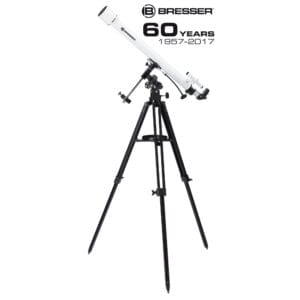
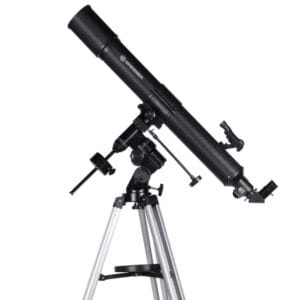
A manual refractor is a lens telescope on a tripod with a mount without motors. No batteries, no app, no collimation. You set it up, point it, and look. For anyone buying a telescope for the first time and wanting to see primarily the moon and planets, this is the category with the least surprises. This category contains all complete refractor sets without GoTo; optical tubes can be found at Refractor OTA.

What you look out for

  • Opening. 60 to 70 mm shows the Moon, Saturn and Jupiter. 90 to 102 mm brings detail in the cloud bands and the bright deep-sky objects. 120 to 150 mm is the upper limit for an achromat on a manual mount.
  • Focal ratio. f/8 to f/10 (for example 90/900) yields sharp planets with little color aberration. f/5 (for example 102/500) provides a wide field of view for star clusters, with some color fringing around bright stars.
  • Assembly. AZ is intuitive and lightweight. EQ tracks the sky with a single button and can later be expanded with a tracking motor. For children and families, we recommend AZ; for planets at high magnification, EQ.
  • Tripod. Aluminum tripods of 1 inch or thicker are stable. Thin tubes with plastic joints vibrate with every touch.

Our recommendations

For whom yes and for whom no

Well: beginners, families, planet observers, anyone observing from a balcony or in a small garden. Not: anyone who wants to see nebulae and galaxies (choose a Dobson) and who wants to take photos (choose a GoTo refractor or an ED tube on a tracker).

Useful accessories: a moon filter, a good quality star diagonal if the included one is disappointing, and a 2x barlow for the planets. Compare with the lensless alternatives in manual reflectors.