

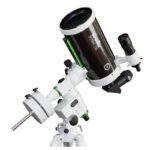

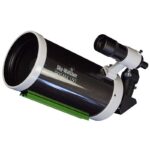
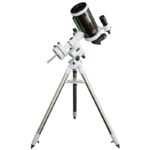
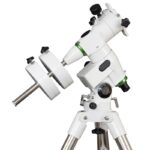


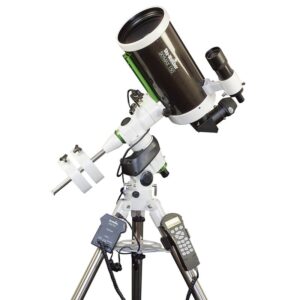
The Skymax-150 PRO EQ5 is a Maksutov-Cassegrain with an aperture of 150 mm and a focal brandlength of 1800 mm (f/12), folded into a closed tube of 40 cm. It is mounted on the EQ5, a German equatorial mount with fine adjustments on both axes and two counterweights, on a stainless-steel tripod with 1.75-inch legs. With the pole axis pointing northwards, you follow a planet by turning a knob; the EQ5 can later be extended with motors. The Skymax line from Sky-Watcher has a 150 mm between 127 and 180 mm; all versions are listed on the category page Maksutov-Cassegrain telescopes.
What do you see through the Skymax-150 PRO?

The Moon, planets, binary stars, and globular clusters are the focus of this telescope. Moon: craters, mountain ranges, and the shadow line at 64x magnification with the 28 mm eyepiece, showing the entire Moon; at 180x magnification with a 10 mm eyepiece, the small craters at the bottom of the large ones, the ridges, and the terraces on the crater walls. Jupiter: the cloud bands with their structure and color variations, the Great Red Spot, the four large moons as small disks, and the shadow of a moon on the planet. Saturn: the ring separate from the planet, the Cassini Division on most clear nights, the shadow of the ring on the globe, and four or five moons. Mars: around the time of opposition, the polar cap and dark regions. Double stars: the double binary in Lyra, widely separated; close pairs down to about 0.8 arcseconds on the calmest nights. Globular clusters such as M13 break down into individual stars right down to the core; planetary nebulae such as the Ring Nebula reveal their ring-like shape.
The field of view with the 28 mm eyepiece is approximately 0.9 degrees, almost twice the full moon. The Pleiades, the Andromedan nebula, and the entire Orion nebula do not fit into that; for those extended objects a wide-field telescope is required. Dobson of Newton is the better choice merk with short brandfocal length. Nebulae and galaxies are seen with the eye in grayscale, not in color. From a city or village with street lighting, you can see the moon, planets, double stars, and star clusters. The highest meaningful magnification is about 300x; due to the air above the Netherlands and Belgium, 150 to 200x is in practice the limit. What you can expect per object is stated in What do you see through a telescope?, Jupiter through a telescope, Saturn through a telescope, Mars through a telescope and The Moon through a telescope.
How does the Skymax-150 PRO EQ5 differ from other 150 mm Maksutovs?
- Mounting: The EQ5 is a German equatorial mount with fine adjustments on both axes, a latitude adjustment with scale and a holder for a polarimeter; load capacity 9 kg, so the 5.6 kg tube sits securely at 200x. With the polar axis on the Polarster you follow an object with one button, without power. A tracking motor for one or two axes is available separately and fits this mounting.
- Tube and optics: closed tube with a meniscus lens at the front, so no collimation and no dust on the mirror. Focusing is done with a button on the back that shifts the main mirror; the connection on the back has T2 wire for a camera. A closed tube of 150 mm takes 45 to 60 minutes to reach outside temperature, and the meniscus lens covers moisture on humid nights; a dew cap prevents that.
- Supplied: a 2-inch diagonal mirror with adapters for 2 and 1.25-inch eyepieces, a 28 mm eyepiece of 2 inches with wide eye-distance (64x), a 9×50 optical viewfinder with crosshairs, two 5.1 kg counterweights and the Starry Sky Handbook.

For whom yes and for whom no
Hello For those who want to view the Moon, planets and double stars with a 150 mm aperture and observe the objects themselves, for those who look in the city and want a telescope that is ready to use without collimation, and for those who are looking for a mount that can later be fitted with a tracking motor. If you are unsure about the type of mount, read on. Tripods and mounts explained.
Not for extended nebulas, the Andromeda Nebula and galaxies; with a 0.9 degree field of view and f/12, that is a Dobson For long exposures of fog, f/12 is too underexposed; for that, the smart telescopes made. You can take photos of the moon and the planets with this telescope using a camera on the T2 thread or a smartphone adapter on the eyepiece. If you want the objects to be automatically found, select the same tube on the EQ5 Pro with GoTo.
What's in the box

- Skymax-150 PRO optical tube with 45 mm dovetail
- EQ5 equatorial mounting with fine movements on both axes
- Stainless steel tripod with 1.75-inch legs
- Two counterweights of 5.1 kg
- 28 mm eyepiece with wide eye distance (64x), 2 inch
- 2 inch diagonal mirror with adapters for 2 and 1.25 inch eyepieces
- 9×50 optical viewfinder with cross wire, in holder
- Handbook for Star Gazers (16 pages, Dutch)
Not included: planetary eyepiece, tracking motor, polar finder. With the 28 mm eyepiece, you get 64x magnification; a 10 mm eyepiece provides 180x magnification for the Moon and planets. A tracking motor keeps a planet in view without having to rotate the telescope, which is useful at high magnifications. A polar finder is not necessary for observing; roughly aiming at the North Star is sufficient.
Format and weight
Approximately 28 kg in total, to be carried in three parts: the 5.6 kg tube, the tripod mounting and two 5.1 kg counterweights; the mounting, tripod and counterweights together weigh 22.3 kg. The tube is 40 cm long and about 18 cm in diameter and is detached from the mounting via a 45 mm dovetail. The stainless steel tripod stands on the ground; through the diagonal mirror you can view it standing or on a stool, and the short 40 cm tube keeps the eyepiece close to the mounting. Place the tripod on a sturdy surface; at 200x, a wooden plinth vibrates.

First evening with the Skymax-150 PRO EQ5
- Cooling: Set the tube outside for 45 to 60 minutes with the cap off; until the air in the closed tube reaches outdoor temperature, the image will vibrate at 200x.
- Dew: on humid evenings the meniscus lens covers the front; a dew cap prevents that. Wipe the lens with a cloth but do not let it dry inside.
- Pole: Set the tripod level with one leg facing north, set the latitude on the scale (about 52 degrees in the Netherlands, 50 to 51 degrees in Belgium) and roughly orient the pole axis towards the North Star. That should suffice for orientation purposes.
- Balancing: First, slide the counterweights onto the rod, then the tube, and then slide the weights until the tube remains in each position when you unscrew the pole shaft clamp. Do the same for the second axis by sliding the tube forward or backward in the saddle.
- Finder and ocular: Line the 9×50 viewfinder at day time on a distant object, for example a church tower. Start in the evening with the 28 mm ocular (64x) in the 2 inch diagonal mirror and the moon. Turn the focus knob until the image is small and sharp; a Maksutov requires several turns of the knob.
- Follow: place the object in view and hold it there with the fine movement of the polar axis; the second fine movement is only needed to adjust the position.
- Do not look through a window; the glass and the temperature difference make the image blurry. Collimation is not necessary with this closed tube: a blurry image almost always results from cooling, fog, or turbulent air.
Which accessories are suitable?
- Vela Optics 10 mm Super Plössl eyepiece, 1.25 inches: 180x for the Moon, Jupiter, and Saturn; fits into the 1.25-inch adapter of the included diagonal mirror.
- Sky-Watcher Enhanced Dual-Axis Motor Drive for EQ5motors on both axes with manual control, tracking speeds for stars, the moon and the sun and a ST-4 connection; made for the EQ5, operates on 4 D batteries in the included battery pack.
- Sky-Watcher Transport Case for Skymax 150: custom-made case for the 150 mm Skymax, for transporting the tube in the car.
Skymax-127 EQ3 Pro, Skymax-150 PRO EQ5 or Skymax-180 PRO EQ5 Pro?
| Skymax-127 EQ3 Pro SynScan | Skymax-150 PRO EQ5 (this page) | Skymax-180 PRO EQ5 Pro SynScan | |
|---|---|---|---|
| Optics | 127 mm, 1500 mm brandfocal length (f/11.8) | 150 mm, 1800 mm brandfocal length (f/12) | 180 mm, 2700 mm brandfocal length (f/15) |
| Magnification with the included eyepieces | 75x and 150x | 64x | 96x |
| Highest meaningful magnification | about 254x, in practice 150 to 200x | about 300x, in practice 150 to 200x | approximately 360x, in practice 150 to 200x |
| Tube | 33 cm, 3.4 kg | 40 cm, 5.6 kg | 52 cm, 7.8 kg |
| Mount | EQ3 Pro, equatorial with GoTo hand controller | EQ5, equatorial with fine movements, extendable with motors | EQ5 Pro, equatorial with GoTo hand controller |
| Seeker and diagonal | red dot, 1.25 inch | 9×50, 2 inch | 9×50, 2 inch |
| Choose this as | you want the lightest equatorial set that finds objects itself | You search for and follow yourself, and later want to add a motor | You want 44% more light than 150 mm and the longest brandpoint for planets and double stars |
Frequently asked questions about the Skymax-150 PRO EQ5
- How long should it cool down? 45 to 60 minutes, depending on the difference between inside and outside; until then, the image of the planets will vibrate. Set the tube with the cap off outside while you assemble the mount.
- Does the lens fog up? Yes, the meniscus lens in front attracts moisture on humid evenings. A dew cap prevents that; wiping the lens with a cloth will not remove the moisture but allow it to dry.
- What magnification does the standard eyepiece provide? 64x with the 28-mm eyepiece (1,800 divided by 28), with a field of view of approximately 0.9 degrees. For planets, 150x to 200x is the magnification that works best; a 10-mm eyepiece provides 180x.
- Can I see it with the deep-sky telescope? Globular clusters, planetary nebulae and small bright nebulae; extended objects like the Pleiades, the Andromeda Nebula and the entire Orion Nebula do not fit within the 0.9 degree field of view. For that, a short- brandfocus Dobson telescope is the better choice.
- Can a follow motor be installed? Yes, a motor for one axis or for both axes is available separately for the EQ5; it keeps an object in view without having to turn the knob. The installation works even without a motor and without power.
- Is it suitable for a child? From the age of 8, together with an adult; from the age of 12, independently: building with the counterweights of 5.1 kg is for an adult. Watching and following with fine motor skills can already be done by a child of 10.
- Can I take photos with it? Of the moon and the planets: with a camera with a T2 ring on the T2 thread on the back or with a smartphone adapter on the eyepiece. Fogging requires long exposures at f/12; for that, a more powerful tube is needed.
Specifications
| Optical design | Maksutov-Cassegrain, closed tube with meniscus lens |
| Opening | 150 mm (6 inches) |
| Focal length | 1800 mm |
| Opening ratio | f/12 |
| Highest meaningful magnification | about 300 times |
| Mount | EQ5, German equatorial, fine movements on both axes, latitude adjustment with scale, holder for polar finder; load capacity 9 kg; expandable with follow motors |
| Tripod | Stainless steel, legs of 1.75 inch |
| Reporter | Internal focus via the main mirror, button on the back |
| Rear connection port | Integrated T2 wire; 2 inch diagonal mirror with adapters for 2 and 1.25 inch |
| Seeker | 9×50 optic with cross wire, in holder |
| Included eyepieces | 28 mm LET (wide field of view), 2 inch (64x) |
| Total weight | about 28 kg (tube 5.6 kg; assembly, tripod and counterweights 2 x 5.1 kg together 22.3 kg) |
| Tube length | 40 cm |
| Tube diameter | about 18 cm |
Shipping and assistance
Orders with multiple items are shipped from multiple warehouses and may arrive in parts; each package will have its own tracking number. More information about this can be merk found on the Sky-Watcher brand page. Help with choosing or on the first evening: WhatsApp or call on weekdays from 9:00 to 17:00, or come by appointment in Sneek. 30 days' cooling-off period.

Reviews
There are no reviews yet.