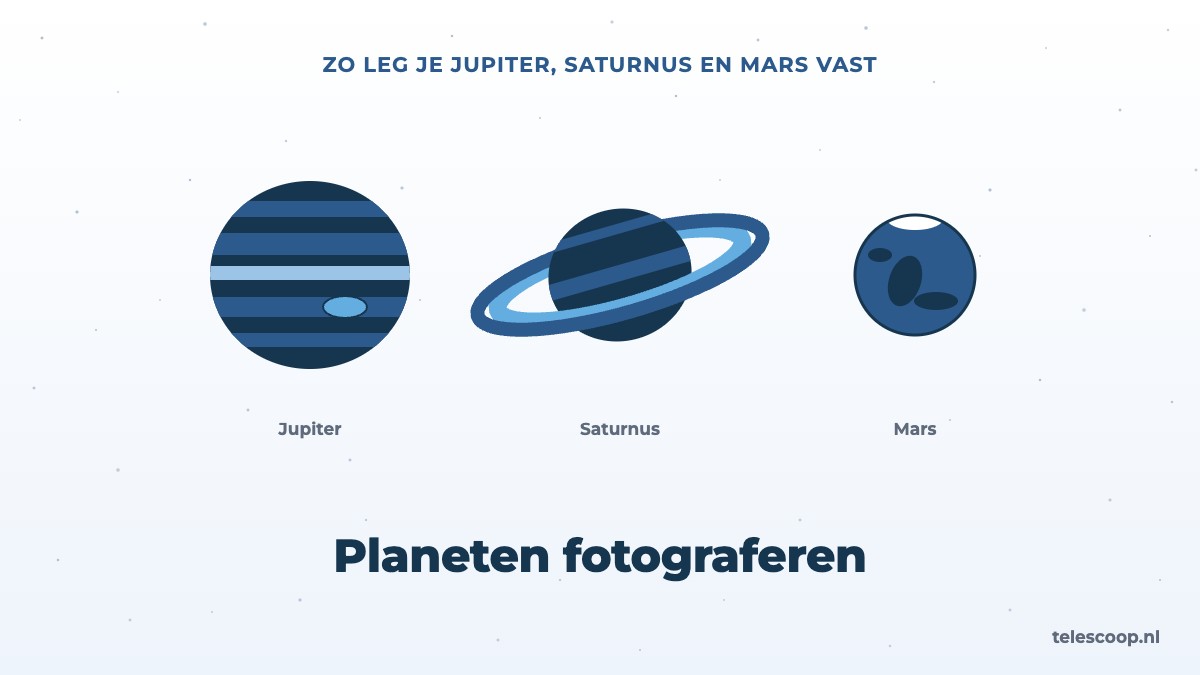
Photographing planets It works differently than other astrophotography. You don’t take a long exposure, but film the planet for a few minutes and let software choose the sharpest images. With a telescope with an aperture of 13 to 20 cm and a small planetary camera, you can see the bands of clouds on Jupiter, the rings of Saturn and dark areas on Mars. In February 2027, Jupiter and Mars will be in opposition within eight days of each other, and both will be high in the Dutch sky. On this page you will read what you need and how to approach it.
Why is planet photography different?
Planets are small and bright. Jupiter is about 45 arcseconds wide in February 2027, Mars not even 14. The full moon, for comparison, is over 1800 arcseconds wide. To see the details, you need a long focal brandlength, and then you get hit by the atmosphere. The air above you vibrates, causing the image to shift and fade from moment to moment.
The solution is called lucky imaging. You film the planet with a fast camera, one hundred or more frames per second. In between all those frames are moments when the air was still for a moment. Software extracts those sharp images and layers them together. This way you can extract fine detail from a shaky image. You can read about how that works in What is stacking in astrophotography.
When will the planets be favorable in 2027?
| Planet | Opposition | Size | When and where |
|---|---|---|---|
| Jupiter | February 11, 2027 | about 45 arcseconds | In the constellation Leo, around midnight it is about 50 degrees high in the south. It is good for photography from December to April. |
| Mars | February 19, 2027 | about 14 arcseconds | Also in the Leo, not far from Jupiter. Small, so mainly suitable for telescopes with a 15 cm aperture. Best from the end of January to mid-March. |
| Saturn | October 18, 2027 | about 19 arcseconds, without the rings | At the beginning of 2027 it will be low in the west after sunset; after that it will disappear behind the sun. The rings will still be quite narrow. |
Saturn is not the target this winter, Jupiter and Mars are. The fact that these two are so high in February is a major advantage: you can see through less atmosphere than when a planet is low above the horizon.
What do you need to photograph planets?
- A telescope with a long focal brandlength. A Maksutov or Schmidt-Cassegrain It is designed for that purpose by nature. A Newton or Dobson telescope works as well, with a Barlow lens to extend the focal brandlength. The larger the aperture, the finer the detail that is contained within it.
- A mounting that rotates. The planet covers only a small part of the sensor and slides out of view within a few seconds without a tracking motor. A motorized mount or a GoTo-Dobson Keep him in the picture.
- A planet camera. A small color camera with small pixels that produces many images per second, connected to your laptop. You can find them at color cameras for astrophotography.
- A Barlow lens to achieve the correct magnification. Rule of thumb: the f-number of your setup is approximately five times the pixel size of your camera in micrometers. With pixels of 2.9 micrometers, you get around f/15. A Maksutov of f/12 is already close to that without a Barlow, a Newton of f/5 has a 3x Barlow lens needed.
- A UV/IR filter. Many color planet cameras only have a protective glass without IR blocking. Without UV/IR-cut filter Your images become soft and get a pink tinge.
- A laptop with free softwareSharpCap for recording, AutoStakkert for stacking and RegiStax for sharpening.
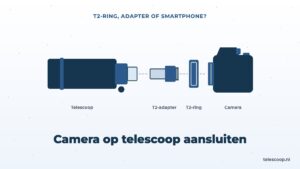
Can you also photograph planets with your phone or a DSLR camera? It is possible, but the result remains limited. Placing a phone behind the eyepiece captures Jupiter as a disk with two bands and four moons. A DSLR or system camera with a film cutout adds further detail, but a planet camera produces more images per second and therefore becomes noticeably sharper. How to connect a camera to your telescope, you can read in Connecting the camera to your telescope.
How do you make the recording?
- Let the telescope cool down. Set it outside for at least half an hour; a large Newton telescope is better than an hour. A warm telescope gives a shaky image. If you have a Newton, also check the alignment of the mirrors. You can read about that in telescope collimation.
- Place the planet in the middle. Do that first with an eyepiece and only then insert the camera. The field of view of a planet camera is small, so the planet really needs to be in the center.
- Focus very precisely. Spin back and forth slowly around the sharp point. Use a moon of Jupiter or the edge of the planet as a handle.
- Choose your settings. A short exposure of 5 to 15 milliseconds, the amplification (gain) so that the planet appears in the histogram at around 60 to 70 percent, and a small crop window around the planet so that the camera can film faster. Save as a SER file.
- The film shouldn't be too long. Jupiter rotates on its axis in just under ten hours. Therefore, keep the video to two to three minutes; otherwise, the detail will be lost. With Mars, which takes more than 24 hours to rotate, it can take longer.
- Make multiple videos. The air changes throughout the evening. Of ten shots, often one is clearly better than the rest.
How do you process the videos?
- PIPP Placements the planet in the center of each image and discards empty or failed images.
- Auto Strike! find the sharpest images and stack them. Start with the best 10 to 25 percent.
- RegiStax Sharpened with wavelets. Proceed with caution: Sharpening too much creates rings around the planet and noise.
- Color balance and contrast Then start editing your photo in your photo program.
If you want to go further, you can use the free program WinJUPOS to combine multiple videos of Jupiter and subtract the rotation of the planet. This way you can record for longer without losing detail. An overview of these programs can be found in our explanation of astrophotography software.
Do you want to learn this step by step?
In his Planetary Imaging Masterclass, Wido Oerlemans shows exactly this process: from choosing the telescope and camera, to recording in SharpCap, stacking in PIPP and AutoStakkert!, and sharpening in RegiStax. These are six lessons, totaling over three hours, and all the software he uses is free. The first lesson can be viewed for free. For more information, see our page about the online course in astrophotography.
Frequently asked questions about photographing planets
Can I use a Seestar or another smart telescope to photograph planets as well?
You can see them in the image, but you don't get much detail from them. Smart telescopes like the Seestar are built for nebulae, galaxies, and star clusters. For planets, their small aperture and short focal brandlength are too limited: Jupiter and Saturn remain small balls. If you already have a regular telescope with a large aperture, the advantage lies more in a planet camera than in another smart telescope.
Why don’t I see a wide ring around Saturn like in the photos?
Because we can now see the rings from the side. In 2025 they were exactly at their side, and since then they tilt slightly further open each year. Many of the photos you see in groups and on social media were taken in earlier years, when the rings were wide open. With a small telescope, you can now see Saturn as a disk with a narrow ring around it, not nearly as wide as in those photos.
Read more
What you see of the planets when you look through the eyepiece yourself is read in Jupiter through a telescope, Mars through a telescope and Saturn through a telescope. If you want to practice first on a larger and easier target, start with Photographing the MoonFilming and stacking work exactly the same way.