
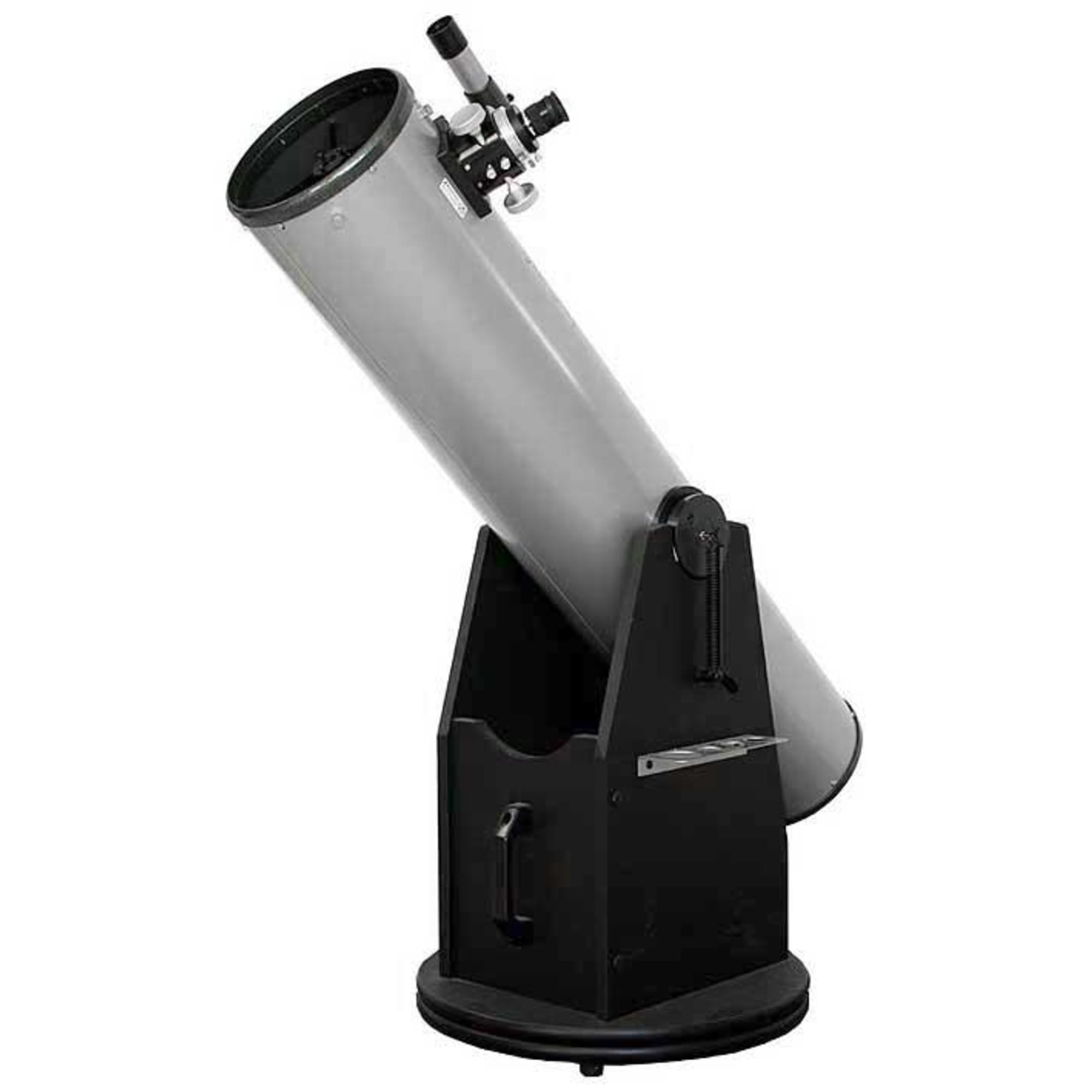


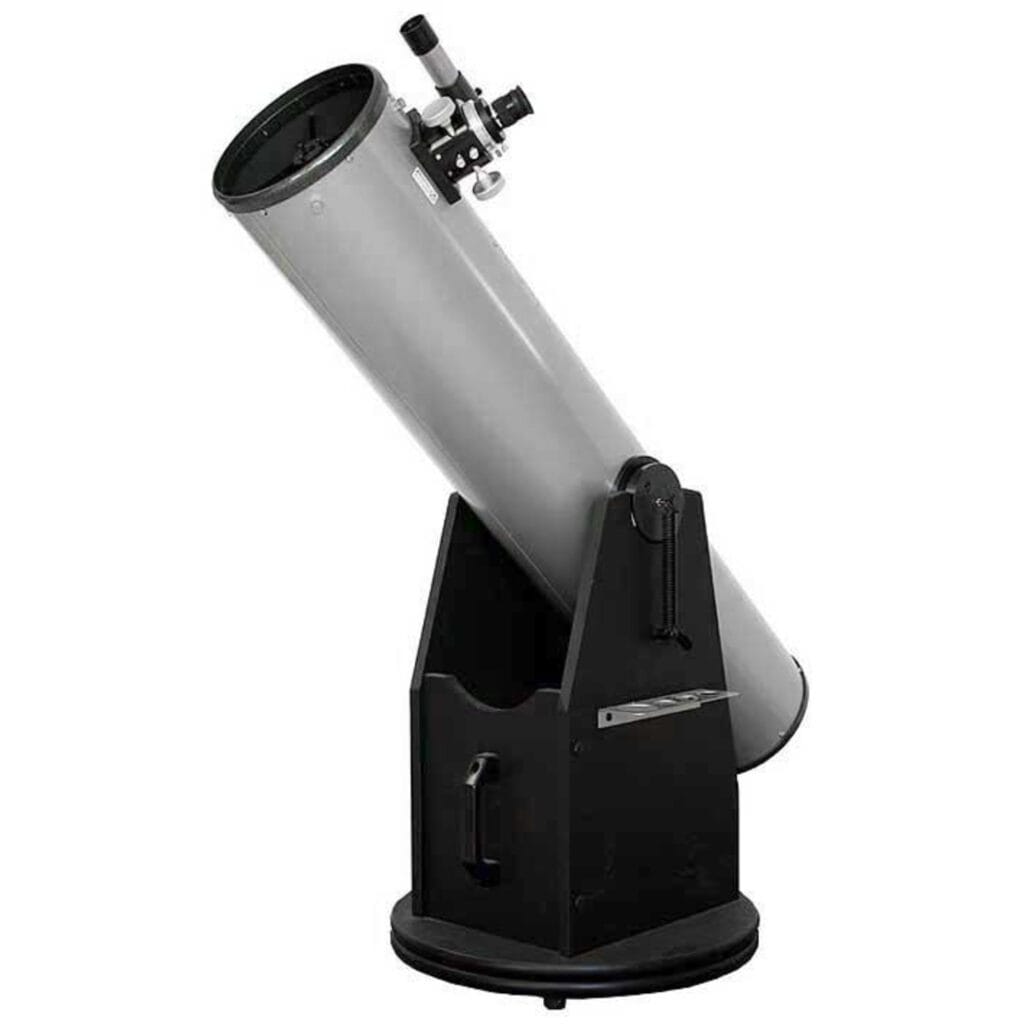
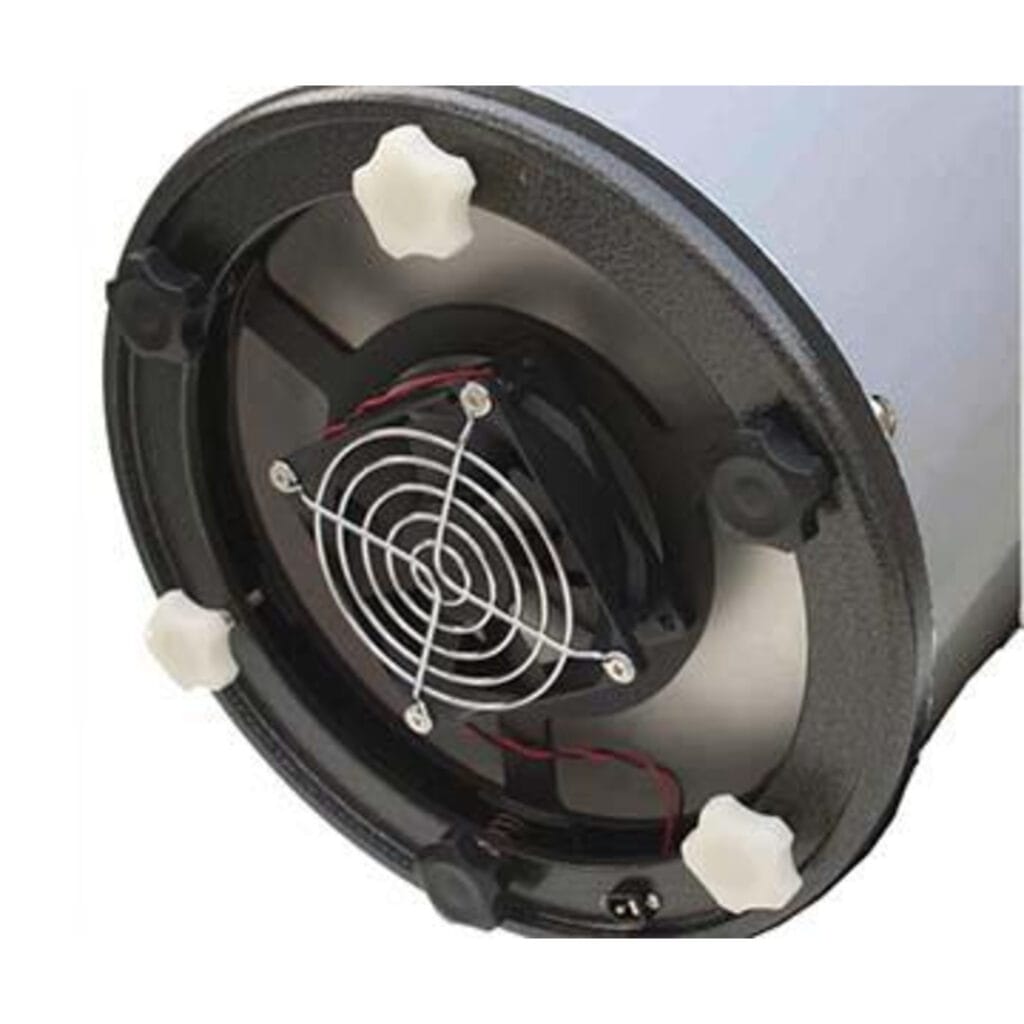
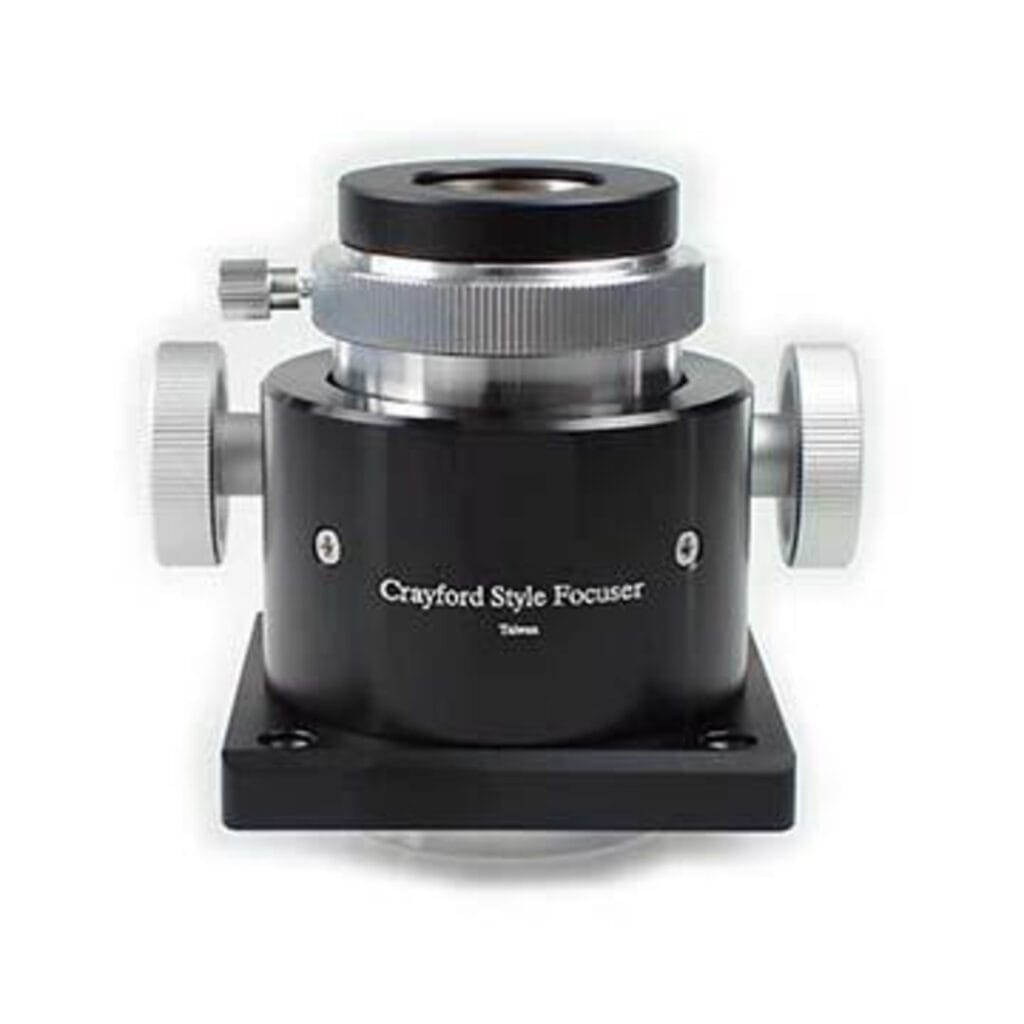
The GSO N 200/1200 is a Dobson floor model with a 200 mm (8 inch) parabolic mirror and a focal brandlength of 1200 mm (f/6). The 115 cm tube is housed in a wooden rocker box with adjustable friction on the height axis. Of the three GSO Dobson telescopes in our range, this is the middle model: it captures 73% more light than the 152 mm model and has a fixed tube that you can move in two parts, whereas the 406 mm model has a demountable dovetail tube. The box includes a 2 inch Crayford eyepiece with 1:10 fine adjustment, an 8×50 viewfinder, two eyepieces and a fan behind the main mirror.
What do you see through the GSO 200/1200?
Moon: with the 30 mm eyepiece (40x), you can see 1.75 degrees of sky; the entire Moon with space around it; at 133x with the 9 mm eyepiece craters, mountain ranges and the shadow line; and at 171x with a 7 mm eyepiece the small craters on the bottom of the large ones. Jupiter: the banded clouds, the Great Red Spot and the shadow of a Moon on the planet during a transit; Saturn: the ring apart from the planet and at good nights the Cassini division in the ring. Deep-sky: the Orion Nebula with its extended structure, the Pleiades filling the field of view at 40x; globular clusters like M13 that break apart into loose stars in the core, and from a dark spot spiral structure in bright systems like M51. Nebulae and galaxies are seen with the eye in gray tones, not in color. From a city or village with street lighting, the Moon, planets, double stars and star clusters remain; nebulae and galaxies require a dark spot. The highest meaningful magnification is approximately 400x, twice the opening in mm; in practice, 200 to 250x is the limit due to the air above the Netherlands and Belgium. What you can expect per object is stated in What do you see through a telescope?, Jupiter through a telescope, Saturn through a telescope and The Moon through a telescope.
How is the GSO 200/1200 different from other 200 mm Dobson telescopes?
- Oculars: The GSO 200/1200 has a 30 mm Erfle of 2 inches with a 70-degree field of view (40x, 1.75 degree sky) and a 9 mm Super Plössl (133x) in the box, so it is a wide-angle ocular for nebulae and star fields without the need for a separate purchase.
- Objective lens: a 2 inch Crayford lens with 1:10 fine adjustment that weighs about 3 kg, with clamps for 2 and 1.25 inch eyepieces, and an 8×50 viewfinder with achromatic lens.
- Cooling and collimation: a fan behind the main mirror brings the mirror to an outside temperature faster, and a center mark on the main mirror (a merkmark in the center as a reference when adjusting) makes collimation with a Cheshire faster.
For whom yes and for whom no
Hello Anyone who wants to start with a first telescope right away at 200 mm and can move 21 kg in two parts; anyone who regularly drives to a dark place for fog and stels; anyone who wants to use 2 inch wide-angle eyepieces without first replacing the eyepiece. If you’re unsure, read on. Telescope Buying Guide for Beginners.
Not for long exposures of nebulas and galaxies; an assembly is required for that that follows the sky; look for it smart telescopes. You can take short shots of the moon and the planets using a smartphone adapter on the eyepiece. If you want to reduce lifting, choose the 152 mm model from GSO15 kg with a 110 cm tube. If you don't have space for a floor model, check the tabletop Dobsonians.
What's in the box
- Optical tube 200/1200 with BK7 parabolic head mirror (94% reflectivity) and center mark
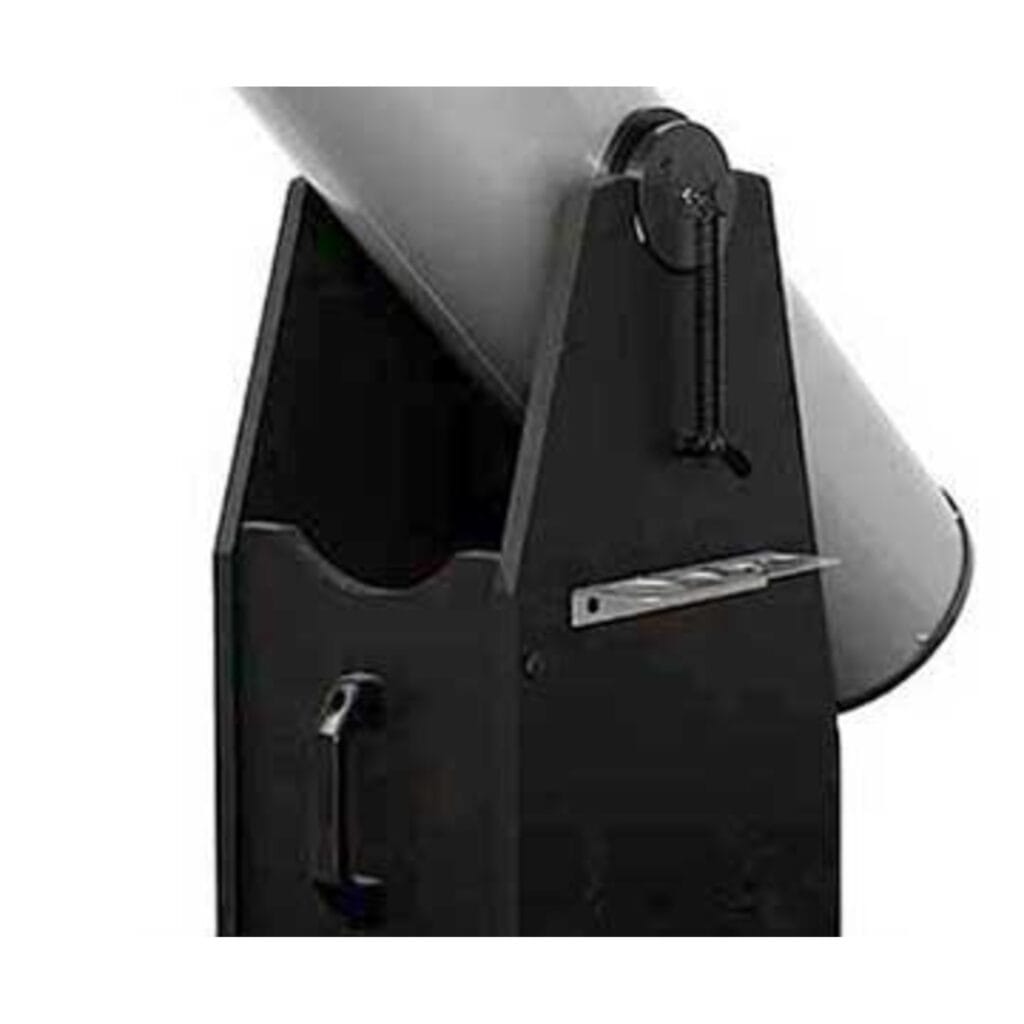
- Wooden rocker box with adjustable friction on the height axis and a holder for eyepieces and accessories
- 2 inch Crayford lens corrector with 1:10 fine adjustment and clamps for 2 and 1.25 inch
- 2 inch extension tube
- 30 mm Erfle eyepiece, 2 inch, 70 degree field of view (40x) for the entire moon, star fields and nebulae
- 9 mm Super Plössl eyepiece, 1.25 inch (133x) for the Moon and Planets
- 8×50 viewfinder with achromatic lens
- Fan behind the head mirror
- Manual for collimating
Not included: moon filter, 6 mm planetarium eyepiece, collimation eyepiece. At 200 mm the moon is bright; a 13% -stop moon filter softens it; the 7 mm eyepiece is the step up to 171x for the planets; with a Cheshire check you can check the mirrors after transport. All three are included as accessories here.
Format and weight
Approximately 21 kg in two parts: the tube weighs 9.5 kg and the rockerbox 11.2 kg. The tube is 115 cm long and 23 cm in diameter; the rockerbox is 60 cm high with a base of 50 cm in diameter. The shipping size is 136 x 38 x 38 cm. It stands on the ground; you look at it sitting on a low stool or standing up, depending on how high the tube is directed.
First evening with the GSO 200/1200
- Take off the tube cap and place the tube in the rockerbox on a flat surface; adjust the friction so that the tube stays in place where you set it down.
- Line the 8×50 viewfinder at daytime at a distant object, for example a church tower or chimney.
- Do not look through a window; the glass and the temperature difference make the image blurry.
- Start with the 30 mm eyepiece (40x) and look for the moon; then switch to the 9 mm eyepiece (133x).
- Rotate the focus ring until the image is small and sharp; a large blurry area is not sharp. If you cannot get the focus point fully out of focus with the focus ring, then insert the 2-inch extension tube in between.
- Set the telescope outside 30 to 45 minutes before viewing, so that the 200 mm mirror reaches outside temperature; the fan behind the mirror speeds that up.
- An unsmooth image almost never results from the collimation. Check it after every drive; how it works is explained in the Collimation guide.
Which accessories are suitable?
- Vela Optics 7 mm Super Plössl eyepiece, 1.25 inch: 171x on this telescope, for the Moon and planets.
- Vela Optics Moon Filter ND96 13%, 1.25 inch: screw into the filter thread at the bottom of the 9 mm eyepiece or the 7 mm eyepiece above; at 200 mm, 13% holes provide the appropriate attenuation.
- Vela Optics Cheshire collimation eyepiece, 1.25 inch: fits into the 1.25 inch clamp ring; together with the center mark on the mirror, you can check the alignment after transport.
GSO 152/1200, GSO 200/1200 or GSO 406/1829?
| GSO 152/1200 Dobson | GSO 200/1200 (this page) | GSO 406/1829 Dobson Truss | |
|---|---|---|---|
| Mirror | 152 mm, f/7.9 | 200 mm, f/6 | 406 mm, f/4.5 |
| Highest meaningful magnification | about 300x, in practice 150 to 200x | about 400 times, in practice 200 to 250 times | about 800x, in practice 250x |
| Seeker and photographer | 6×30, 1.25 inch | 8×50, 2 inch Crayford with 1:10 | 8×50, 2 inch Crayford with 1:10 |
| Tube and weight | Fixed tube of 110 cm, 15 kg total | Fixed tube of 115 cm, 21 kg in two parts | rectangular tube approximately 185 cm long, approximately 65 kg in parts |
| Nebulae and star clusters | Orion nebula with structure, clusters of stars in loose form | Spiral structure in clear systems from a dark spot, globular clusters to the core | weak systems and planetary nebulae, more than four times as much light as 200 mm |
| Choose this as | You mainly look at the moon and planets and want to lift 6 kg less | you want more light for fog and systems and can move 21 kg | You have experience, often go to a dark place and want to build a large instrument |
Frequently asked questions about the GSO 200/1200
- Is it suitable for a child? From 8 years old, together with an adult; from 12 years old, independently: with a tube weighing 9.5 kg and 115 cm in diameter, this is a large floor model.
- Can I take photos with it? Of the moon and the planets, using a smartphone adapter on the eyepiece; long exposures of nebulas and galaxies require a mount that follows the sky.
- Which sun filter fits? A filter that is attached to the tube before it is installed. The tube is 23 cm thick; measure the circumference of the front of the tube for good measure, divide that by 3.14 and choose the filter size from the table below. sun filters a Baader ASTF whose clamping range covers that size (the ASTF 200 clamps at 230 to 260 mm). Check the film before each use, cover the viewfinder, and never use an eclipse glasses behind the viewfinder or a filter in the eyepiece.
- Do I need to collimate it? After transport check; at f/6 the alignment is tighter than with an f/8 lens. With a Cheshire and the center mark on the mirror, this can be done in a few minutes; the steps are listed in the Collimation guide.
- Is it on a table or on the ground? On the ground: the rockerbox is the foot, a table or tripod is not necessary.
- Can it fit in a car? Yes, in two parts: the 115 cm tube in the back seat or in a station wagon, the 50 cm wide rockerbox in the trunk.
Specifications
| Optical design | Newton reflector, parabolic main mirror |
| Opening | 200 mm (8 inches) |
| Focal length | 1200 mm |
| Opening ratio | f/6 |
| Mirror | BK7 with 94% reflectivity, center marking; central obstruction 25% |
| Highest meaningful magnification | about 400 times, in practice 200 to 250 times |
| Mount | Dobson, floor model, wooden rocker box with adjustable friction on the height axis |
| Reporter | 2 inch Crayford, 1:10 fine adjustment, weighs about 3 kg, clamps for 2 and 1.25 inch |
| Seeker | 8×50 with achromatic lens |
| Included eyepieces | 30 mm Erfle 2 inch, 70 degrees (40x); 9 mm Super Plössl 1.25 inch (133x) |
| Cooling | Fan behind the head mirror |
| Total weight | about 21 kg (tube 9.5 kg, rockerbox 11.2 kg) |
| Tube length | 115 cm, diameter 23 cm |
| Rockerbox | 60 cm high, foot diameter 50 cm |
| Packed | 136 x 38 x 38 cm (shipping size) |
Shipping and assistance
Orders with multiple items are shipped from multiple warehouses and may arrive in parts; each package will have its own tracking number. More information about this can be merk found on the GSO merkpage. Help with choosing or on the first evening: WhatsApp or call on weekdays from 9:00 to 17:00, or come by appointment in Sneek. 30 days' cooling-off period.

Tristan Roeleveld (verified owner) -
Top telescope, just had it in and tested it right away. I could see the rings of saturn well and among other things the orion nebula a lot better than my previous telescope which had a smaller diameter.
Helpful to look for a manual online of how to put it together yourself though because no manual was included.
Tristan Roeleveld (verified owner) -
Top telescope of good quality
Brendan Deconynck (verified owner) -
Fast delivery and good product . Nothing to comment on .