


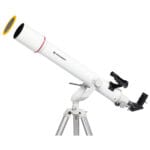




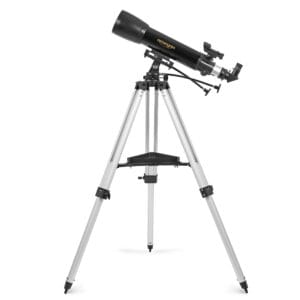
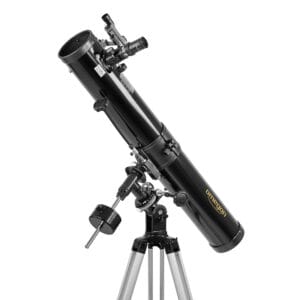
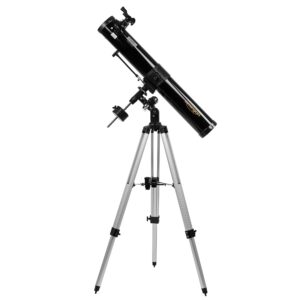
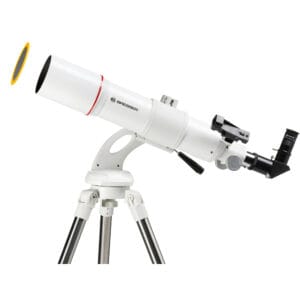
The Nano 70/700 is an achromatic refractor (lens telescope with a lens of two elements) with a 70 mm aperture and 700 mm focal brandlength (f/10), mounted on an alt-azimuthal Nano-mount with a tripod. The lens does not need to be collimated and the 700 mm focal brandpoint keeps the color fringes around the Moon and planets thin. The Bresser Messier 130/650 Dobson The same one merk captures 3.4 times as much light with a 130 mm mirror, but it is placed on a table instead of on a tripod. In the Telescope Buying Guide for Beginners The entry-level models are placed side by side.
What do you see with the Nano 70/700?
Moon: craters, mountain ranges and the shadow line, at 78x with the 9 mm eyepiece. Around the bright lunar edge and around Venus you see a thin purple-blue rim: that is characteristic of an achromatic lens and cannot be removed by focusing. Jupiter: the four large moons and, at 78x, the two main bands. Saturn: the ring detached from the planet, small. Double stars like Albireo and Mizar: two tight star points. Deep-sky: the Pleiades at 35x, the Orion Nebula as a grey smudge with the four Trapezium stars, the Andromedan system as a long-shaped smudge from a dark spot and globular clusters like M13 as round spots that do not disperse into stars at 70 mm. Nebulae and galaxies are seen with the eye in gray tones, not in color. From a city or village with street lighting, the moon, planets, double stars and star clusters remain; nebulae and galaxies require a dark spot. The highest meaningful magnification is approximately twice the opening in millimeters, so about 140x. With the included 9 mm eyepiece, you are at 78x; for more magnification, you need a Barlow or a shorter eyepiece. What you can expect per object is stated in What do you see through a telescope?, Jupiter through a telescope, Saturn through a telescope and The Moon through a telescope.
How does the Nano 70/700 differ from other 70 mm refractors?
- Mounting: The Nano 70/700 is mounted on a Nano alt-azimuthal mount with a tripod, set 155 cm high on a 90 x 90 cm base; you push and rotate the tube in height and direction, without counterweight and without power.
- Optics: achromatic lens of 70 mm at f/10, 700 mm brandfocal length. The long focal brandlength keeps the color edge around the moon and planets thin and gives 35x and 78x magnification with the supplied eyepieces; the lens is fixedly aligned, collimation is not required.
- Included: a 20 mm and a 9 mm eyepiece (1.25 inch) and a red dot viewfinder.

For whom yes and for whom no
Hello Anyone who wants a telescope without maintenance for the Moon, planets and double stars; anyone who looks from a city or from a balcony; and families with children from around the age of 8. If you’re unsure, read the Telescope Buying Guide for Beginners.
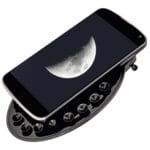
Not for nebulae and star clusters with structure; that requires an opening, choose then the table-Dobson of 130 mm of the same merk. Long exposures of clouds require a mounting that follows the sky; then look at the smart telescopes; photos of the moon and the planets are possible with a smartphone adapter attached to the eyepiece. If you want an app to guide you to objects, select the Celestron StarSense Explorer LT 70AZ with the same 70/700 optics.
What's in the box
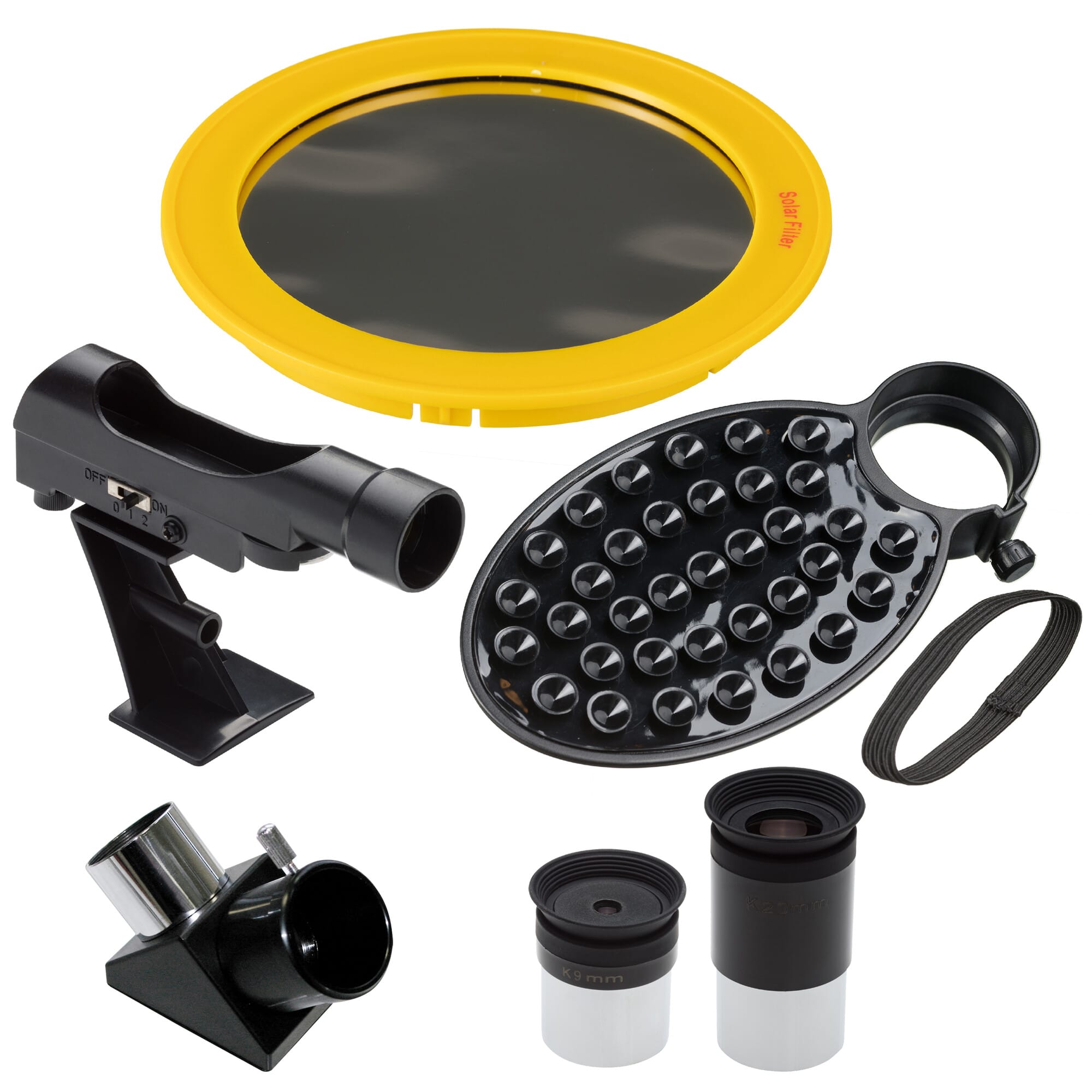
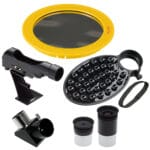
- Achromatic optical tube 70/700
- Nano alt-azimuth mount with tripod
- 20 mm eyepiece (35x), 1.25 inch, for star fields and searching
- 9 mm eyepiece (78x), 1.25 inch, for the Moon and Planets
- Red dot viewfinder
- Manual
Not included: Barlow lens, moon filter, 6 mm planetarium eyepiece, smartphone adapter. A moon filter is welcome around a full moon; the 6 mm eyepiece is the step to 117x; a smartphone adapter is the easiest way to take a moon photo.
Format and weight
It is 155 cm high, with a tripod base of 90 x 90 cm. The box measures 76 x 27 x 27 cm. It stands on the supplied tripod; a table is not required.
First evening with the Nano 70/700
- Take off the lens cap and the focusing ring cap.
- Line the viewfinder at day time on a distant object, for example a church tower or chimney.
- Do not look through a window; the glass and the temperature difference make the image blurry.
- Start with the 20 mm eyepiece (35x) and look for the moon; then switch to the 9 mm eyepiece (78x).
- Rotate the focus lever until the image is small and sharp; a large blurry disc is not sharp.
- Set the telescope outside 15 minutes before viewing; a lens heats up faster at outdoor temperatures than a mirror.
- No need to collimate: the lens is fixedly aligned. A blurred image is caused by focusing, by a window or by turbulent air (seeing). You look through a zenith mirror or prism behind the focus device: with a zenith mirror the image is upright but in a mirror image, with a reverse prism it is also good. In the sky it doesn’t matter.
Which accessories are suitable?
- Vela Optics smartphone adapter: Clamp it to the eyepiece for moon photos with your phone through the 20 mm eyepiece.
- Vela Optics Barlow 1.8x, 1.25 inch: 63x with the 20 mm eyepiece and 140x with the 9 mm eyepiece, the highest meaningful magnification at 70 mm.
- Bresser Plössl 5 mm eyepiece, 1.25 inch: 140x, the highest meaningful magnification at 70 mm, for the Moon and planets on quiet nights.
- Vela Optics Moon Filter ND96 13%, 1.25 inch: screw into the filter thread at the bottom of a 1.25 inch eyepiece and let 13% of the light through so that the moon is not dazzled.
Zoomion 70 AZ, Nano 70/700 or Messier 130/650?
| Zoomion 70 mm AZ | Nano 70/700 (this page) | Bresser Messier 130/650 Dobson | |
|---|---|---|---|
| Optics | 70 mm lens, 360 mm brandfocal length (f/5.1) | 70 mm lens, 700 mm brandfocal length (f/10) | 130 mm mirror, 650 mm focal brandpoint (f/5) |
| Magnification with the included eyepieces | 18x and 60x, with 3x Barlow 54x and 180x | 35x and 78x | 26x and 72x |
| Highest meaningful magnification | about 140x | about 140x | about 260x, in practice 150 to 200x |
| Mount | AZ-1 on a tabletop tripod | Nano alt-azimuth on a tripod, 155 cm high | table Dobson, designed 71 cm high |
| Maintenance | no collimation | no collimation | checking mirrors after transport |
| Supplied alongside the eyepieces | 3x Barlow, 1.5x reversing lens, 45-degree amici-prism | Red dot sight | LED red dot viewfinder, moon filter, lens-sun filter |
| Choose this as | you want a light viewer on the table, also for daytime use | you want a telescope with a thin colored rim on the moon and planets and without maintenance | You want 3.4 times as much light for fog and star clusters and you have a table |
Frequently asked questions about the Nano 70/700
- Is it suitable for a child? From about 8 years old, together with an adult; from 10 years old, independently: you can then focus and find the moon yourself.
- Can I take photos with it? Of the moon and the planets: with a smartphone adapter on the eyepiece you can take short shots. Long exposures of nebulas and galaxies not; for that you need a mount to follow the sky.
- Which sun filter fits it? A filter that is attached to the tube before it. Measure the circumference of the front of the tube (the fog cap), divide by 3.14 and choose on the page of the Omegon Helievo The size that this fits. Cover the viewfinder and check the film before each use. Never use an eclipse glasses or a filter in the eyepiece.
- Do I need to collimate it? No. The lens is aligned correctly; that's the difference with a reflecting telescope, where you check the mirrors after transport.
- Tripod or table? The tripod is included in the box; you don't need a table.
Specifications
| Optical design | Achromatic refractor |
| Opening | 70 mm |
| Focal length | 700 mm |
| Opening ratio | f/10 |
| Lens | Achromatic, two elements |
| Highest meaningful magnification | about 140x |
| Mount | Nano, alt-azimuthal, manual, on a tripod |
| Reporter | 1.25 inches |
| Seeker | Red dot (LED) |
| Included eyepieces | 20 mm (35x) and 9 mm (78x) |
| Height set | 155 cm, tripod foot 90 x 90 cm |
| Packed | 76 x 27 x 27 cm |
Shipping and assistance
Orders with multiple items are shipped from multiple warehouses and may arrive in parts; each package will have its own tracking number. Help choosing or first night: WhatsApp or call on business days from 9:00 to 17:00, or come by appointment in Sneek. 30-day return period.
Thijs (verified owner) -
This is my first telescope, it is easy to use and gives a good image. The phone holder is super rickety so if you want that I would definitely choose another one.
A. -
Unable to test product due to later delivery time than I needed it. Service from telescoop.nl was top notch. I was helped quickly and well to another product.