


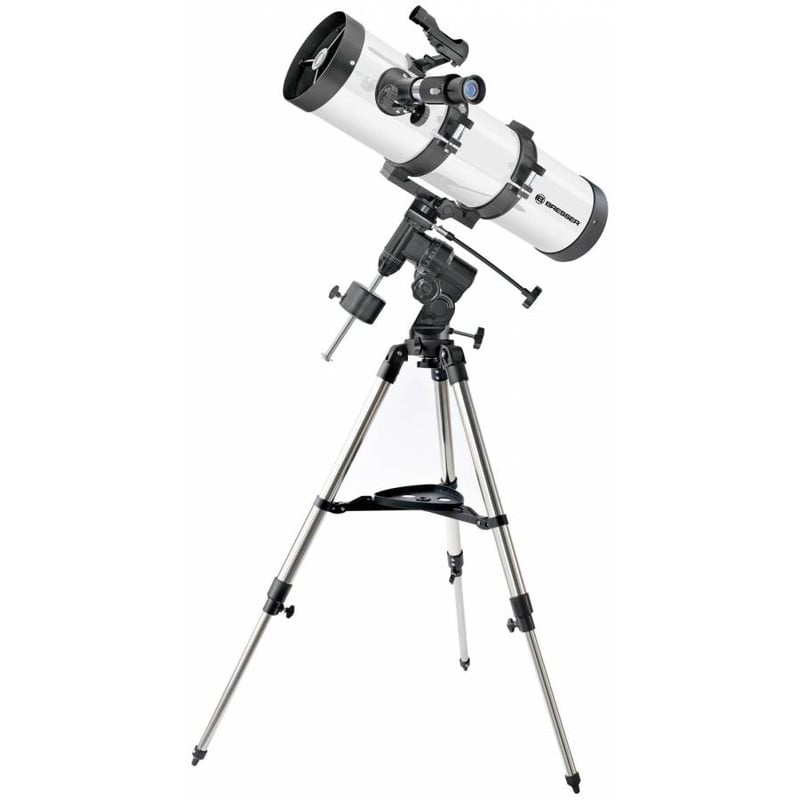
The Bresser 130/650 EQ3, known as the Pegasus 130/650 at Bresser, is a Newtonian reflector with a mirror of 130 mm and a focal brandlength of 650 mm (f/5) on a German equatorial EQ3 mount with counterweight, two flexible axes for fine adjustment and a steel tripod that is adjustable in height from 63 to 108 cm. The aluminum tube is 61 cm long and weighs 3.25 kg; the entire setup weighs 8.2 kg. With two eyepieces and a 3x Barlow in the box, you have four magnification levels, from 26x for the entire moon to 195x for planets on clear nights. It captures 30% times more light than a 114 mm telescope; how an equatorial mount works is explained in the product description. Tripods and mounts explained.
What do you see with the 130/650 EQ3?
Moon: at 26x with the 25 mm eyepiece, the entire Moon with space around it; at 65x with the 10 mm eyepiece, craters, mountain ranges, and the shadow line, where the light falls obliquely over the crater rims. Jupiter: the two dark main bands and the four large moons at 65x to 78x (25 mm with the Barlow); on the quietest nights at 195x (10 mm with the Barlow) the Great Red Spot. Saturn: the ring apart from the planet at 65x, and on good nights the Cassini division as a thin dark line. Deep sky: the Orion Nebula with the four stars of the Trapezium and the curved nebulous wings, the core of the Pleiades at 26x in a single image, globular cluster M13 as a grainy blob with detached stars at the edge, and from a dark spot the Andromedine Nebula as an oval blob with a bright core. With the 25 mm eyepiece you see at least one and a half degrees of sky, three times the Moon. Nebulae and systems are seen with the eye in gray tones, not in color. From a city or village with street lighting, the moon, planets, double stars and star clusters remain; nebulae and systems require a dark spot. The highest meaningful magnification is approximately twice the opening, 260x; in practice, 150 to 200x is the limit due to the air above the Netherlands and Belgium; therefore, the 195x of the 10 mm eyepiece with the Barlow is the upper limit. What you can expect per object is stated in What do you see through a telescope?, Jupiter through a telescope, Saturn through a telescope, The Moon through a telescope and The Orion Nebula through a telescope.
Photos: With a smartphone holder on the eyepiece, you can take pictures of the moon and of Jupiter and Saturn as small discs; the holder is not included in the box and is shown below among the accessories. Long exposures of clouds require a motorized mount that follows the sky. Tips are included in Astrophotography with your smartphone.
How is the 130/650 EQ3 different from other 130 mm telescopes?
- Optics and tube: the 130/650 EQ3 has a mirror of 130 mm with a 650 mm focal brandpoint (f/5) in an aluminum tube 61 cm long and 16 cm thick, weighing 3.25 kg; this makes the tube fit in the trunk and with the 25 mm eyepiece you have at least one and a half degrees of field of view for star clusters and nebulae.
- Mounting: EQ3 with counterweight and two flexible axes; with the pole axis (the axis you point at the Polester) facing north, follow an object with a single knob. The tripod is made of steel, adjustable from 63 to 108 cm and has an accessory platform for the eyepieces.
- Included: eyepieces of 25 mm (26x) and 10 mm (65x) and a 3x Barlow, for a total of four magnifications: 26x, 65x, 78x and 195x. Also included is a red-dot viewfinder with LED and astronomy software for download. A sun filter and a smartphone holder are not included.
For whom yes and for whom no
Hello Anyone who wants to see the Orion Nebula and star clusters alongside the Moon and planets with a first telescope; anyone who wants to learn to track with an equatorial mount, with four magnification levels out of the box; anyone looking for an 8.2 kg setup with a 61 cm tube that fits in the boot. If you’re unsure, read the Telescope Buying Guide for Beginners.
Not for long exposures of nebulas and galaxies; the EQ3 does not have a motor, please see the smart telescopes. If you want a sun filter and smartphone holder in the box and 33% more lights, please The 150 mm model on an EQ3 mount from Bresser, At 12.5 kg compared to 8.2 kg. If you don't want to align the axle and check immediately, choose the 130/650 tabletop Dobson from Bresser with the same mirror size, where this EQ3 has a tripod from 63 to 108 cm and is controlled by a single rotary knob opposite it.
What's in the box
- 130/650 aluminum Newton tube with 1.25 inch focus lens
- EQ3 equatorial mounting with counterweight and two flexible axes for fine positioning
- Stainless steel tripod, height adjustable from 63 to 108 cm, with accessory platform
- 25 mm eyepiece (26x) for the entire moon, star clusters and star searching
- 10 mm eyepiece (65x) for the Moon and planets
- 3x Barlow, 1.25 inch: 78x with the 25 mm eyepiece and 195x with the 10 mm eyepiece
- Red-dot viewfinder with LED
- Astronomical software as download, manual
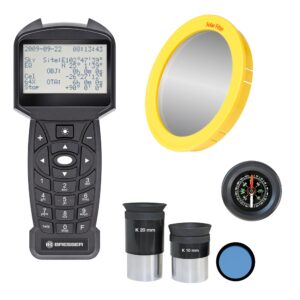
Not included: sun filter, smartphone holder, moon filter. To view the sun, you only need to attach a filter to the tube first, and the 16 cm tube fits into the Helievo size of 144 to 168 mm. A smartphone holder is the easiest way to take a moon photo. At full moon, the light from 130 mm is strong; a 13% mm moon filter softens it. All three are included as accessories below.
Format and weight
8.2 kg complete, with mounting, counterweight, tripod and accessories; the tube weighs 3.25 kg and is 61 cm long and 16 cm thick. The tube, mounting and tripod come separately so you carry them in parts. It stands on its own tripod on the ground; a table is not necessary; the tripod is adjustable from 63 to 108 cm. With a Newton, the eyepiece is on the side of the tube: with objects high in the sky it is high and you look while standing; with objects low in the horizon it is lower and you look on a stool.
First night with the 130/650 EQ3
- Take off the tube cap, place the tripod on a flat surface, attach the mounting to the axis, and then place the tube on the mounting.
- Line the red-dot viewfinder at day time on a distant object, for example a church tower or chimney, with the 25 mm eyepiece in the viewfinder.
- Point the north pole in the direction of the North Pole: place the elevation scale on your latitude (52 degrees in the Netherlands, 51 in Belgium) and rotate the entire assembly until the north pole points towards the North Pole. For sighting with the eye, that is accurate enough.
- Balance: loosen the clamp on the axle and slide the counterweight until the tube remains in place; then do the same for the declination axis.
- Do not look through a window. Start with the 25 mm eyepiece (26x) and look for the moon; follow it with the flexible axis of the eyepiece, then switch to the 10 mm eyepiece (65x) and on calm nights to the 25 mm with the Barlow (78x).
- Rotate the viewfinder until the image is small and sharp; a large blurred disc is not sharp. Set the telescope outside for 30 minutes before viewing, so that the 130 mm mirror reaches outside temperature.
- An unsmooth image almost never results from collimation. Check it after a drive; at f/5, the alignment is very precise; how it works is described in the manual. Collimation guide.
Which accessories are suitable?
- Vela Optics smartphone adapterClamps around the ocular and holds the camera on your phone directly above the lens; on the 25 mm ocular (26x), the entire moon with space around it fits on the photo.
- Omegon Helievo solar filterClamps on the tube with three screws; choose size 144 to 168 mm for this 160 mm outer diameter tube. This allows you to see sunspots during the day at 26x magnification.
- Vela Optics 7 mm Super Plössl eyepiece, 1.25 inch: 93x on this tube; between 78x and 195x from the box; the magnification for Jupiter and Saturn on a normal evening.
- Vela Optics Moon Filter ND96 13%, 1.25 inch: screw into the filter thread at the bottom of a 1.25 inch eyepiece and let 13% of the light through so that the moon is not dazzled.
Pluto 114/500, 130/650 EQ3 or Pollux 150/750?
| Pluto 114/500 EQ | 130/650 EQ3 (this page) | Pollux 150/750 EQ3 | |
|---|---|---|---|
| Mirror | 114 mm, 500 mm brandfocal length (f/4.4) | 130 mm, 650 mm brandfocal length (f/5) | 150 mm parabolic, 750 mm brandspot (f/5) |
| Oculars and magnification | 20 and 4 mm (25x and 125x), 3x Barlow | 25 and 10 mm (26x and 65x), 3x Barlow up to 195x | 20 and 4 mm (38x and 188x), 3x Barlow |
| Seeker and photographer | red-dot, 1.25 inch | red-dot, 1.25 inch | red-dot, 2 inch with 1.25 inch adapter |
| Tripod | aluminum, height-adjustable | steel, 63 to 108 cm | aluminium, 110 to 140 cm |
| Sun filter and smartphone holder | Both in the box | Available for sale | Both in the box |
| Format | tube 50 cm | 8.2 kg complete, tube 61 cm and 3.25 kg | 12.5 kg complete |
| Choose this as | You want a sun filter in the box that is 114 mm and has a tube of 50 cm | You want 30% more lumens than 114 mm, with four increments up to 195x out of the box | You want 33% more light, a 2 inch viewfinder and you can carry 12.5 kg |
Frequently asked questions about the 130/650 EQ3
- Is it suitable for a child? From the age of 8 with a parent, from 10 years old independently; the tube weighing 3.25 kg requires a child to assemble it themselves, aligning the pole shaft and balancing it requires some explanation the first few times.
- Can I take photos with it? Of the moon and the planets, using a smartphone holder on the eyepiece; that is not included in the box. Long exposures of clouds require a motorized mount that follows the sky.
- Which sun filter fits it? A filter that fits before the tube: the tube is 160 mm thick, so the size 144 to 168 mm of the filter is suitable. Omegon Helievo. Check the film before each use; cover the viewfinder and never use eclipse glasses behind the viewfinder or a filter in the eyepiece.
- Do I need to collimate it? After a drive: checking at f/5, a slight misalignment of the mirrors at 195x (10 mm with the Barlow) already produces a softer planetary image. A collimation aid is not included in the box; how to check it on a bright star is described in the manual. Collimation guide.
- Is there a tracking motor on it? No, you track with the flexible axis of the uaras. At 65x, the moon remains visible for well over a minute; at 195x, you rotate a little bit every 20 seconds.
- Do the 2 inch eyepieces fit? No, the eyepiece is 1.25 inch. All 1.25 inch eyepieces and filters fit, like the ones above in the accessories.
Specifications
| Optical design | Newton reflector |
| Opening | 130 mm |
| Focal length | 650 mm |
| Opening ratio | f/5 |
| Mirror | 130 mm head mirror; separation ability 0.88 arc seconds |
| Highest meaningful magnification | about 260x, in practice 150 to 200x |
| Mount | EQ3 German equatorial mounting, manual, fine movement on both axes with flexible axes, counterweight |
| Tripod | Stainless steel, height adjustable from 63 to 108 cm, with accessory tray |
| Reporter | 1.25 inches |
| Seeker | Red dot (LED) |
| Included eyepieces | 25 mm (26x) and 10 mm (65x), 3x Barlow (78x and 195x) |
| Solar filter | Not included; Omegon Helievo in sizes 144 to 168 mm fits |
| Software | Astronomical software as a download |
| Total weight | 8.2 kg including accessories (tube 3.25 kg) |
| Tube length | 61 cm, tube diameter 16 cm |
Shipping and assistance
Orders with multiple items are shipped from multiple warehouses and may arrive in parts; each package will have its own tracking number. More information about this can be merk found on the Bresser 1TP5 Page. Help with choosing or on the first evening: WhatsApp or call on weekdays from 9:00 to 17:00, or come by appointment in Sneek. 30 days' cooling-off period.

Reviews
There are no reviews yet.