
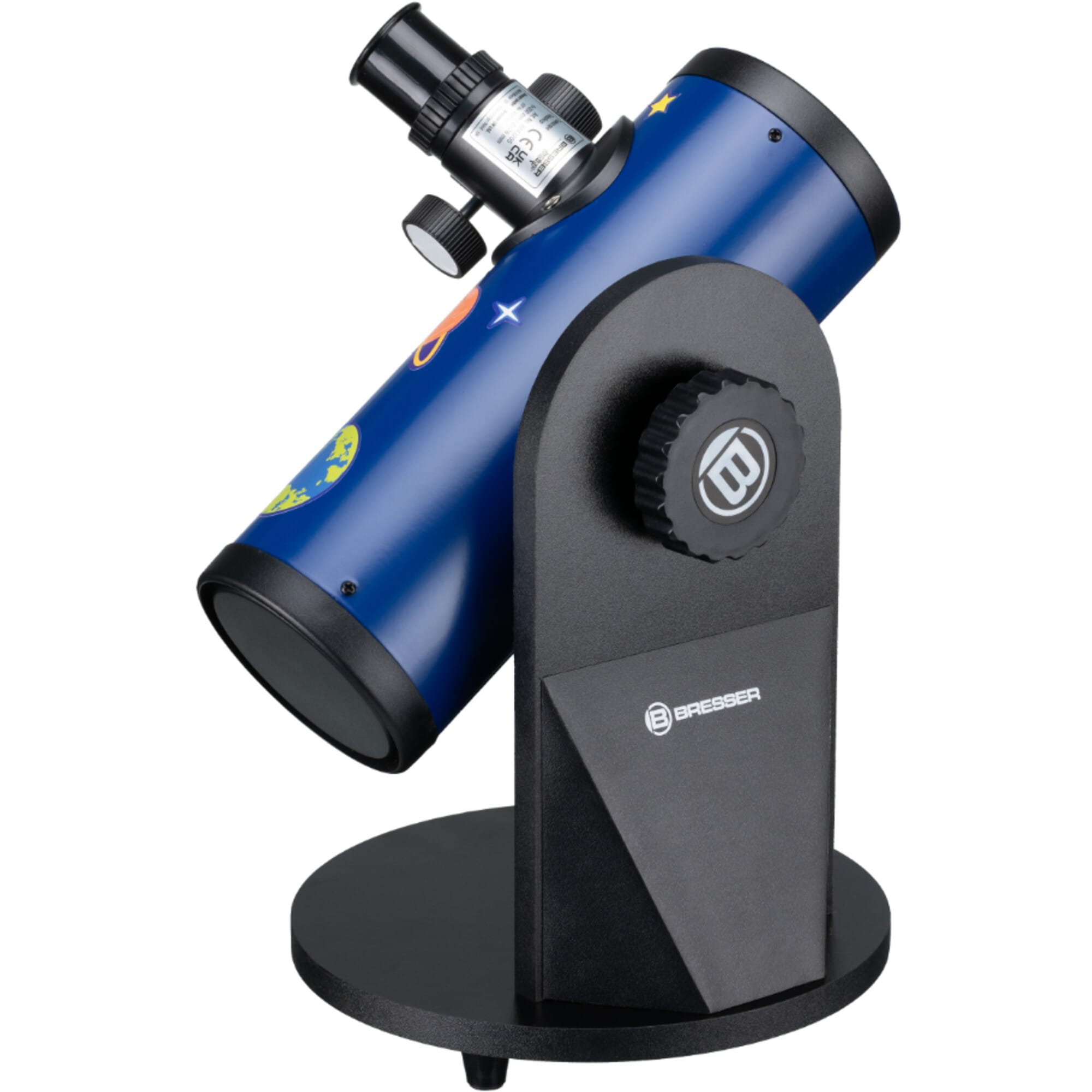
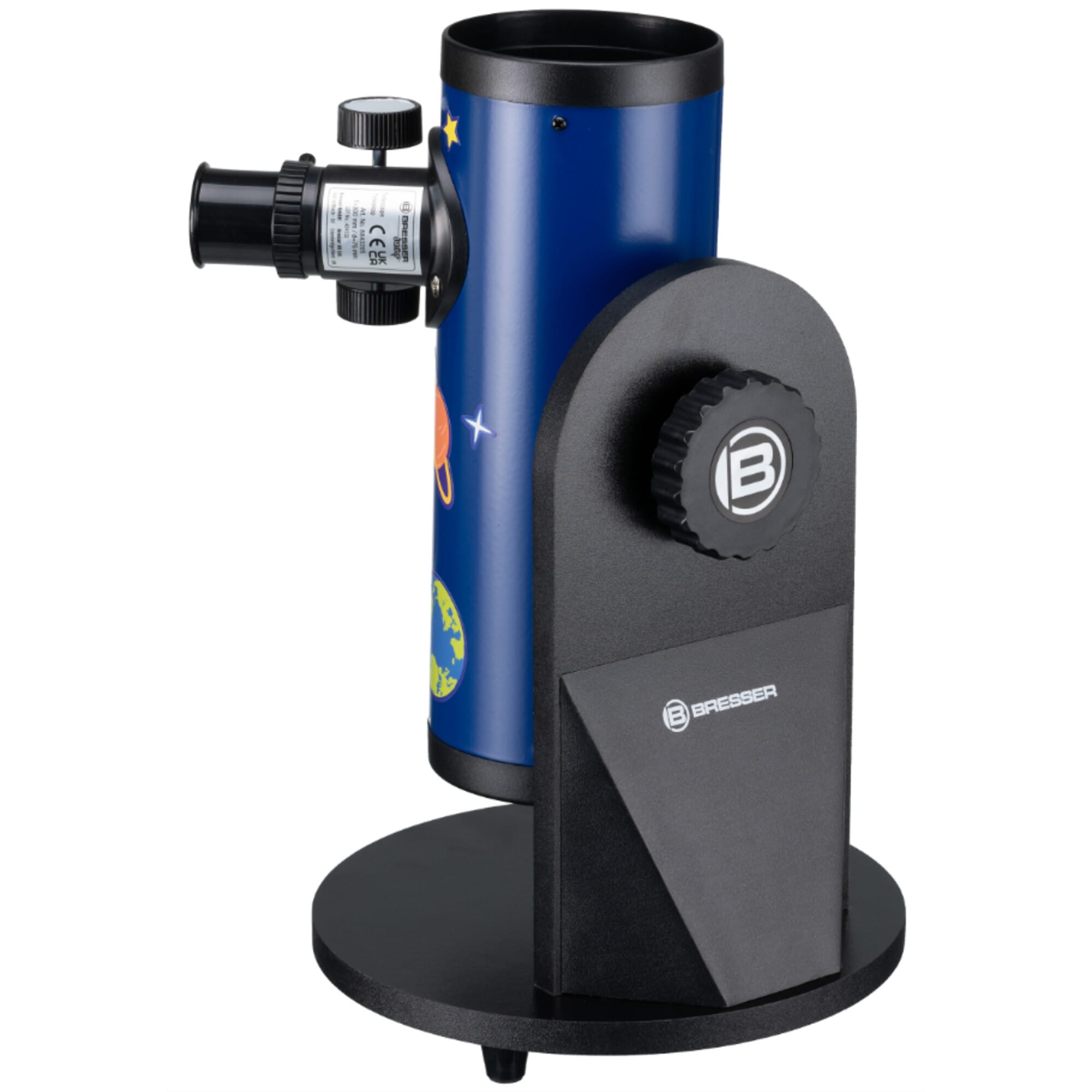
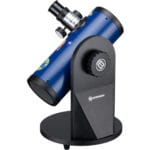
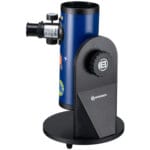
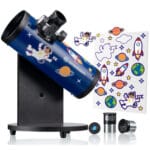


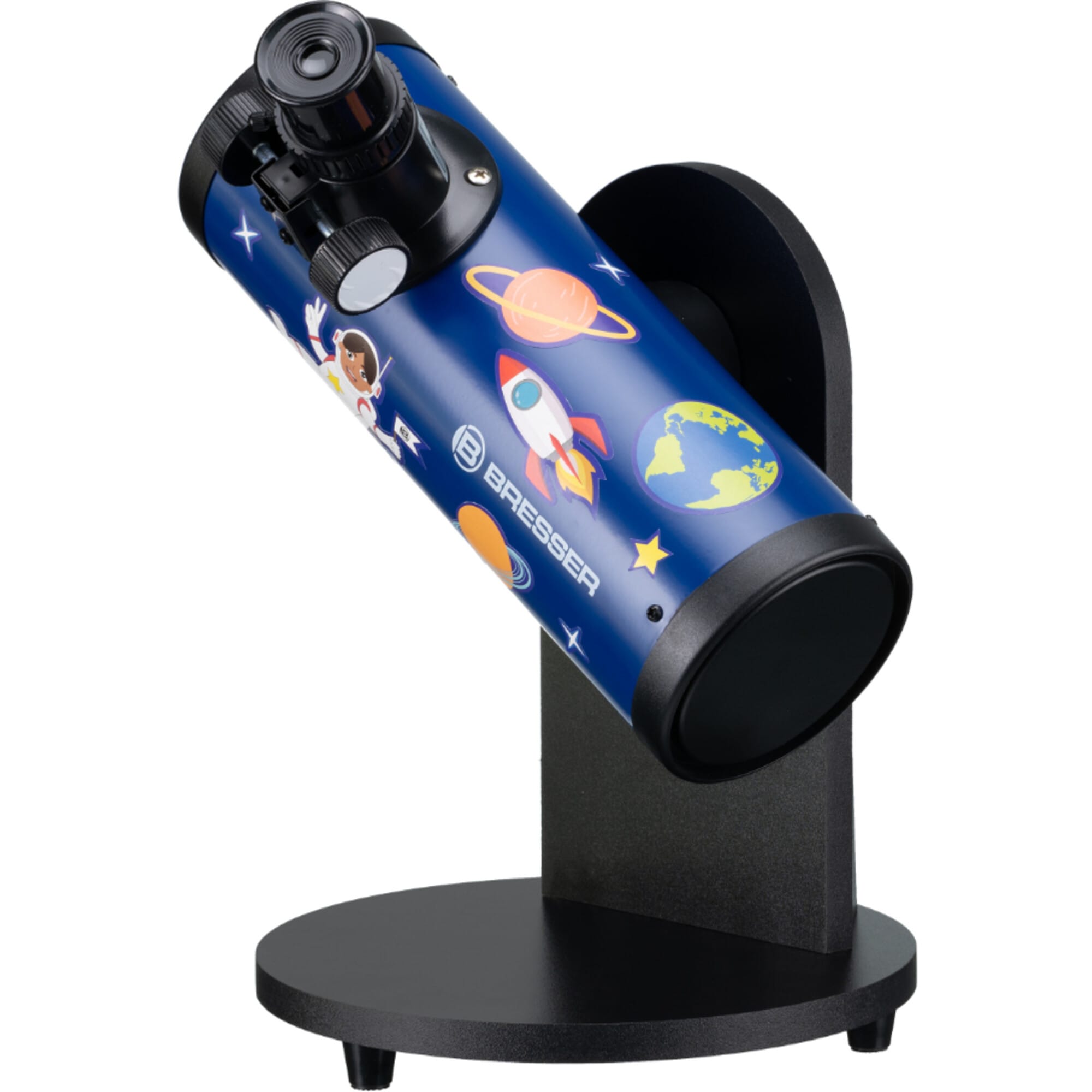
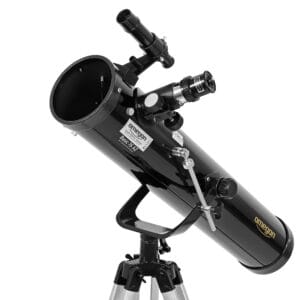
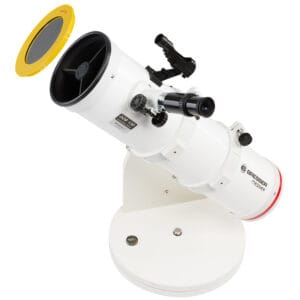
The Junior 76/300 is a tabletop Dobson telescope from Bresser with a 76 mm spherical mirror and a focal brandlength of 300 mm (f/3.9). The tube rotates on a small tabletop tripod in height and direction and comes fully assembled out of the box; there is no electronics on it and no power is required. At 1.6 kg and 29 cm high, it is intended as the first telescope for children from 8 years of age, who can use it together with an adult to explore the moon and the bright planets. More about the series of this can be merk found in the Bresser merkguide.
What do you see with the Junior 76/300?
Moon: at 15x with the 20 mm eyepiece, the entire Moon is visible, with the large craters and the dark lunar seas; at 50x with the 6 mm eyepiece, you see the walls of the large craters and the mountains along the shadow line. The included Moon filter blurs the bright Moon around full Moon. Jupiter: a small disk with the four large moons as dots in a row; at 50x on a quiet night, the two dark main bands are also visible. Saturn: small, but at 50x the ring is detached from the planet. Deep-sky: the Pleiades fit in one image at 15x, the Orion Nebula is a gray spot with stars in it, and from a dark spot the Andromedan system is a long oblong spot. Nebulae and galaxies are seen with the eye in gray tones, not in color. From a city or village with streetlights, the Moon, planets, double stars, and star clusters remain; nebulae and galaxies require a dark spot. The highest meaningful magnification is approximately 150x, twice the opening in millimeters, but a spherical mirror of f/3.9 gives the sharpest image up to about 50x, the magnification of the 6 mm eyepiece. What you can expect per object is stated in What do you see through a telescope?, Jupiter through a telescope, Saturn through a telescope and The Moon through a telescope.
How is the Junior 76/300 different from other table models?
- Size and structure: The Junior 76/300 measures 21 x 21 x 29 cm and weighs 1.6 kg with the eyepieces and filter. It comes fully assembled from the box, so a child can take it out of the box themselves and put it on the table.
- Aiming without a viewfinder: there is no viewfinder; at 15x you can see enough sky to find the moon and the bright planets by aiming along the tube. A built-in compass shows in which wind direction the tube points.
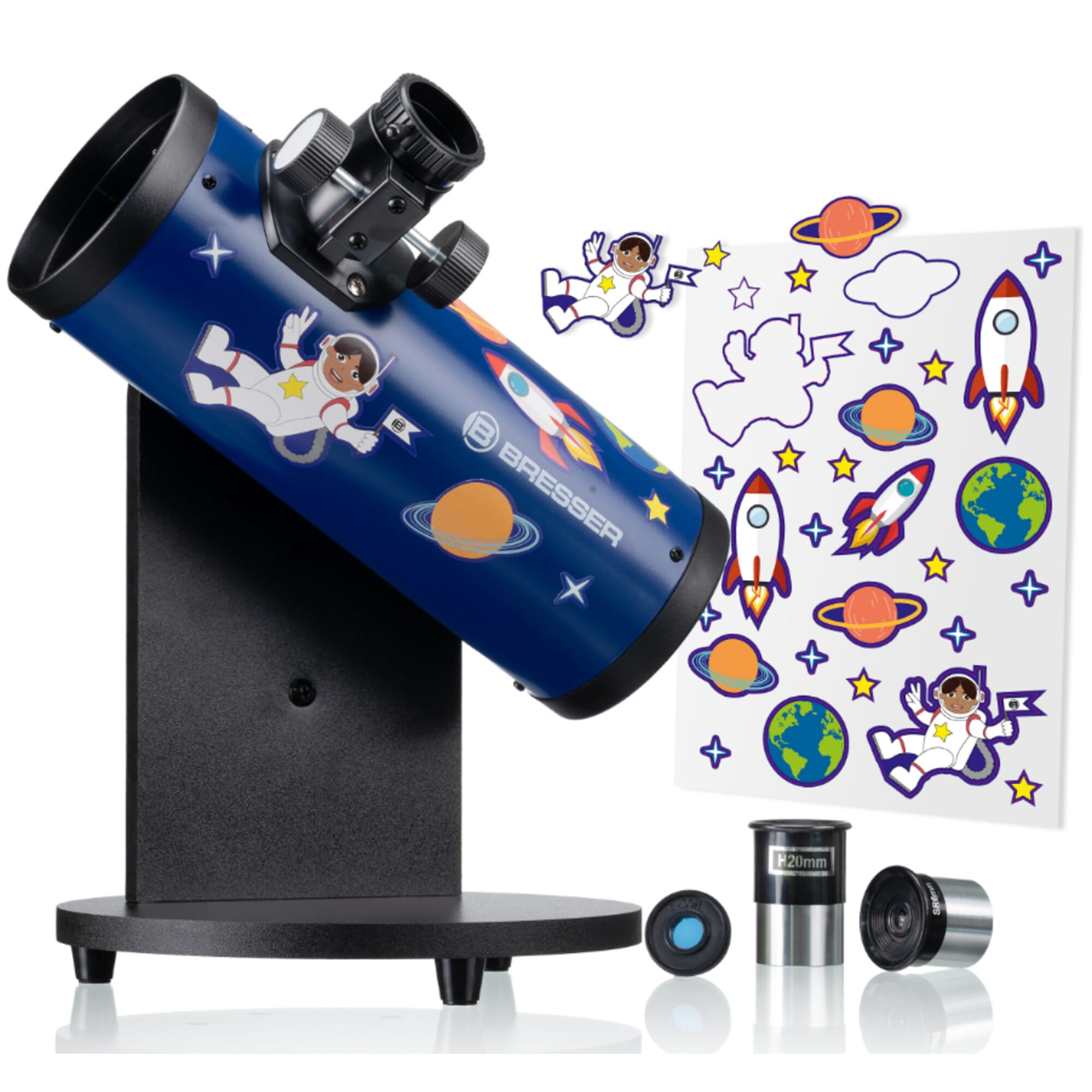
- Included: two eyepieces (20 mm for 15x and 6 mm for 50x), a moon filter and BRESSER FAMILY stickers, which allow a child to decorate the telescope itself.
For whom yes and for whom no
Hello as the first telescope for a child from 8 years of age, together with an adult; for a child who wants to discover the Moon, the moons of Jupiter and the rings of Saturn; as a small 1.6 kg viewer for the windowsill, balcony or camping. Tips for the first evenings with children are included in Astronomy for children.
Not For details on the planets or for nebulae and galaxies; at 76 mm, Jupiter remains a disk with two bands. If you want more than twice as much light in a tabletop model with a red dot viewfinder and parabolic mirror, choose the 114 mm tabletop model from National Geographic, The Junior 1.6 kg weighs 3.75 kg and comes fully assembled from the box. For an older child or an adult who wants to go further, the larger models are available at Dobson telescopes. Long exposures of clouds require a mounting that follows the sky; then look at the smart telescopes; a photo of the moon is possible with a smartphone holder on the eyepiece.
What's in the box
- Junior 76/300 reflecting telescope on the tabletop tripod, fully assembled
- 20 mm eyepiece (15x), for the entire moon, the Pleiades and star searching
- 6 mm eyepiece (50x), for the Moon and planets
- Moon Filter
- BRESSER FAMILY stickers to decorate the telescope
- Manual
Not included: viewfinder, smartphone holder, sun filter. Without the viewfinder, you focus at 15x along the tube; a smartphone holder clamps the phone above the eyepiece for a photo of the moon; you only look at the sun with a filter attached to the tube, and a child only under supervision. The holder and filter are shown below among the accessories.
Format and weight
1.6 kg with eyepieces and moon filter; set up at 21 x 21 cm at the base and 29 cm high. It stands on a sturdy table, box, or windowsill; on the ground, the base is too low to view comfortably. A child looks standing or sitting in a chair, depending on how high the tube is aimed.
First evening with the Junior 76/300
- Take off the tube cap and place the telescope on a sturdy table outside; a shaky table will vibrate at 50x magnification in the image.
- There is no viewfinder: during the day, point the scope at a distant object, such as a church tower or chimney, using the 20 mm eyepiece inside it, so that you know where the scope is when the target is in view. Look at the compass to see where the south is: the moon and the planets are between south-east and south-west at night.
- Do not look through a window; the glass and the temperature difference make the image blurry.
- Start with the 20 mm eyepiece (15x) and look for the moon; then switch to the 6 mm eyepiece (50x) and focus, because at 50x the image is more than three times narrower.
- Rotate the focus lever until the image is small and sharp; a large blurry disc is not sharp.
- Set the telescope outside 15 minutes before viewing; a 76 mm mirror is quickly ready for outdoor use.
- An unsmooth image almost never results from collimation, the alignment of the mirrors; the viewfinder of the Junior is not adjustable. First check the focus and whether the eyepiece is at the bottom of the holder; what collimation is stated in the Collimation guide.
Which accessories are suitable?
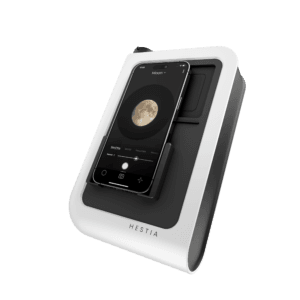
- Vela Optics smartphone adapterClamps around the eyepiece and holds the camera on your phone directly above the lens; this allows a child to take a photo of the entire moon at 15x magnification.
- Omegon Helievo solar filter: foil in an aluminum ring that clamps onto the tube before; available in sizes from 44 mm outer diameter; measure the circumference of the front of the tube, divide by 3.14 and choose the size that corresponds to that result. A child should only look at the sun under supervision.
- Omegon Star Chart Netherlands 25 cm (52 degrees): Rotatable star map for the width of the Netherlands; you can compare the date and time and see which constellations are above the horizon.
Junior 76/300, Dobson 114/500 Compact or Messier N 130/650?
| Junior 76/300 (this page) | Dobson N 114/500 Compact | Messier N 130/650 | |
|---|---|---|---|
| Mirror | 76 mm spherical, f/3.9 | 114 mm parabolic, f/4.4 | 130 mm, f/5 |
| Eyepieces | 20 mm (15x) and 6 mm (50x) | 20 mm (25x) and 4 mm (125x), 2x Barlow | 25 mm (26x) and 9 mm (72x) |
| Seeker | none; built-in compass | red dot viewfinder | LED red dot finder |
| Filters in the box | moon filter | Moon filter and three color filters | Moon filter and lens-sun filter |
| Highest meaningful magnification | approx. 150x, sharpest up to 50x | about 230x | about 260x |
| Weight | 1.6 kg | 3.75 kg | 6.6 kg |
| Choose this as | A child aged 8 or older wants to find the Moon and the moons of Jupiter together with an adult. | You want more than twice as much light and planets up to 125x | You want almost three times as much light and sunspots with the included filter |
Frequently asked questions about the Junior 76/300
- From what age is it suitable? From 8 years old with an adult; from 10 years old independently; with 1.6 kg and without a built-in base, a child can carry it themselves; the parent helps with orientation the first few nights because there is no viewfinder attached.
- Can I take photos with it? Of the moon, with a smartphone holder attached to the eyepiece; the planets remain a blur on a phone photo. How that works is explained in Astrophotography with a smartphone.
- Which solar filter fits it? A filter that is attached to the tube first, like the Omegon Helievo: measure the circumference of the front of the tube, divide by 3.14 and choose the size that corresponds to that result. Check the film before each use; cover the viewfinder and never use an eclipse glasses behind the viewer or a filter in the eyepiece. The included moon filter is not a solar filter.
- Do I need to collimate it? No; the viewfinder is not adjustable. If the image is blurry, check the focusing, the eyepiece, and whether the telescope has been out for a quarter of an hour already.
- Is it on a table or on the ground? On a table, in a box or on a windowsill: the telescope is 29 cm high and a tripod is not necessary.
- Can I use it during the day? The image is upside down, as with every Newton telescope; for the moon and the stars it doesn't matter, but for birds and the landscape it does. Never point directly at or right next to the sun during the day.
Specifications
| Optical design | Newton reflector, spherical main mirror |
| Opening | 76 mm (3 inch) |
| Focal length | 300 mm |
| Opening ratio | f/3,9 |
| Mirror | 76 mm, spherical, captures 117 times as much light as the eye; viewfinder cannot be adjusted |
| Highest meaningful magnification | approx. 150x, sharpest up to 50x |
| Mount | Dobson tabletop model, azimuthal, manual, fully assembled |
| Seeker | No; built-in compass |
| Included eyepieces | 20 mm (15x) and 6 mm (50x) |
| Filter | Moon Filter |
| Total weight | 1.6 kg with eyepieces and filter |
| Dimensions | 21 x 21 x 29 cm (width, depth, height) |
| Age | From the age of 8, with a parent; from the age of 10, independently |
Shipping and assistance
Orders with multiple items are shipped from multiple warehouses and may arrive in parts; each package will have its own tracking number. More information about this can be merk found on the Bresser 1TP5 Page. Help with choosing or on the first evening: WhatsApp or call on weekdays from 9:00 to 17:00, or come by appointment in Sneek. 30 days' cooling-off period.
Reviews
There are no reviews yet.