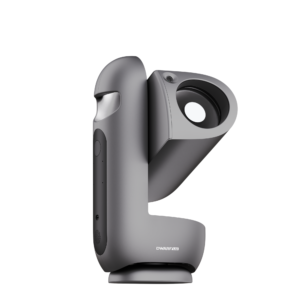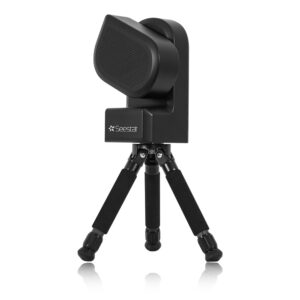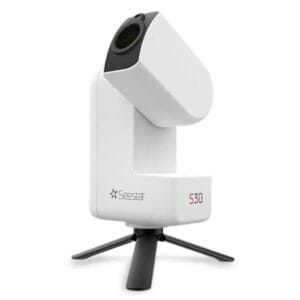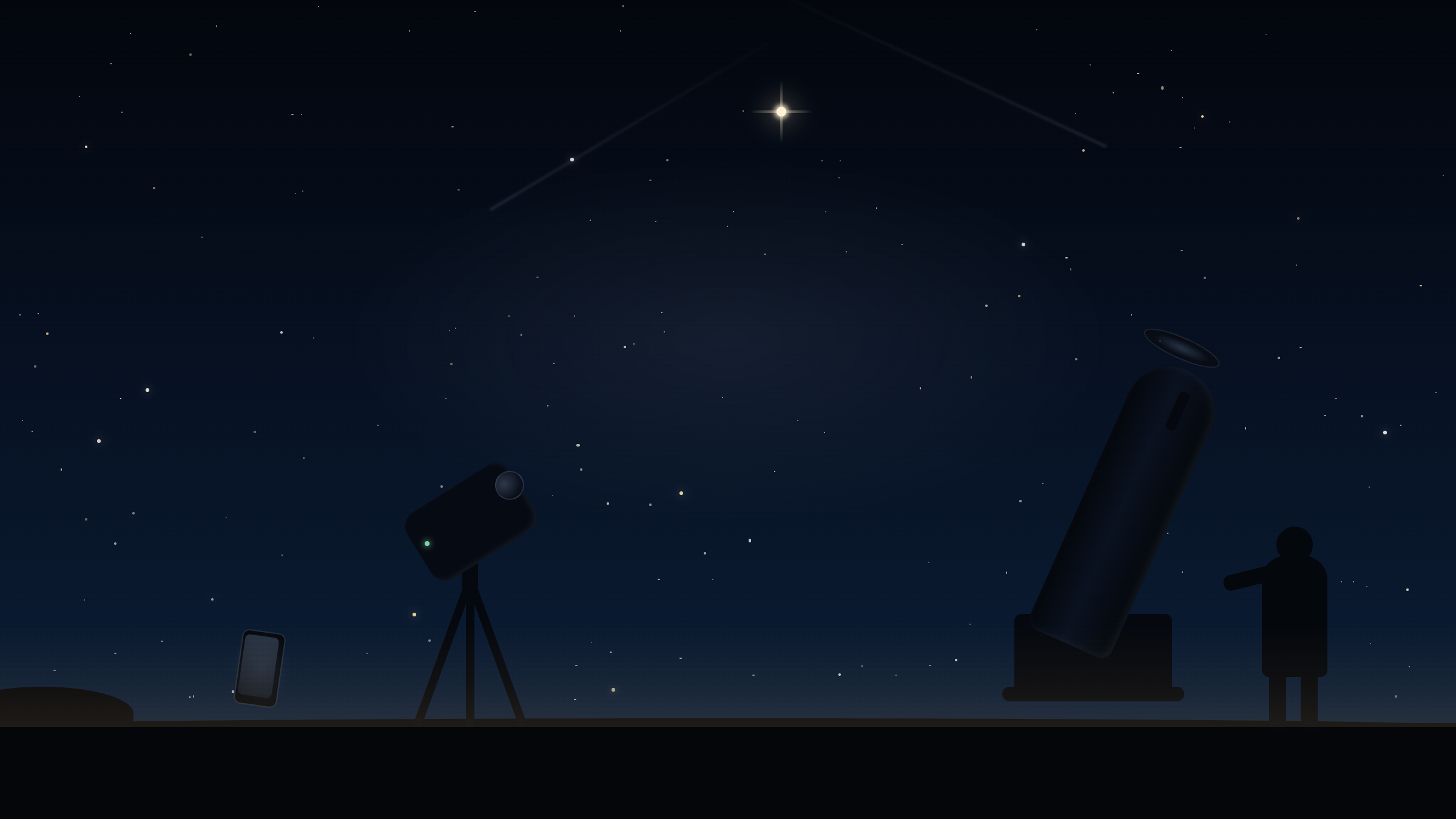
Smart telescope or classic telescope: this is the most frequently asked question in our store and inbox in 2026. On the one hand, there are the new generation smart telescopes like the Seestar S30 Pro and the DWARF Mini: compact, fully automatic and surprisingly affordable. On the other hand, there is the classic Dobson telescope, which for decades has been the standard recommendation for beginners who really want to stargaze. Both are good choices, but they do fundamentally something different. In this guide, we explain the real difference, without sales talk, so you know which of the two fits your expectations.
The key difference: watching versus taking pictures
All specifications aside, the choice comes down to one question: do you want to look through a telescope with your own eye, or do you want to take pictures of space and view them on a screen?
A Dobson is a purely visual instrument. The light of the moon, Saturn, or a star cluster travels directly into your eye via the mirror. What you see is live and real: Saturn's rings in the present moment, craters on the moon with a depth that no photograph conveys. The downside: nebulae and galaxies are visually faint, grey smudges. The colourful images you know from astrophotography will never be seen with your eye, through any telescope.
A smart telescope is a telescope-shaped camera. It doesn’t have an eyepiece; the device takes dozens to hundreds of short exposures of the same object and stacks them into a single, increasingly detailed image on your phone or tablet. This way, the Orion Nebula or the Andromeda Nebula appear in color on your screen after 15 minutes, even from a backyard with light pollution. The downside: you’re looking at a screen, and when it comes to the Moon and planets, most smart telescopes are actually limited by their short focal length.
The differences at a glance
| Smart telescope | Classic Dobson | |
| Experience | Photos on your phone or tablet | Watch live with your own eye |
| Strong in | Nebulae, galaxies, star clusters | Moons, planets, binary stars |
| Light pollution | Also works from the city | Deep-sky requires a dark sky |
| Operation | Fully automatic via app | Manual, self-learning navigation |
| Setup time | A few minutes | A few minutes |
| Format | Fits in a backpack | From tabletop models to knee-high |
| Share with others | Everyone is watching the screen | One person at a time at the eyepiece |
| Learning curve | Virtually none | Part of the hobby |
Who is the smart telescope for?
Choose a smart telescope if you’re primarily fascinated by deep-sky objects: nebulae, galaxies, and star clusters. Visually, these objects remain disappointing, whereas a smart telescope can capture impressive images of them in a single evening. Another decisive factor: if you live in a city or town center with a lot of light pollution, a smart telescope’s stacking technique will still produce results where a visual telescope shows very little. And if you want to share the viewing experience with your family, the screen beats the eyepiece: everyone sees the same thing at the same time.
The entry-level model that we recommend most often is the Seestar S30 Pro (€699). In our comprehensive Seestar S30 Pro review Read what he can and cannot do. Those who want to be even more compact can compare it with the DWARF line: in DWARF 3 vs Seestar S30 Pro We put the S30 Pro next to the DWARF 3, and our comparison of the DWARF 3 and DWARF Mini Put those two side by side. You can find the full selection at our smart telescopes.
Who is the classic Dobson telescope for?
Choose a Dobsonian if you’re looking for the real observing experience. The Moon and the planets are the objects that most often leave beginners in awe, and that’s exactly where the Dobsonian shines: a large aperture for relatively little money means a lot of detail. Saturn with its rings, Jupiter’s cloud bands and its four moons, the terminator on the Moon—seeing these live is a completely different experience than watching them on a screen. A Dobson also forces you to get to know the night sky. For some, that’s a hurdle; for others, it’s exactly what makes the hobby so rewarding.
For use on a table or balcony, the Sky-Watcher Heritage line is our go-to choice; read our Heritage 130P review Whether the comparison between the 130P and 150P. If you're ready to take the next step, an 8-inch Dobson is the classic choice; in Skyliner 200P vs Omegon Advanced X 203 We'll compare the two most popular ones side by side. The complete selection can be found at our Dobson telescopes.
Three Misconceptions We Often Hear
- “Through a large telescope, I see the nebulae just like in the photos.” No. Colorful images of nebulae are always the result of long exposures. Visually, most nebulae appear gray, even through a large Dobsonian telescope. If you want those kinds of images, a smart telescope is the way to go.
- “A smart telescope is also fine for planets.” Limited. Saturn and Jupiter remain small on the sensor of most smart telescopes. For planets and moon detail, the traditional telescope clearly wins.
- “The smart telescope makes the classical telescope obsolete.” They coexist because they serve different needs. In fact, we’re seeing more and more customers who start with one and then add the other.
What about your budget?
For under €300, the choice is simple: there aren't any good smart telescopes in that price range yet, and a tabletop Dobsonian is the best buy in that category. Check out our guide with The best telescopes under 300 euros. Between €500 and €800, both worlds come together, and it becomes a real choice; our guide with the best telescopes under 500 euros helps you on your way in that segment. For both routes, expect some budget for accessories: for a Dobson, these are eyepieces and a collimator; for a smart telescope, mainly power and dew protection.
Our honest advice
Ask yourself what you want to have done a year from now. Do you want to have stood outside in the evenings and seen the rings of Saturn with your own eyes? Choose the Dobson. Do you want a folder full of your own photos of nebulae and galaxies, taken from your backyard? Choose the smart telescope. Are you still in doubt, or would you like to look through both first? In our showroom they are set up side by side, and our Beginner's Guide helps you further with all the other choices that come with it.
Ready to choose? All models from this article are grouped together in our categories. smart telescopes and Dobson telescopes, each with a brief buying guide above the selection. If you would first like the complete overview of all types, please look at buy telescope.