
GoTo reflector telescopes
From photographing unimaginably distant clusters of galaxies to spotting the subtle structures in Jupiter's cloud bands, these telescopes perform at their peak! Are you looking for a state-of-the-art, computer-controlled reflector telescope that navigates the night sky for you completely automatically? Then quickly discover our selection of high-quality GoTo reflector telescopes Find the model that perfectly fits your ambitions!
Showing 21–23 of 23 resultsSorted by popularity
Showing 21–23 of 23 resultsSorted by popularity
GoTo reflector telescope: search and track at the push of a button
A GoTo reflector telescope combines a Newtonian mirror with a mount that automatically slews to objects and tracks them. You align on one or two stars, and then you choose from a database of tens of thousands of objects. In this category, there are three types of mounts, and they determine what you can do with it.
Three types of GoTo mounts
- Alt-azimuth with WiFi (AZ-GTi, AZ-Go2, Virtuoso GTi). Lightweight, quick to set up, operated via the SynScan app on your smartphone. Excellent for visual observation and planetary photography. Not suitable for long exposures due to field rotation.
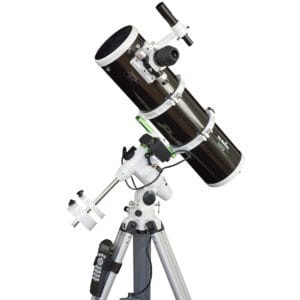
- Equatorial with SynScan (EQ3 Pro, EQ5 Pro, EQM-35 Pro). Tracks without field rotation. Payload capacity 5 to 10 kg. The entry into deep-sky astrophotography with a 130 or 150 mm Newtonian.
- Equatorial, heavy (HEQ5 Pro, EQ6-R Pro). Payload capacity 13 to 20 kg, polar scope, autoguider port. For 200 and 250 mm Newtonians and serious astrophotography.
Our recommendations
- Visual, compact: Sky-Watcher Explorer-130PS AZ-GTi. 130 mm on the WiFi mount, which is also popular separately as a travel mount.
- Visual, tabletop model: Sky-Watcher Heritage-150P Virtuoso GTi. Our bestseller in GoTo.
- First deep-sky photos: Sky-Watcher Explorer-150PDS EQ5 Pro. 150 mm f/5 OTA with dual-speed focuser on an EQ5 Pro.
- Serious photography: Sky-Watcher Explorer-200P HEQ5 Pro. 200 mm on the mount that is the standard for this class.
For whom yes and for whom no
Pros: anyone who wants to see many objects per evening without searching, and who wants to shoot with a DSLR or astro camera. Cons: anyone who only does visual observation on a limited budget. A Dobson offers a wider aperture for the same money. Anyone who wants photography without a learning curve is better off with a smart telescope.
Every Newtonian telescope requires a laser collimator; a coma corrector on the photographic PDS models. Overview of the merk: Sky-Watcher.