

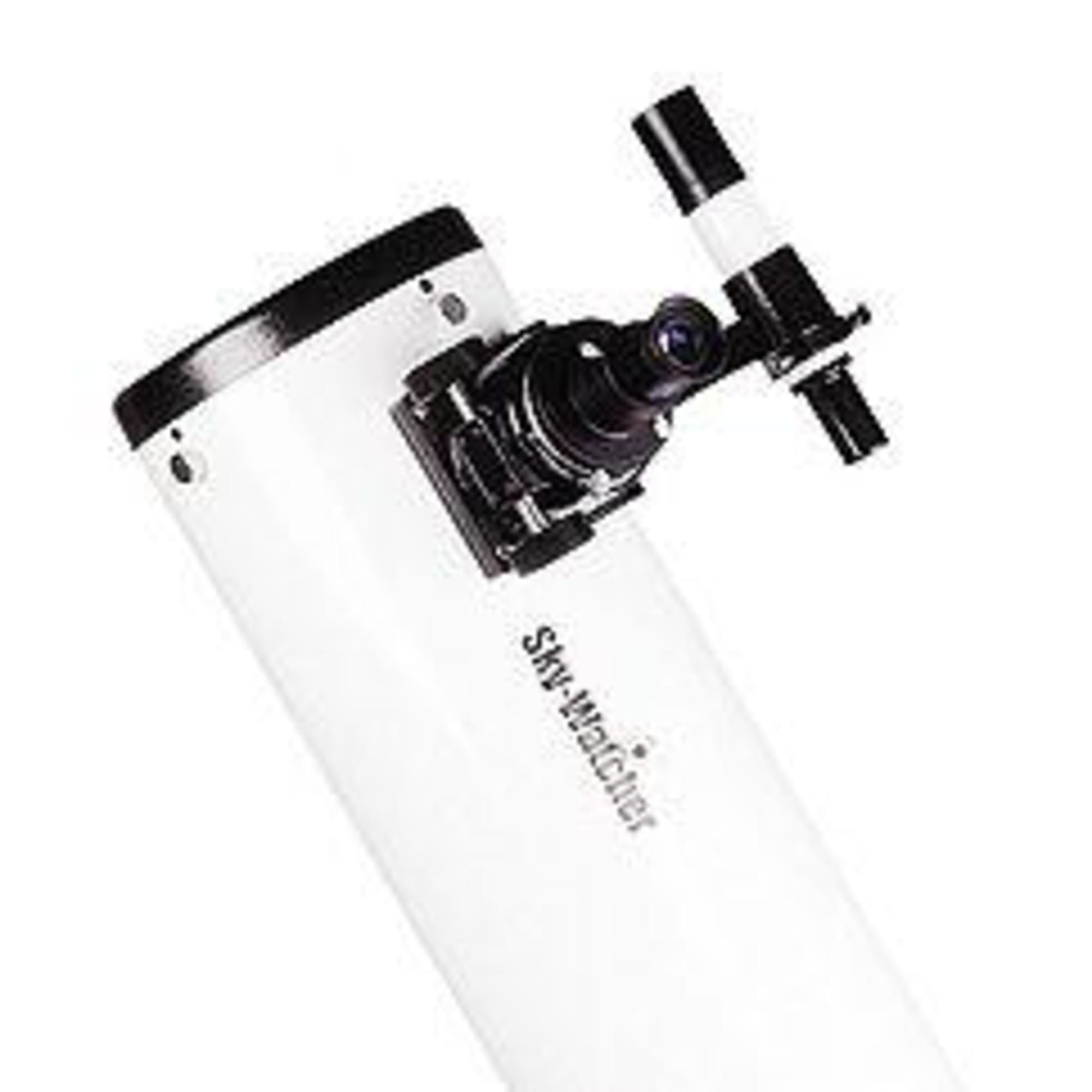
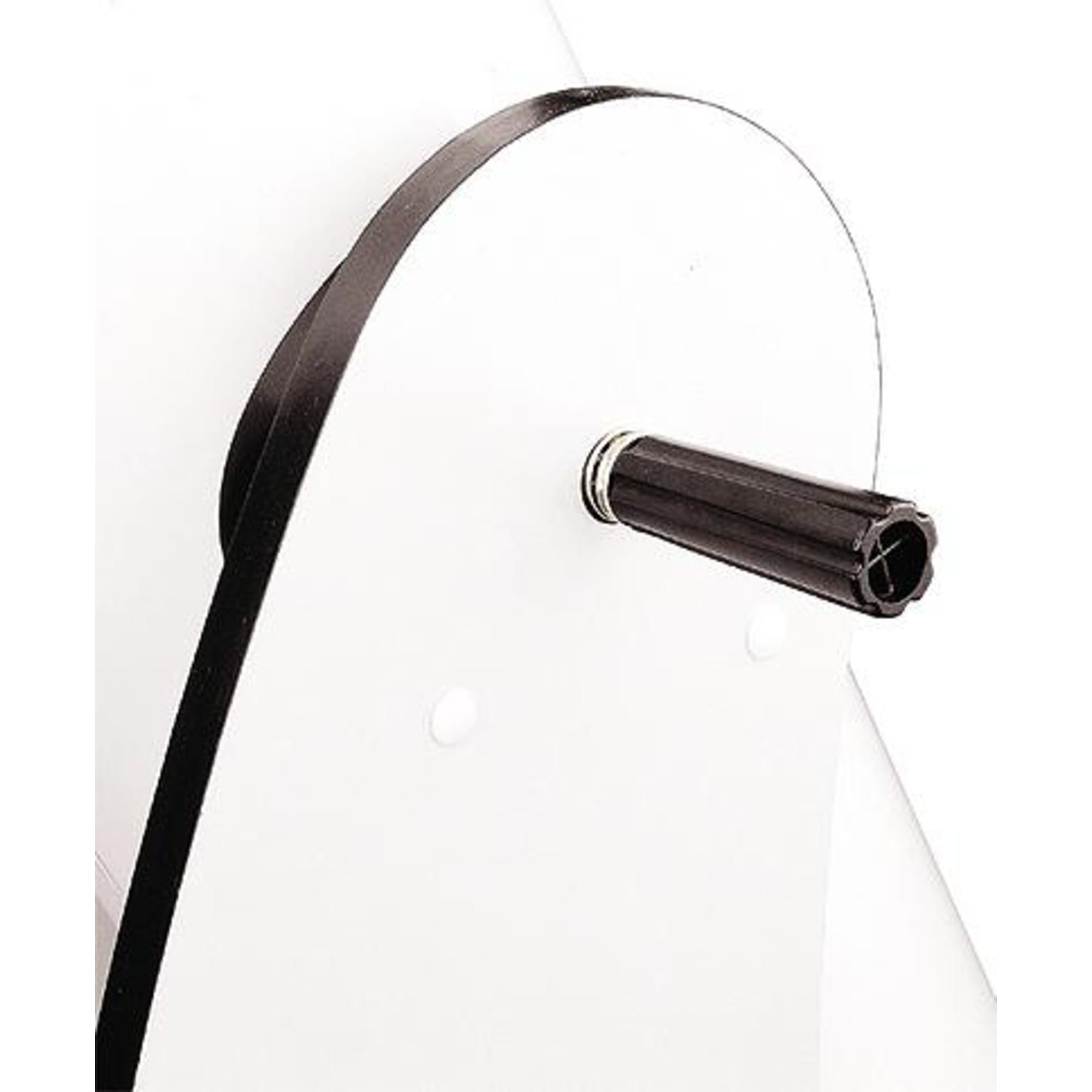



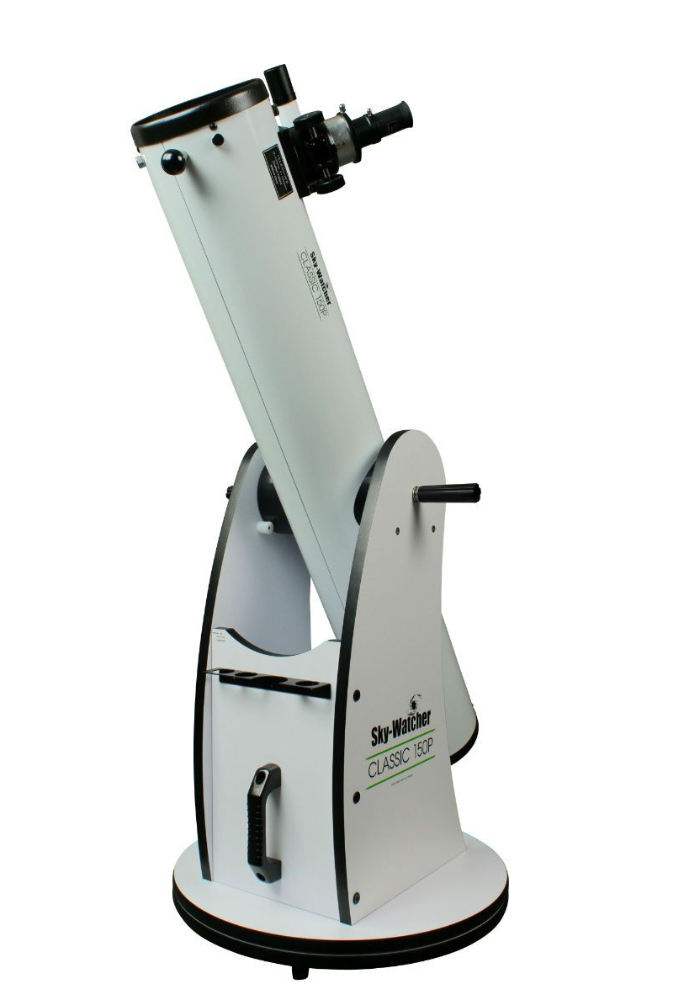
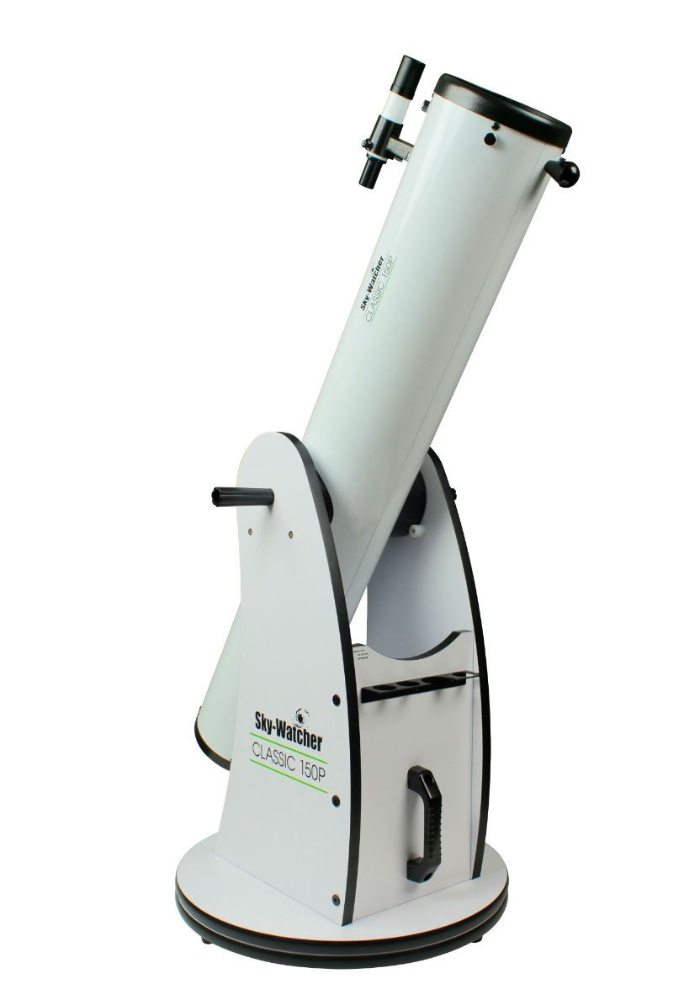
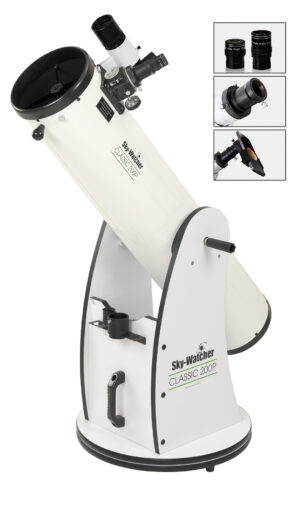
The Skyliner-150P Classic is a Dobson floor model with a 153 mm (6 inch) parabolic mirror and a focal brandlength of 1200 mm (f/8). The tube is housed in a wooden rockerbox that stands on the ground; you sit or stand next to it. Compared to the Heritage-150P FlexTube, a tabletop model with the same mirror size and 750 mm brandfocal length, the long brandfocal length provides a quieter image at 150 to 200x and the collimation is less precise, compared to a tube of over one meter and 18 kg instead of 7.5 kg. The Skyliner-200P Classic is the same design with 77% more light.
What do you see through the Skyliner-150P?
Moon: craters, mountain ranges and the shadow line; at 96x with the 12.5 mm eyepiece; Jupiter: two dark cloud bands, the four large moons and, at calm air, the Great Red Spot. Saturn: the ring apart from the planet; on calm nights the Cassini division in the ring. Deep sky: the Orion Nebula with structure; globular clusters like M13 that break off from loose stars; the Andromeda Galaxy as a long, elongated blob. With the 20 mm eyepiece (60x, 70 degrees), you see 1.2 degrees of sky, more than twice the Moon; the Pleiades do not quite fit in there. Nebulae and galaxies are seen with the eye in gray tones, not in color. From a city or village with street lighting, the Moon, planets, double stars and star clusters remain; nebulae and galaxies require a dark place. Due to the air over the Netherlands and Belgium, 150 to 200x is in practice the usable limit. What you can expect per object is stated in What do you see through a telescope?, Jupiter through a telescope, Saturn through a telescope and The Moon through a telescope.
How does the Skyliner-150P differ from other 150 mm telescopes?
- Mounting, tube and optics: the Skyliner-150P is housed in a floor-standing wooden rockerbox with an accessory plate; the tube is made of rolled steel, fixed and over a meter long, with a parabolic mirror of 153 mm at f/8 (RAQ coating up to 94% reflectivity). The long brandtip provides a quiet image at 150 to 200x and the collimation is less precise than at f/5.
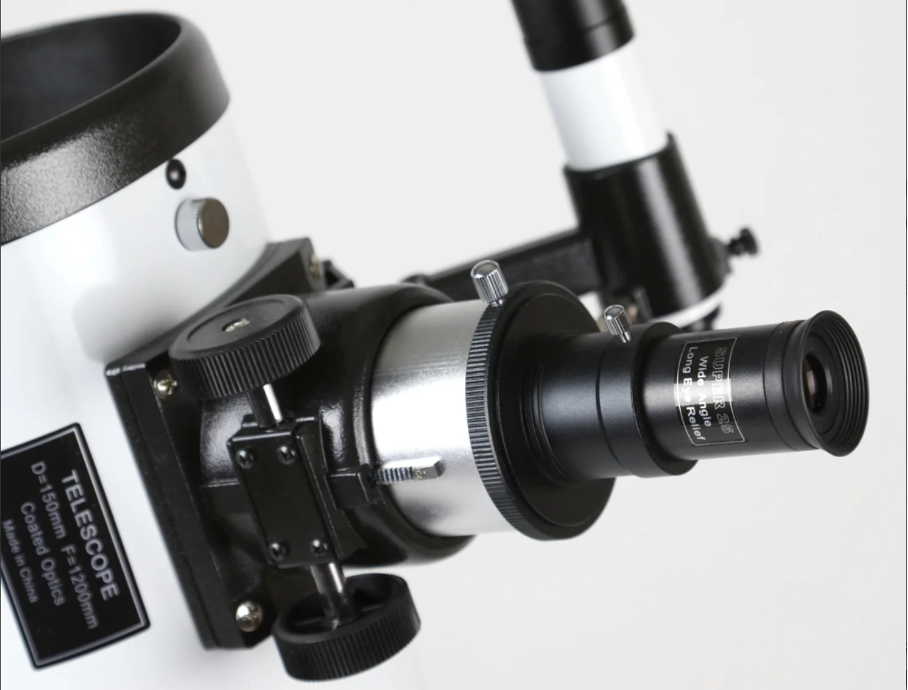
- Objective lens: 2 inch dovetail with metal gears and a 1.25 inch adapter with brass clamp ring, so 2 inch eyepieces will also fit; 6×30 optical viewfinder with cross wire.
- Included: two eyepieces with a 70-degree field of view (20 mm for 60x and 12.5 mm for 96x), a smartphone adapter and the Star Gazers Handbook.
For whom yes and for whom no
Hello For those who primarily look at the Moon and planets and want a quiet image at 150 to 200x magnification, for those who are looking for a telescope that requires little maintenance of the collimation, and for those who can accommodate a tube of over one meter and 18 kg in two parts. If you are in doubt, read on. Telescope Buying Guide for Beginners.
Not for long exposures of nebulas and galaxies; an assembly is required for that that follows the sky; look for it smart telescopes. Photos of the moon and the planets are possible: with the supplied smartphone adapter on the eyepiece, you can take short shots. If you want more light for nebulas and star clusters, choose the 200 mm model with the same rocker box; if you want to put it on the table and in a cabinet, then the tabletop model with the same mirror size.
What's in the box
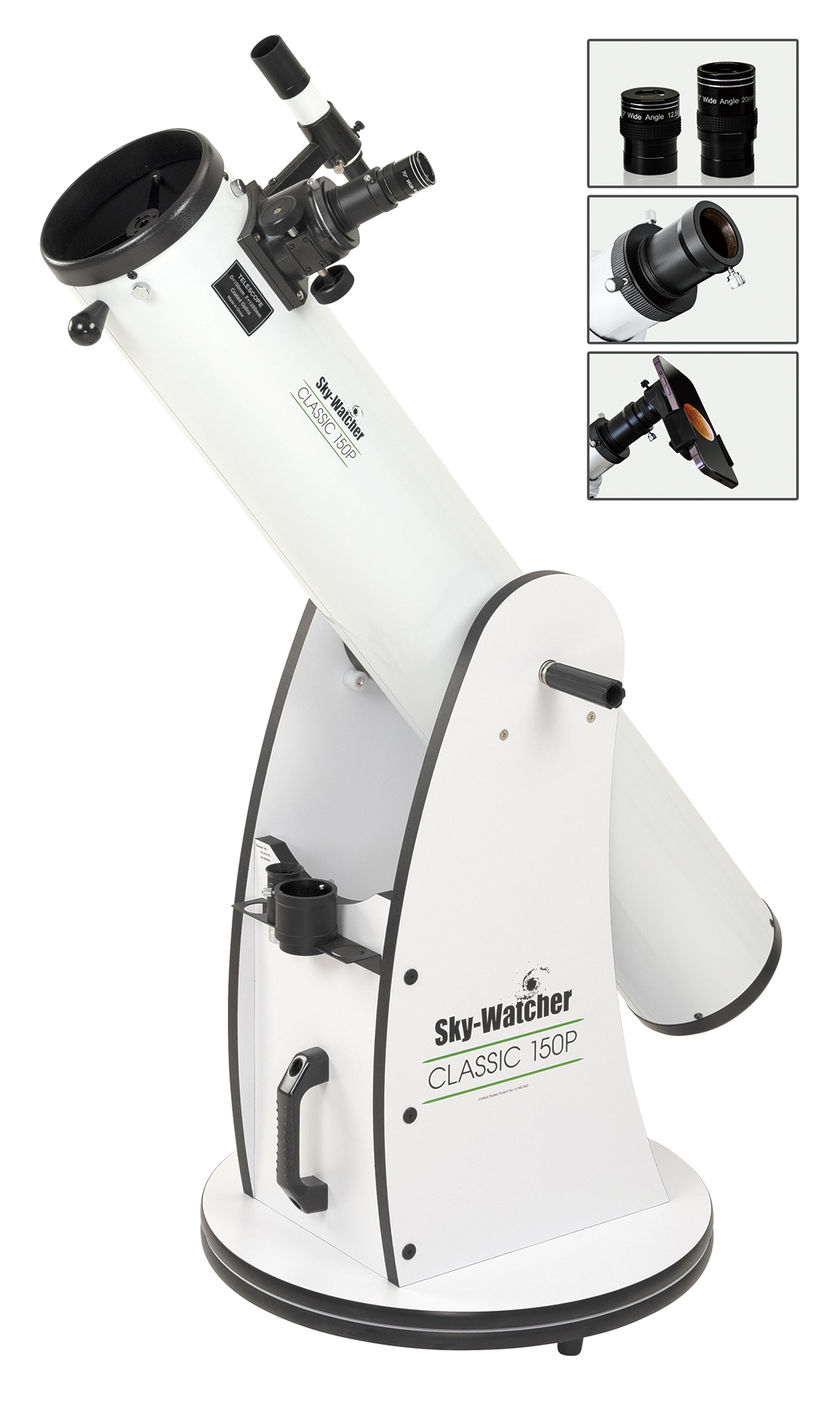
- Skyliner-150P Classic optical tube with wooden rockerbox and accessory plate
- 20 mm eyepiece (60x, 70 degrees) for star fields and nebulae
- 12.5 mm eyepiece (96x, 70 degrees) for the Moon and planets
- 2 inch to 1.25 inch step-down adapter with brass compression ring
- 6x30 optical finder scope with crosshair
- Smartphone adapter for phones with a width of 54 to 90 mm
- Handbook for Star Gazers (16 pages, Dutch)
Not included: collimation cap, moon filter, 7 mm planetarium eyepiece. A moon filter is welcome during a full moon; the 7 mm eyepiece is the step to 171x; a Cheshire checks the mirrors after transport.
Format and weight
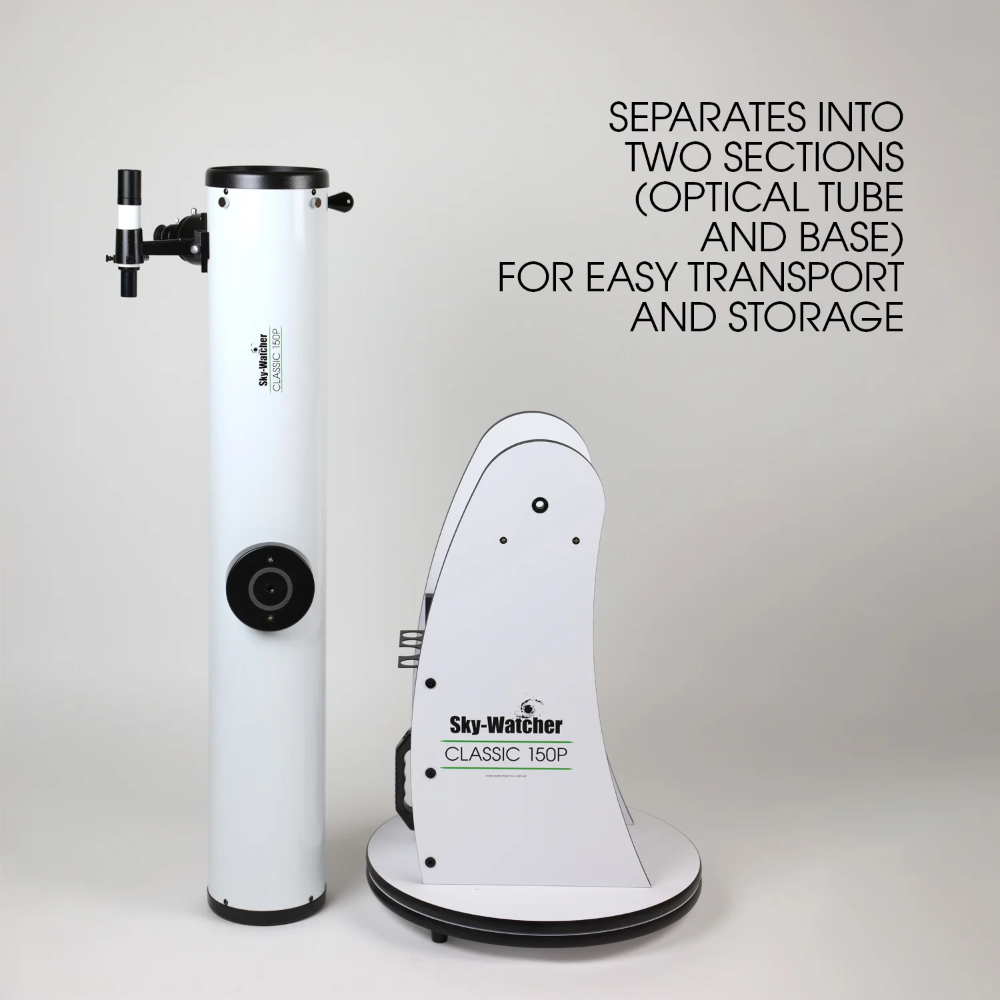
18 kg in two parts: the 6 kg tube and the 12 kg wooden rocker box come apart. Tube about a meter long, foot with a 52 cm diameter, packaged in two boxes (123 x 37 x 23 cm). It stands on the ground; you sit on a low stool or stand up, depending on how high the tube is directed.
First evening with the Skyliner-150P
- Take off the tube cap and place the tube in the rockerbox on a flat surface.
- Line the 6×30 viewfinder at day time on a distant object, for example a church tower or chimney; the crosshairs makes that accurate.
- Do not look through a window; the glass and the temperature difference make the image blurry.
- Start with the 20 mm eyepiece (60x) and look for the moon; then switch to the 12.5 mm eyepiece (96x).
- Rotate the focus lever until the image is small and sharp; a large blurry disc is not sharp.
- Set the telescope outside 30 to 45 minutes before viewing, so that the mirror reaches room temperature.
- An unsmoothed image almost never results from collimation. Check it after transport; with f/8 a slight deviation is not disturbing. How to check is stated in the Collimation guide.
Which accessories are suitable?
- Vela Optics 7 mm Super Plössl eyepiece, 1.25 inch: 171x on this telescope, for the Moon and planets.
- Vela Optics Cheshire collimation eyepiece, 1.25 inch: fits into the extension adapter, for checking the mirrors after transport.
- Sky-Watcher 1.25 inch Light Pollution Filter: screws into the filter thread of the supplied eyepieces and suppresses the light from streetlights, for more contrast on fog from the garden or balcony.
- Vela Optics Moon Filter ND96 13%, 1.25 inch: screw into the filter thread at the bottom of a 1.25 inch eyepiece and let 13% of the light through so that the moon is not dazzled.
Heritage-150P, Skyliner-150P or Skyliner-200P?
| Heritage-150P FlexTube | Skyliner-150P Classic (this page) | Skyliner-200P Classic | |
|---|---|---|---|
| Mirror | 150 mm, 750 mm, f/5 | 153 mm, 1200 mm, f/8 | 203 mm, 1200 mm, f/5.9 |
| Magnification with the included eyepieces | 30x and 75x | 60x and 96x | 60x and 96x |
| Highest meaningful magnification | about 300x, in practice 150 to 200x | about 300x, in practice 150 to 200x, with a calmer image through f/8 | about 400 times, in practice 200 to 250 times |
| Reporter | 1.25 inch helical | 2 inch hinge | 2-inch Crayford |
| Weight and size | 7.5 kg, tabletop model, retractable tube | 18 kg in two parts, floor model, tube over a meter long | 23 kg in two parts, floor model, tube over a meter long |
| Moon and planets | crater, the moons and rings of Jupiter, the ring of Saturn | the same objects, quieter image at 150 to 200x, on good nights the Cassini separation | Color differences on Jupiter, the Cassini division more visible |
| Choose this as | he has to fit in a cabinet and it stands on the table | You mainly look at the moon and planets and don't want to do much collimation | you want more light for fog and systems and can move 23 kg |
Frequently asked questions about the Skyliner-150P
- Is it suitable for a child? From about 12 years old, self-reliant, younger together with a parent because of the weight: the tube weighs more than a child alone safely in the rockerbox when tilted.
- Can I take photos with it? Of the moon and the planets, using the supplied smartphone adapter on the eyepiece; long exposures of nebulas and galaxies require a mount that follows the sky.
- Which sun filter fits it? A filter that fits on the tube before it. Measure the circumference of the front of the tube, divide by 3.14 and choose on the page of the Omegon Helievo The size that this fits. Cover the viewfinder and check the film for each use. Never use an eclipse lens or a filter in the eyepiece.
- Do I need to collimate it? Check after transport; at f/8 there is usually nothing to do. A collimation cap is not included in the box; a Cheshire does it accurately, the steps are in the instructions. Collimation guide.
- Is it on a table or on the floor? On the floor: the rocker box is the base; a table or tripod is not necessary. You can watch sitting on a low stool if the tube is oriented low and standing if it is high.
- Can it fit in a car? Yes, in two parts: the tube in the back seat, the 52 cm diameter rockerbox in the trunk.
Specifications
| Optical design | Newton reflector, parabolic mirror |
| Opening | 153 mm (6 inch) |
| Focal length | 1200 mm |
| Opening ratio | f/8 |
| Mirror | RAQ coating, up to 94% reflectivity, spin of 0.5 mm |
| Highest meaningful magnification | about 300 times |
| Mount | Dobson, floor model, wooden rocker box, manual, with accessory plate; foot diameter 52 cm |
| Reporter | 2 inch tongue with 1.25 inch pitch |
| Seeker | 6×30 optic with cross wire |
| Included eyepieces | 20 mm (60x) and 12.5 mm (96x), 70 degree field of view |
| Total weight | 18 kg (tube 6 kg, rockerbox 12 kg) |
| Tube length | more than a meter |
| Packed | 123 x 37 x 23 cm |
Shipping and assistance
Orders with multiple items are shipped from multiple warehouses and may arrive in parts; each package will have its own tracking number. Help choosing or first night: WhatsApp or call on business days from 9:00 to 17:00, or come by appointment in Sneek. 30-day return period.
His morality (verified owner) -
Great telescope. Assembly was easy (and all required tools were included as standard).