
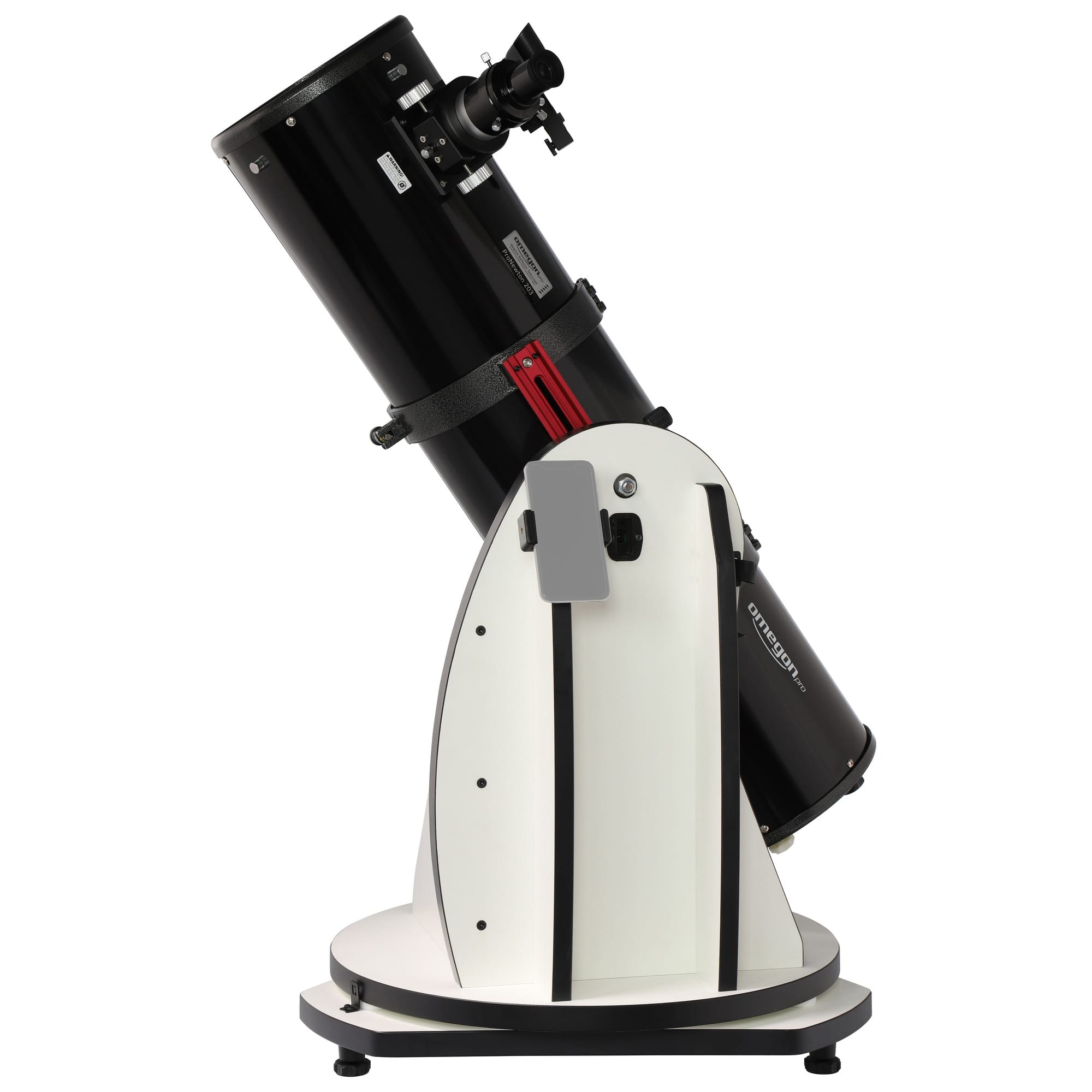
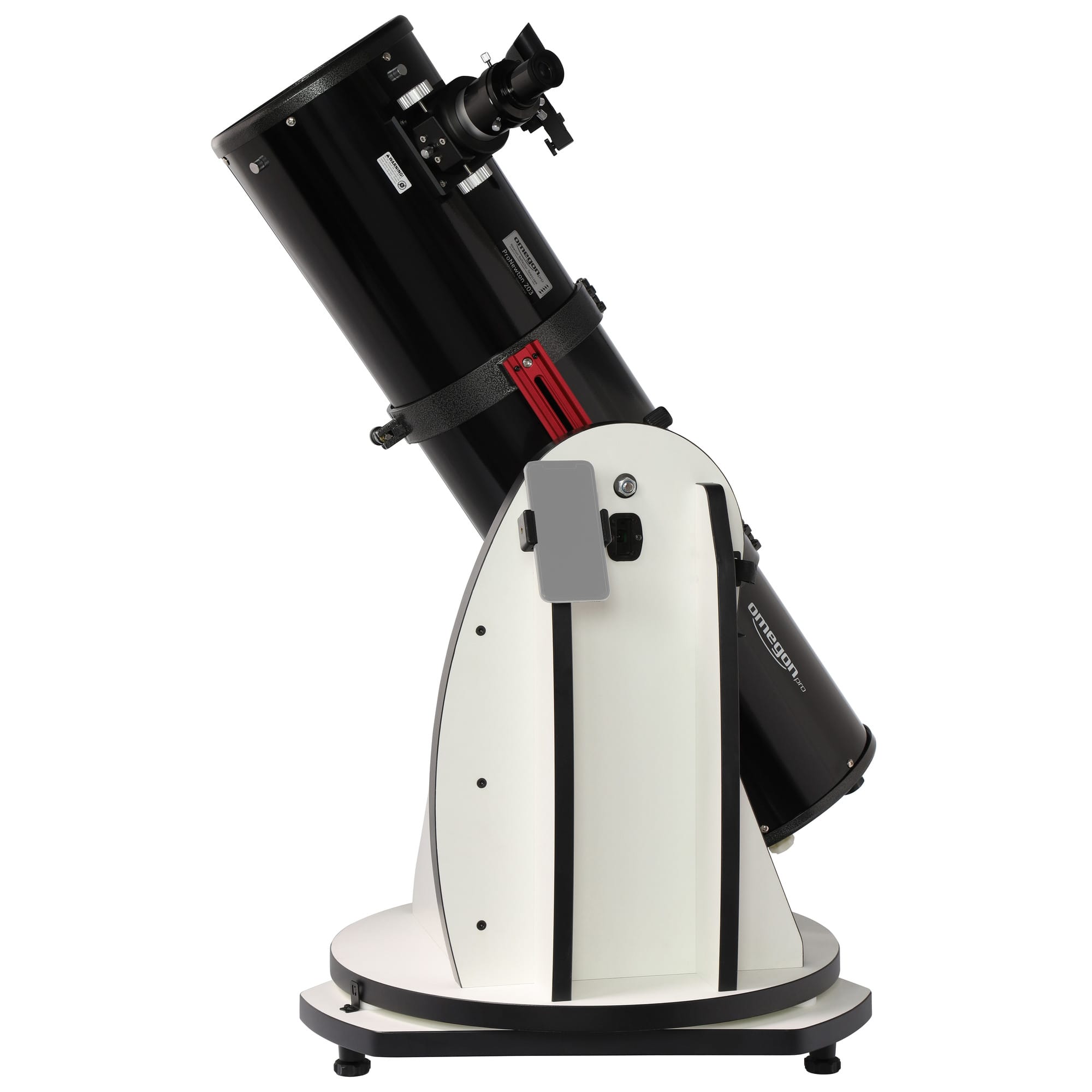
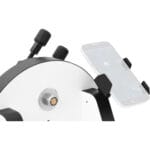
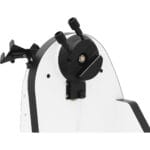


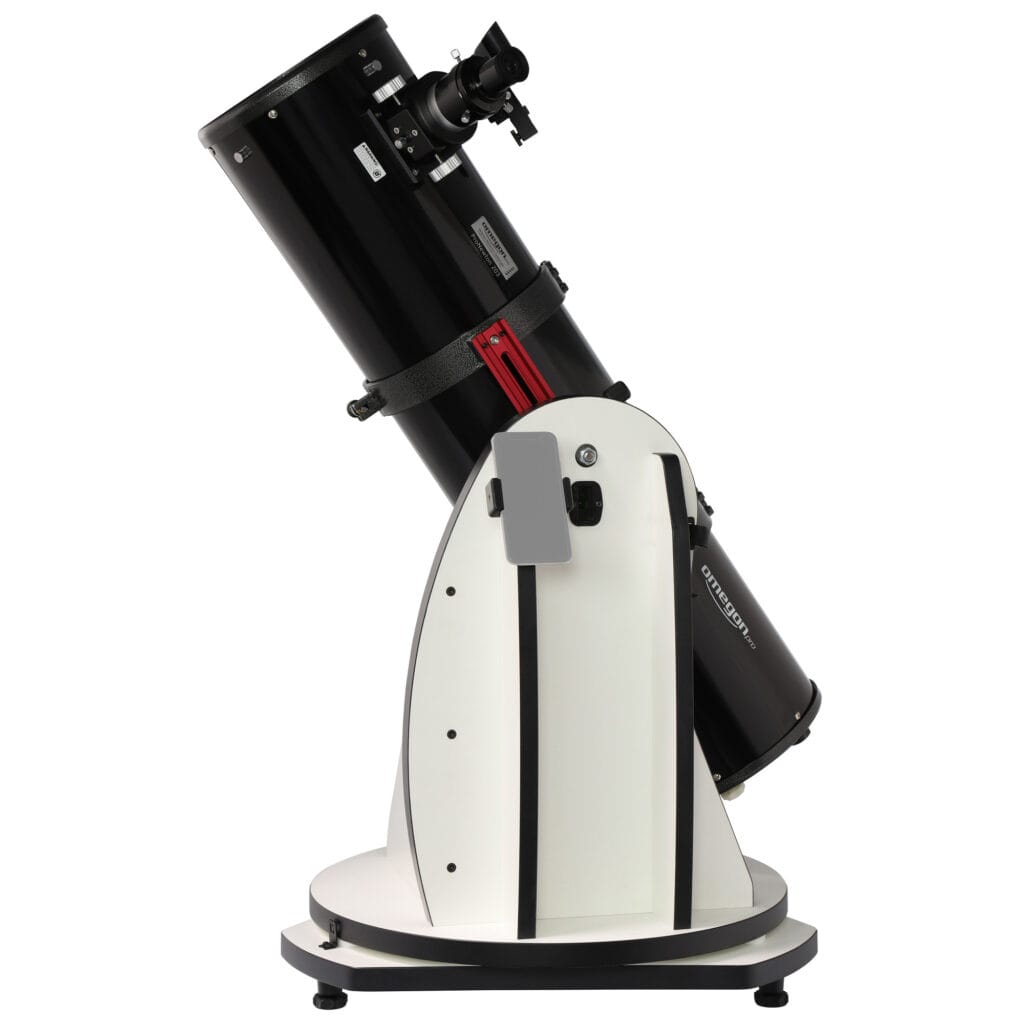
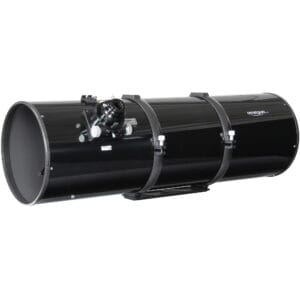
The Omegon Push+ 203/1000 is a Dobson floor model with a 203 mm (8 inch) parabolic mirror and a focal brandlength of 1000 mm (f/4.9, the brandfocal length divided by the aperture). The tube clamps with a Vixen dovetail on the wooden Push+ mount, with digital encoders in both axes: sensors that measure the tube’s position and transmit it via Bluetooth to a planetarium app on your Android phone. The app shows on the star map where the tube points; you push the tube towards the object (push-to); motors are not included. It is the largest of the two Push+ models in our range, with more than 800 times the light output of the naked eye. How the Omegon series relate to each other is shown in the Omegon merkguide.
What do you see with the Push+ 203/1000?
Moon: craters, mountain ranges, and the shadow line at 100x with the 10 mm eyepiece; with a 7 mm eyepiece (143x), the small craters on the bottom of the large ones are also visible. Jupiter: the banded clouds with color variation, the Great Red Spot, and during a transit the shadow of a moon on the planet. Saturn: the ring apart from the planet and on good nights the Cassini division. Deep sky: star clusters like M13 that break apart into loose stars in the core, the Orion Nebula with its extended structure, and from a dark spot spiral structure in bright systems like M51. Nebula and star clusters are seen with the eye in gray tones, not in color. From a city or village with street lighting, only the moon, planets, double stars, and star clusters remain; nebula and star clusters require a dark spot. With Push+, you can also find star clusters and planetary nebulae that you cannot see in the viewfinder: according to the manual, the system usually indicates up to 0.5 to 0.7 degrees within the field of view of a 25 mm eyepiece on an 8-inch Newton. The highest meaningful increase is approximately twice the opening in mm, so 400x; in practice, 200 to 250x is the limit due to the air above the Netherlands and Belgium. What you can expect per object is stated in What do you see through a telescope?, Jupiter through a telescope, Saturn through a telescope and The Moon through a telescope.
How is the Push+ 203/1000 different from other 200 mm Dobson telescopes?
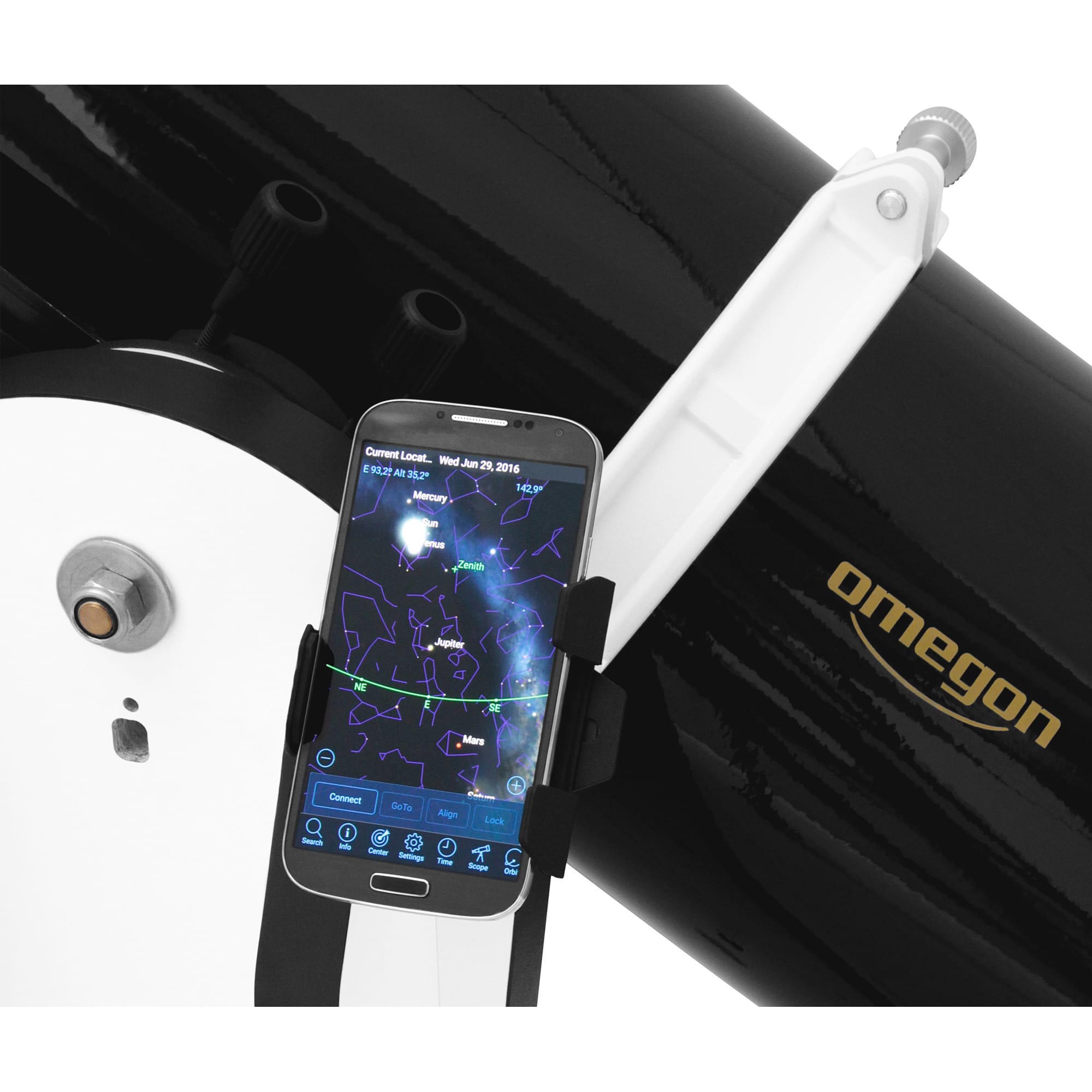
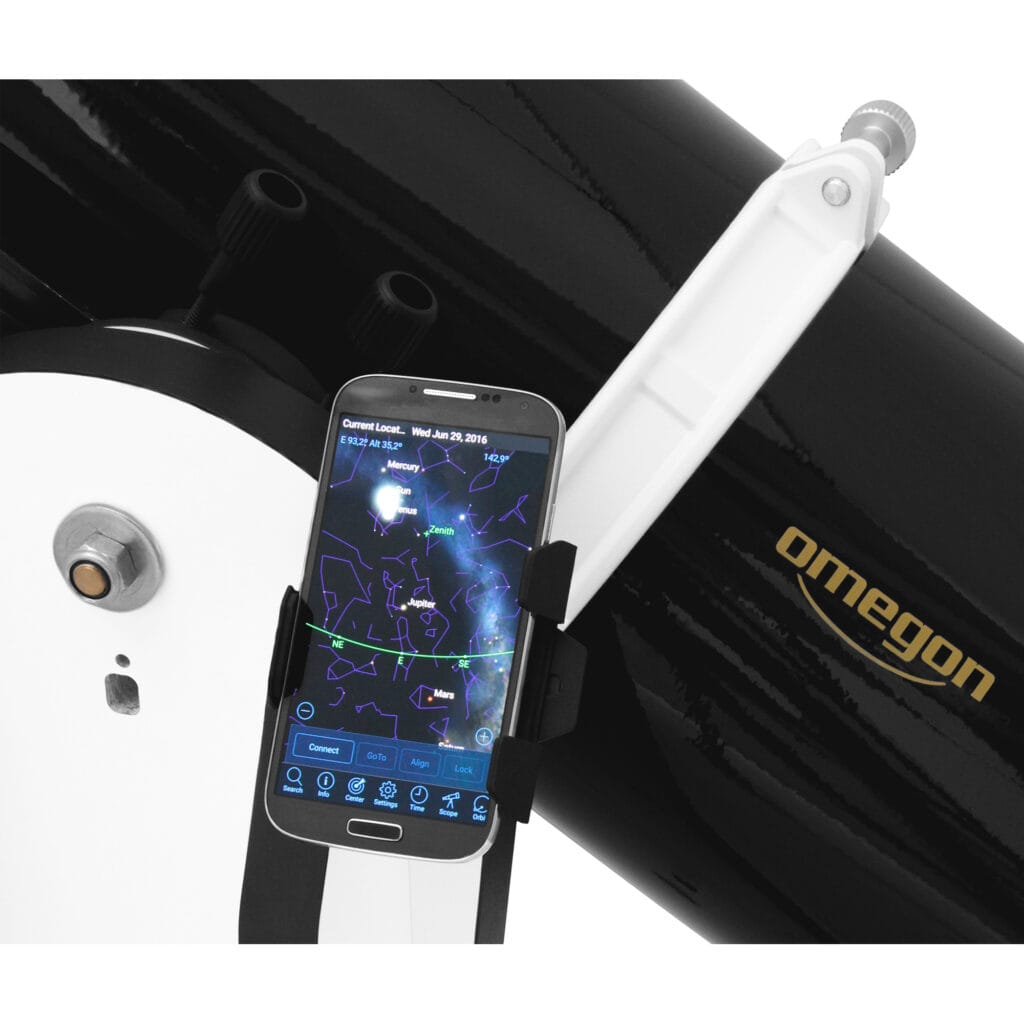
- Push+ search assistance: The Push+ 203/1000 transmits the position of the tube via Bluetooth 2.0 (range 10 meters) to SkySafari Plus or Pro (version 4 or later) on an Android phone or tablet, or to Stellarium or Cartes du Ciel on a laptop. Push+ does not work with an iPhone or iPad. The encoders require 9 to 12 V; the telescope does not move on its own.
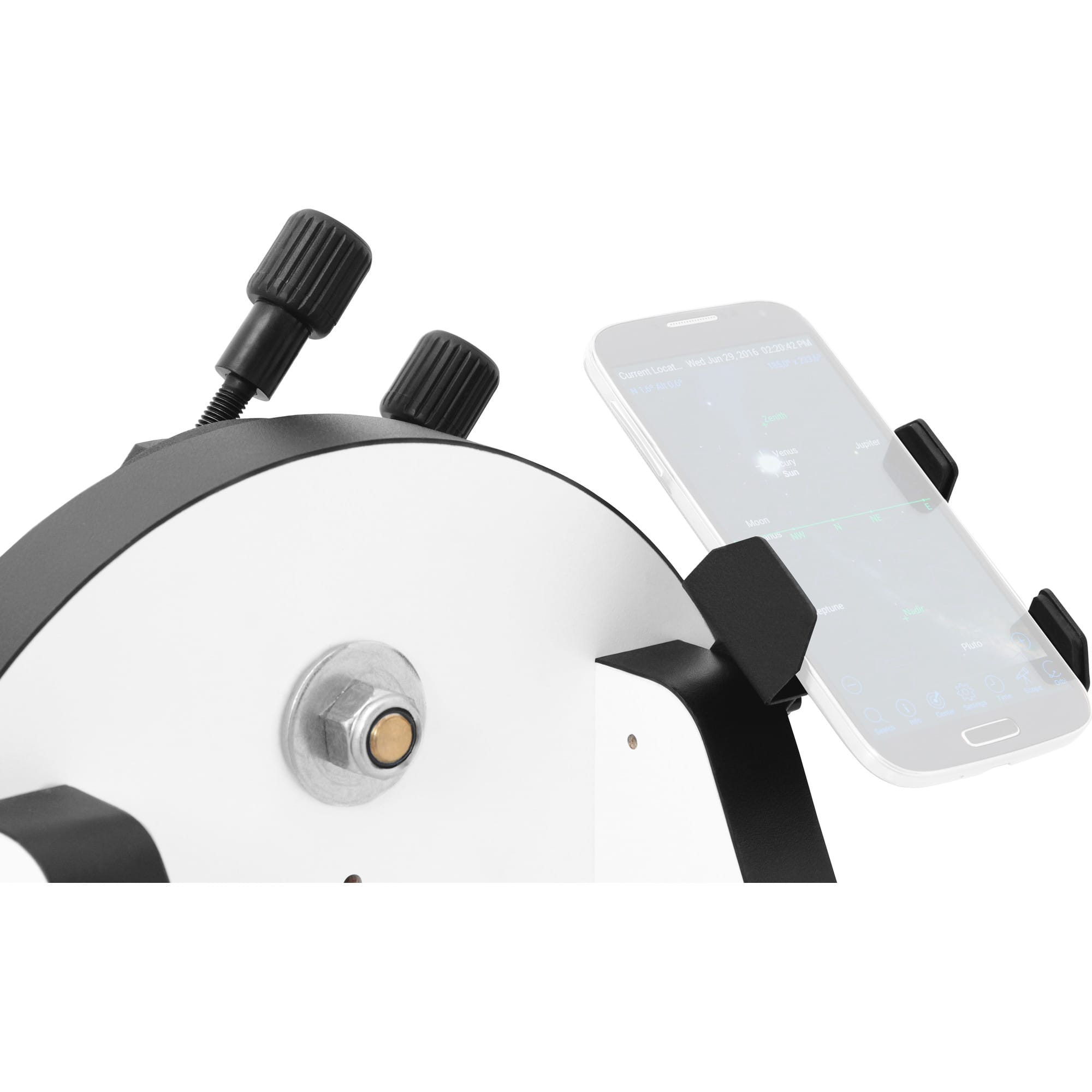
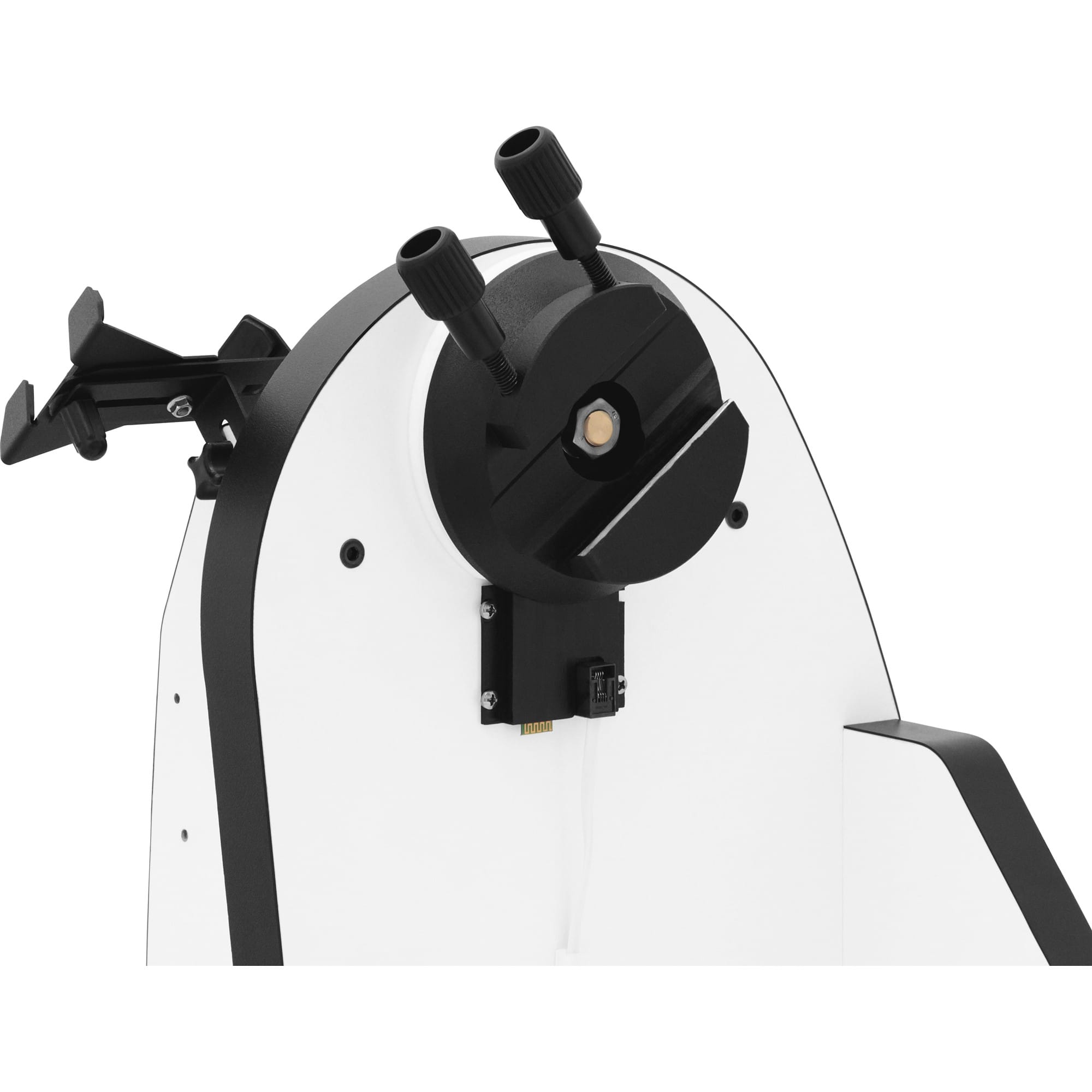
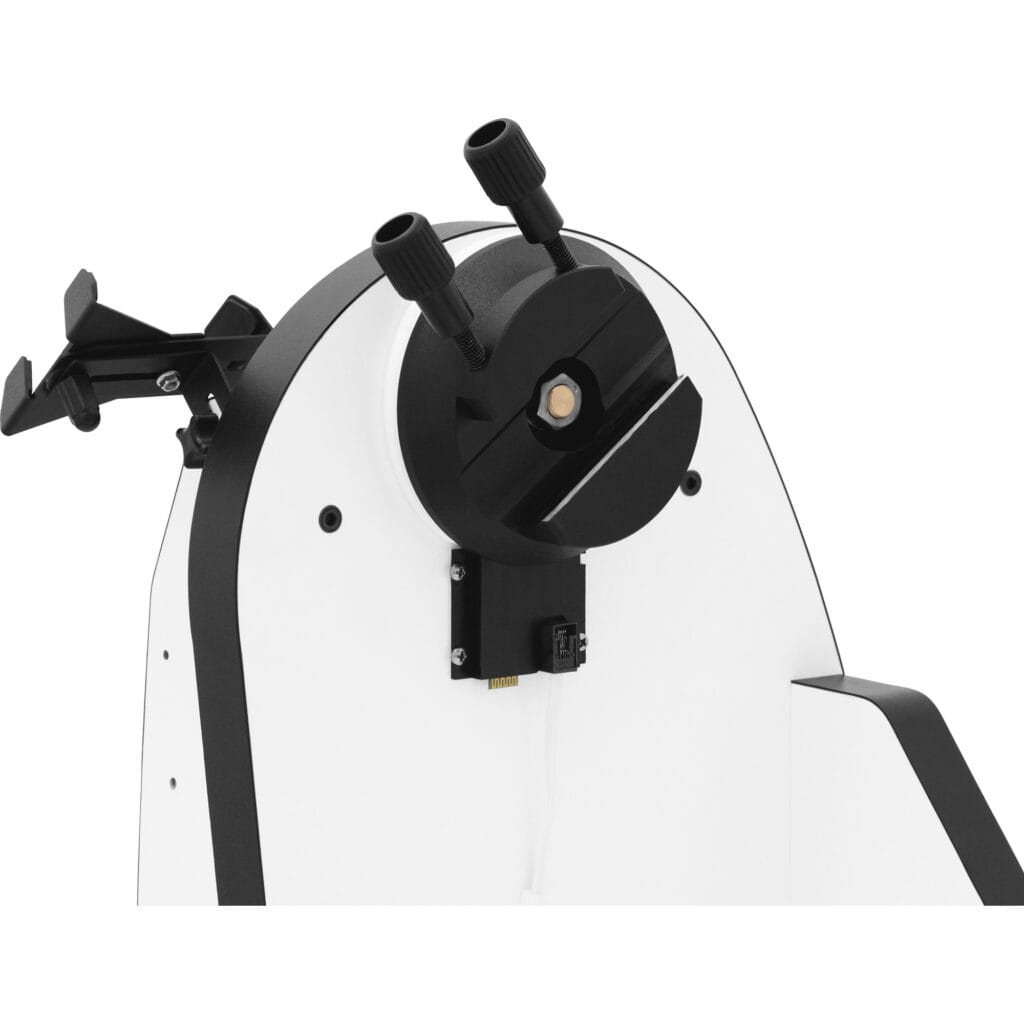
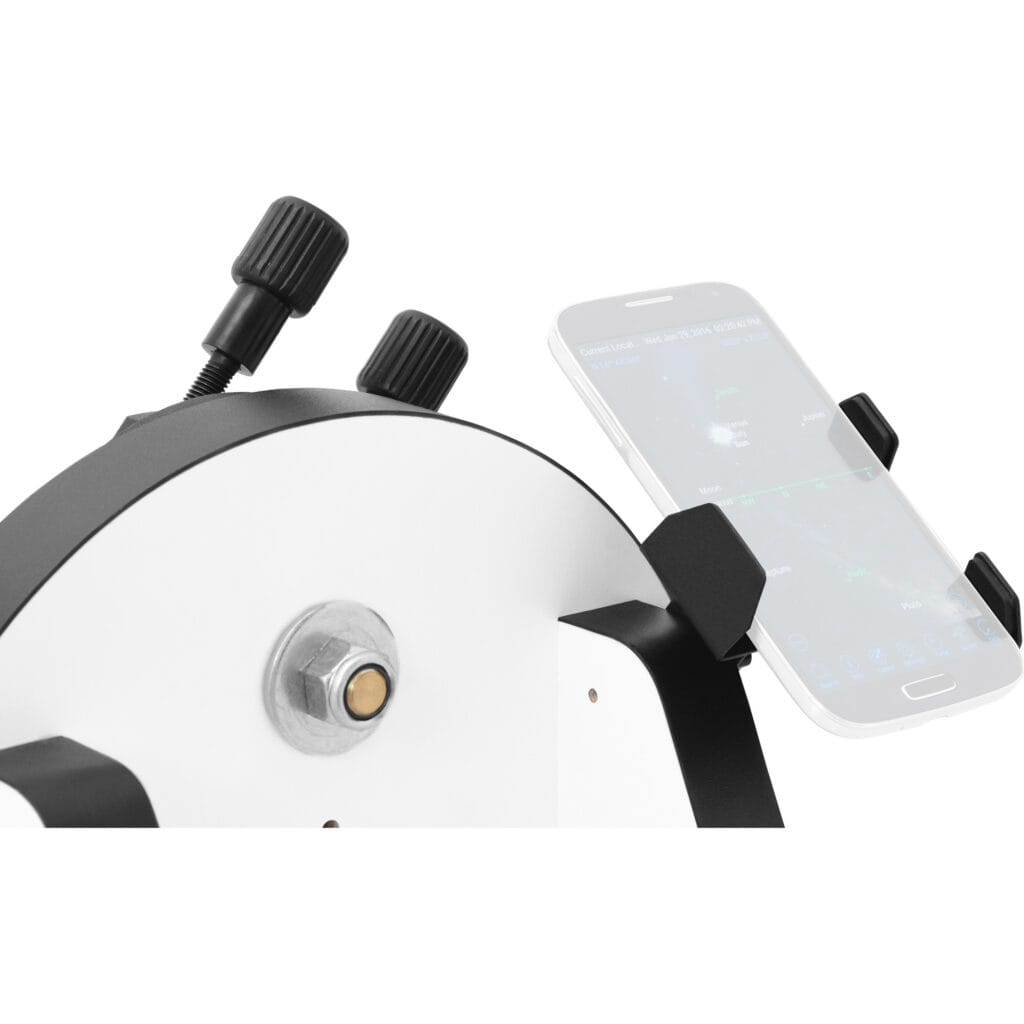
- Mounting: a wooden Push+ mounting of approximately 15 kg that supports up to 12 kg; the tube is attached to a Vixen swan tail with tube clamps and clips into the saddle. The mounting includes a smartphone holder for phones up to 75 mm wide, so you can view the app next to the tube while searching.
- Optics and eyepieces: parabolic mirror of 203 mm at f/4.9; 2-inch Crayford with 1.25-inch adapter, so 2-inch eyepieces also fit; two Kellner eyepieces for 40x and 100x and a red dot viewfinder.
For whom yes and for whom no
Hello For those who want to find objects without a star map and an Android phone; for those who want a 203 mm aperture with two magnification levels already in the box; for those who can carry a floor model in two parts, with a mounting of about 15 kg. If you’re unsure, then read the Telescope Buying Guide for Beginners.
Not for long exposures of nebulas and galaxies; an assembly is required for that that follows the sky; look for it smart telescopes. Photos of the moon and the planets are possible: with a smartphone adapter on the eyepiece you can take short shots. If you have an iPhone, check the Push-to Dobsons to a model with an app for iOS. If you want a lighter set with the same search feature, choose the 150 mm Push+ model: 11 kg in total, with a tube of 69 cm.
What's in the box
- Newton optical tube 203/1000 with parabolic main mirror, tube clamps and Vixen owl tail
- Wood Push+ mounting with encoders on both axes and Bluetooth
- Smartphone holder on the mounting bracket, for phones up to 75 mm wide
- 2 inch Crayford lens with 2 to 1.25 inch adapter
- Kellner eyepiece 25 mm, 1.25 inch (40x) for star fields, nebulas and object finding
- Waiter eyepiece 10 mm, 1.25 inch (100x) for the Moon and Planets
- Red dot viewfinder
Not included: phone and app, planetarium, moon filter. You need an Android phone with SkySafari Plus or Pro, a paid app from the Google Play Store; the free version does not provide a telescope. A 7 mm eyepiece is the step to 143x; at 203 mm the moon is bright, a 13% mm moon filter attenuates that.
Format and weight
The Push+ mounting weighs approximately 15 kg and carries up to 12 kg. The tube comes loose: the swan neck clamps into the saddle, so you carry and transport the tube and mounting separately. Packed 115 x 38 x 38 cm. It stands on the ground; you sit on a stool or stand, depending on how high the tube is aimed. A table or tripod is not required.
First night with the Push+ 203/1000
- Set the mounting upright on a flat surface, clamp the swan-neck of the tube into the saddle and remove the cap from the tube.
- Line the red dot viewfinder at day time on a distant object, for example a church tower or chimney.
- Install SkySafari Plus on your Android phone at home. Connect the encoders to 9 to 12 V, for example a power bank with a 12 V output, place the phone in the holder, pair via Bluetooth and turn the app off on two bright stars.
- Do not look through a window; the glass and the temperature difference make the image blurry.
- Start with the 25 mm eyepiece (40x) and look for the moon; then switch to the 10 mm eyepiece (100x).
- Rotate the focus lever until the image is small and sharp; a large blurry disc is not sharp.
- Set the telescope outside 45 to 60 minutes before viewing, so that the 203 mm mirror reaches outdoor temperature.
- An unsmooth image almost never results from collimation, the alignment of the mirrors. Check it after every drive, at f/4.9, that’s where it’s important; how it works is explained in the manual. Collimation guide.
Which accessories are suitable?
- Vela Optics 7 mm Super Plössl eyepiece, 1.25 inch: 143x for Moon, Jupiter and Saturn; fits in the 1.25 inch adapter of the Crayford.
- Vela Optics Moon Filter ND96 13%, 1.25 inches: screws into the filter thread at the bottom of the Vela eyepiece; for a 203 mm aperture, the 13% aperture provides the appropriate attenuation.
- Omegon Powerbank 10k 37Wh 12V12 V output of 5.5 x 2.1 mm with the plus in the middle, within the 9 to 12 V range of the encoders; Omegon calls it suitable for the Push+.
- Omegon Pro UHC nose filter, 1.25 inch: lets through the light from the gas nebulae and reduces the rest, so that the Orion Nebula, the Ring Nebula and the Pleiades Nebula gain more contrast from a dark spot.
Push+ Mini 150/750, Push+ 203/1000 or Advanced X 254/1250?
| Push+ Mini 150/750 Pro | Push+ 203/1000 (this page) | Advanced X 254/1250 | |
|---|---|---|---|
| Mirror | 150 mm parabolic, f/5 | 203 mm parabolic, f/4.9 | 254 mm parabolic, f/4.9 |
| Light compared to 150 mm | 100% | 83% more | 2.9 times as many |
| Search assistance | Push+ via an Android phone | Push+ via an Android phone | No, 8×50 optical viewfinder |
| Included eyepieces | 20 mm Plössl (38x) | 25 and 10 mm Kellner (40x and 100x) | 25 mm Plössl (50x) |
| Highest meaningful magnification | about 300x, in practice 150 to 200x | about 400 times, in practice 200 to 250 times | about 500x, in practice 200 to 250x |
| Position and weight | 11 kg, tube 5.3 kg and 69 cm long | floor model, mounting weight approximately 15 kg, tube is loose | floor model, 24.4 kg in two parts, tube 15 kg, mirror fan |
| Choose this as | You want the same search functionality in a set of 11 kg | You want your 203 mm and want to find objects via your Android phone | You want a 254 mm telescope, you can also use a viewfinder and star chart and you can lift a tube weighing 15 kg |
Frequently asked questions about the Push+ 203/1000
- Is it suitable for a child? From 8 years old together with an adult, from 12 years old independently: the tube of a 203 mm floor model puts an adult in the saddle. Then a child searches for objects using the app and pushes the tube itself.
- Does Push+ work with an iPhone? No, only with Android: the encoders send their position via Bluetooth 2.0 to SkySafari Plus or Pro on an Android phone or tablet, or to Stellarium or Cartes du Ciel on a laptop. With the phone in the holder, you can see two stars in SkySafari; Cartes du Ciel also works with more stars.
- What current does Push+ need? 9 to 12 V DC on a 2.1 mm plug with the positive terminal in the middle, for example from a power bank with a 12 V output. The telescope has no motors; only the encoders and Bluetooth use power.
- Can I take photos with it? Of the moon and the planets, using a smartphone adapter on the eyepiece; the holder on the mount is for the app, not for photos through the eyepiece. Long exposures of nebulas and galaxies require a mount that follows the sky.
- Which solar filter fits? A filter that is attached to the tube before it is installed. Measure the circumference of the front of the tube, divide that by 3.14 and choose the appropriate size. sun filters a filter whose clamping range covers that outcome; the Omegon Helievo goes up to 208 mm. Check the foil before each use, cover the viewfinder and never use an eclipse glasses behind the viewfinder or a filter in the eyepiece.
- Do I need to collimate it? After transport check; at f/4.9, the alignment is tighter than with a f/6 telescope. With a laser collimator in the 1.25 inch adapter, you can quickly see if the mirrors are aligned correctly; the steps are marked in the adapter. Collimation guide.
Specifications
| Optical design | Newton reflector, parabolic mirror |
| Opening | 203 mm (8 inches) |
| Focal length | 1000 mm |
| Opening ratio | f/4,9 |
| Highest meaningful magnification | about 400x |
| Light output | about 820 times the naked eye |
| Mount | Push+, wood Dobson, encoders on both axes, push-to, Vixen saddle, holds up to 12 kg |
| Navigation | Bluetooth 2.0 (10 m); SkySafari Plus or Pro on Android, Stellarium or Cartes du Ciel on a laptop; not for iOS |
| Stream | 9 to 12 V DC, plug 2.1 mm with plus in the middle |
| Reporter | 2 inch Crayford with 1.25 inch adapter |
| Seeker | Red dot |
| Included eyepieces | Waiter 25 mm (40x) and 10 mm (100x), 1.25 inch |
| Smartphone Holder | For mounting, phones up to 75 mm wide |
| Mounting weight | about 15 kg |
| Packed | 115 x 38 x 38 cm |
Shipping and assistance
Orders with multiple items are shipped from multiple warehouses and may arrive in parts; each package will have its own tracking number. More information about this can be merk found on the Omegon brand page. Help with choosing or on the first evening: WhatsApp or call on weekdays from 9:00 to 17:00, or come by appointment in Sneek. 30 days' cooling-off period.

Reviews
There are no reviews yet.