
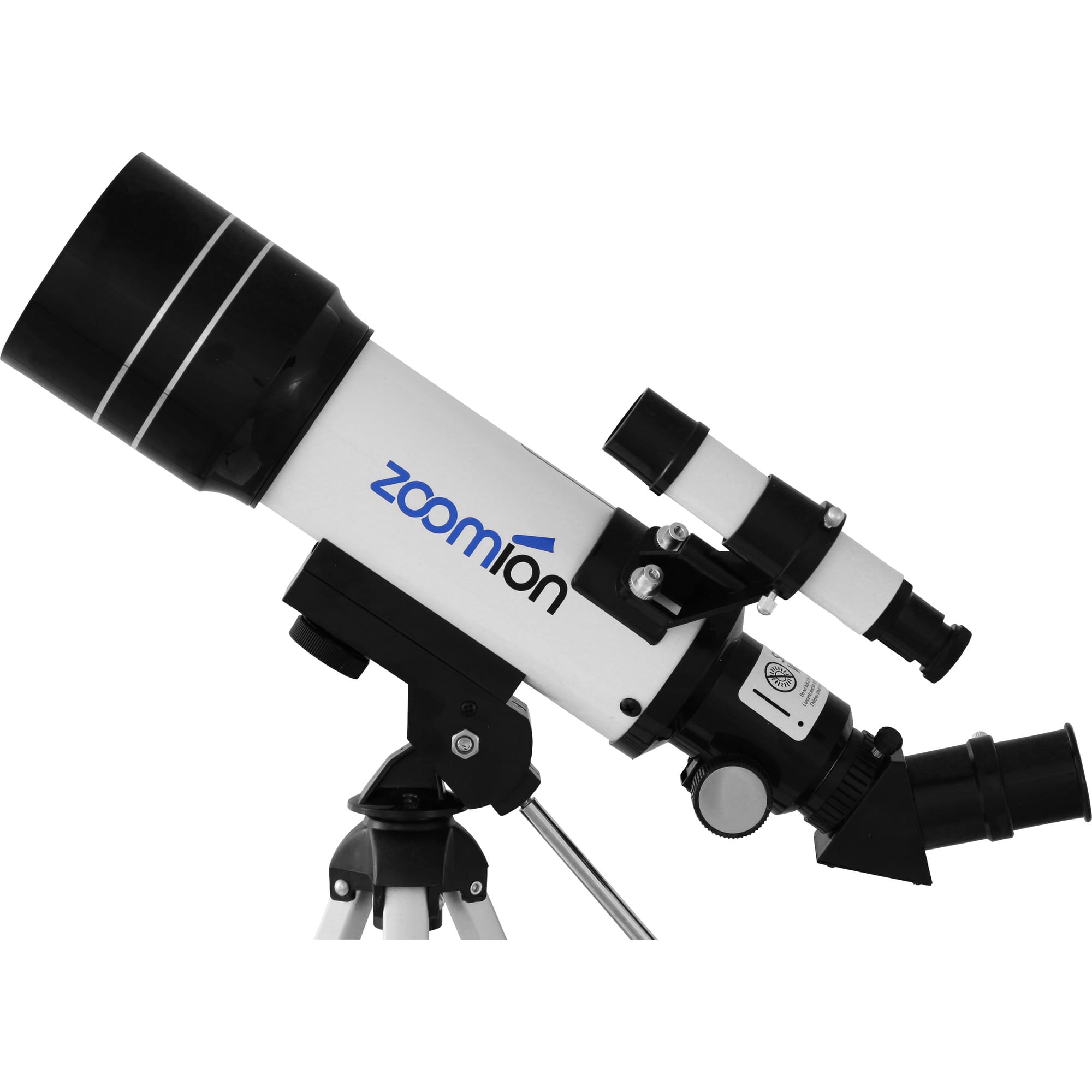
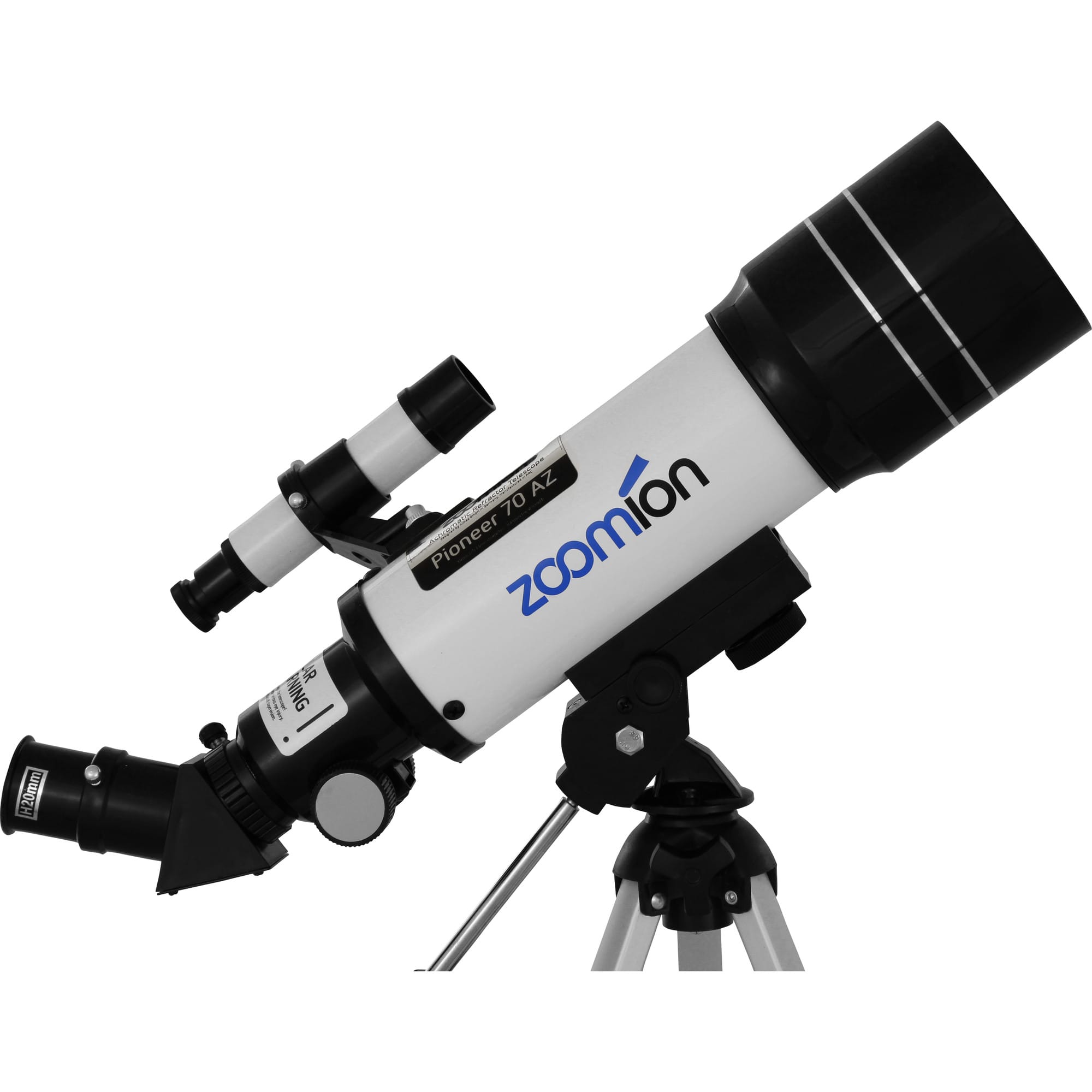
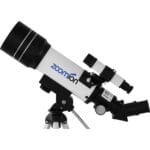
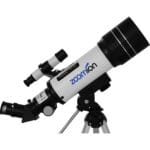
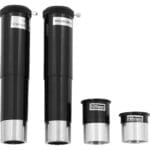


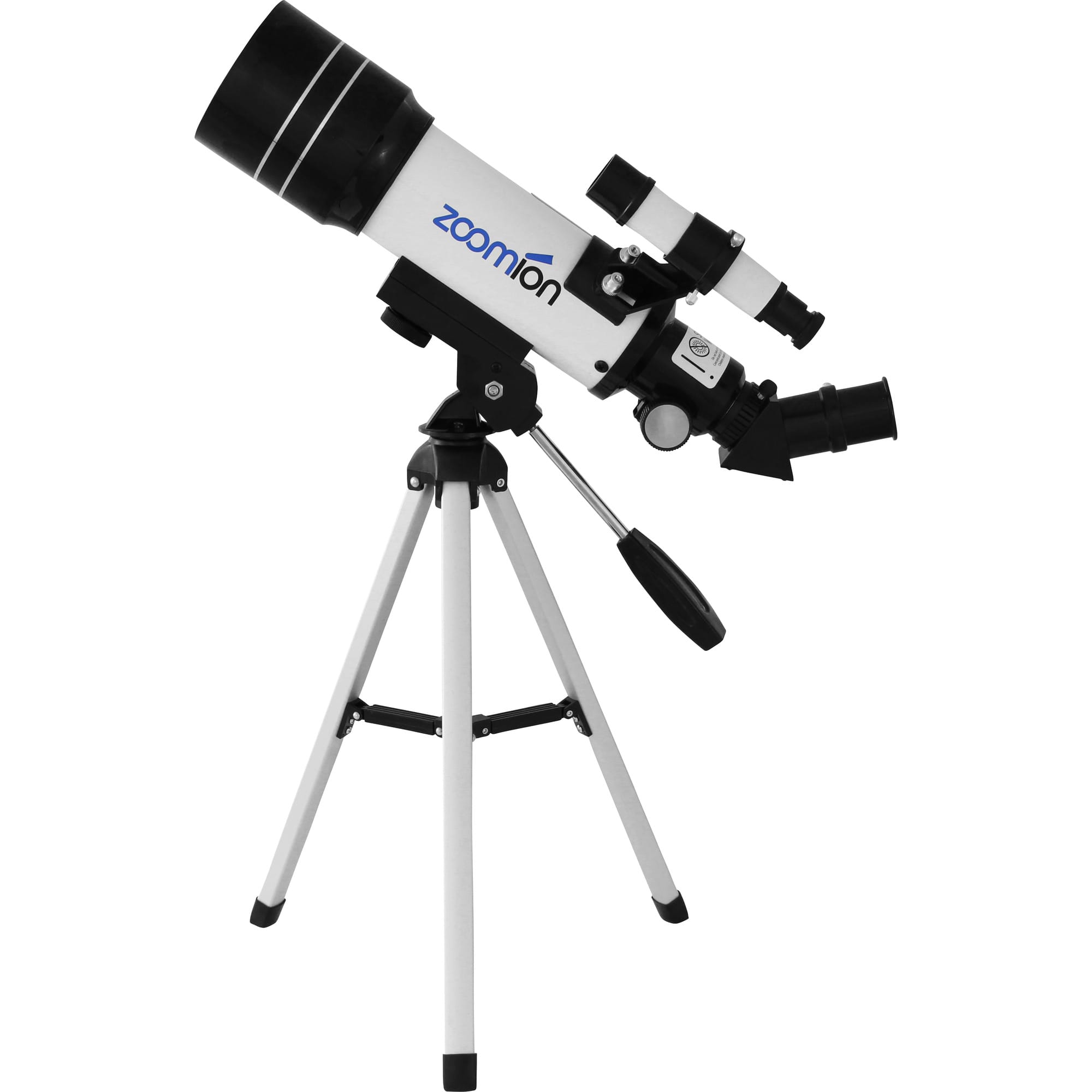
The Zoomion 70 mm AZ (also called Pioneer 70 AZ) is an achromatic refractor (lens telescope with a lens of two elements) with a 70 mm aperture and 360 mm focal brandlength (f/5.1) on an AZ-1 mount with a table tripod. The short focal brandpoint provides a wide field of view at low magnification; the Bresser Nano 70/700 has the same opening with twice as many brandpoints, so more magnification per eyepiece and a thinner color border. Those who want to see more on the same table come to the Heritage-100P, a tabletop Dobson with a parabolic mirror of 100 mm. The Telescope Buying Guide for Beginners place the entry-level models side by side.
What do you see with the Zoomion 70 AZ?
Moon: at 18x, the entire Moon is visible; at 60x, you see craters, mountain ranges, and the shadow line. Around the bright Moon edge and around Venus you see a purple-blue rim: that is characteristic of an achromatic lens and is clearer at f/5.1 than at a f/10 refractor. Jupiter: the four large moons as dots next to a small disk; at 60x, the two main bands are faint streaks. Saturn: at 60x, a small oval with the ring detached from the planet. Deep sky: the Pleiades is clearly visible at 18x, the Orion Nebula as a gray blob with the four Trapezium stars, the Andromedan system as a long, narrow blob from a dark spot. Nebulae and galaxies are seen with the eye in gray tones, not in color. From a city or village with streetlights, the Moon, planets, and star clusters remain; nebulae and galaxies require a dark spot. During the day, you look through the amici prism upright at birds and the landscape. The highest meaningful magnification is about twice the opening in millimeters, so about 140x; the 6 mm eyepiece with the 3x Barlow (180x) is above that and gives a dark, blurry image. The highest usable combination out of the box is the 6 mm eyepiece with the 1.5x flip lens (90x). What you can expect per object is stated in What do you see through a telescope?, Jupiter through a telescope, Saturn through a telescope and The Moon through a telescope.
How is the Zoomion 70 AZ different from other entry-level telescopes?
- Mounting: the Zoomion 70 AZ is mounted on an AZ-1 mount with a table-mounted tripod, so on a table, box or wall; the tube, mount and tripod together weigh 2.5 kg.
- Optics: achromatic lens of 70 mm at f/5.1, designed for a wide field of view: at 18x the entire Moon and the Pleiades are in the frame. The color border around the Moon and planets is clearer at f/5.1 than at a f/10 refractor; the lens is fixedly aligned, collimation is not required.
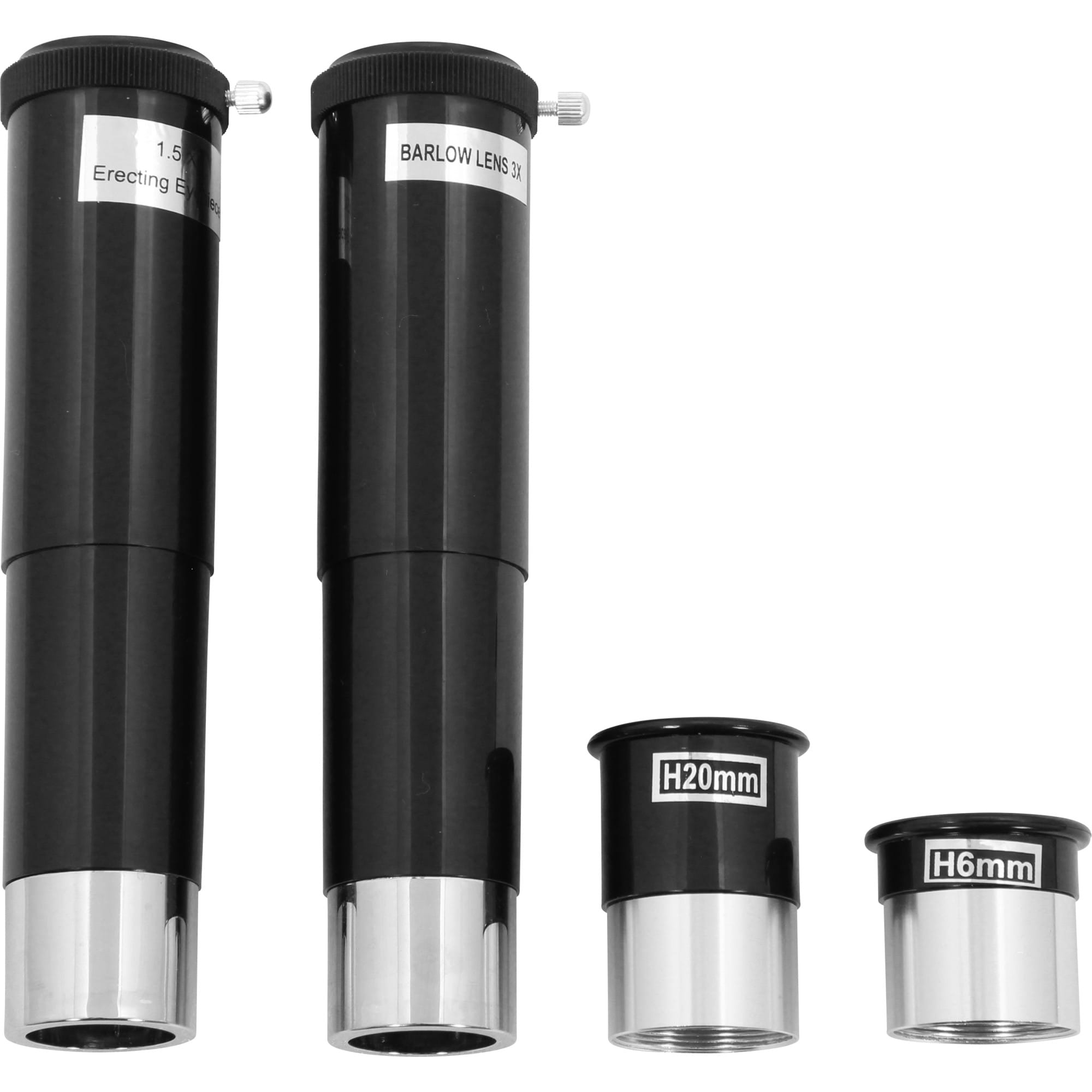
- Included: a 20 mm and a 6 mm eyepiece, a 3x Barlow, a 1.5x reversing lens and a 45-degree amici prism that straightens the image so that the viewer is also a natural observer during the day; a viewfinder is not included.
For whom yes and for whom no
Hello children from about 8 years of age together with an adult, who wants to observe the moon and nature during the day, and who looks from a balcony or garden table. See also telescopes for children and read astronomy for children.
Not for detail on the planets; there requires a thinner color border or more opening, see the other two models in the comparison table below. For nebulae and galaxies, a mirror of 130 mm is the step, as shown in the Heritage-130P FlexTube. Long exposures of clouds require a mounting that follows the sky; then look at the smart telescopes; photos of the moon can be taken with a smartphone adapter attached to the eyepiece.
What's in the box
- Optical tube 70/360
- AZ-1 azimuthal mount
- Table Tripod
- 20 mm eyepiece (18x) for the entire moon, star fields and searching
- 6 mm eyepiece (60x) for the Moon and Planets
- 3x Barlow lens (54x with the 20 mm eyepiece)
- 1.5x reversing lens (27x and 90x with the eyepieces)
- 45-degree amici-prisma for a upright image
- Manual
Not included: viewfinder, moon filter, smartphone adapter. You miss a viewfinder when you zoom to 18x; the field of view is wide enough to focus on the moon and bright planets along the tube; a moon filter is welcome around a full moon; a smartphone adapter is the simplest way to take a moon photo.
Format and weight
2.5 kg for the tube, assembly and table tripod together. It stands on the table tripod: on a table, box or wall, not on the ground.
First evening with the Zoomion 70 AZ
- Take off the lens cap and insert the amici prism into the viewfinder.
- During the day, practice focusing on a distant object, for example a church tower; there is no viewfinder, so look through the tube and focus at 18x.
- Do not look through a window; the glass and the temperature difference make the image blurry.
- Start with the 20 mm eyepiece (18x) and look for the moon; then switch to the 6 mm eyepiece (60x). You will only use the Barlow and the flip lens later.
- Rotate the focus lever until the image is small and sharp; a large blurry disc is not sharp.
- Set the telescope outside 15 minutes before viewing; a lens heats up faster at outdoor temperatures than a mirror.
- No collimation is necessary: the lens is fixedly aligned. A blurred image is caused by focusing, by a window or by turbulent air (seeing). Thanks to the amici-prism, the image is upright and sharp, day and night.
Which accessories are suitable?
- Omegon Smartphone Adapter 25 to 48 mm: clamps to ocular housings from 25 to 48 mm, for moon photos with your phone through the 20 mm eyepiece; measure the outer diameter of the eyepiece.
- Omegon Premium Moon Filter: screws a 1.25-inch filter thread into the eyepiece and attenuates the moonlight around full moon; about 30% apertures is the size for a telescope of 70 mm.
Zoomion 70 AZ, Bresser Nano 70/700 or Heritage-100P?
| Zoomion 70 AZ (this page) | Bresser Nano 70/700 | Heritage-100P | |
|---|---|---|---|
| Optics | 70 mm lens, 360 mm brandfocal length (f/5.1) | 70 mm lens, 700 mm brandfocal length (f/10) | 100 mm parabolic mirror, 400 mm brandspot (f/4) |
| Magnification with the included eyepieces | 18x and 60x, with 3x Barlow 54x and 180x | 35x and 70x, with 3x Barlow 105x and 210x | 16x and 40x, with 2x Barlow 32x and 80x |
| Highest meaningful magnification | about 140x | about 140x | about 200x |
| Mount | AZ-1 on a tabletop tripod | Nano alt-azimuth on a tripod | table Dobson, tube removable for a photo tripod |
| Maintenance | no collimation | no collimation | checking mirrors after transport |
| Supplied alongside the eyepieces | 3x Barlow, 1.5x reversing lens, amici-prism | 3x Barlow, viewfinder | 2x Barlow, red dot finder, Handbook for Star Gazers |
| Choose this as | You want the lightest model, even for daytime use | you want a thinner color border on the moon and planets and a tripod | you want the most opening on the table |
Frequently asked questions about the Zoomion 70 AZ
- Is it suitable for a child? From about 8 years old, together with an adult; from 10 years old, independently: you can then focus and find the moon yourself.
- Can I take photos with it? Of the moon: with a smartphone adapter on the 20 mm eyepiece, you can take short shots. Planets remain small in the photo at 70 mm; long exposures of clouds are not possible; for that, a mount must follow the sky.
- Which sun filter fits it? A filter that fits on the tube before it. Measure the circumference of the front of the tube, divide by 3.14 and choose on the page of the Omegon Helievo The size that this outcome falls into. Check the film before each use. Never use an eclipse glasses behind the viewer or a filter in the eyepiece, even during day time when observing nature near the sun.
- Do I need to collimate it? No. The lens is fixedly aligned; that's the difference with a reflecting telescope.
- Table or tripod? Table tripod: place it on a sturdy table, box, or wall. Sitting on the ground is too low to see through the eyepiece.
Specifications
| Specification | Value |
|---|---|
| Optical design | Achromatic refractor |
| Opening | 70 mm |
| Focal length | 360 mm |
| Opening ratio | f/5.1 |
| Lens | Achromatic, two elements |
| Highest meaningful magnification | about 140x |
| Mount | AZ-1, azimuthal, manual, on a tabletop tripod |
| Seeker | No |
| Included eyepieces | 20 mm (18x) and 6 mm (60x), plus 3x Barlow and 1.5x zoom lens |
| Prism | 45 degrees amici, upright posture |
| Total weight | 2.5 kg |
Shipping and assistance
Orders with multiple items are shipped from multiple warehouses and may arrive in parts; each package will have its own tracking number. Help choosing or first night: WhatsApp or call on business days from 9:00 to 17:00, or come by appointment in Sneek. 30-day return period.


Renske (verified owner) -
Nice telescope for the price. Easy to assemble. Adjusting the finder scope is a bit of a hassle but essential. Great instructions. This telescope is really for beginners, does exactly what it promises.