
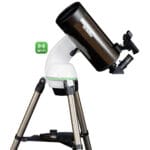
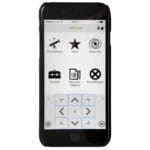
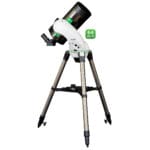
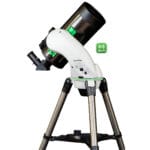


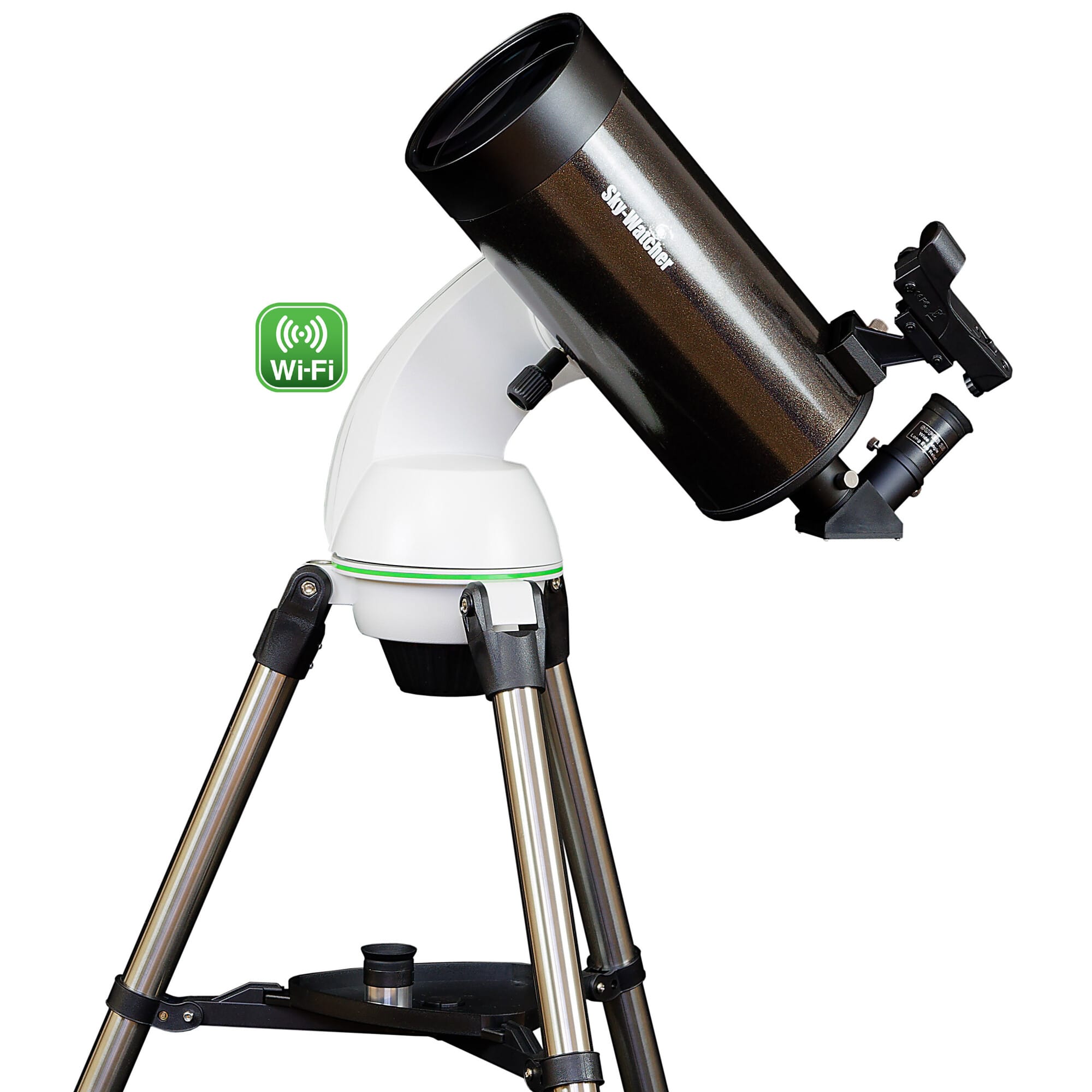
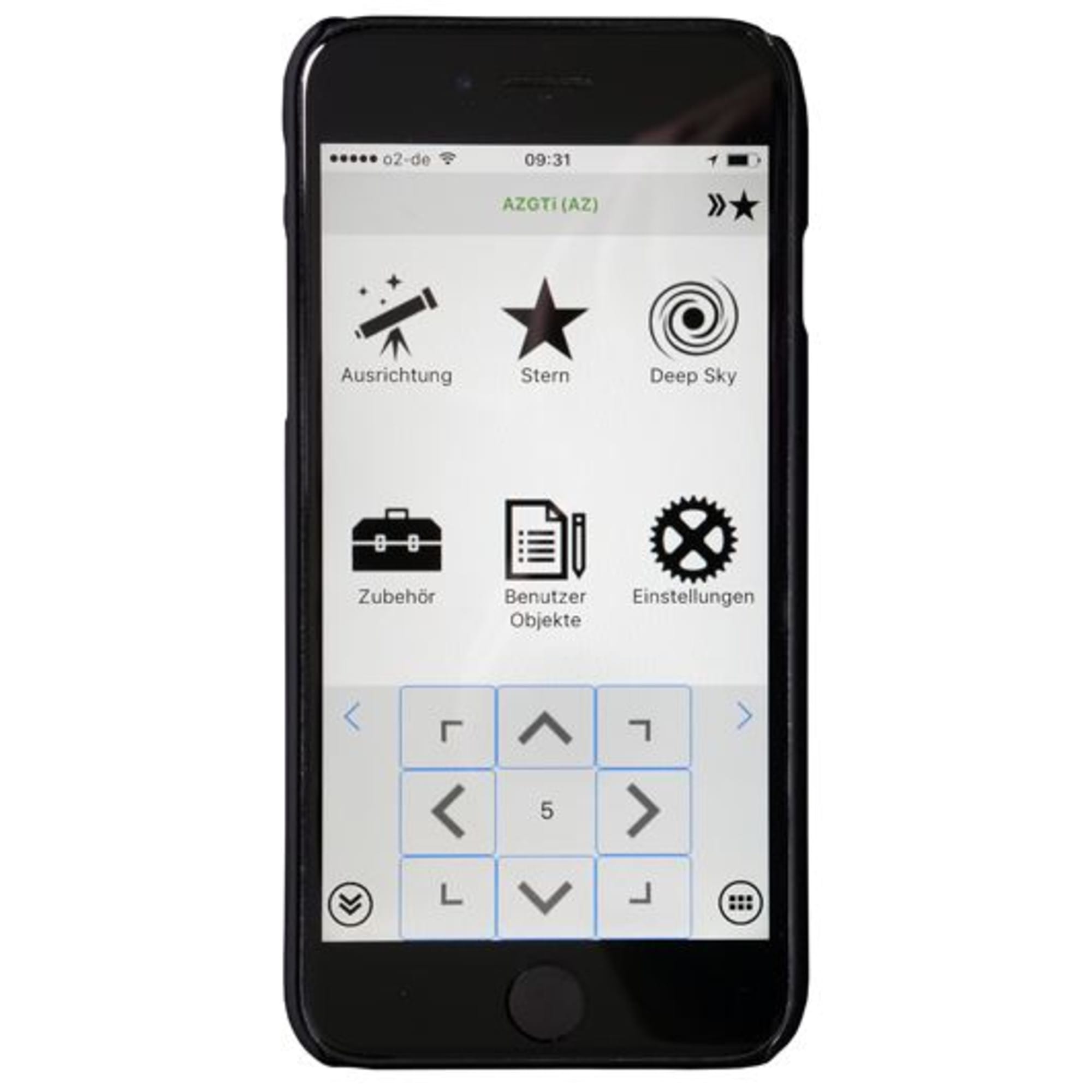
The Skymax-127 AZ-Go2 is a Maksutov-Cassegrain with a 127 mm aperture and a focal brandlength of 1500 mm (f/11.8), folded into a 33 cm closed tube. It mounts on the AZ-Go2, an alt-azimuthal GoTo mount with motors on both axes and its own Wi-Fi network: in the free SynScan app for iOS and Android, you choose an object from among over 10,000, the telescope rotates towards it and continues tracking. The entire system is mounted on a stainless steel tripod with an accessory platform. In the Skymax line from Sky-Watcher, 127 mm is the middle size between 102 and 150 mm; all versions are listed on the category page. Maksutov-Cassegrain telescopes.
What do you see through the Skymax-127?
Moons, planets, double stars and globular clusters are the core of this telescope. Moon: craters, mountain chains and the shadow line at 75x with the 20 mm eyepiece; at 150x with the 10 mm eyepiece the small craters at the bottom of the large ones and the ridges along the crater rims. Jupiter: the two dark cloud bands with color differences, the four large moons and at quiet nights the Great Red Spot and the shadow of a moon on the planet. Saturn: the ring apart from the planet, the moon Titan and at 150x the Cassini separation as a thin dark line in the ring. Mars: around an opposition the polar cap and dark spots on a small disk. Double stars: Albireo in orange and blue, the double star in the Pleiades at 150x separated into four stars. Globular clusters like M13 show a grainy ball that breaks apart at the edge into loose stars; the Ring Nebula is a small ring of smoke.
The field of view with the 20 mm eyepiece is approximately 0.7 degrees, slightly more than the full moon. The Pleiades, the Andromedan nebula, and the entire Orion nebula do not fit into that; for those extended objects a wide field of view is required. Dobson Of the same merk with short brandfocal length, Newton is the better choice. Nebulae and galaxies are seen with gray-scale vision, not in color. From a city or village with street lighting, the moon, planets, double stars, and star clusters are visible, making this telescope also suitable for a balcony. The highest meaningful magnification is approximately 254x; due to the air above the Netherlands and Belgium, 150 to 200x is the practical limit, and because the mount is attached, a planet at that magnification remains visible. What you can expect per object is stated in What do you see through a telescope?, Jupiter through a telescope, Saturn through a telescope and The Moon through a telescope.
How does the Skymax-127 AZ-Go2 differ from other 127 mm Maksutovs?
- Mounting: The AZ-Go2 is an alt-azimuthal GoTo mount with DC servo motors, built-in Wi-Fi and the SynScan app (over 10,000 objects; align on the brightest stars or with the tube plumbed north). A hand controller and internet are not required. Freedom Find does not name the manufacturer for this mount: after alignment, you use the arrow keys in the app, not by hand. Carrying capacity 5 kg and a Vixen saddle of 45 mm, so the tube will detach and fit on another mount with a Vixen saddle.
- Tube and optics: a 33 cm, 3.4 kg closed tube with a meniscus lens at the front; collimation is not required and no dust gets on the mirror. You focus with a button on the back that shifts the main mirror, and a camera with a T2 ring fits on the T2 wire on the back. The 127 mm tube takes 30 to 60 minutes to reach outside temperature; on humid evenings the meniscus lens covers it, and a dew cap prevents that.
- Included: eyepieces of 20 mm (75x) and 10 mm (150x), a 1.25 inch diagonal mirror of 90 degrees, a red dot finder, a smartphone adapter for phones with a width of 54 to 90 mm and the Star Gazers Handbook.
For whom yes and for whom no
Hello who especially wants to see the Moon, planets and double stars, and who wants the objects automatically to be searched for and tracked; who looks in the city or on a balcony and wants a telescope that is ready without collimation; and who wants a complete set with a tube of 33 cm and about 7.5 kg in total. If you are unsure about the mounting type, please read Tripods and mounts explained.
Not for extended nebulas, the Andromeda Nebula and star clusters; with a 0.7 degree field of view and f/11.8, that is a Dobson For long exposures of fog, an alt-azimuthal mount rotates the image during tracking; for that purpose, the smart telescopes made. You can take photos of the moon and the planets with this telescope using the supplied smartphone adapter on the eyepiece or with a planet camera in the eyepiece holder. If you want to be able to move the tube by hand after alignment without losing the alignment, then choose Same tube on the AZ-GTi with Freedom Find.
What's in the box
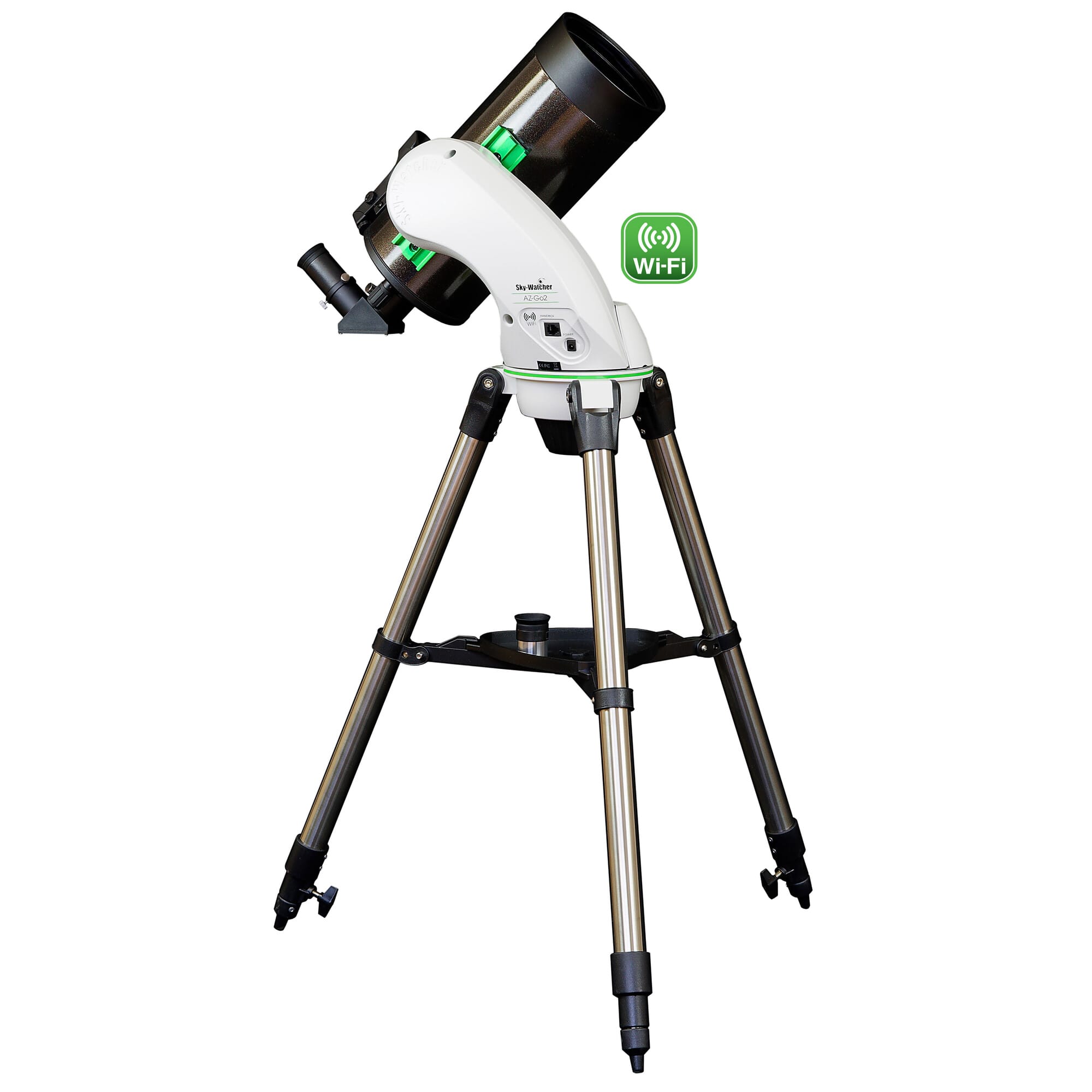
- Skymax-127 45 mm optic tube with dovetail
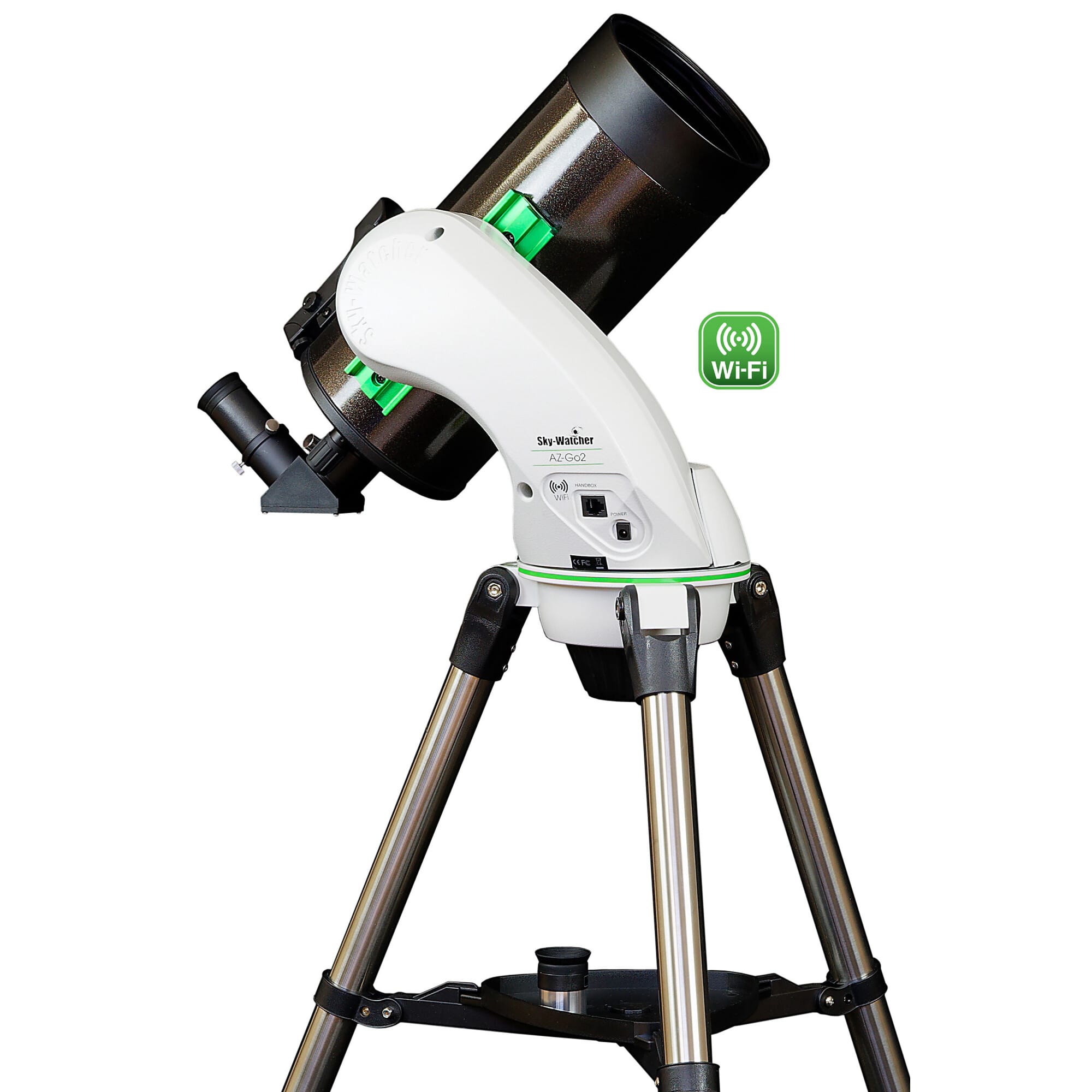
- AZ-Go2 GoTo mounting with built-in Wi-Fi
- Stainless steel tripod with accessory tray
- 20 mm eyepiece (75x), 1.25 inch
- 10 mm eyepiece (150x), 1.25 inch
- 90-degree diagonal mirror, 1.25 inches
- Red dot finder
- Smartphone adapter for phones with a width of 54 to 90 mm
- Handbook for Star Gazers (16 pages, Dutch)
Not included: batteries or power supply, dew cap, moon filter. Assembly requires 8 AA batteries or a 12 V power supply of 1 A; a power bank with 12 V output keeps it running for an evening, even in cold weather. A dew cap keeps the meniscus lens free of moisture on humid evenings. A moon filter keeps the bright moon at 75x and 150x.
Format and weight
Approximately 7.5 kg in total: the tube weighs 3.4 kg and, with the dovetail attached, it slides off the mounting; the mounting with a tripod weighs about 4 kg. The tube is 33 cm long and approximately 14 cm in diameter and fits in a small bag with diagonal and ocular mounts. The stainless steel tripod is height-adjustable; you can view it standing or on a stool, and with the diagonal mirror you can view the tube from the side, even when it is mounted high up. Place the tripod on a sturdy, flat surface: tiles or grass are fine, a wooden deck will vibrate with 150x.
First evening with the Skymax-127
- Cooling: Set the telescope outside for 30 to 60 minutes with the cap off; until the air in the closed tube reaches outside temperature, the image will vibrate at 150x magnification.
- Dew: on humid evenings the meniscus lens covers the front; a dew cap prevents that. Wipe the lens with a cloth but do not let it dry inside.
- Power: place 8 AA batteries or connect a 12 V power supply of 1 A with the positive terminal at the center of the plug; neither of these are included in the box.
- Setting up: Set the tripod level, clamp the tube with the dovetail in the saddle and line the red dot finder at day time on a distant object, for example a church tower.
- Alignment: Connect your phone to the mounting’s Wi-Fi network and open the SynScan app; internet is not required. Center the bright stars that the app suggests, then the mounting itself searches and tracks them. Do not rotate the tube by hand afterwards, otherwise you will have to align it again.
- Diagonal and ocular: Insert the diagonal mirror into the 1.25 inch holder, start with the 20 mm eyepiece (75x) on the moon and then switch to 10 mm (150x). Turn the focus knob until the image is small and sharp; a Maksutov requires several turns of the knob, a large fuzzy disc is not sharp.
- Do not look through a window; the glass and the temperature difference make the image blurry. Collimation is not necessary with this closed tube: a blurry image almost always results from cooling, fog, or turbulent air.
Which accessories are suitable?
- Omegon Powerbank 10k 37Wh 12V12 V output with a 5.5 x 2.1 mm plug and the plus in the middle, up to 1.5 A, 200 grams. The AZ-Go2 requires 12 V and 1 A, so the powerbank will power the installation for an entire evening without batteries.
- Omegon Moon Filter 25%, 1.25 inch: screws into the supplied eyepieces and reduces the glare of moonlight; 25% -thread fits openings up to 150 mm. More information can be found in the Moon filter guide.
- Sky-Watcher 32 mm Super Plössl eyepiece, 1.25 inch: 47x with 52 degree apparent field of view, about 1 degree of sky. That is the lowest magnification for this tube, for the entire moon with space around it and for larger star clusters.
Skymax-102 AZ-Go2, Skymax-127 AZ-Go2 or Skymax-150 Fusion-120i?
| Skymax-102 AZ-Go2 | Skymax-127 AZ-Go2 (this page) | Skymax-150 Fusion-120i | |
|---|---|---|---|
| Optics | 102 mm, 1300 mm brandfocal length (f/12.7) | 127 mm, 1500 mm brandfocal length (f/11.8) | 150 mm, 1800 mm brandfocal length (f/12) |
| Magnification with the included eyepieces | 65x and 130x | 75x and 150x | 64x (28 mm, 2 inch) |
| Highest meaningful magnification | about 204x, in practice 150 to 200x | about 254x, in practice 150 to 200x | about 300x, in practice 150 to 200x |
| Mount | AZ-Go2, wifi and SynScan app, 5 kg carrying capacity | AZ-Go2, wifi and SynScan app, 5 kg carrying capacity | Fusion-120i, WiFi, Bluetooth or hand controller, 12 kg carrying capacity |
| Stream | 8 AA batteries or 12 V | 8 AA batteries or 12 V | Built-in rechargeable battery |
| Weight | about 6 kg | about 7.5 kg, tube 3.4 kg | about 13 kg, tube 5.3 kg |
| Choose this as | you want the lightest set and find 130x enough for planets | You want 55% more lumens than 102 mm and you want to wear the set all at once | You want 40% more lumens than 127 mm and a mounting with your own battery |
Frequently asked questions about the Skymax-127 AZ-Go2
- How long should it cool down? 30 to 60 minutes, depending on the difference between inside and outside; until then, the image of the planets will vibrate. Leave it outside with the cap on while you align the mounting.
- Does the lens fog up? Yes, the meniscus lens in front attracts moisture on humid evenings. A dew cap prevents that; wiping the lens with a cloth will not remove the moisture but allow it to dry.
- What magnification does the standard ocular provide? 75x with the 20 mm ocular and 150x with the 10 mm ocular (1500 divided by the brandpoint of the ocular). The 20 mm ocular shows about 0.7 degrees of sky.
- Can I see deep-sky objects with it? Globular clusters, planetary nebulae and small bright nebulae; extended objects like the Pleiades, the Andromeda Nebula and the entire Orion Nebula do not fit within the 0.7 degree field of view. For that, a short- brandfocus Dobson telescope is the better choice.
- What power does he need? 8 AA batteries or a 12 V power supply of 1 A with the plus on the middle; neither of these are included in the box. Batteries run out quickly in the cold, a power bank with a 12 V output lasts longer.
- Is it suitable for a child? From the age of 8, together with an adult; from the age of 10, independently: the child chooses an object in the app and the telescope rotates towards it.
- Can I take photos with it? Of the moon and the planets: using the supplied smartphone adapter on the eyepiece, or with a camera on the T2 thread on the back (requires the T2 ring). Long exposures of clouds require an equatorial mount, because an alt-azimuth mount rotates the image during tracking.
Specifications
| Specification | Value |
|---|---|
| Optical design | Maksutov-Cassegrain, closed tube with meniscus lens |
| Opening | 127 mm (5 inch) |
| Focal length | 1500 mm |
| Opening ratio | f/11,8 |
| Highest meaningful magnification | about 254x |
| Mount | AZ-Go2, alt-azimuth GoTo with DC servo motors, Wi-Fi and SynScan app (iOS and Android), over 10,000 objects; Vixen mount 45 mm, load capacity 5 kg |
| Tripod | Stainless steel, height-adjustable, with accessory tray |
| Reporter | Internal focus via the main mirror, button on the back |
| Rear connection port | 1.25 inch eyepiece holder, integrated T2 thread |
| Seeker | Red dot finder |
| Included eyepieces | 20 mm (75x) and 10 mm (150x), 1.25 inch, with diagonal mirror of 90 degrees |
| Total weight | about 7.5 kg (tube 3.4 kg) |
| Tube length | 33 cm |
| Tube diameter | about 14 cm |
| Stream | 8 AA batteries (not included) or 12 V DC, 1 A, plug 5.5 x 2.1 mm with the plus in the middle |
Shipping and assistance
Orders with multiple items are shipped from multiple warehouses and may arrive in parts; each package will have its own tracking number. More information about this can be merk found on the Sky-Watcher brand page. Help with choosing or on the first evening: WhatsApp or call on weekdays from 9:00 to 17:00, or come by appointment in Sneek. 30 days' cooling-off period.


Reviews
There are no reviews yet.