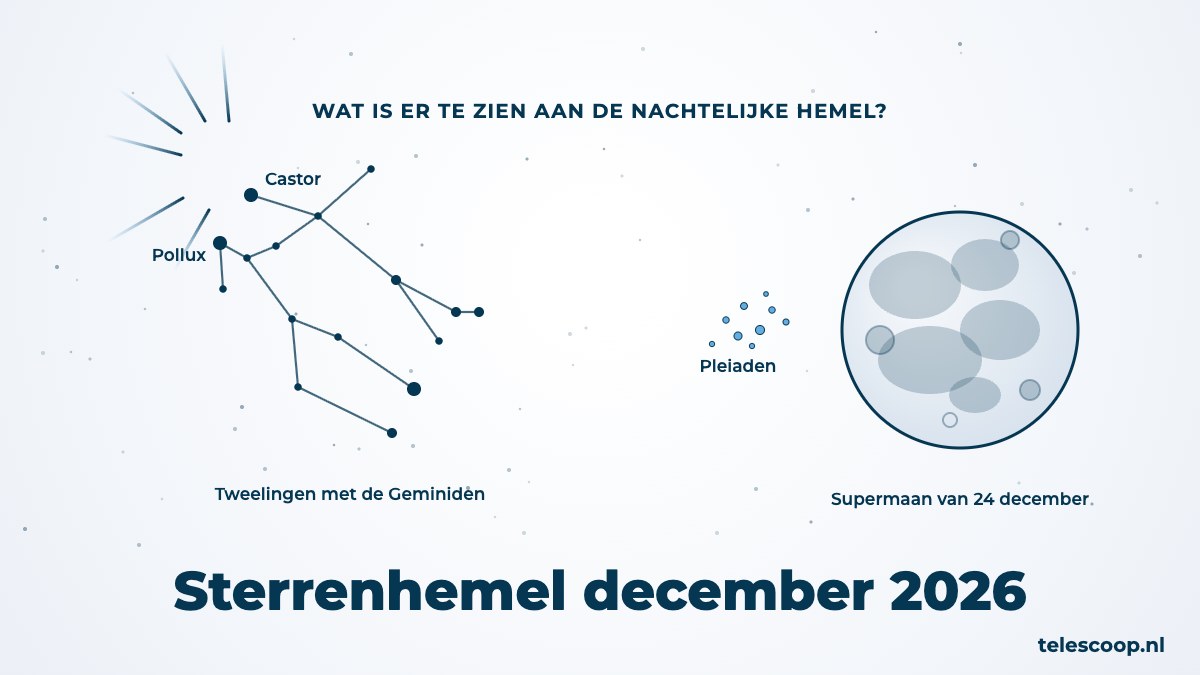
The starry sky in December 2026 is one to look forward to! In November, we were still looking at Saturn with a GoTo telescope in the garden. Now it’s Mars’ turn. It rises a little earlier every night and gets brighter throughout the month, on its way to its opposition in February. The Geminids fall this year without any disturbing moonlight, and we’ll try to spot them ourselves. Furthermore, the Moon will be closest to the Pleiades on the longest night of the year, and the closest full moon of 2026 will be on Christmas Eve. In this guide, you’ll learn what you can see with the naked eye and what you should use a binoculars or telescope for. All times are winter time and apply to central Netherlands.
The Moon Phases of December 2026
The moon determines how dark your nights are. Around new moon they are the darkest. From December 1 to December 12 the nights are moonless, and from December 6 to December 11 the entire night is dark.
| Last quarter | Tuesday, December 1 |
| New Moon | Wednesday 9 December, 01:52 hours |
| First quarter | Thursday 17 December |
| Full Moon (cold moon) | Thursday, December 24, 02:28 hours |
| Last quarter | Wednesday 30 December |
Geminid meteors in the nights of December 13th to 14th and 14th to 15th
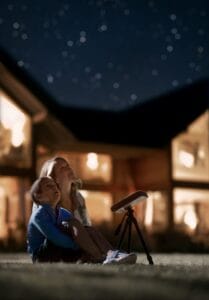
The Geminid meteor shower is really worth seeing this year! The moon is down on time, so you have a dark sky for the rest of the night. Choose especially the night of December 14th to 15th, which is closest to the maximum. The official maximum falls on Monday afternoon December 14th, during the day, but the activity remains high for a long time, so both nights are good. The Geminid meteor shower is the richest meteor shower of the year. They are often bright, fairly slow meteors, and sometimes you see one with a yellow or green color. From a dark spot outside the city, 30 to 60 meteors per hour are realistic.
| Night | Moon under | Most meteors |
|---|---|---|
| Sunday 13th on Monday 14th December | 20:34 hours | between midnight and 04:00 |
| Monday 14th to Tuesday 15th December | 21:47 hours | between midnight and 04:00 |
You don't need a telescope or binoculars for this. Find a place without streetlights and dress yourself as if you were going to sit outside for hours in silence. Give your eyes twenty minutes to get used to the darkness and don't look directly at the Twins, but a good distance away, for example towards Orion or the Great Bear. You can start as early as about an hour. A reclining chair and a thermos will make the difference between half an hour and the whole night. The Ursids of December 22 can be left this year, because the moon is almost full. All the major constellations of the year are visible this year, so you can watch them all at once. Guide to the Perseids and Other Meteor Showers.
Mars and Jupiter in the Leo
We are primarily planet observers, so this is what we look forward to the most. Mars and Jupiter are both in Leo and rise a little earlier every night. By mid-December they are already well above the eastern horizon at around 1:00 a.m., and by morning they are high in the south. Jupiter is the brightest object of the night and is close to Regulus, the brightest star of Leo, all month long. Mars is to the left of Jupiter. It gets brighter and bigger quickly in December, and that continues until its opposition on February 19, 2027. Every week you watch, the image gets better!
| Jupiter | Mars | |
|---|---|---|
| Rise in early December | 22:42 hours | 23:08 hours |
| Rise at the end of December | 20:42 hours | 21:51 hours |
| Highest score | between 05:00 and 06:00 hours, well over 50 degrees in the south | between 05:00 and 06:00 hours, well over 50 degrees in the south |
| Brightness | magnitude −2.1 to −2.3 | magnitude +0.5 to −0.1 |
| Opposition | February 11, 2027 | February 19, 2027 |
| Moon near | Sunday, December 27th, around 23:00 hours, more than 4 degrees from Jupiter and less than 2 degrees from Regulus | Monday 28th December, about 7 degrees from Mars |
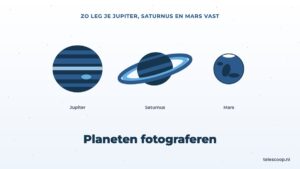
With a telescope, you can see the two dark bands of clouds and the four Galilean moons of Jupiter, which each night appear differently. On quiet nights, from a magnification of 150 times, you can see an orange disc with dark spots. You can read about what to expect from both planets in Jupiter through a telescope and Mars through a telescope. If you want to capture them, read on Photographing planets.
Saturn and Neptune in the early evening
Saturn is and remains our favorite. In December it sets earlier every week, so watch early in the evening when it is highest in the south. It then appears as a yellow-white “star” and is slightly dimmer than in November. We are now looking almost from the side at the rings. They are narrow, but every telescope from about 70 mm aperture shows the ring detached from the planet. With a Dobson telescope At an altitude of 150 or 200 mm, you can also see the large moon Titan in calm weather. You can find more tips in Saturn through a telescope.
| Early December | End of December | |
|---|---|---|
| Highest score | around 20:30, 39 degrees | around 18:30 hours |
| Destruction | around 2:30 AM | around 00:40 hours |
| Moon near | Thursday 17 December at the right of Saturn, Friday 18 December at the left of Saturn | |
Neptune is about 7 degrees to the right of Saturn in Pisces. You need a telescope or a smart telescope for that. How to recognize it, you can read in Neptune through a telescope.
The Pleiades cover of December 21 and Uranus
On Monday evening, December 21st, the longest night of the year, the nearly full moon slides past the Pleiades. Six stars of the constellation disappear one after another behind the moon. A star cover is one of the few things in the sky that you can really see happening. A star is there, and a few seconds later it’s gone!
The Moon will be high in the southwest. Use a telescope with a magnification of 50 to 100 times and point it a few minutes before the time in the table at the dark eastern edge of the Moon. The stars disappear there, and that is the easiest place to see them. The Moon will appear again at the illuminated edge and is more difficult to see. Set a moon filter in your eye when the image is too bright. With a telescope you can see the moon and the star cluster together, but the fainter stars disappear in the moonlight.
| Ster | Disappears | Coming back |
|---|---|---|
| Taygeta | 23:23 hours | 00:27 hours |
| Celaeno | 23:29 hours | 23:48 hours |
| Asterope | 23:43 hours | 00:51 hours |
| 22 Tauri | 23:47 hours | 00:53 hours |
| 18 Tauri | 23:48 hours | 00:20 hours |
| Maia | 23:53 hours | 00:27 hours |
Uranus is at about 5 degrees from the Pleiades that night, so you can take it with you right away. It was at opposition on November 25 and is still just as visible in December. In a telescope it looks like a little star. Look again a week later and you will see that it has shifted. With a telescope you can see a small blue-green disc from about 150 times magnification. The best time to look for it is on moonless nights until December 12. You can read more about this planet in Uranus through a telescope.
The supermoon of Christmas Eve
The full moon of December 24 is the last and largest supermoon of 2026, and the closest full moon of the year. A full moon that hangs low above the horizon is one of the most beautiful things to see. This time you have two chances. On the morning of December 24, it will still be low in the northwest-northwest around 8:00 AM, just before the sun rises. On Christmas Eve, it will be in the northeast just after sunset. If you want to photograph it, do it low above the horizon with something recognizable in the foreground. In Photographing the Moon It tells you how to approach it with a phone, camera or telescope. If you look at the full moon through a telescope, use a moon filter, because without a filter the image is too bright and flat. All the full moons of the coming year are listed in our lunar calendar.
| Full moon | Thursday, December 24, 02:28 hours, at 356,738 kilometers from Earth |
| Morning of December 24th | Around 8:00 a.m., about 11 degrees high in the northwest-west, sun at 8:47 a.m., moon at 9:39 a.m. |
| Christmas Eve | Moon at around 16:45 in the northeast, sun setting at 16:31 |
Venus as the morning star, Mercury only at the beginning of December
Venus is the morning star in the southeast all month long and rises almost four hours before the sun. After the moon she is the brightest object in the morning sky, so you can almost not miss it. Through a telescope you can see her crescent getting thicker and thinner every week. On Saturday morning December 5 there is a narrow crescent next to it. More about that in Venus through a telescope.
Mercurius can only be found in the first week of December, low to the left of Venus. You need a clear horizon and a pair of binoculars; after about 8 December it disappears into the morning twilight. Stop searching before the sun rises and never point a telescope or binoculars at this part of the sky if the sun is already above the horizon. You can read more about this tricky planet in Mercury through a telescope.
| Venus | Mercury | |
|---|---|---|
| Attendance | between 04:30 and 04:50 hours | only available for the first week |
| At 7:30 a.m. | about 21 degrees high in the southeast | at most 5 degrees above the southeast horizon |
| Lighted part | 28 percent at the beginning of December, almost half on New Year's Day | |
| Moon near | Saturday 5 December, watch between 06:30 and 07:45 |
Hues and star clusters on the dark evenings
On the moonless nights until December 12, you can also look beyond our solar system. It is completely dark all the way around 18:35 hours, so you don’t have to stay up late. The Andromeda Nebula is almost directly above you in the early evening of December. From a dark spot you can see it with the naked eye as a faint speck and with a telescope as a bright nebula. astronomical binoculars As a long, elongated light spot. How to find it step by step, you can read in View the Andromeda Nebula. The Pleiades are high in the sky later in the evening, and with a pair of binoculars you can count dozens of stars. The Orion Nebula appears through every telescope as a gray cloud around the four stars of the Trapezium. More about that in The Orion Nebula through a telescope.
| Object | Highest score at the beginning of December | Highest score at the end of December |
|---|---|---|
| Andromeda Nebula (M31) | around 20:40 hours, 79 degrees | around 18:45 hours |
| Pleiades | around 23:45, 62 degrees | around 21:45 hours |
| Orion Nebula (M42) | around 1:30 a.m., 33 degrees | around 23:30 hours |
| Sirius (rise) | around 22:15 hours | around 20:15 hours |
Do you want to capture the Orion Nebula, the Pleiades, or the Andromeda Nebula instead of just looking at them? Then the moonless nights until December 12 are the best period of the month for a night sky observation. smart telescope.
What do you need for the December sky?
- With only your eyes See the Geminid meteor shower, Venus with the lunar halo on December 5, Jupiter near Regulus with the moon on December 27, Saturn in the early evening, and the supermoon of December 24.
- With binoculars You can see the Moon at the Pleiades on December 21st, Uranus, the Andromedan Nebula, the Double Cluster and Jupiter's moons. A 10×50 on a tripod is enough to get started.
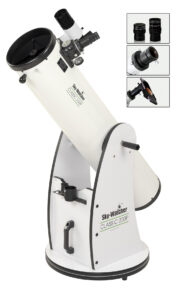
- With a telescope See the star cover of December 21st, the rings of Saturn and Titan, the cloud bands of Jupiter, the disk of Mars, the sickle of Venus, the disk of Uranus and the Orion Nebula. A Dobson gives the most opening per euro and therefore the most detail.
- With a smart telescope Take photos of the Orion Nebula, the Pleiades and the Andromedan Nebula on moonless nights until December 12.
We prefer to look at it ourselves with a GoTo telescope. That searches for the planet and keeps it in view, so you can chat for a while in between and then look again to see if it’s still there. GoTo Dobson that combines with the opening of a Dobson telescope.
Are you unsure which instrument suits you best, or do you want to put one under the Christmas tree? Our Beginner's Guide We would be happy to discuss your choices with you by phone, email or WhatsApp. In any case, we plan to watch the Geminid meteor shower together under the December sky. Have fun out there!
Would you like to know what is in the sky every month, with a notification in advance for special nights? Then sign up for our newsletter. newsletter.