Uranus through a telescope viewing is an experience for those looking beyond the familiar planets. This ice giant is much farther from Earth than Jupiter or Saturn and is therefore less conspicuous. Still, with the right preparation and a suitable telescope, Uranus is easily distinguishable from the background stars. Precisely because it is so subtle, observing it feels extra special.
What do you see when you view Uranus through a telescope?
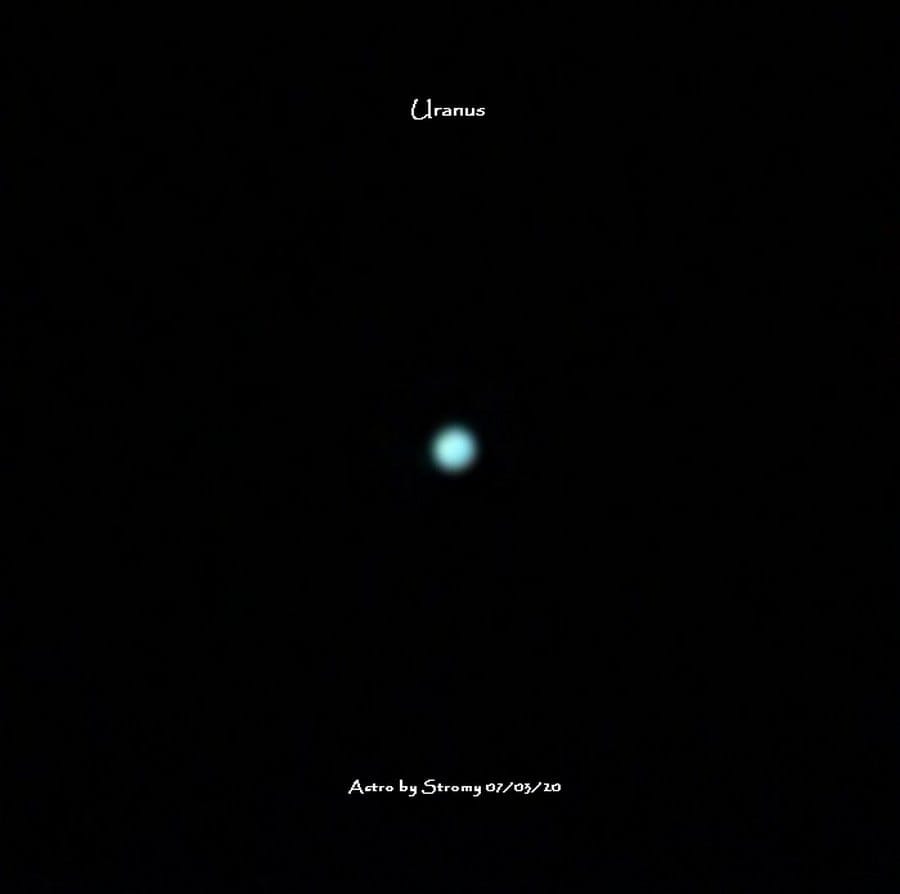
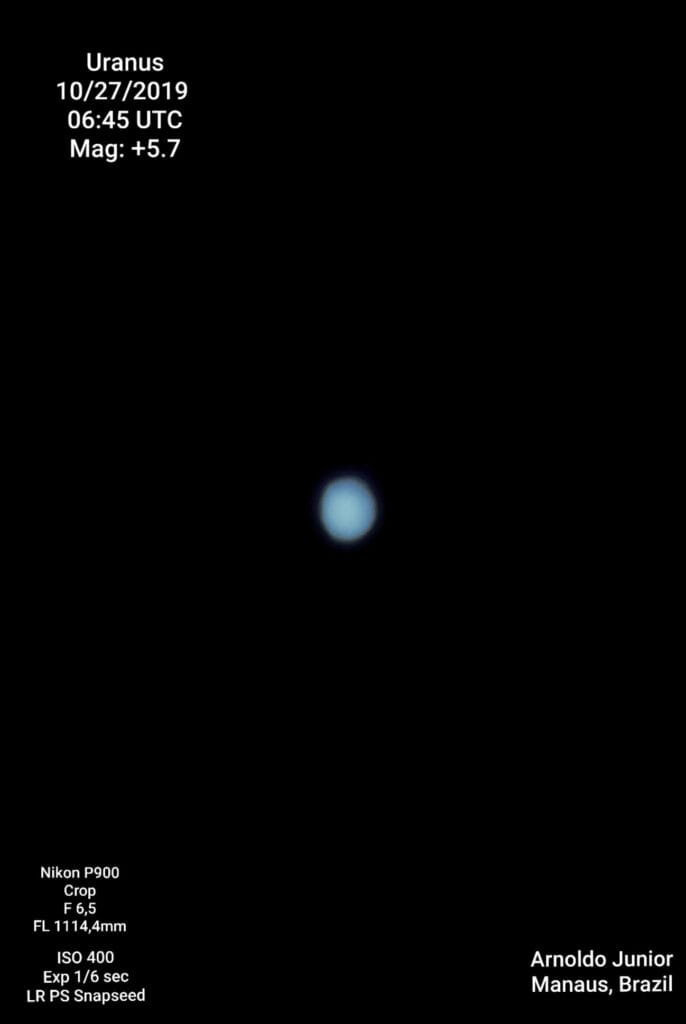
When you view Uranus through a telescope, you don't see a point of light like stars, but a small, even disc with a blue-green tint. That color is real and occurs because methane gas in the atmosphere absorbs red light. This leaves mostly blue and green light, which gives Uranus its distinctive appearance.
At magnifications around 100 to 150 times, the planetary disk becomes clearly visible. The image remains calm and even, with no obvious structures or cloud patterns. This is normal. Uranus has a deep, dense atmosphere with little contrast, so details are hardly noticeable visually. With larger telescopes and under exceptionally good conditions, slight differences in color can sometimes be observed, but do not expect bands as with Jupiter.
At sufficient aperture, you can also see some of the moons. The brightest ones, such as Titania and Oberon, then appear as faint dots right next to the planet.
When is Uranus best visible through a telescope?
Uranus is best visible around its opposition, a time that occurs about once a year. During opposition, the planet is directly opposite the sun in the sky, is visible all night and is relatively high. This makes observing considerably easier. To know when planets are in ‘opposition,’ it's best to use apps such as Stellarium use.
During this period, Uranus is usually in constellations such as Pisces or Aries, depending on the year. Although with a brightness around magnitude 5.7 it can be just visible to the naked eye under perfect conditions, it is virtually indistinguishable from stars without an aid. A star chart or planetarium app is therefore not a luxury, but a practical tool.
Do you need a telescope to see Uranus?
Yes, a telescope is necessary to really recognize Uranus as a planet. Without a telescope, you see at most a faint star-like point. With a telescope, its round shape becomes visible and you immediately distinguish it from stars.
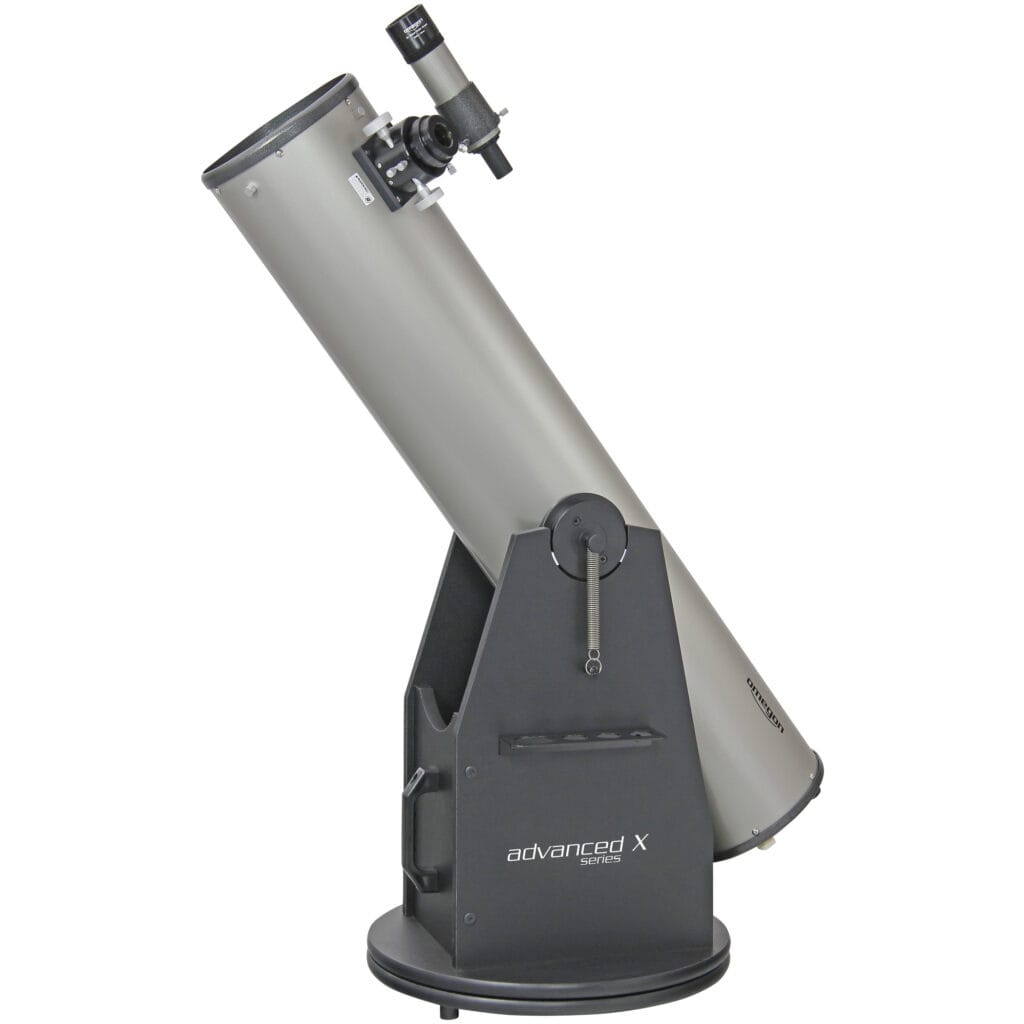
An aperture of about 60 millimeters is sufficient to recognize the disc, but a larger aperture makes the image quieter and observation more pleasant. With telescopes from about 100 millimeters, it becomes easier to also see moons and observe the color clearly. Higher magnifications help, but only as long as the sky is calm and the mount remains stable.
Filters are not a requirement, but a light blue or violet filter can sometimes help make subtle contrast differences a little more visible. Don't expect miracles, but for experienced observers it can give a slight improvement.
What makes Uranus through a telescope so special to observe?
Uranus is not a planet of spectacle, but of nuance. Its color is unique among the planets and its axis of rotation is extremely skewed, at an angle of about 98 degrees. That means Uranus moves through the solar system “on its side,” so to speak. Seasons there last decades and proceed completely differently than on Earth.
Historically, Uranus is also special. It was the first planet discovered with a telescope, in 1781 by William Herschel. This proved for the first time that the solar system was larger than had been thought for centuries.
How do you find Uranus in the sky?
Because Uranus moves slowly among the stars and is not very noticeable, preparation is important. Always start with low magnification to find the right star field. Once you are sure you have the right object in view, you can increase the magnification step by step until the disc becomes clearly visible.
Nearby star patterns and a planetarium app make recognition considerably easier. Without tools, Uranus is virtually indistinguishable from stars.
Uranus through a telescope: our opinion
Seeing Uranus through a telescope is not a quick reward, but a subtle discovery. Don't expect bright rings or stormy clouds, but a calm, blue-green planet nearly three billion kilometers away. It is precisely this subduedness that makes Uranus interesting for observers who want to look beyond the familiar objects.
With a telescope of sufficient aperture, patience and good preparation, Uranus can be observed excellently. Those who also want to observe other planets would do well to choose a telescope that is not only powerful, but also stable and comfortable to use. A focused buying guide will help you make the right choice and get the most out of every clear night.