


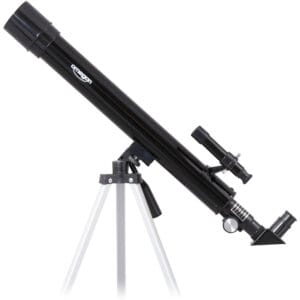
The AC 70/700 AZ-2 is an achromatic lens telescope with a 70 mm aperture and 700 mm focal brandlength (f/10) on the azimuthal AZ-2 mount with an aluminum tripod. In the Omegon AC series it stands between the 60 mm model with a reversing lens and the 102 mm model on the AZ-3: 36% more light than the 60 mm model, and with f/10 a longer brandfocal length per millimeter opening than the 102 mm model (f/6.5), which keeps the chromatic edge of an achromatic lens small. Two eyepieces, a 2x Barlow lens, a red dot viewfinder and a diagonal sight are included in the box, so on the first evening you don't need anything else. How the series of these merk relate to each other is explained in the Omegon merkguide.
What do you see through the AC 70/700?

Moon: craters, mountain ranges and the shadow line at 70x with the 10 mm eyepiece; at 140x (10 mm with the Barlow) the small craters at the bottom of the large ones, as long as the air is calm. Along the bright edge of the moon you see a thin bluish-purple rim; that is the chromatic aberration of an achromat and is characteristic of this lens type. Jupiter: the two dark main bands and the four large moons, which change place from evening to evening. Saturn: the ring apart from the planet at 70x, with the moon Titan as a small star next to it. Venus shows its disk shapes; Mars remains a small orange disk. Deep-sky: the Pleiades fill the field of view at 35x, the Orion Nebula shows the four Trapezium stars in a gray nebulosity, Albireo splits into a yellow and a blue star, and from a dark spot the Andromedan Nebula is an oval light spot. With the 20 mm eyepiece (35x) you see about 1.4 degrees of sky, almost three times the moon. Nebulae and galaxies are seen in gray tones, not in color. From a city or village with street lighting, the moon, planets, double stars and star clusters remain; nebulae and systems require a dark spot. The highest meaningful magnification is approximately 140x, twice the opening in millimeters; in most evenings this is also the usable limit due to the air above the Netherlands and Belgium. What you can expect per object is stated in What do you see through a telescope?, Jupiter through a telescope, Saturn through a telescope and The Moon through a telescope.
How does the AC 70/700 differ from other 70 mm refractors?
- Optics: an achromatic doublet lens of 70 mm with a 700 mm focal brandpoint (f/10). The long focal brandpoint keeps the color edge smaller than with 70 mm viewers with a 400 or 500 mm focal brandpoint and with the 10 mm eyepiece it already gives 70x without a Barlow.
- Mounting and tripod: the AZ-2 moves left-right and up-down, has fine adjustment for height and locks in both axes, so that a found object stays in place while changing eyepieces. The aluminum tripod is adjustable to about 120 cm and has an accessory plate for the eyepieces.
- Complete: two eyepieces (35x and 70x), 2x Barlow lens, red dot viewfinder and 90 degree diagonal; with a total weight of 4 kg; that is the same weight as the 60 mm model in this series, with 36% more light.

For whom yes and for whom no
Hello Anyone looking for a first telescope for the moon and planets from their garden, balcony or village; anyone who wants a complete set without electricity and without alignment; anyone who carries 4 kg at a time and looks at it sitting or standing on a tripod up to 120 cm away. If you’re unsure, read the Telescope Buying Guide for Beginners.
Not for long exposures of nebulas and galaxies; an assembly is required for that that follows the sky; look for it smart telescopes. Photos of the moon and the planets are possible with a smartphone adapter attached to the eyepiece (not included). If you want to take photos with your phone from the first evening and have a straight image during the day, then the the Horizon version of this 70/700 Bring a smartphone adapter, Bluetooth splitter, and amigo prism. If you want to see nebulae and galaxies, choose the 102 mm model from this series with more than twice as much light, or a Dobson with a mirror of 150 mm or more.
What's in the box

- Optical tube AC 70/700 with lens cap
- AZ-2 azimuthal mounting with fine movement in height
- Aluminum tripod with accessory tray
- 20 mm eyepiece (35x), 1.25 inch, for searching, star clusters and the entire moon
- 10 mm eyepiece (70x), 1.25 inch, for the Moon and Planets
- 2x Barlow lens, 1.25 inch: doubles to 70x and 140x
- Red dot sight
- 90-degree diagonal, 1.25 inches
Not included: moon filter, smartphone adapter, amici prism. At 70 mm, the full moon is bright enough to leave a ghosting effect; a 30% mm moon filter softens that; a smartphone adapter clamps your phone to the eyepiece for photos of the moon; the included diagonal gives a mirrored image; for birds and landscapes during the day, you need an amici prism.
Format and weight
4 kg complete: tube, mounting and tripod together. Everything comes in one box of 76 x 27 x 27 cm, so the tube is shorter than 76 cm. The tripod is adjustable from about 70 to 120 cm; by diagonal view you see from above in the tube, sitting on a low tripod and standing with the legs extended. It stands on the ground, not on a table.

First evening with the AC 70/700
- Remove the lens cap and place the tripod on a flat surface with the legs fixed; focus with both axes unlocked and lock the focus once the subject is in focus.
- Line the red dot viewfinder at day time on a distant object, for example a church tower or chimney: first focus with the 20 mm eyepiece, then set the red dot with the screws at the same point.
- Do not look through a window; the glass and the temperature difference make the image blurry.
- Start with the 20 mm eyepiece (35x) and look for the moon; then switch to the 10 mm eyepiece (70x). Only insert the Barlow when the image is stable at 70x.
- Rotate the focus lever until the image is small and sharp; a large blurry disc is not sharp.
- Set the telescope outside for 20 to 30 minutes before viewing; a 70 mm lens cools down faster than a mirror, but a warm tube produces shaky images.
- A lens telescope does not need to be collimated. If you see nothing or only a blur, the viewfinder is crooked or the magnification is too high; after a few hours the lens may become foggy; then put the lens cap on and let it dry inside, never wipe it off. More causes are listed in Why can't I see anything through my telescope?.
Which accessories are suitable?
- Omegon Cronus WA 7 mm eyepiece, 1.25 inch: 100x with a wider field of view and more eye distance than the 10 mm eyepiece with the Barlow; the magnification at 70 mm gives the best image of Jupiter and Saturn most often.
- Omegon Premium Moon Filter 1.25 inch30% aperture, intended for telescopes up to 150 mm; screws into the included eyepieces and suppresses the full moon.
- Omegon Smartphone Adapter for eyepieces from 25 to 48 mmClamps around the ocular and holds the camera lens of your phone above the eye of the ocular for moon photos at 35x and 70x.
- Omegon Helievo solar filter: foil in a ring that clips onto the tube beforehand; measure the circumference of the front of the tube, divide by 3.14 and choose the size that corresponds to that result.
AC 60/700, AC 70/700 or AC 102/660?
| AC 60/700 AZ-1 | AC 70/700 AZ-2 (this page) | AC 102/660 AZ-3 | |
|---|---|---|---|
| Lens | 60 mm, f/11.7 | 70 mm, f/10 | 102 mm, f/6.5 |
| Highest meaningful magnification | about 120x | about 140x | about 200x, in practice 150x |
| Mount | AZ-1, fine movement in height | AZ-2, fine motion in height, locking on both axes | AZ-3, fine movements on both axes |
| Sharpener and oculairs | 1.25 inch eyepiece; 20, 12.5 and 4 mm, 2x Barlow, 1.5x flip lens | 1.25 inch telescope eyepiece; 20 and 10 mm, 2x Barlow | 2 inch threaded rod with 1.25 inch adapter; 20 and 10 mm |
| Weight and box | 4 kg, box 84 cm | 4 kg, box 76 cm | box 73 cm |
| Moon and planets | crater, the moons of Jupiter, the ring of Saturn at 56x | crater sizes up to 140x, the main bands of Jupiter, the ring of Saturn with Titan | the Great Red Spot, on the best nights the Cassini division |
| Choose this as | a child or beginner wants to look straight ahead during the day | you want a complete set for the moon and planets without alignment | You also want to see the Orion Nebula and star clusters with structure |
Frequently asked questions about the AC 70/700
- Is it suitable for a child? From 8 years old together with an adult, from 10 years old independently: 4 kg complete, no alignment, and the moon is visible within a minute with the 20 mm eyepiece.
- Can I take photos with it? Of the moon and the planets, using a smartphone adapter on the 20 mm or 10 mm eyepiece (35x or 70x); long exposures of nebulas and galaxies require a mount that follows the sky.
- Which sun filter fits it? A filter that fits on the tube before it. Measure the circumference of the front of the tube, divide by 3.14 and choose on the page of the Omegon Helievo The size that this outcome falls into. Cover the viewfinder and check the film for each use. Never use an eclipse glasses behind the viewfinder or a filter in the eyepiece.
- Do I need to collimate it? No; the lens is stuck in the tube and remains aligned, even after transport. That’s the difference with a reflecting telescope.
- Is it on a table or on the ground? On the ground, on the supplied tripod of about 70 to 120 cm. A table is not necessary and makes the setup wobble.
- Can I watch it during the day? Yes, but with the supplied diagonal, the image is upright and mirrored. For birds and landscapes, replace the diagonal with a amici-prisma of 1.25 inch.
Specifications
| Specification | Value |
|---|---|
| Optical design | Achromatic refractor, double lens |
| Opening | 70 mm |
| Focal length | 700 mm |
| Opening ratio | f/10 |
| Lens | Achromatic double lenses of 70 mm, capture 100 times as much light as the eye |
| Highest meaningful magnification | about 140x |
| Separating power | 1.64 seconds |
| Mount | AZ-2 azimuth drive with fine movement in height and locking on both axes |
| Tripod | Aluminium, adjustable from approximately 70 to 120 cm, with accessory panel |
| Reporter | Rack, 1.25 inch |
| Seeker | Red dot |
| Included eyepieces | 20 mm (35x) and 10 mm (70x), 1.25 inch; 2x Barlow lens |
| Diagonal | 90 degrees, 1.25 inch |
| Total weight | 4 kg |
| Tube length | less than 76 cm |
| Packed | 76 x 27 x 27 cm |
Shipping and assistance
Orders with multiple items are shipped from multiple warehouses and may arrive in parts; each package will have its own tracking number. More information about this can be merk found on the Omegon brand page. Help with choosing or on the first evening: WhatsApp or call on weekdays from 9:00 to 17:00, or come by appointment in Sneek. 30 days' cooling-off period.
Reviews
There are no reviews yet.