


The AstroMaster 70EQ is a refractor with a achromatic lens of 70 mm and a focal brandlength of 900 mm (f/12.9), on a manual CG-2 German equatorial mount with adjustment circles, fine-adjustment cables on both axes and a steel tripod. It is the same tube as in the azimuthal version of the AstroMaster series, on a mount whose one axis points towards the Pole Star: you then follow the object with one cable. The long brandtip of the supplied 10 mm eyepiece already gives 90x, and the color edge of the lens remains thin. The series of this merk are side by side in the Celestron brand guide.
What do you see with the AstroMaster 70EQ?

Moon: craters, mountain ranges and the shadow line at 45x; at 90x with the 10 mm eyepiece, the central mountain peaks in large craters and the ridges along the shadow line. Jupiter: the two dark main bands and the four large moons, which change place from evening to evening. Saturn: the ring detached from the planet and the moon Titan as a faint star next to it. Double stars like Albireo with their color difference, a strong point of a long- brandfocus refractor. Deep-sky: with the 20 mm eyepiece you can see about 1 degree of sky, twice the Moon; the bright stars of the Pleiades fill the field of view; the Orion Nebula is a gray spot with the four Trapezium stars; the Andromedan system from a dark spot is a long oblong spot. Nebulae and galaxies are seen with the eye in gray tones, not in color. From a city or village with streetlights, the Moon, planets, double stars, and star clusters remain; nebulae and galaxies require a dark spot. The highest meaningful magnification is about 140x, twice the opening in mm; at 90x a planet without guidance drives through the image in one and a half to two minutes, with the cable of the straight climb holding it in the center. What you can expect per object is stated in What do you see through a telescope?, Jupiter through a telescope, Saturn through a telescope and The Moon through a telescope.
How does the AstroMaster 70EQ differ from other 70 mm refractors?
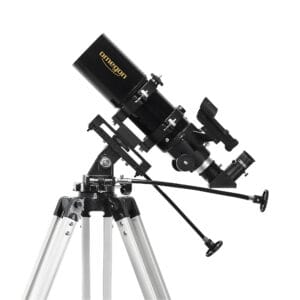
- Mounting: the AstroMaster 70EQ is mounted on a CG-2 German equatorial mount with a width adjustment of approximately 20 to 60 degrees, adjustment rings on both axes, a counterweight bar with two counterweights and fine motion cables for straight climbing and declination. If the polar axis is on the Pole Star, then you follow a single cable for the planet.
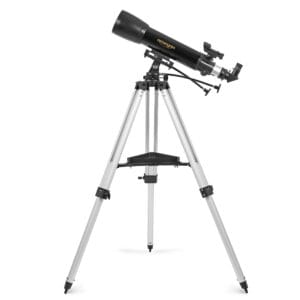
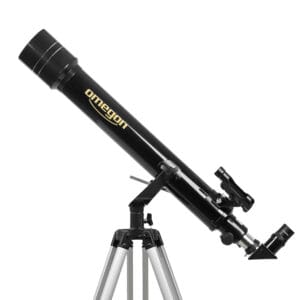
- Optics and tube: Fully coated achromatic lens of 70 mm at f/12.9 in an aluminum tube with a 1.25 inch dovetail focus ring; the tube is attached with a CG-2 dovetail on the mount and slides back and forth to balance the lens.
- Included: two eyepieces (20 mm for 45x and 10 mm for 90x), a 90-degree flip-up prism with upright image, the StarPointer red dot viewfinder, a steel tripod with 32 mm legs, and accessory platform, and planetarium software (Starry Night Basic and the SkyPortal app).

For whom yes and for whom no
Hello who wants to learn how the sky rotates and how an equatorial mount works, as a stepping stone to a larger mount; who wants to follow planets and double stars at 90x with a single cable instead of pushing; who wants to watch without power, batteries or an app. If you’re unsure, then read the Telescope Buying Guide for Beginners.
Not For those who want to direct the light without a pole and counterweight, for example with children; choose same tube on the azimuth mounting with pan handle. For nebulas and galaxies as the main target; with 70 mm, those faint spots remain, The 90 mm model on the CG-3 captures 65% more light. For long exposures of fog, a motor-driven mount and precise pole alignment are required; see the smart telescopes; photos of the moon and the planets work well, using a smartphone adapter on the eyepiece.
What's in the box

- Optical tube 70/900, aluminum, achromatic lens, on CG-2 dovetail
- CG-2 equatorial mounting with adjustment rings, width adjustment and steel tripod, pre-assembled, with accessory plate
- Fine motion cables for straight climbing and declination
- Counterweight bar with two counterweights of 0.9 kg
- 20 mm eyepiece (45x), 1.25 inch, for the entire moon and star fields
- 10 mm eyepiece (90x), 1.25 inch, for the Moon and planets
- 90-degree reverse prism, 1.25 inch, upright image
- StarPointer Red Dot Finder
- Manual, Starry Night Basic (download) and the SkyPortal app
Not included: moon filter, smartphone adapter, 7 mm eyepiece. A moon filter makes the moon appear calmer to the eye at 45x wide-angle full moon; with a smartphone adapter over the 20 mm eyepiece, you can take moon photos while the cable from the straight climb keeps the moon in focus; a 7 mm eyepiece gives 129x for the planets on calm nights.
Format and weight
4.7 kg for the tube, mounting and tripod (tube 1.3 kg, mounting with tripod 3.4 kg); with the two counterweights of 0.9 kg added, about 6.5 kg. The tube is 91 cm long and 7.3 cm in diameter. The mounting tripod stands 81 to 130 cm high; with a refractor, the eyepiece is located at the rear of the tube, so the higher you aim, the lower the eyepiece. It stands on the supplied tripod; a table is not required. For transport, the tube and the counterweights are removed from the mounting.

First evening with the AstroMaster 70EQ

- Slide the tripod onto a flat surface, screw the counterweight rod into it, place the counterweights on it and clamp the tube with the dovetail on the mounting. Remove the lens cap, insert the reversing prism and 20 mm eyepiece into the viewfinder and slide the tube and counterweights until the tube stays attached when you release the clamps.
- Orient the pole axis of the mounting to the north and set the width adjustment to approximately 52 degrees (the Netherlands and Belgium), so that the axis points towards the North Pole; for most purposes this is accurate enough.
- Line the StarPointer across the day at a distant object, for example a church tower or chimney, with the object in the center of the 20 mm eyepiece.
- Do not look through a window; the glass and the temperature difference make the image blurry.
- Start with the 20 mm eyepiece (45x) and look for the moon; follow it with the cable of the straight climb and then switch to the 10 mm eyepiece (90x).
- Rotate the focus lever until the image is small and sharp; a large blurry disc is not sharp.
- Set the telescope outside 20 minutes before viewing. You don't collimate a refractor; the lens is fixed; if the lens is covered, let it dry indoors and never wipe it off. An unsmooth image almost always comes from the focusing system or a fogged lens, see Why can't I see anything through my telescope?.
Which accessories are suitable?
- Celestron Luminos eyepiece 7 mm, 1.25 inch: 129x with an 82 degree field of view, for the Moon and planets on calm nights; the wide field of view keeps a planet in view longer between two turns on the cable.
- Celestron Omni eyepiece 32 mm, 1.25 inch: 28x with 48-degree field of view, approximately 1.7 degrees of sky against approximately 1 degree with the supplied 20 mm eyepiece, so the Pleiades fit into a single image; 22 mm eye distance, also usable with glasses.
- Omegon Premium Moon Filter 1.25 inch: Approximately 30% apertures, the size for 70 to 114 mm openings; screws at the bottom for 1.25 inch eyepieces with filter thread and keep the moon steady at 45x full moon for the eye.
- Omegon Smartphone Adapter for eyepieces from 25 to 48 mmClamps around the supplied eyepieces, which are 34 mm wide, and holds the phone camera above the eyepiece for moon shots at 45x or 90x.
AstroMaster 70AZ, AstroMaster 70EQ or AstroMaster 90EQ?
| AstroMaster 70AZ | AstroMaster 70EQ (this page) | AstroMaster 90EQ | |
|---|---|---|---|
| Optics | 70 mm lens, 900 mm brandfocal length (f/12.9) | 70 mm lens, 900 mm brandfocal length (f/12.9) | 90 mm lens, 1000 mm brandfocal length (f/11) |
| Mount | adjustable with pan handle, no counterweight | CG-2 equatorial, fine-motion cables on both axes, adjustment rings, two counterweights | CG-3 equatorial, fine movements on both axes, adjustment circles |
| Magnification with the included eyepieces | 45x and 90x | 45x and 90x | 50x and 100x |
| Highest meaningful magnification | about 140x | about 140x | about 180x |
| Weight according to Celestron | 4.9 kg | 4.7 kg without the counterweights | 6.2 kg |
| Choose this as | You want to direct the shot immediately without the pole and counterweight | You want to learn how the sky works and want to follow planets with one cable | You want 65% more light on a heavier equatorial mount |
Frequently asked questions about the AstroMaster 70EQ
- Is it suitable for a child? From the age of 8, together with an adult; from the age of 10, independently; the first times an adult will be involved in aligning the pole and balancing the counterweights.
- Can I take photos with it? Of the moon and the planets, using a smartphone adapter on the 20 mm eyepiece (45x) or the 10 mm eyepiece (90x); long exposures of nebulas and galaxies require a motorized mount and precise polar alignment.
- Can a follow motor be installed? There is no motor of the same type merk in our range for the CG-2 of this model, and motors from other merkbrands do not guarantee a proper fit on the axle and the sprocket. For follow-up use, follow the cable from the straight climb.
- How precisely should the polar axis be positioned? For orientation, the width setting is 52 degrees and the axis is oriented toward the Pole Star; then you can follow it with just one cable and only need to adjust the declination occasionally.
- Which sun filter fits it? A filter that fits on the tube before it. Measure the circumference of the front of the tube, divide by 3.14 and choose on the page of the Omegon Helievo The size that that outcome falls into. Cover the viewfinder, check the film for each use, and never use an eclipse glasses behind the viewfinder or a filter in the eyepiece.
- Can I use it during the day? Yes, the reversing prism produces a upright image. The axes of an equatorial mount are at an angle, so turning along the horizon involves two axes at the same time; for birds and landscapes, the azimuthal version is more convenient; the equatorial version, in contrast, tracks the moon and planets with one cable.
Specifications
| Specification | Value |
|---|---|
| Optical design | Refractor, achromatic lens |
| Opening | 70 mm |
| Focal length | 900 mm |
| Opening ratio | f/12.9 |
| Lens | 70 mm achromatic, fully coated; aluminum tube with a diameter of 7.3 cm |
| Highest meaningful magnification | about 140x |
| Mount | CG-2 German equatorial mount, manual, fine-adjustment cables on both axes, adjustment rings, width approximately 20 to 60 degrees |
| Counterweight | Two counterweights of 0.9 kg on a counterweight bar |
| Tripod | Steel legs, 32 mm diameter, 81 to 130 cm high, with mounting, accessory platform |
| Reporter | 1.25 inch rack |
| Seeker | StarPointer red dot |
| Diagonal | 90-degree reverse prism, 1.25 inch, upright image |
| Included eyepieces | 20 mm (45x) and 10 mm (90x), 1.25 inch |
| Total weight | 4.7 kg without counterweights (tube 1.3 kg, mounting with tripod 3.4 kg) |
| Tube length | 91 cm |
| Packed | 96 x 27 x 27 cm |
Shipping and assistance
Orders with multiple items are shipped from multiple warehouses and may arrive in parts; each package will have its own tracking number. More information about this can be merk found on the Celestron brand page. Help with choosing or on the first evening: WhatsApp or call on weekdays from 9:00 to 17:00, or come by appointment in Sneek. 30 days' cooling-off period.
Reviews
There are no reviews yet.