
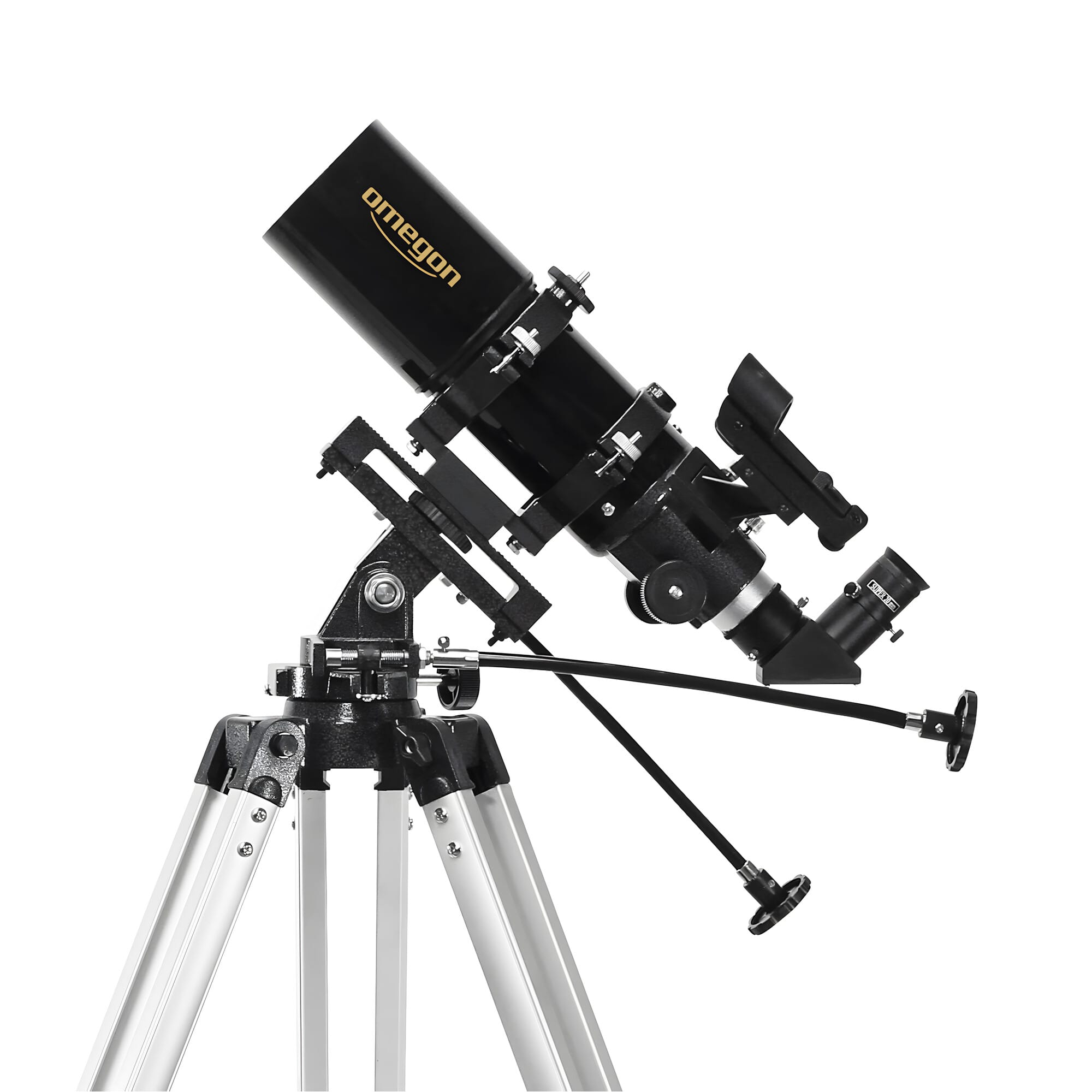
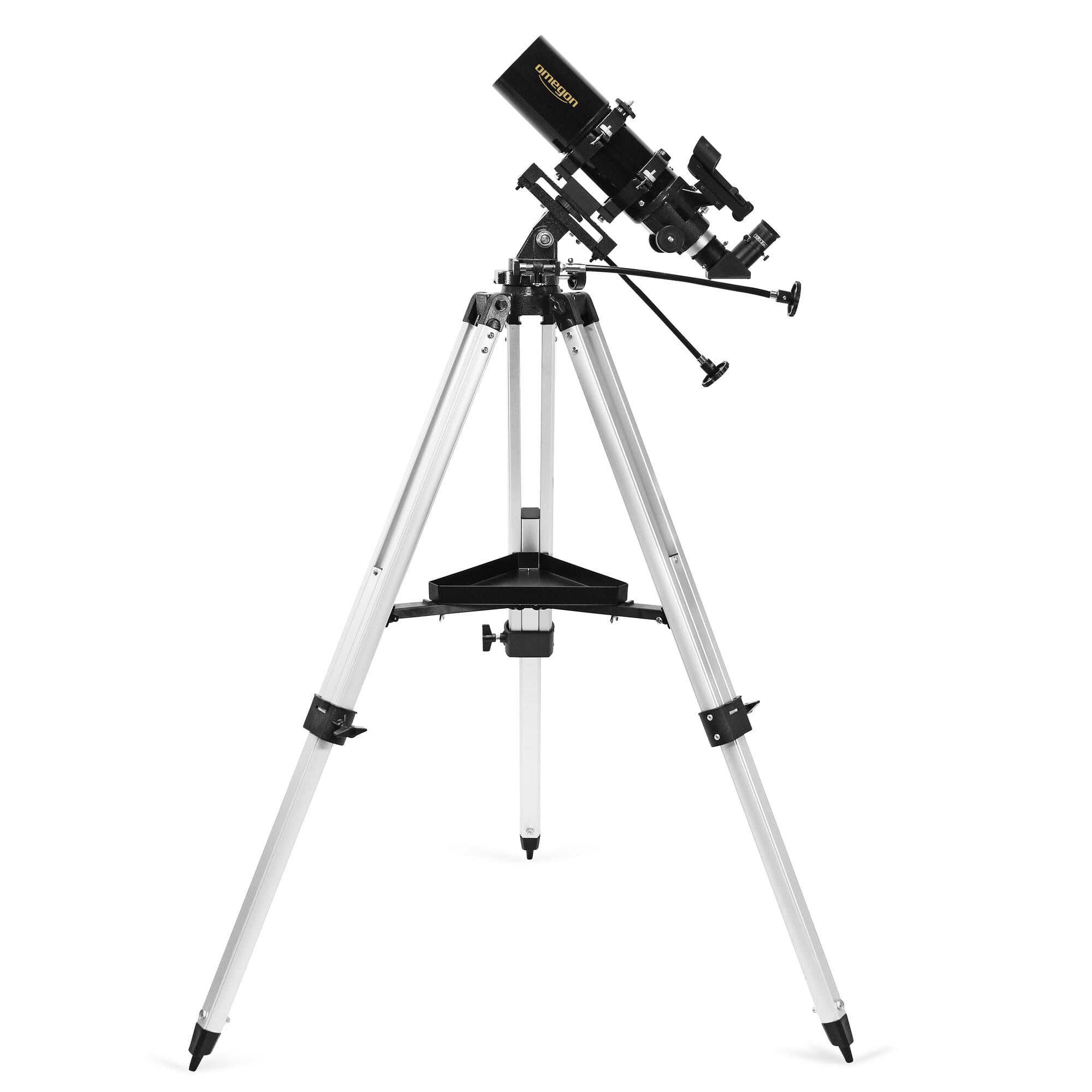
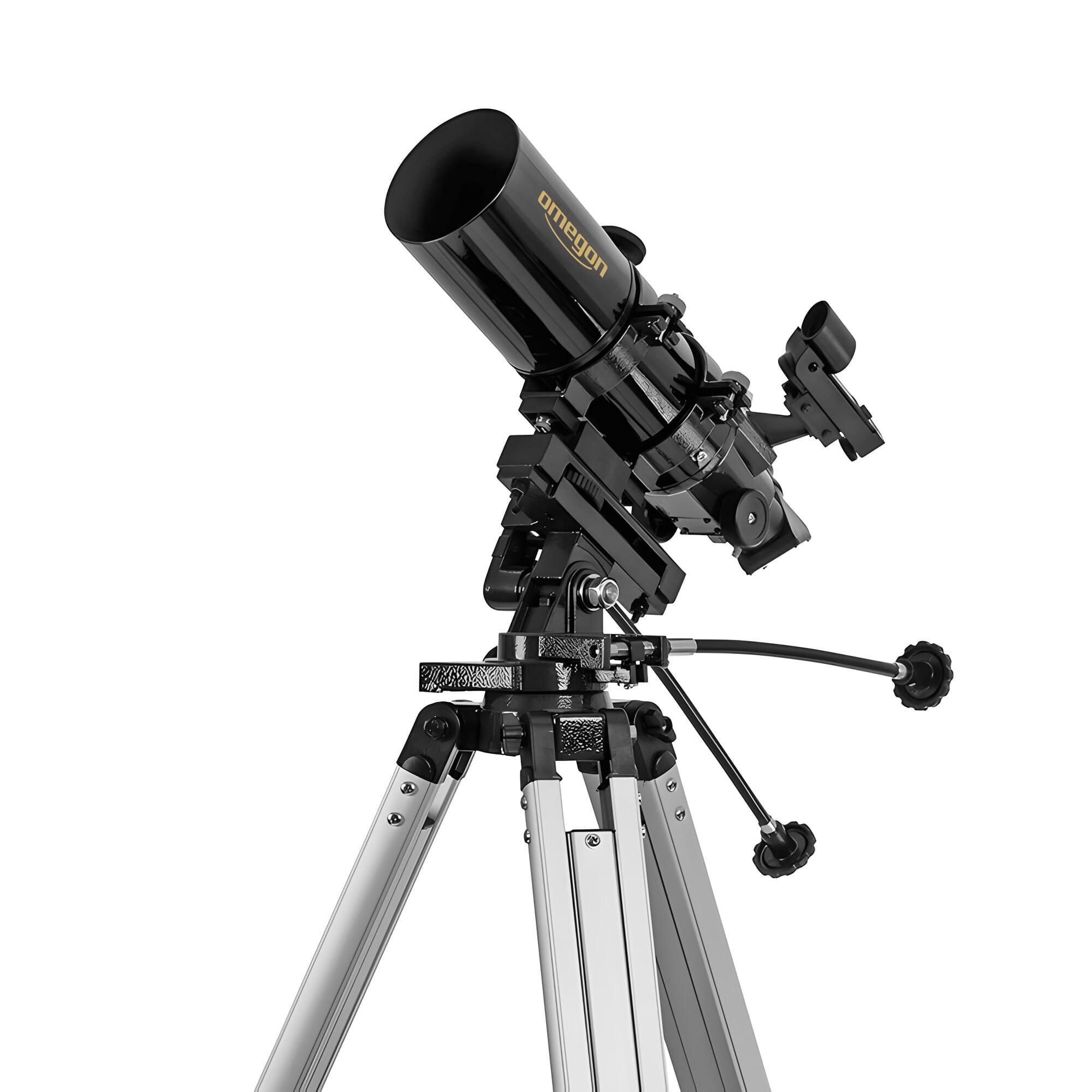
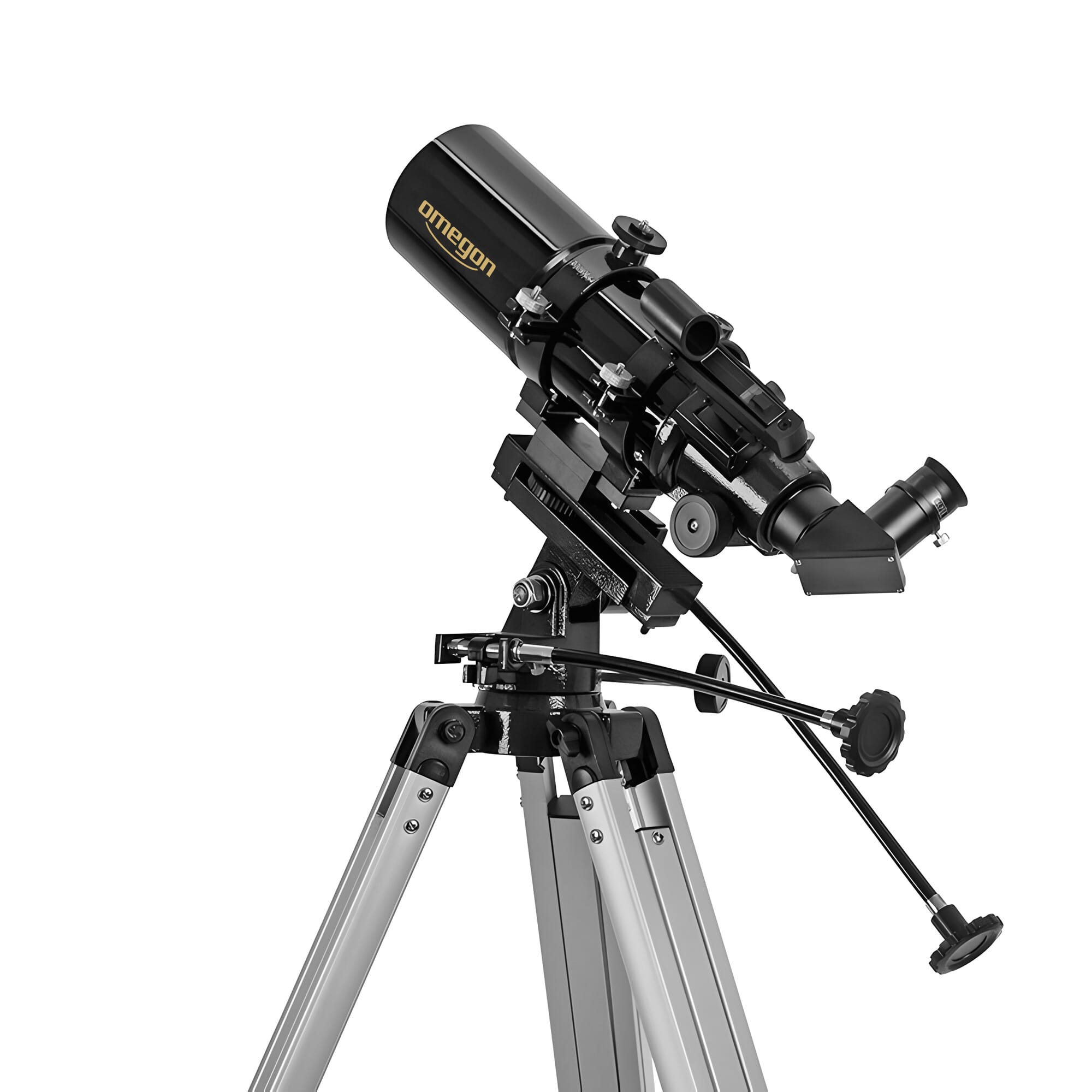
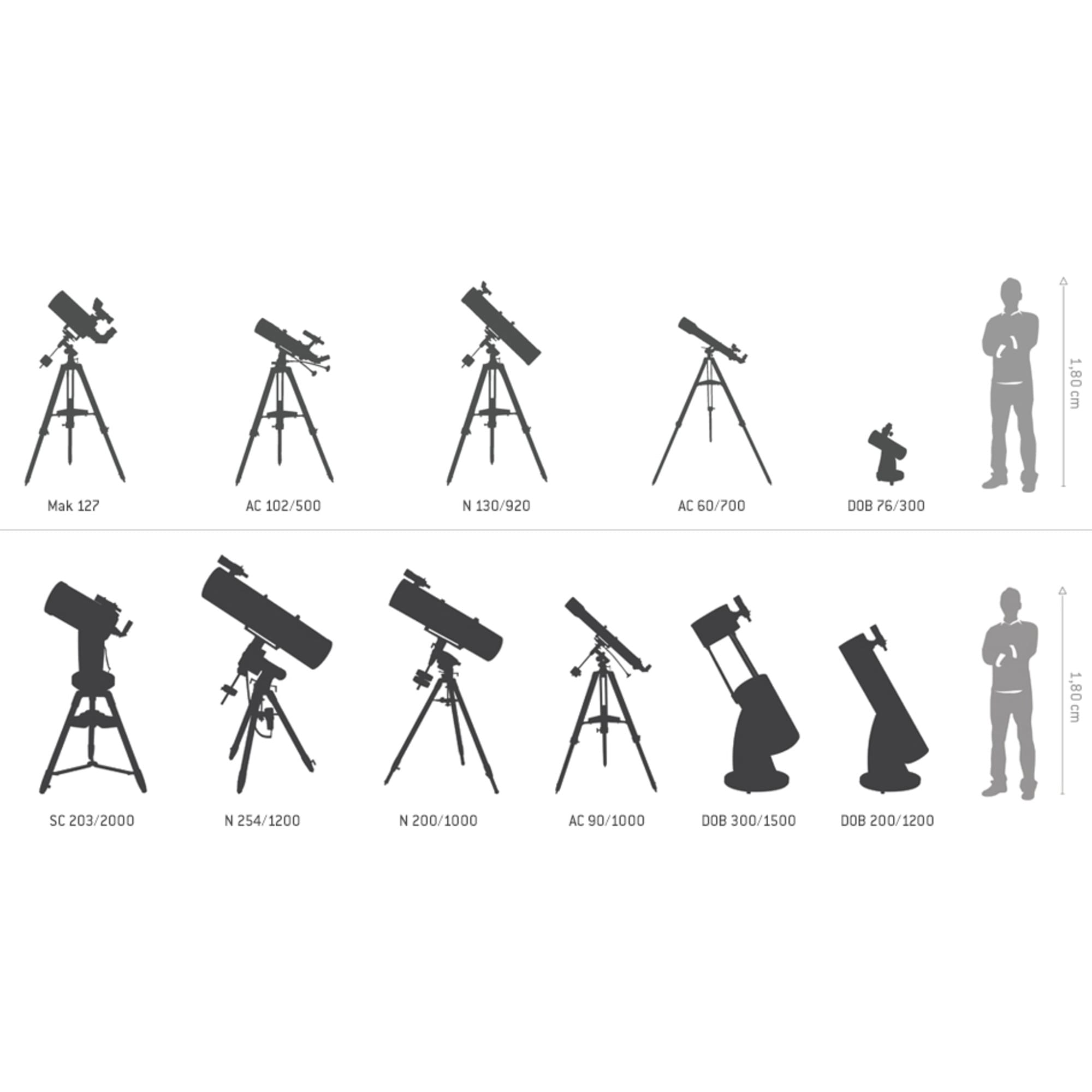
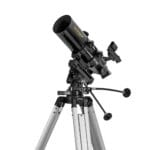
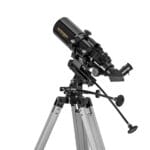
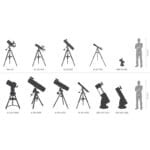


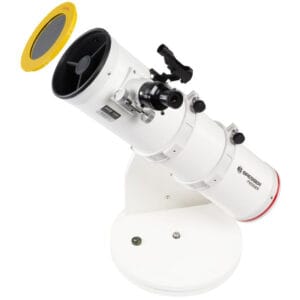
The AC 80/400 AZ-3 is an achromatic lens telescope with an aperture of 80 mm and a focal brandlength of 400 mm (f/5) on the azimuthal AZ-3 mount with fine adjustments on both axes and an aluminum tripod. An achromatic lens has a lens made of two types of glass; at f/5 the tube is short, and around clear objects a bluish-purple border appears at about 80x. In the AC series from Omegon it sits between the 70 mm model on the AZ-2 and the 102 mm model on the AZ-3: 31% more light than the 70 mm model, and with the 20 mm eyepiece the widest field of view of the three. How the series relate to each other merk is shown in Omegon merkguide.
What do you see through the AC 80/400?
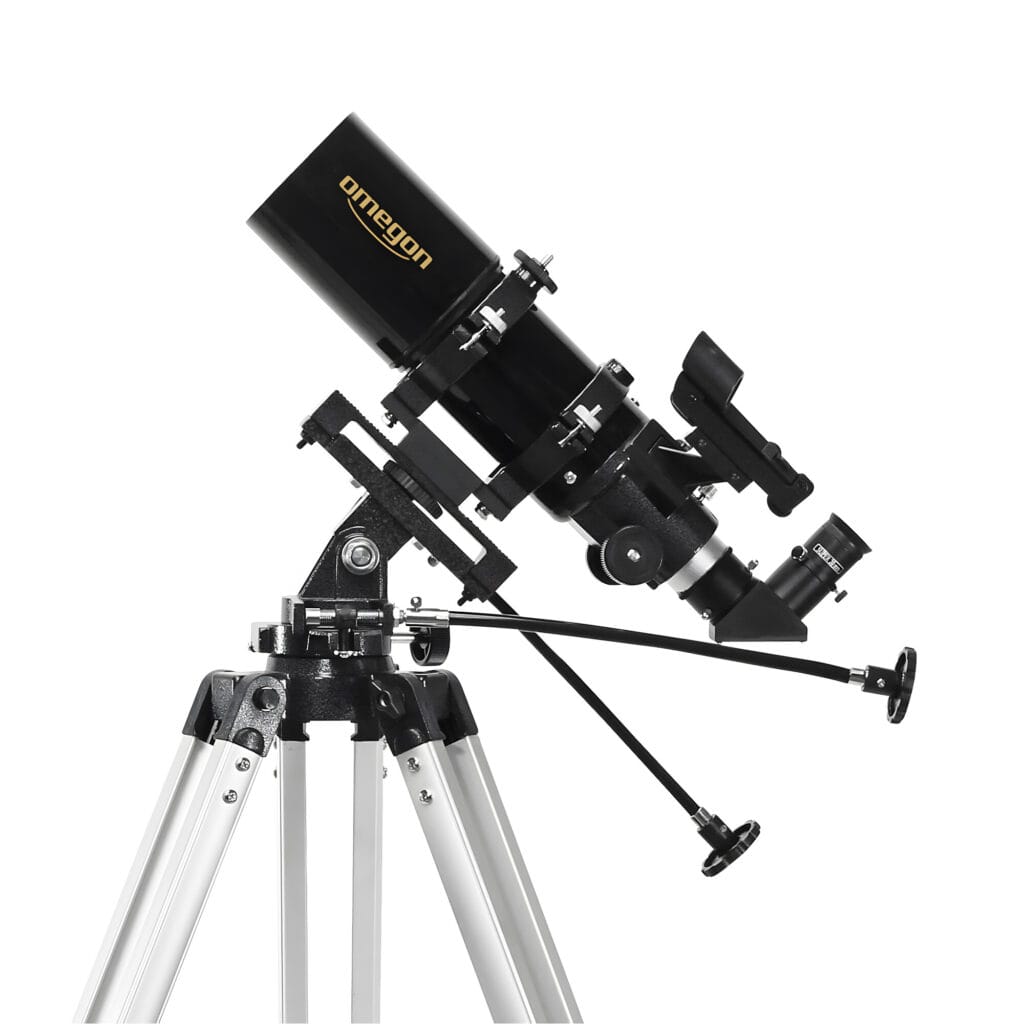
Star fields and star clusters are the core: with the 20 mm eyepiece (20x), you can see about 2.5 degrees of sky, five times the width of the Moon. The Pleiades fit right in there, as does the double star cluster in Perseus and the Cape of Good Hope in the constellation of the Swan; along the Milky Way in the Cygnus and the Pleiades you see hundreds of stars in a single image. Moon: at 20x, the entire disk with the lunar seas and the largest craters; at 40x, craters, mountain ranges and the shadow line. Jupiter: a small disk with the four large moons in a row; the two dark main bands are easily visible at 40x. Saturn: at 40x, the ring is detached from the planet, small. Around the edge of the Moon, Jupiter and Venus are seen with a bluish-pink rim; that is the chromatic aberration of an achromat, which is larger at f/5 than at a long tube. Deep sky: the Orion Nebula as a gray spot around the stars of the Trapezium, the globular star cluster M13 as a round cloud, and from a dark spot the Andromedan Nebula as a long-elongated spot with a bright core. Nebulae and galaxies are seen with the eye in grayscale, not in color. From a city or village with streetlights, the moon, planets, double stars, and star clusters remain; nebulae and galaxies require a dark spot. The highest meaningful magnification is approximately 160x, twice the opening in millimeters; due to the color border at f/5, the usable limit in practice is around 80 to 100x. What you can expect per object is stated in What do you see through a telescope?, The Moon through a telescope, Jupiter through a telescope and Observing deep-sky objects.
How does the AC 80/400 differ from other 80 mm refractors?
- Focus point and field of view: the AC 80/400 has a 400 mm focal brandpoint at an aperture of 80 mm (f/5). This gives 20x magnification and a 2.5 degree field of view with the 20 mm eyepiece in a tube that is shorter than 52 cm; this is offset by a larger color edge at high magnification than with a refractor at f/10.
- Mounting: The AZ-3 is adjusted manually and then steered with fine movements on both axes; it rotates 360 degrees around its axis. This allows you to keep the moon or a star cluster in focus at 40x without pushing on the tube.
- Objective and accessories: 1.25 inch eyepiece with two eyepieces (20x and 40x), a red dot viewfinder and a 90 degree diagonal. A Barlow lens is not included; with the 1.8x Barlow it becomes 36x and 72x.
For whom yes and for whom no
Hello Anyone looking for a lightweight viewer for star fields, star clusters and the entire moon; anyone who also uses it for birds and landscape during the day, with an amici-prisma for a straight image; anyone who wants to look outside without power and without aligning within a few minutes. If you're unsure, read the Telescope Buying Guide for Beginners.
Not for long exposures of nebulas and galaxies; an assembly is required for that that follows the sky; look for it smart telescopes. You can take photos of the moon with a smartphone adapter attached to the eyepiece. If you want to see Jupiter and Saturn bigger, choose The 70 mm model with a 700 mm brandtip from this series: with the same 10 mm eyepiece 70x and a smaller color border. If you want to see more of nebulas and globular clusters, then the the 102 mm model from this series 63% more light.
What's in the box
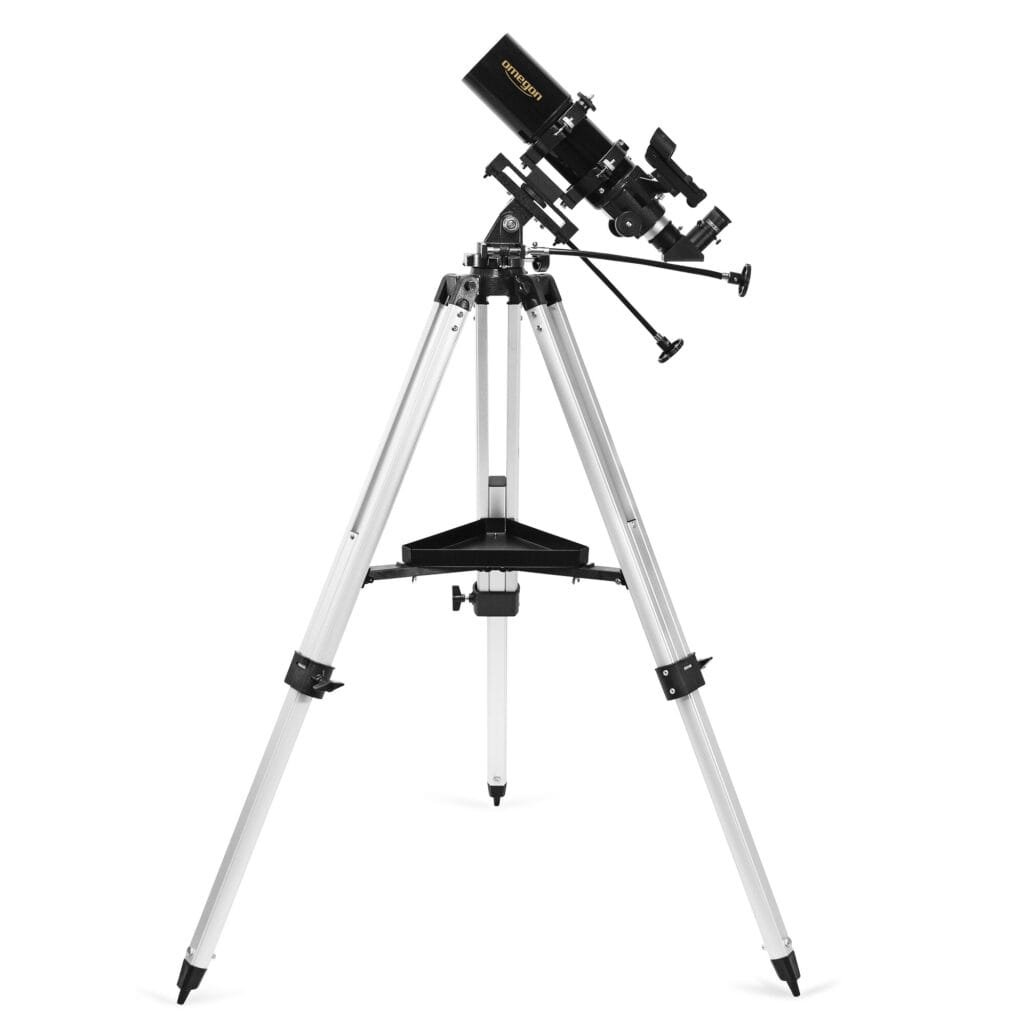
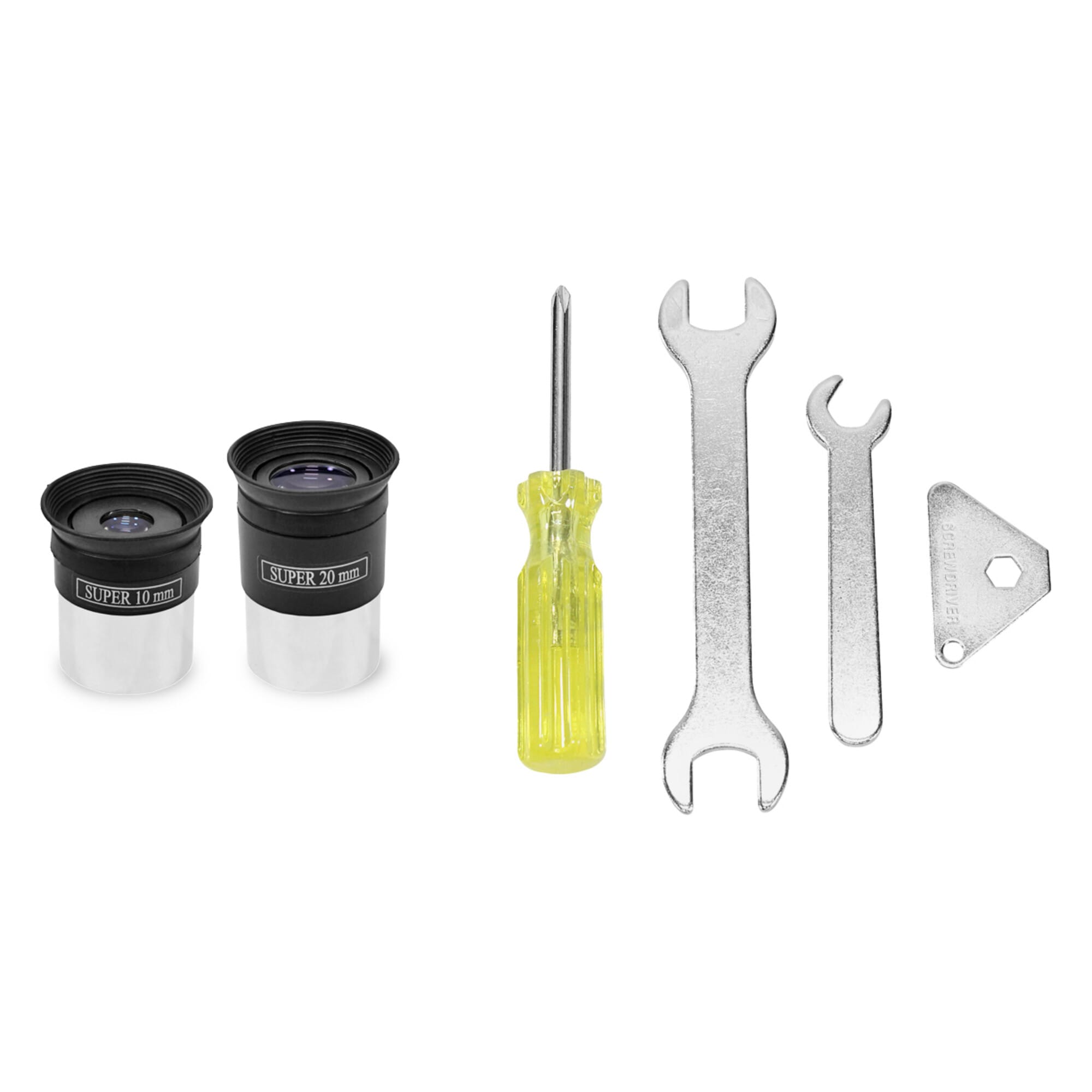
- Optical tube AC 80/400 with dew cap and tooth gear focus adjuster of 1.25 inch
- AZ-3 azimuthal mounting with fine movements on both axes
- Aluminum Tripod
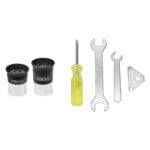
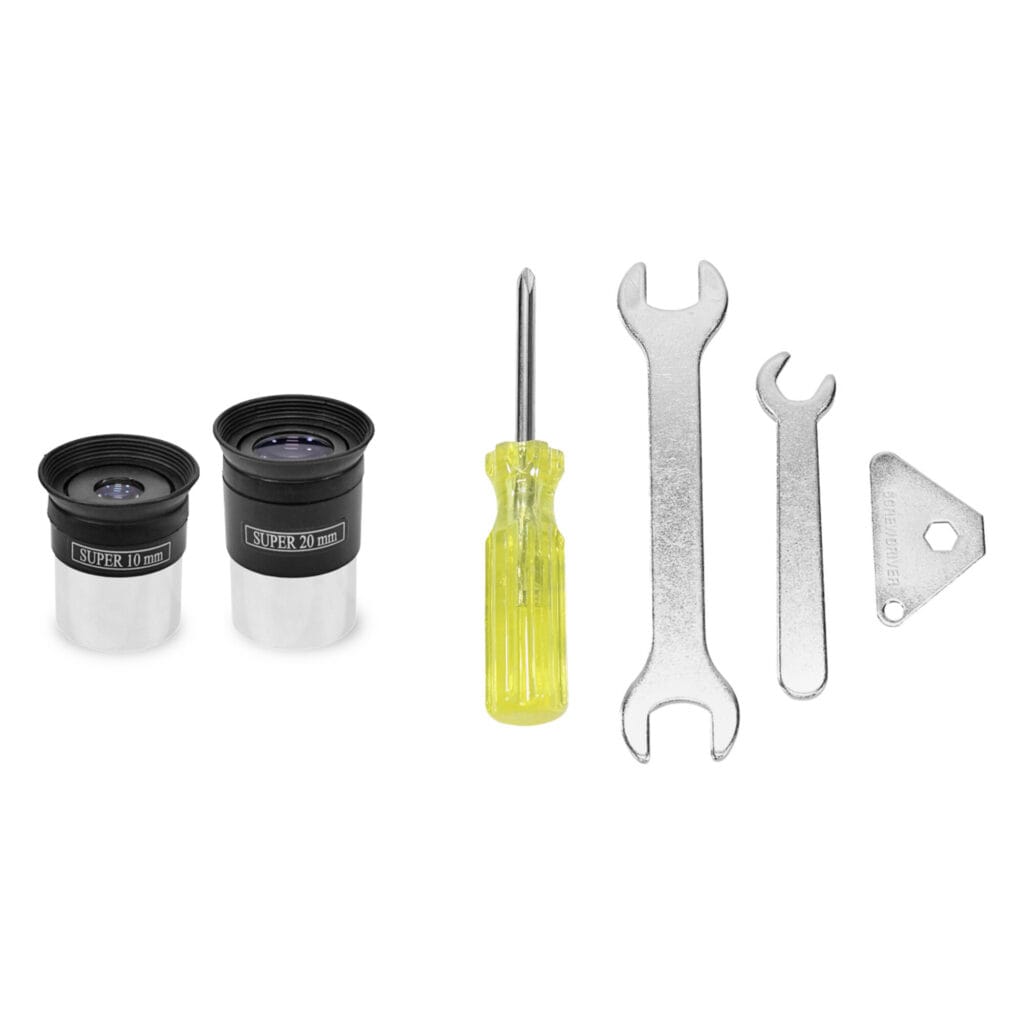
- Super 20 mm eyepiece (20x), 1.25 inch, for star fields, star clusters and the entire moon
- Super 10 mm eyepiece (40x), 1.25 inch, for the Moon and Planets
- Red dot sight
- 90-degree diagonal, 1.25 inches
Not included: Barlow lens, amici prism, moon filter. The 1.8x Barlow brings the two eyepieces to 36x and 72x, below 80x where the color border starts to stand out; the supplied diagonal gives a straight but mirrored image; for birds and landscape you need an amici prism; around a full moon a moon filter softens the bright light. All three are included below in the accessories.
Format and weight
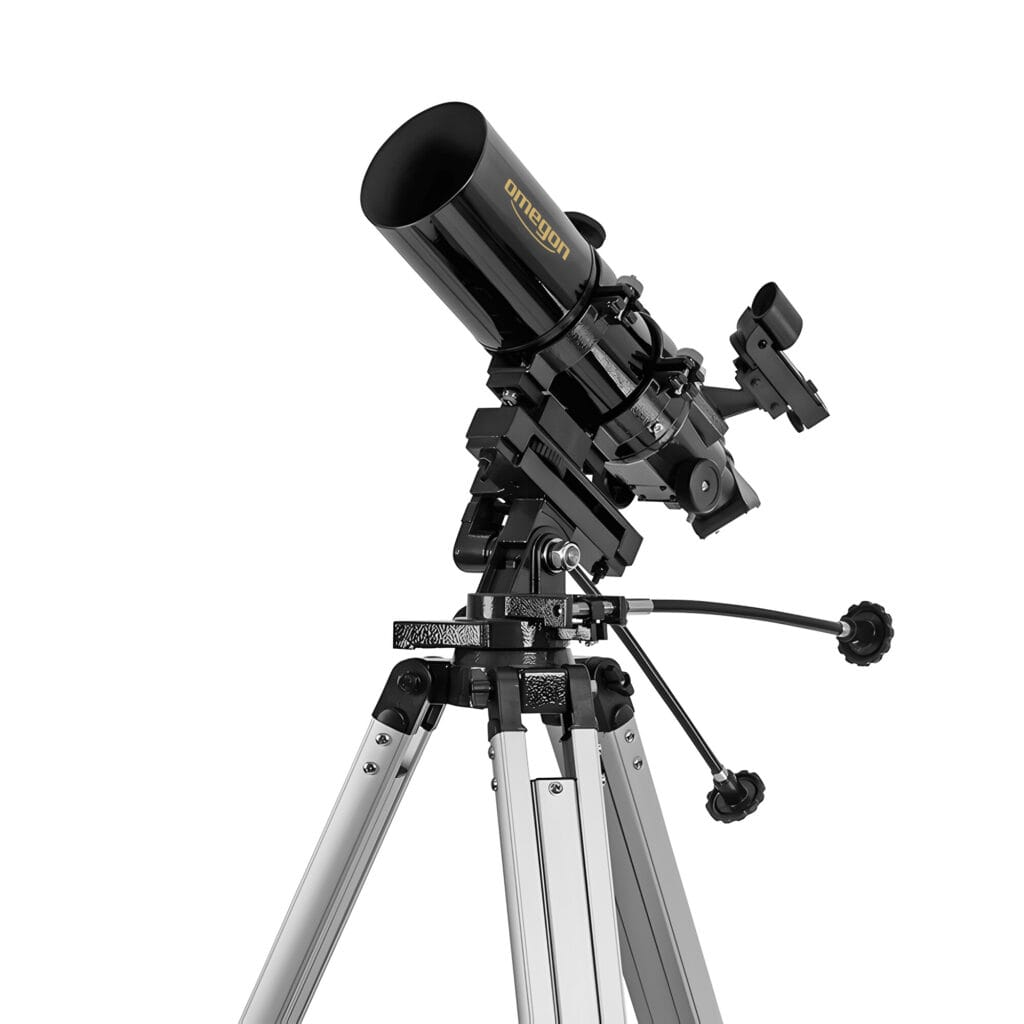
The loose tube with the same optics weighs 1.3 kg. The tube is approximately 9 cm thick, with a dew cap of 100 mm, and shorter than 52 cm; packaged 52 x 26 x 26 cm. By looking diagonally from above, you see the tube from above, sitting on a low tripod and standing with extended legs. It stands with the tripod on the ground, not on a table.
First evening with the AC 80/400
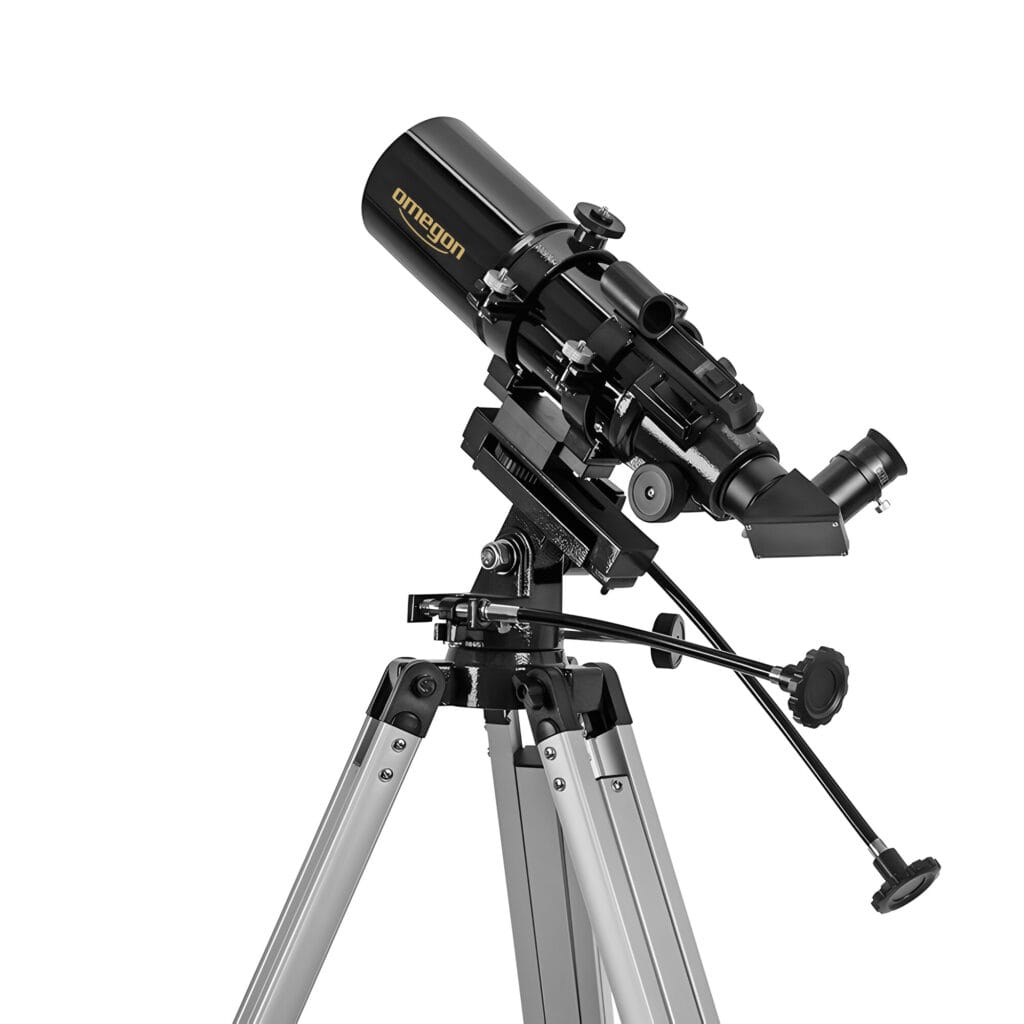
- Take off the dew cap, place the tripod on a flat surface with the legs fixed in place and focus manually; the final step is done with fine movements.
- Line the red dot viewfinder at day time on a distant object, for example a church tower or chimney: first focus with the 20 mm eyepiece, then set the red dot with the screws at the same point.
- Do not look through a window; the glass and the temperature difference make the image blurry.
- Start with the 20 mm eyepiece (20x) and look for the moon; then switch to the 10 mm eyepiece (40x).
- Rotate the focus lever until the image is small and sharp; a large blurry disc is not sharp.
- Set the telescope outside 20 to 30 minutes before watching; a warm bulb produces shaky images.
- A lens telescope does not need to be collimated. If you see nothing or only a blur, the viewfinder is crooked or the magnification is too high; after a few hours, the lens may become coated with dew; then let it dry indoors and never wipe it off. More causes are listed in Why can't I see anything through my telescope?.
Which accessories are suitable?
- Vela Optics Barlow 1.8x (1.25 inch): comes between diagonal and ocular and makes the two oculars 36x and 72x; for craters and the bands of Jupiter, without buying a new ocular.
- Omegon Amici prism 90° 1.25 inchesReplaces the supplied diagonal in the 1.25 inch viewfinder and positions the image upright and side-on for birds and landscapes during the day.
- Vela Optics Moon Filter ND96 13%, 1.25 inch: screw into the filter thread at the bottom of a 1.25 inch eyepiece and let 13% of the light through so that the moon is not dazzled.
- Vela Optics smartphone adapterClamps around the eyepiece and holds the camera lens of your phone above the eyepiece, for photos of the entire moon at 20x.
AC 70/700, AC 80/400 or AC 102/660?
| AC 70/700 AZ-2 | AC 80/400 AZ-3 (this page) | AC 102/660 AZ-3 | |
|---|---|---|---|
| Lens | 70 mm, 700 mm, f/10 | 80 mm, 400 mm, f/5 | 102 mm, 660 mm, f/6.5 |
| Image field with the 20 mm eyepiece | 35x, approximately 1.4 degrees | 20x, approximately 2.5 degrees | 33x, approximately 1.5 degrees |
| Highest meaningful magnification | about 140x | approx. 160x, in practice up to 100x due to the color border at f/5 | about 200x, in practice 150x |
| Mount | AZ-2, fine movement in height | AZ-3, fine movements on both axes | AZ-3, fine movements on both axes |
| Sharpener and oculairs | 1.25 inch telescope eyepiece; 20 and 10 mm, 2x Barlow | 1.25 inch tongue guard; 20 and 10 mm | 2 inch threaded rod with 1.25 inch adapter; 20 and 10 mm |
| Weight and box | 4 kg, box 76 cm | box 52 cm | box 73 cm |
| Choose this as | You especially want to see the moon and planets with a small colored border | you want a short wide-angle lens for star clusters, the entire moon and nature | You want the most opening for fog and lumps |
Frequently asked questions about the AC 80/400
- Is it suitable for a child? From the age of 8 with an adult; from the age of 10 independently; no alignment is required, and at 20x the moon with the red dot finder is quickly in view.
- Can I take photos with it? Of the moon, of course, using a smartphone adapter on the eyepiece; planets remain small at 40x on a phone photo. Long exposures of nebulas and galaxies require a mount that follows the sky.
- Which sun filter fits on it? A filter that fits onto the tube first. According to the manufacturer, the dew cap is 100 mm thick, which falls within the size range of 84 to 108 mm. Omegon Helievo; measure the circumference of the front face for inspection and divide by 3.14. Cover the viewfinder and check the film before each use. Never use eclipse glasses behind the viewfinder or a filter in the eyepiece.
- Do I need to collimate it? No; the 80 mm lens is fixed in the tube and remains aligned, even after transport.
- Can I use it during the day? Yes; with the supplied diagonal, the image is displayed upright but mirrored. For birds and landscapes, replace the diagonal with the amici-prism above in the accessories. Never point at or directly in front of the sun without a filter on the tube.
Specifications
| Optical design | Achromatic refractor, double lens |
| Opening | 80 mm |
| Focal length | 400 mm |
| Opening ratio | f/5 |
| Lens | 80 mm achromatic double lens, captures 130 times as much light as the eye |
| Highest meaningful magnification | about 160x, in practice 80 to 100x |
| Separating power | 1.44 seconds |
| Mount | AZ-3 azimuthal, fine movements on both axes, 360 degrees of rotation |
| Tripod | Aluminum |
| Reporter | Rack, 1.25 inch |
| Seeker | Red dot |
| Included eyepieces | Super 20 mm (20x) and Super 10 mm (40x), 1.25 inch |
| Diagonal | 90 degrees, 1.25 inch |
| Tube weight | 1.3 kg (single tube with the same optics) |
| Tube length | less than 52 cm; tube approximately 90 mm thick, dew cap 100 mm |
| Packed | 52 x 26 x 26 cm |
Shipping and assistance
Orders with multiple items are shipped from multiple warehouses and may arrive in parts; each package will have its own tracking number. More information about this can be merk found on the Omegon brand page. Help with choosing or on the first evening: WhatsApp or call on weekdays from 9:00 to 17:00, or come by appointment in Sneek. 30 days' cooling-off period.
Reviews
There are no reviews yet.