
Catadioptric telescopes
Showing 1–20 of 71 resultsSorted by popularity

- Price range: 2.049,00 through 2.849,00 Select options This product has multiple variants. The options may be chosen on the product page









Showing 1–20 of 71 resultsSorted by popularity
Catadioptric telescopes: the perfect balance of power and compactness
For many astronomers, the search for the ideal telescope is a struggle between aperture and handling. You want to capture as much light as possible, but you don't want to lug around a meter-long tube every night. This is where the catadioptric telescope shines. By combining the advantages of lenses (refractors) and mirrors (reflectors) into one clever, "folded" optical design, these instruments offer a huge focal length in a very short housing.
Whether you choose Schmidt-Cassegrain or a Maksutov-Cassegrain, with a catadioptric telescope you get a versatile instrument that excels in both visual observations of planets and high-resolution astrophotography.
How does a catadioptric system work?
The term "catadioptric" simply means that the system uses both refraction (bending of light by a lens) and reflection (bouncing of light off a mirror). In a catadioptric telescope light falls through a correction plate or meniscus lens at the front, bounces against a main mirror at the back, is reflected back to a secondary mirror on the back of the front lens, and finally passes through a hole in the main mirror to the eyepiece.
This folded light path ensures that a telescope with a focal length of, say, 2000 mm can still be only 40-50 cm long. This makes the catadioptric telescope the ultimate choice for those who observe from a small balcony or often take the telescope on trips.
The two main types: SCT and Maksutov
Within the category catadioptric telescopes we distinguish between two popular designs, each with its own specific strengths.
1. Schmidt-Cassegrain telescopes (SCT).
The Schmidt-Cassegrain is the most versatile all-rounder. With apertures ranging from 5 to as much as 14 inches, these telescopes are suitable for virtually any object in the sky.
Light intensity: Due to the larger available apertures (such as the popular 8-inch and 9.25-inch models), SCTs are excellent for observing faint deep-sky objects like nebulae and galaxies.
Astrophotography: Using a focal reducer, you can shorten the focal length for deep-sky photography, or you can remove the secondary mirror (on Fastar/HyperStar systems) for extremely fast wide-field shots.
2. Maksutov-Cassegrain telescopes (Mak).
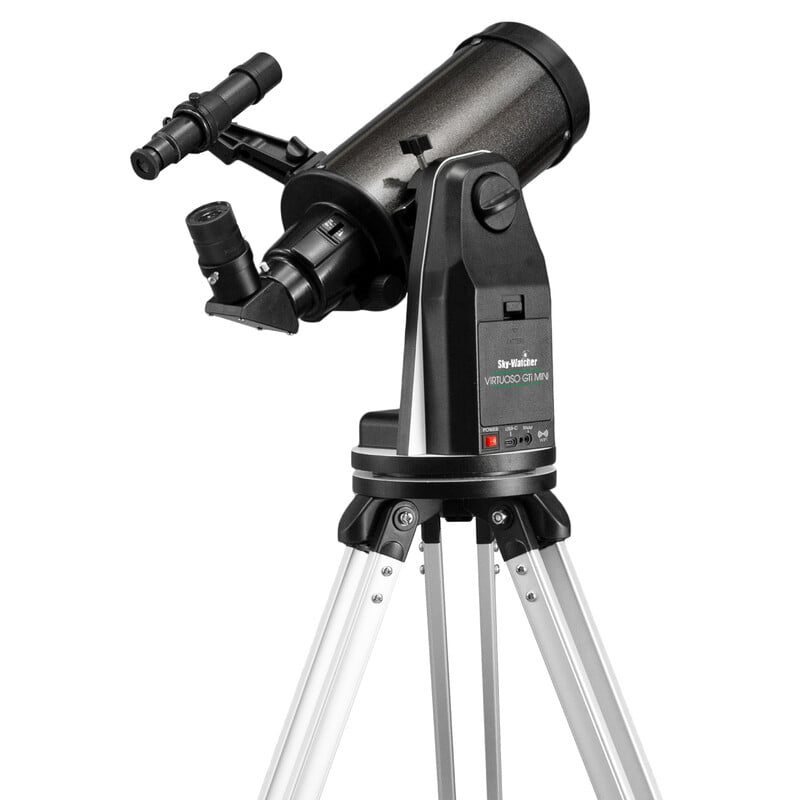
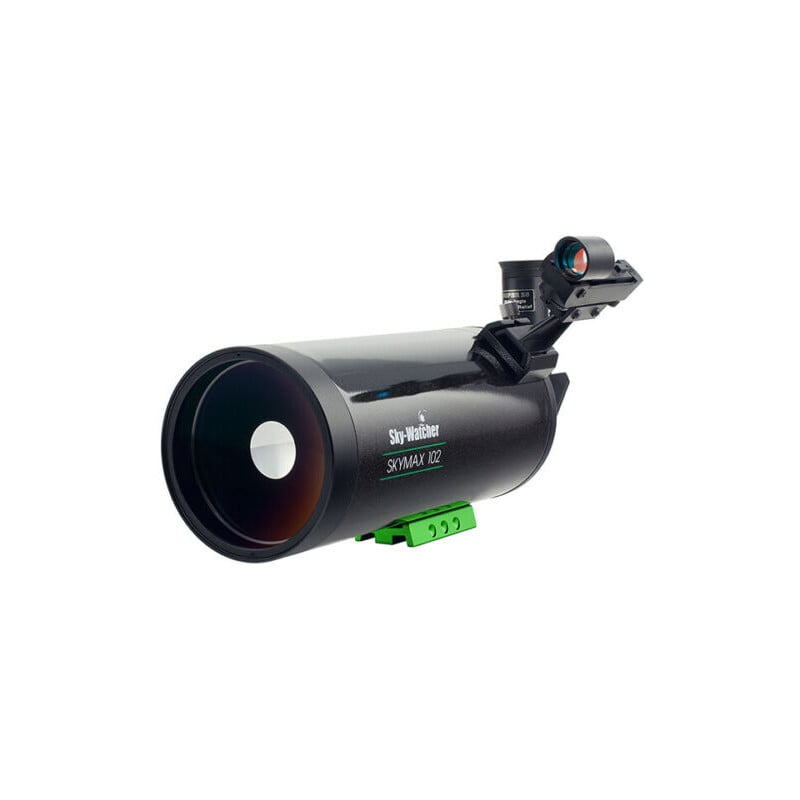
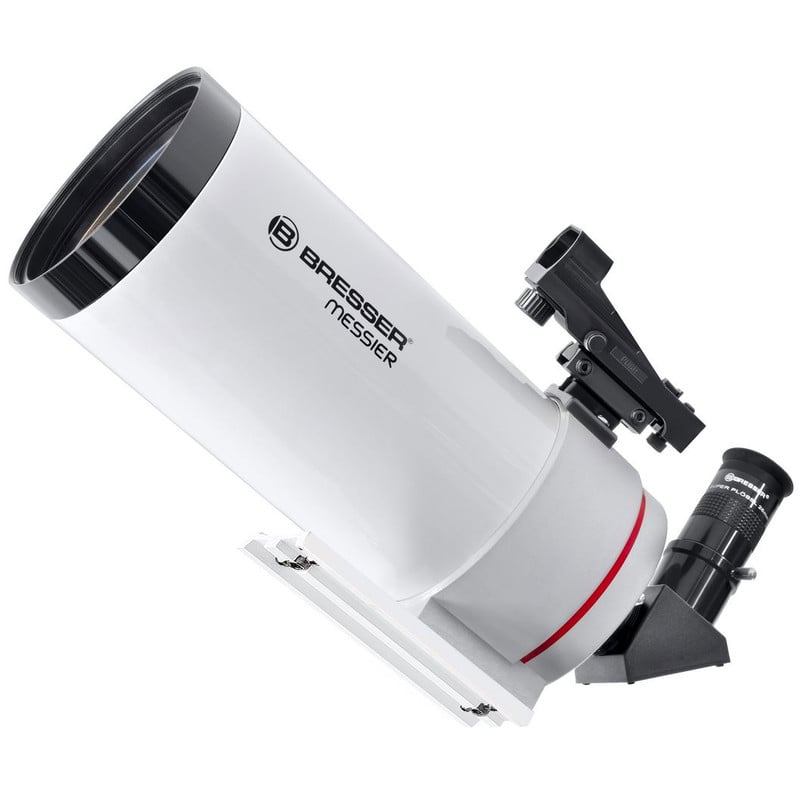
You can recognize the Maksutov by the thick, spherical meniscus lens at the front. This design is the specialist for solar system enthusiasts.
Contrast and sharpness: Because of the small secondary mirror and the specific lens shape, Maksutovs offer contrast almost equal to that of an expensive refractor.
Planetary viewer pure and simple: The long focal length makes it easy to achieve high magnifications, which is essential for studying the cloud bands on jupiter or the cassini separation in the rings of saturn. The NexStar 4SE is a great example of a compact catadioptric telescope in this segment.
Advanced optics for the astrophotographer
For the discerning photographer, there are within the catadioptric telescopes advanced variants have been developed, such as the Ritchey-Chrétien (RC) and the EdgeHDsystems.
where standard SCTs can sometimes suffer from coma (distortion in the corners), offer EdgeHD ACF designs offer a completely flat field of view. This is crucial when working with modern cameras with large sensors. Stars will remain tack-sharp and point-like right to the very edges of your photo.
Advantages of a catadioptric telescope
Why should you choose a catadioptric system over a regular mirror or lens telescope?
Compactness: No other telescope offers so much aperture in such a compact size. This saves space during storage and transport.
Closed system: The tube is completely sealed. This prevents dust from getting on the mirrors and you have less air turbulence inside the tube, which improves image stability.
Comfortable view: Because the eyepiece is at the rear (just like a refractor), but the tube is much shorter, you rarely have to stand in uncomfortable positions no matter where the telescope is pointing.
Compatibility: These systems work excellently with almost all types of accessories, from heavy binoviewers to large DSLR cameras.
What should you pay attention to when purchasing?
Although the catadioptric telescope very user-friendly, here are two important expert tips:
Cooling time: Because of the closed tube and often thick glass elements, this type of telescope needs time to reach outdoor temperature. For an 8-inch SCT, we recommend putting it outside at least 45 to 60 minutes before your observation for the sharpest image.
Dew formation: Because the correction lens is at the very front, it is prone to fogging. A dew cap or dew tape is an indispensable accessory for anyone using a catadioptric telescope used in our humid climate.
Why buy your SCT or Maksutov from the specialist?
At telescoop.nl, we understand that purchasing a catadioptric telescope is a serious investment. Whether you go for the portability of a small Maksutov or the brute force of an 11-inch Schmidt-Cassegrain on an equatorial mount, we offer the support you need.
Expertise in collimation: We can explain exactly how to perfectly align your SCT's mirrors for maximum performance.
Expert advice We'll look at your goals together. Do you want visual viewing only or photography as well? We match the right mount to your optics.
Prompt delivery: Ordered before 11:59 p.m., in most cases within 48 hours.
Discover the power of "folded optics" and view our full range at catadioptric telescopes page