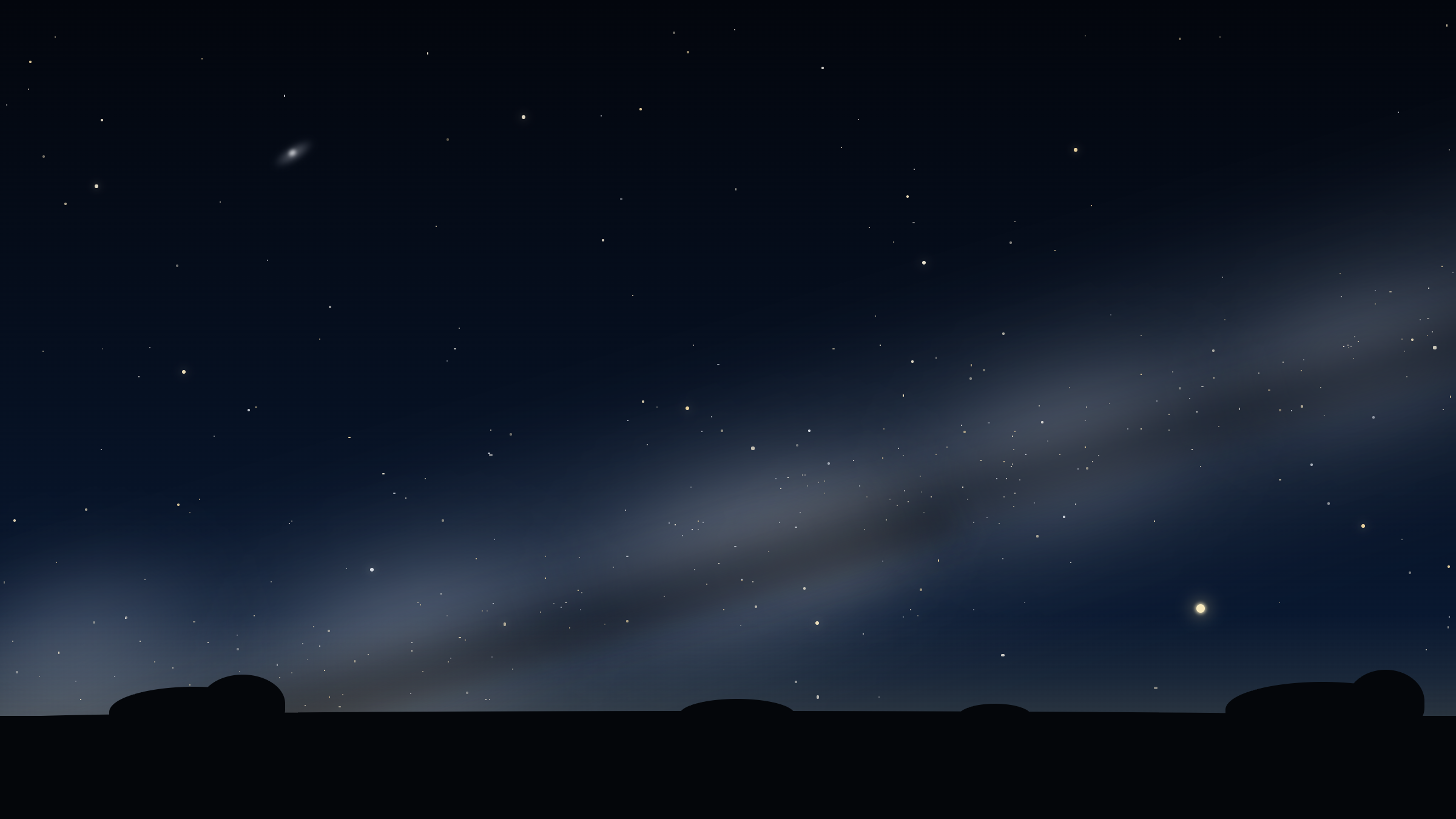
The night sky in September 2026 marks the transition from summer to fall, which is good news for anyone with a telescope or binoculars. The evenings are getting noticeably longer: by early September, it’s truly dark around 9:30 p.m., and by late September, it’s dark before 8:30 p.m. So you no longer have to stay up late into the night for a serious observing session. What’s more, September has a standout star this year: Saturn, which is building up to its opposition in early October and growing brighter throughout the month. In this guide, you’ll find a weekly breakdown of what’s visible, what you can see with the naked eye, and what requires binoculars or a telescope.
The moon phases of September 2026
The moon determines how dark your nights are, so plan your sessions around these dates:
| Last quarter | Friday, September 4 |
| New Moon | Friday, September 11, 05:27 AM |
| First quarter | Friday, September 18 |
| Full moon (harvest moon) | Saturday, September 26, 6:50 PM |
The full moon of September 26 is the harvest moon: the full moon closest to the autumn equinox. It rises around sunset and stays in the sky all night. Would you like to look ahead to the rest of the year, including rise times and moon names? You can find them in our lunar calendar. If you are going to view the full moon through a telescope, then a moon filter Nice: the image is otherwise so bright that your night vision disappears immediately.
The dark window: September 7 through 16
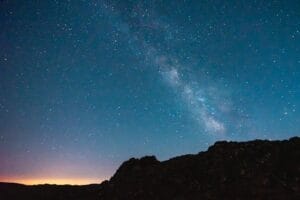
Around the new moon of September 11 are the darkest nights of the month. This is the time for deep-sky: in the early evening, the Milky Way still spans the sky as a band of light from south to northeast, with the Summer Triangle area (Vega, Deneb, Altair) high above you. From a dark location outside the city, you can see the structure with the naked eye.
At the same time, the autumn season climbs up in the east: the Great Square of Pegasus and below it Andromeda. The Andromeda Galaxy (M31) reaches a fine altitude in September, making it the easiest galaxy to find yourself. Under a dark sky, you can see it as a faint patch with the naked eye, and with a astronomical binoculars it becomes an elongated patch of light with a bright core. It is precisely for these kinds of large, extended objects that binoculars are often more rewarding than a high-magnification telescope.
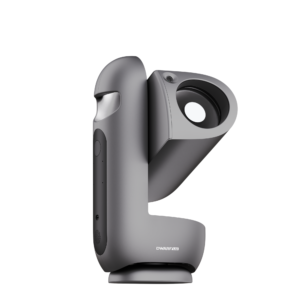
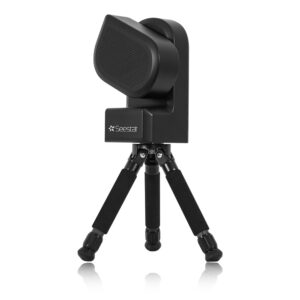
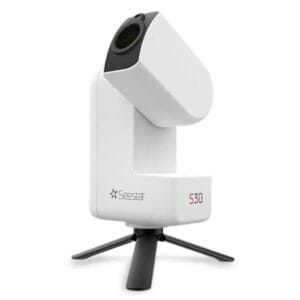
Would you like to photograph M31 and the nebulae in the Milky Way instead of just looking at them? Then this window is also the best time of the month for a smart telescope: ten days without the moon's glare.
Saturn: Planet of the Month
In September 2026, Saturn is the planet you’ll want to point your telescope at. It’s located on the border between Pisces and Cetus and is building up to its opposition on October 4, the moment when Earth is positioned exactly between the Sun and Saturn. Here’s a heads-up: the planet will gradually brighten over the course of September (from about magnitude +0.5 to +0.3) and rise earlier each evening. By the end of September, it will be visible in the sky for almost the entire night.
Extra interesting this year: the rings. In 2025 they were practically on edge and barely visible. In 2026 the ring tilt opens up again, making the rings clearly recognizable once more through a telescope. Any telescope with an aperture of about 70 mm or more shows the rings; with a Dobson telescope With a 150- or 200-mm telescope, you can also see Saturn’s largest moon, Titan, and details in the rings when the sky is clear. On the evening of September 27, the nearly full moon will be close to Saturn: a great landmark for anyone who has never looked for the planet before.
Jupiter and the crescent moon near the Kribbe (September 8 and 9)
Early risers will be treated to the most beautiful conjunction of the month in September. Jupiter appears as a bright morning object (magnitude −1.9) in the constellation Cancer, near the open star cluster Praesepe (M44), also known as the Manger or the Beehive. On the mornings of September 8 and 9, a thin waning crescent moon will glide past this pair. Look low in the eastern sky starting around 5:30 a.m. With binoculars, you can see the star cluster, the ash-gray crescent moon, and Jupiter all in the same field of view: one of the most beautiful morning scenes of this fall, and well worth seeing even without a telescope.
Venus at her brightest as evening star
Venus will be low above the west-southwest horizon after sunset this month. It won’t be very high in the sky, but it will be unmistakable: around September 19, it will reach its greatest brightness as the evening star, at about magnitude −4.5. Find a spot with an unobstructed view to the west and look for half an hour to three-quarters of an hour after sunset. Through a telescope—and even with a pair of sturdy binoculars—you’ll see that Venus isn’t a disk but a crescent: just like the Moon, the planet exhibits phases, and that crescent will become thinner and larger over the coming weeks.
Neptune in opposition (September 26)
On September 26, Neptune will be in opposition, in the same region of the sky as Saturn. With a magnitude of +7.8, it is the farthest planet in our solar system and invisible to the naked eye. However, it can definitely be spotted through a telescope or smart telescope: a small, bluish disk. Don’t expect to see any detail, but the idea that you’re capturing light that has traveled for over four hours makes this a bucket-list object for many observers. The downside of this date: the full moon that same evening will interfere. The following week, in early October, Neptune will be just as visible, with less moonlight.
Mars: Please be patient a little longer
In September, Mars is barely visible in the morning twilight and is not yet a target for the telescope. The planet is slowly approaching its next opposition, in early 2027. Starting in late fall, it will gradually become more interesting; we’ll include it again in our upcoming monthly overviews.
September 23: the fall equinox
On Wednesday, September 23 at 02:05, astronomical autumn begins. Day and night are then of roughly equal length, and from that moment on, the nights begin to outlast the days. For stargazers, this is the official starting gun of the observing season: every week brings well over fifteen minutes of extra darkness. Incidentally, you do not need to expect meteor showers this month; after the Perseids of August, things are quiet for a while. When the next major showers peak can be read in our Guide to the Perseids and Other Meteor Showers.
What do you need for the September sky?
- Eyes only: the Milky Way around September 11, the harvest moon, Venus in the evening twilight, and the conjunction of the moon and Jupiter on September 8 and 9.
- Binoculars: the Andromeda Nebula, the Manger with Jupiter, the moons of Jupiter and the crescent of Venus. A 10×50 on a tripod is enough to start.
- Telescope: the rings of Saturn, Titan, crater views on the moon, and Neptune. A Dobson provides the most aperture per euro and therefore the most detail.
- Smart telescope: photos of M31 and the nebulae in the Milky Way during the dark window from September 7th to 16th.
Not sure which instrument is right for you? Our Beginner's Guide Take a look at the options, and we'd be happy to help you decide in the store. Have fun under the September sky, and hopefully there will be plenty of clear nights.