The starry sky august 2025 is exceptionally interesting this year for anyone who enjoys looking upward. Not only because the summer months offer warm, clear nights, but also because of a special planetary parade in which six planets are visible simultaneously. Add to that the annual Perseid meteor swarm to it and you have one of the most beautiful months of the year for observers.
Whether you are a beginner looking with the naked eye, or someone who has just acquired a telescope or wants to purchase one, August 2025 offers a wealth of celestial phenomena for every skill level.
Starry sky August 2025: what to see?
In August, the Milky Way stands prominently high in the sky. From a dark location, the band-shaped ribbon of light of billions of stars can be seen with the naked eye, an impressive sight that never bores even experienced observers.
The Summer Triangle formed by the bright stars Vega (Lyra), Deneb (Swan) and Altair (Eagle) dominate the night sky. These three stars act as a handy signpost: once you find them, you can easily navigate to other objects. Or use an app such as Stellarium.
To the south, low above the horizon, in August 2025 are the richest regions of the Milky Way: the center of our galaxy in the constellation Sagittarius. Here lie spectacular nebulae and star clusters such as:
- The Lagoon Nebula (M8)
- The Trifid Nebula (M20)
- The Omega or Swan Nebula (M17)
With a small telescope or binoculars you can already see them as bright spots, but in a large telescope details become visible.
Suggestions for beginning observers
- Find a dark location outside the city and give your eyes 20 minutes to get used to the dark.
- Use a simple planisphere or an app to identify constellations.
- Try a binoculars Or invest in a telescope. Many deep-sky objects are already visible this way.
Planet parade August 2025: six planets visible simultaneously
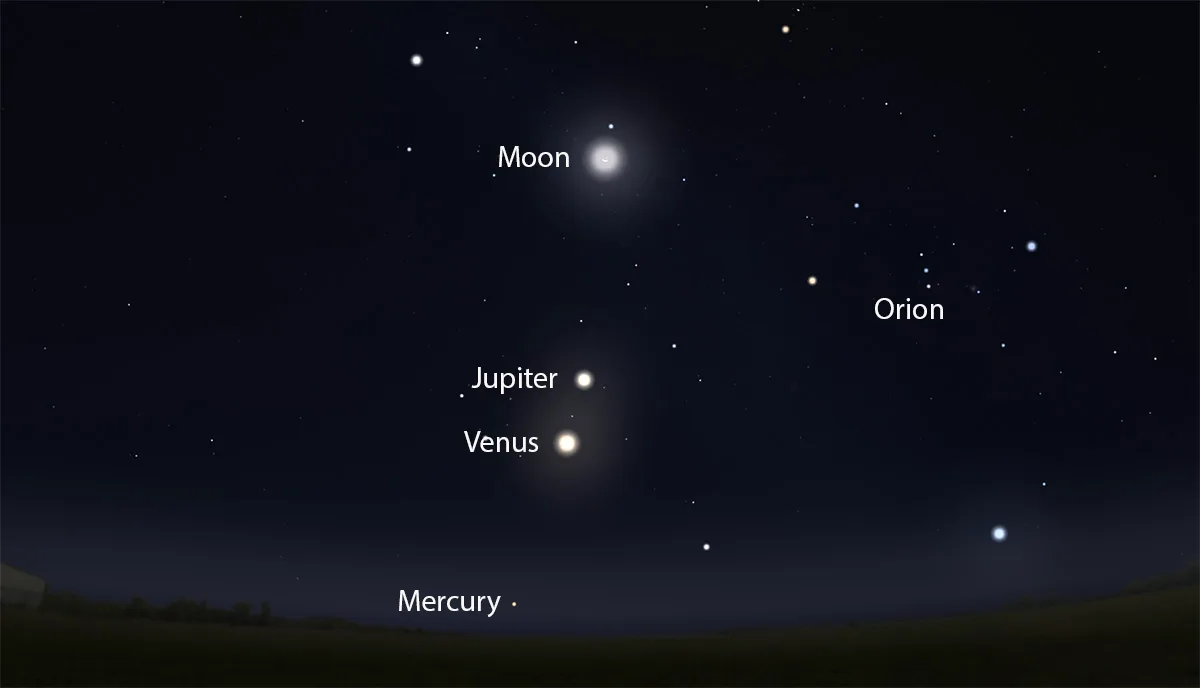
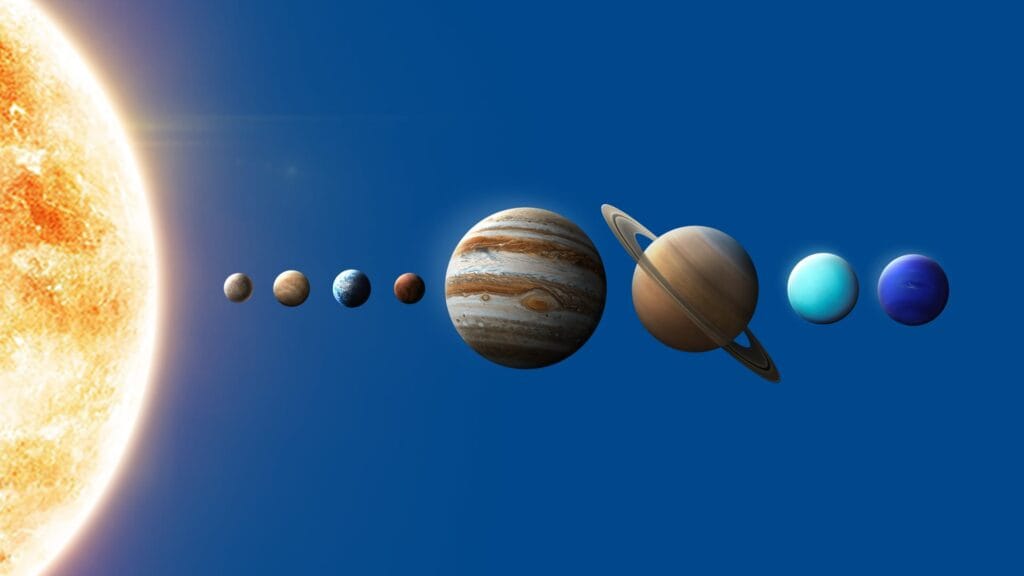
The biggest news for August 2025 is undoubtedly the planetary parade. Just before sunrise, you will see as many as six planets at once in the sky: Venus, Jupiter, Saturn, Mercury, Uranus and Neptune.
Which planets are visible and how do you see them?
- Where and when: Clear in the east around 04:30 / 05:30.
- How to watch: With the naked eye, a brilliant “morning star.” With a telescope, you can see the phase difference of Venus, as if looking at a miniature moon.
- Where and when: Close to Venus, slightly lower on the horizon.
- How to watch: Already visible to the naked eye as a bright star. With a small telescope or good binoculars, you can see the four largest moons (Io, Europa, Ganymede, Callisto) as points of light around the planet.
- Where and when: Stands visible in the south all night and is still easily visible around sunrise.
- How to watch: To the naked eye, a bright, yellow star. With a telescope, the ring structure reveals itself, one of the most impressive appearances you can see.
- Where and when: From about Aug. 18, low in the east, just before sunrise.
- How to watch: Mercury is small and fast. Look shortly before the sun rises and make sure you have a clear view. A telescope makes it clearly visible as a disc.
- Where and when: Both planets are visible only with a telescope, low above the horizon in the east.
- How to watch: Use a star guide or app to find their exact position.
Fortunately, we have written a blog for each planet on how best to view them. Click on the name of the planet and you will be directed to a blog in which we explain in detail with which telescope you can view the planet.
Tip: Use an app like Stellarium to see them easily. Don't feel like downloading an app? Use this live map.
Best moments for the planetary parade
- August 12: Venus and Jupiter are closest to each other.
- August 12 to 20: All six planets are visible before sunrise, provided the horizon is clear and the sky is clear.
A small telescope such as a 70 mm refractor is already enough to discover the main details of Venus, Jupiter and Saturn. Did you know that light pollution does not affect planets? This is because planets in our solar system are much brighter than the faint deep-sky objects. They reflect sunlight and therefore stand out sharply against the background sky, even in a city with lots of artificial light.
Starry sky August 2025: Meteor swarm Perseids and other highlights
Besides the planets, August is famous for the Perseids.
When: The peak falls around the night of Aug. 12-13.
What to expect:
- Many shooting stars per hour in ideal conditions, but don't expect too many.
- No equipment needed; just lie down and look up.
Other highlights:
- New Moon: During the first week of August. Perfect for deep sky objects.
- Full Moon: In the last week of August, ideal for lunar craters and details along the terminator.
Best way to watch in August
- Choose a dark location: Avoid artificial light. National parks or the Wadden Islands are favorites in the Netherlands.
- Plan ahead: Look in advance on a star chart where planets are located. An app such as Stellarium helps.
- Use the right tools:
- With naked eye: Perseids and the bright planets.
- With binoculars: Star clusters and nebulae such as M13 or M31 (Andromeda Nebula).
- With a telescope: Details of Saturn, Jupiter and deep sky objects. See also our telescope selection guide.
Which telescope suits you?
Many people discover during such a month how beautiful it is to look at the sky for themselves. If you want to do more after August, consider:
- For beginners: A simple Dobson telescope (for example, a 130 or 150 mm). Easy to operate and plenty of observing power.
- For those who like to be helped: The StarSense explorer line from Celestron helps you with an app, and you are looking live through the eyepiece. A smart telescope such as the DWARF Mini Whether the Seestar S30 Pro, which automatically finds and tracks objects. Less suitable for planets
- For astrophotography: A small apochromatic refractor with a tracking mount.
On our website you will find a comprehensive selection guide in which we explain step by step which telescope suits your way of viewing.
Are you just starting out and mainly want to learn to explore on your own? Then we often recommend a simple Dobson - robust, affordable and ideal for mastering the basics.
If you like it when an app helps you find objects, you quickly end up with Celestron's StarSense Explorer models: you search the sky yourself, but get clear directions.
And those who prefer to view and photograph completely automatically can switch to a smart telescope such as the DWARF Mini or the Seestar S30 Pro, which detects and tracks objects itself so that you can focus on the image.
More learning and planning for later
Want more depth? We publish a monthly summary of what to see, no newsletter subscriptions, no spam, just simply keep an eye on our blog page each month end.
Conclusion
The starry sky august 2025 offers a unique combination: an impressive planetary parade, the Perseids, and beautiful deep-sky objects. Whether you look with the naked eye, use binoculars or want to buy your first telescope, this month is the time to explore the night sky.
This is the time to start stargazing.
Use August to discover what appeals most to you and prepare for a season of discovery. Visit our webshop and find the right telescope to see the planetary parade, Jupiter's moons and Saturn's rings up close yourself.