Viewing Saturn through a telescope is, for many, the moment when stargazing becomes magical. Not a hazy spot of light, but a planet with a bright ring system that you can see for yourself, live. But how sharp can you really see those rings? And what is the difference between a live view and a stacked image? This blog gives you a realistic picture of what to expect, backed up by real observations.
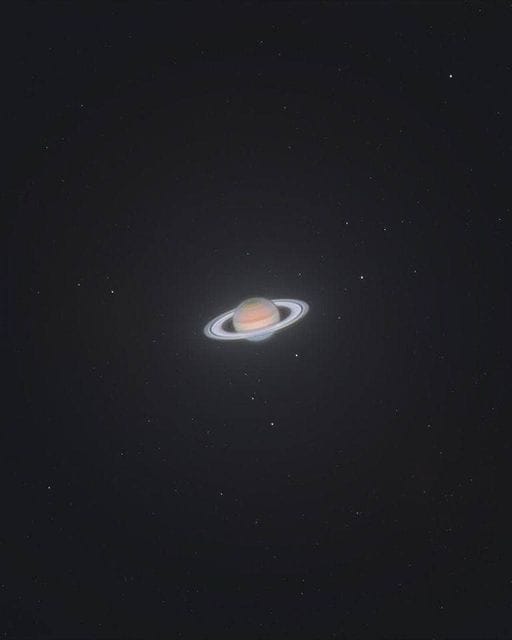
What do you see when you view Saturn visually?
At an enlargement of such 80x to 120x you see Saturn as a yellow disc with rings on both sides. The image is compact, but clear... you can tell it's not a star. Under favorable conditions, you can see a gap between the planet and the ring: the beginning of the Cassini separation.
Figure 1 shows a visually realistic image: Saturn floating in a star field, the rings detached from the planet's disk. No pronounced color or detail, but clearly discernible structure.
As soon as you head toward the 150x to 200x magnification goes, you see more definition: the rings become sharper, the difference between the A and B rings becomes visible, and in good seeing, even the Cassini separation briefly shows itself.
What do you see with post-processing?
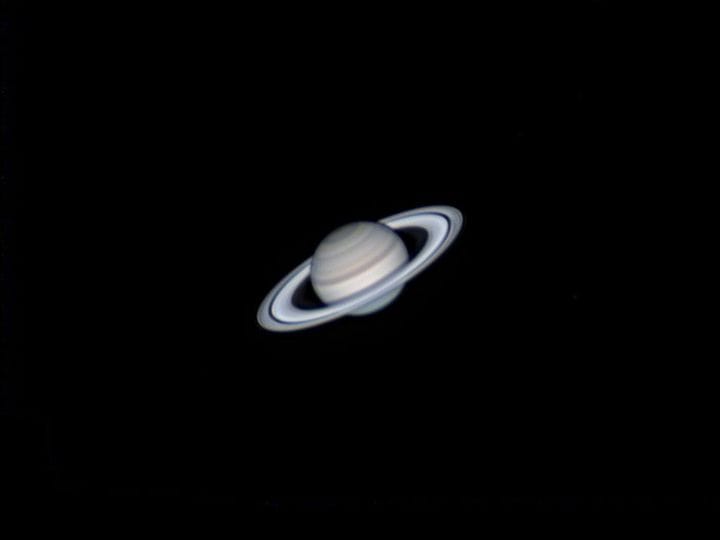


The technique behind razor-sharp planet photos
The impressive details you see in the recordings of this blog (as in images 2 and 3) are no coincidence. In astrophotography, we call this 'lucky imaging'. This process begins by making video recordings with a high frame rate. By capturing thousands of frames, we can use specialized software like Auto Strike!, Registax or PixInsight filter out the moments of perfect air stability.
This process, also known as 'stacking,' averages out the noise and brings forward details that are almost imperceptible visually. Think of the subtle band structures on the planet's sphere, the razor-sharp rings, and the incredibly fine shadow play. To reach this level, our experts recommend a telescope with an aperture of at least 130 mm to 150 mm, preferably combined with a planetary camera from the ZWO ASI Series. It's a technical game between high-end hardware and patient post-processing, where you often get more out of your telescope than you could ever see with the naked eye.
Optimal magnification: Quality over quantity
A common question is what magnification is needed for Saturn. Although the theoretical limit of a telescope is usually at 2x the diameter of the objective aperture (in mm), practice is more recalcitrant.
From a modest magnification of 50x to 60x the rings become recognizable as an oval shape around the planet. Do you really want to see the rings separate from the planet's sphere? Then you need at least 100x needed. The holy grail for many hobbyists, the Cassini separation (the dark gap between the rings), only becomes really visible from 150x, provided atmospheric conditions (seeing) permit.
Above the 250x you often run into the limits of physics; the air vibrations are then magnified too much. At Telescoop.nl we therefore always emphasize: rather invest in a high quality Barlow lens and a quality eyepiece in a cheap telescope that promises '300x magnification.' Optical purity always wins over empty marketing numbers.
When is Saturn at its best?
Timing is everything in planetary viewing. The absolute highlight is the opposition, the time when Saturn is closest to Earth and visible all night. This is best viewed through apps such as Sky Tonight or Stellarium.
For the sharpest images, it's essential to wait until Saturn reaches its highest point in the sky, usually around midnight. The higher the planet is, the thinner the layer of atmosphere you're looking through. This minimizes the annoying 'shimmer' of the air.
Three golden rules for a clear session:
Acclimatization: Put your telescope outside at least 30 to 60 minutes before your session. The optics must cool to the outside temperature to prevent internal air swirls (tubus-seeing).
Location and Surroundings: Avoid observing directly over roofs or asphalt, as these give off heat that obscures the image.
Light pollution: Don't worry about city lights. Planets are so bright that they remain perfectly visible even from a lighted backyard. Only bright moonlight can slightly reduce the contrast of Saturn's fainter moons.
Which telescopes are suitable for Saturn?
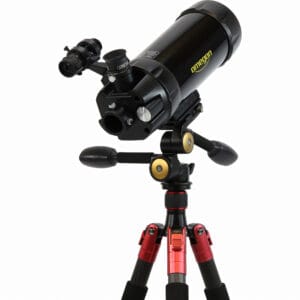
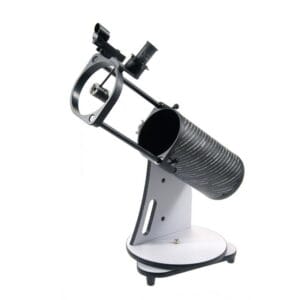
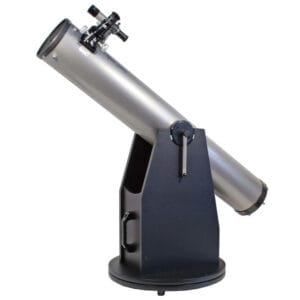
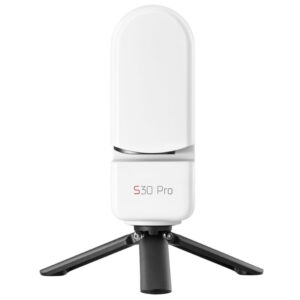
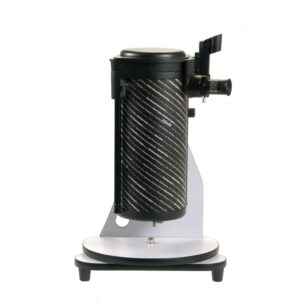
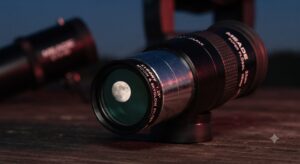
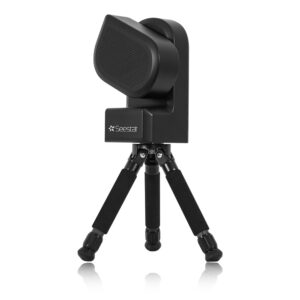
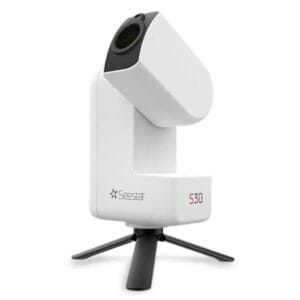
For a clear and sharp image of Saturn and its rings, we recommend:
Preferably use high-quality eyepieces and avoid cheap 4 mm H eyepieces or unusable Barlow lenses.
See also our choice guide for planetary viewers for more explanation of these models.
Conclusion
Seeing Saturn through a telescope is unforgettable. It is one of the few objects in the sky that is instantly recognizable. The rings are truly visible without Photoshop or filters. But it is important to know what to expect. The images in this blog show that spectrum: from simple visual observation to processed astrophotos.
Want to experience Saturn for yourself? Check out our current range of telescopes or try out a telescope rental at telescoop.nl, then you'll immediately know what's really possible with your view of the universe.