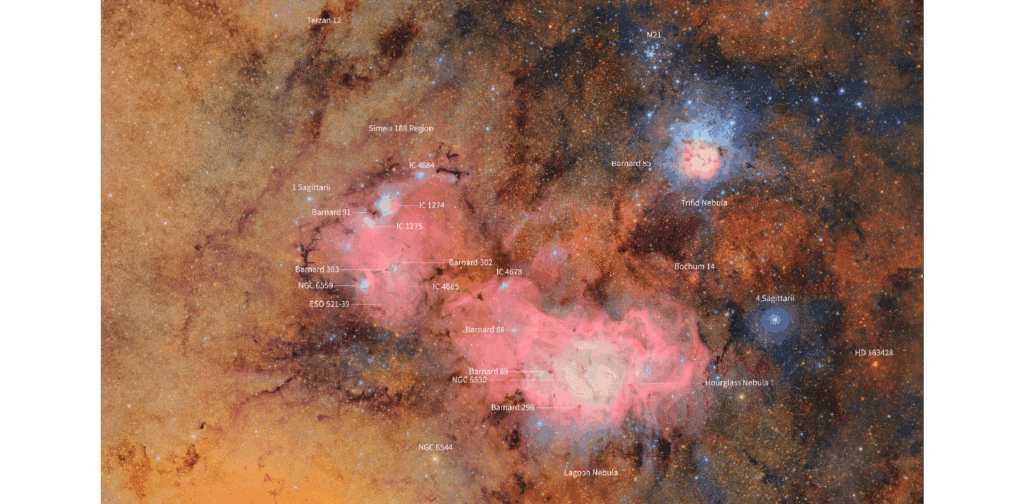
The bright glow of gas and stars on the left side of the image marks the center of our galaxy. The dark strip running straight through this center is known as the Great Rift. It looks like the Milky Way is split in half, right through the center and along its spiral arms. In reality, this gap is caused by a curtain of dust that blocks and scatters visible light. This makes it difficult to observe this area with traditional telescopes.
Fortunately, Rubin is designed to provide the Legacy Survey of Space and Time (LSST). to be carried out. During this 10-year survey, the entire visible southern sky will be re-photographed every few nights - accounting for about 1000 images per night.
One of the four main scientific goals of this mission is the Mapping the Milky Way, to answer fundamental questions about the structure and origin of our galaxy.
The Vera Rubin telescope is no ordinary telescope. It is a revolutionary observatory, built in Chile's Atacama Desert, that in 10 years will map the entire universe - with a speed, precision and depth that no other instrument has ever achieved. And all with a camera of 3200 megapixels, the largest digital camera in the world.
What makes the Vera Rubin telescope so special?
At 2680 meters above the clouds and the turbulent part of the atmosphere is the Rubin Observatory. This is no small dome with a telescope lens: the structure weighs 350 tons and can turn and tilt at unprecedented speed - as if you were stopping and turning a Boeing 747 in four seconds. That's necessary, because this telescope takes about 1000 images of the night sky, in segments of almost 10 square degree per shot - large enough to fit 40 moons.
The secret? The LSST camera: a system the size of a small car, cooled to -100 °C, consisting of 189 individual sensors that together provide an unprecedented level of detail. Where the James Webb Telescope zooms deep into small areas, Rubin views a huge portion of the sky at once - and does so every three days.
What will the Vera Rubin telescope do?
Rubin's mission is grand, but crystal clear: to understand the universe as we never could before. There are four scientific goals:
1. Understanding dark matter and dark energy, why is the universe expanding?
Rubin enters a detailed map of the universe make. By tracking millions of supernovas and measuring the effect of gravity on light (gravitational lensing), astronomers can calculate how dark matter and dark energy behave - potentially solving the universe's greatest mystery.
2. Discovering and tracking asteroids
We now know of about 500,000 asteroids. Rubin is expected to have more than 5 million mapping. More importantly, it also detects objects potentially dangerous to Earth long before they approach us.
3. Real-time event capture
Each recording is directly compared to the previous. Within 60 seconds, all changes are transmitted to scientists around the world. Think exploding stars, black holes gobbling up matter, or objects moving in front of stars. Rubin can thus see up to 10 million notifications per night send.
4. Finally mapping the Milky Way
What we now know about the Galaxy are artist impressions. Rubin is going to make a real map. From 3 billion known stars we will go to more than 20 billion accurately measured stars, including brightness, position and motion. This is a quantum leap in our knowledge of our own galaxy.
Smarter than smart telescopes?
At Telescoop.nl, we often discuss smart telescopes like the Seestar S30 Pro, DWARF Mini or Vespera II. But the Vera Rubin telescope is in an entirely different league. Not just because it is bigger and more powerful, but because it literally discovers what is new by itself - and shares it with the world within a minute. This is the epitome of automation and data-driven astronomy. You might say: this is the ultimate smart scope.
First images: a glimpse of the future
The first images of Rubin have now been released - compiled from more than 650 exposures per image, spread over 7 hours. They show gas clouds, distant galaxies, stereo explosions and colliding galaxies, all captured in one shot.
Figure 1: Spiral galaxies and galactic dance
By photographing images like this one in six bands of light (UV, blue, green, red, infrared and Y-band), Rubin shows both the visible and invisible universe.
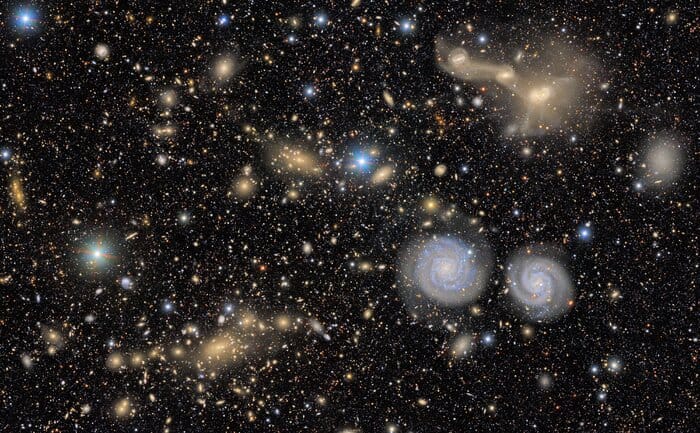
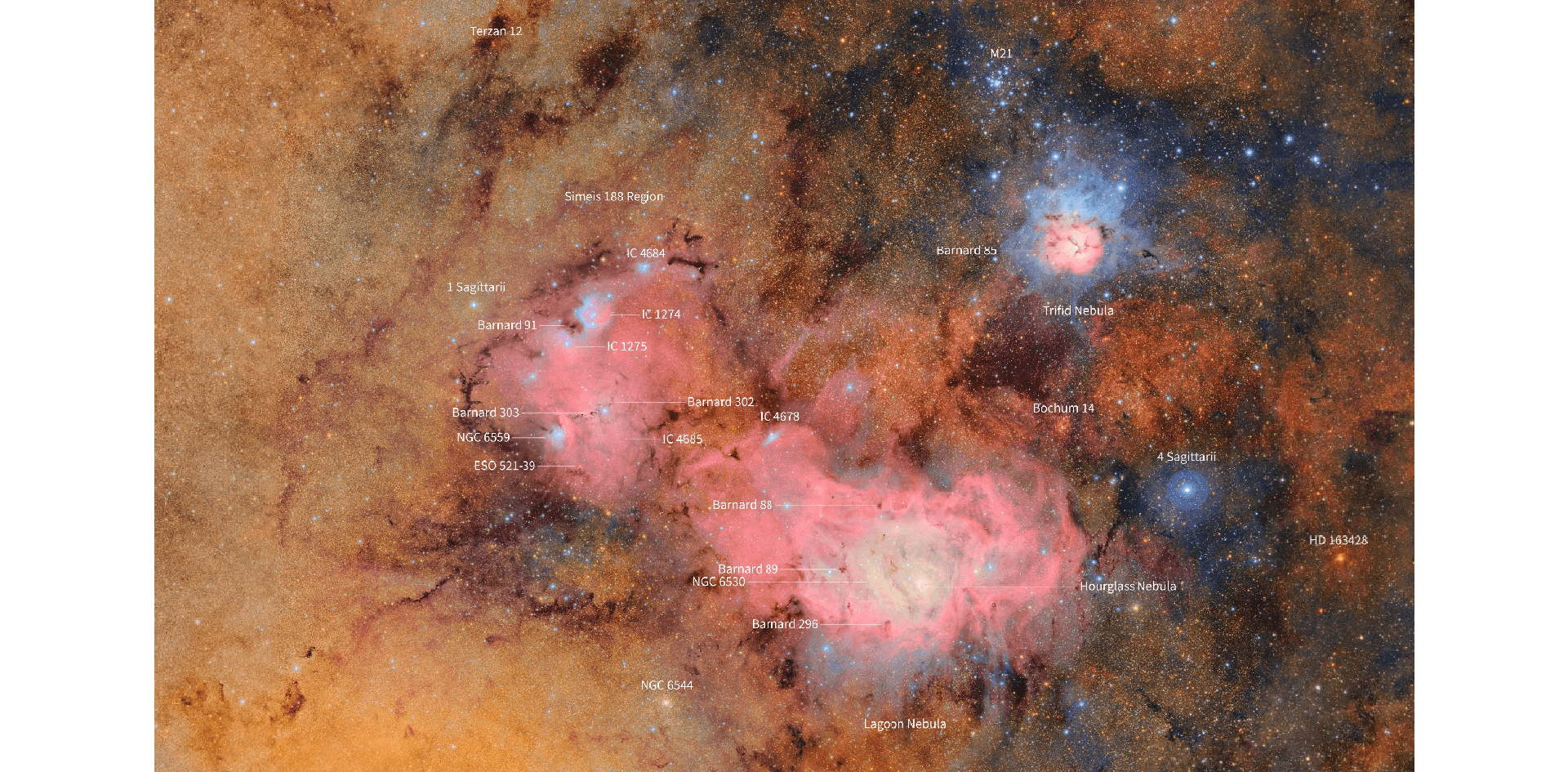
What makes these images so special is not only their beauty, but the science contained within them. Every dot, every cloud, every gleam is data. And with billions of these dots filtered through six different bands of light (from ultraviolet to infrared), it creates the most complete picture of the universe humanity has ever had.
Why all this matters
The Vera Rubin telescope is more than a feat of engineering. It is a scientific document of time. By completely re-photographing the night sky every three days, Rubin creates a kind of film of the universe in motion. Never before have we been able to follow dynamic processes in the universe so closely.
And perhaps most exciting of all? The ‘unknowns’. The discoveries no one had anticipated. Like Hubble and Voyager did before. Rubin is going to change the course of astronomy - and probably redefine our place in the universe.
Also interesting:
- What do you see with a telescope?
- What is dark matter anyway?
- Compare smart telescopes such as Seestar and DWARF 3
Would you also like to explore the night sky yourself, but from your balcony? Check out our offer of smart telescopes and begin your own discoveries today.