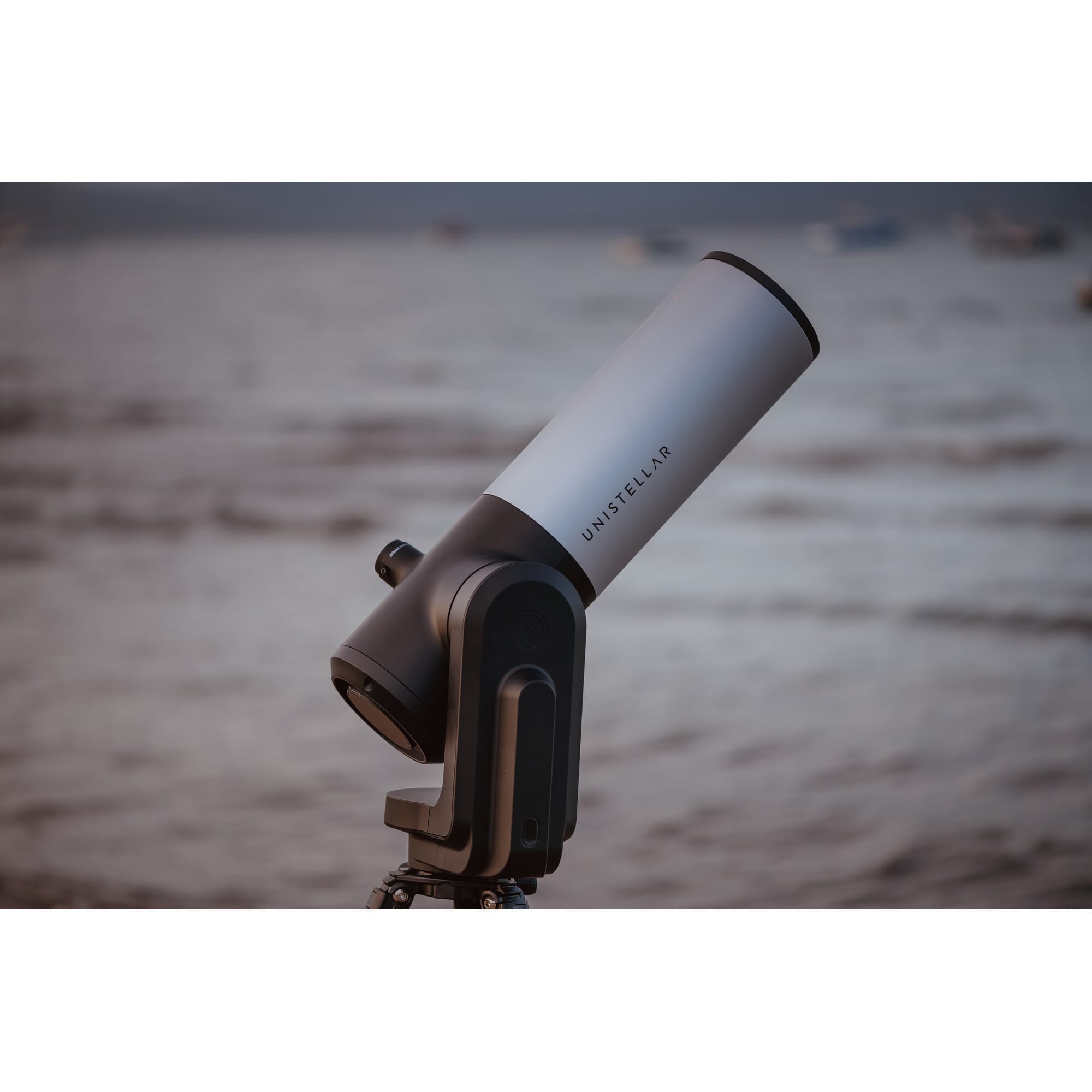
Unistellar eQuinox 2 vs eVscope 2: Unistellar is known for its smart telescopes that make deep-sky objects visible even from illuminated cities. But what are the differences between the eQuinox 2 and the eVscope 2? In this comparison, we explain which model is best for you depending on your observing goal, comfort level and desired image quality. We take a thorough look at each aspect so you can choose with confidence.
Image quality and sensor: eyepiece versus app only
Both models use a Newton reflector design with a 114 mm aperture and a focal length of 450 mm. So in terms of light output and optical performance, they are basically equivalent. But the difference is in the imaging experience.
The eVscope 2 has a unique electronic eyepiece, developed together with Nikon. This allows you to see live in the image, offering a particularly immersive experience - as if you were looking through a classic eyepiece yourself, but with digital clarity. This makes it very suitable for demonstrations, educational use or simply for those who like to ‘really look.
The eQuinox 2, on the other hand, uses only an app view. This is more practical for astrophotographers or those who want to share images on a screen, but less immersive for visual observers.
Both models use similar Sony Starvis sensors, so resolution and sensitivity are virtually the same in practice.
Technology and image processing: stacking or live amplification?
The technology behind the images is where Unistellar stands out. The eQuinox 2 uses classic image stacking (stacking), which automatically merges multiple short exposures into one clear final result. This requires a little more time, but gives control over the quality of the final image.
The eVscope 2 works with Unistellar's patented live image enhancement. Here, the image is continuously built up and enhanced as you look. So you see the object appear almost instantly, which is especially impressive for visitors, beginners or impatient observers. This feature also makes it easier to frame the object properly.
Both use stacking, but with the eVscope 2 it feels more like live viewing than photography. The eQuinox 2 is more focused on astrophotography on classical principles.
Unistellar eQuinox 2 vs eVscope 2 Storage and battery capacity: are there any significant differences?
In terms of technical specifications, the differences are small:
- eQuinox 2: 64 GB storage, 11 hours of battery life
- eVscope 2: 64 GB storage, 10 hours of battery life
Both offer ample memory for a full session as well as backups, and both are suitable for extended use without recharging. The eQuinox 2 scores slightly better in terms of battery life. In practice this difference is hardly noticeable during one night of observation, but if you want to do several sessions without charging in between, this is worth mentioning.
The models are also similar when it comes to storage. Through the app, you can easily transfer files to your smartphone, tablet or laptop. Just keep in mind that RAW export is currently still limited; both models deliver mostly processed JPEG images.
User comfort and design: portability versus immersion
Both telescopes are user-friendly and quick to deploy. Mounting is intuitive, alignment automatic, and everything works through the Unistellar app. Still, there are differences in user experience.
The eVscope 2 feels like a luxury device. Its aluminum body, built-in eyepiece and rugged construction give it a premium feel. At 9 kg, it is slightly heavier than the eQuinox 2 (8 kg), but both are still easy to carry.
The eQuinox 2 is more compact and simpler in design. Because there is no built-in eyepiece, it is slightly lighter, and less fragile when transported. This makes it more suitable for those who travel often or photograph on location.
Both models support participation in citizen science projects, such as tracking asteroids or observing exoplanets. The app experience is nearly identical, offering features such as object recognition, automatic tracking, live stacking, and keeping track of your observations.
Unistellar eQuinox 2 vs eVscope 2 Table: Specifications at a glance
| Feature | Unistellar eVscope 2 | Unistellar eQuinox 2 |
|---|---|---|
| Optics | Newton reflector | Newton reflector |
| Aperture | 114 mm | 114 mm |
| Focal length | 450 mm | 450 mm |
| Sensor resolution | Similar | Similar |
| Image processing | Amplified live image | Classic stacking |
| Picture Eye | Electronic eyepiece | Via app only |
| Weight | 9 kg | 8 kg |
| Storage | 64 GB | 64 GB |
| Battery life | 10 hours | 11 am |
In brief: The eVscope 2 offers a more immersive experience thanks to its eyepiece and direct image enhancement. The eQuinox 2 is slightly lighter, less expensive and delivers the same smart technology without a built-in screen. Both offer excellent sighting capabilities and are suitable for use in urban environments.
Unistellar eQuinox 2 vs eVscope 2: Which smart telescope best suits your needs?
Are you someone who likes to observe together, share images with others or just want immediate results? Then the eVscope 2 your best choice. Thanks to the electronic eyepiece, you watch live and see the image improve as you observe.
Are you more into post-processing, exporting images later and don't need an eyepiece? Then the eQuinox 2 perfect. You get the same optics, the same app experience, but at a lower price and in a more compact package.
👉 See both models in our category smart telescopes for current prices and availability.
Unistellar eQuinox 2 vs eVscope 2: Help in making your choice: ask yourself these questions
Still in doubt? Then it helps to get your own usage situation in focus for a moment. Ask yourself these questions:
- Want to see instant details of planets such as Saturn's rings or the bands on Jupiter? Then the eVscope 2 the better choice. Thanks to the amplified live image, you get instant spectacular results even without post-processing.
- Want to edit your own images later with maximum control over stacking and export? Then the eQuinox 2 better with you because it works according to classical astrophotography logic.
- Are you often on the road or want to stay mobile? Then the eQuinox 2 with 1 kg less weight is slightly easier to carry, although the difference is small.
- Want to use your sessions for citizen science, with lots of participation opportunities and a strong community? Then both models are equivalent - you can participate in scientific projects through the app in both cases.
Both models are powerful, user-friendly and designed for people who want to explore the night sky without technical barriers. The choice depends mainly on how you want to view, via screen or eyepiece - and whether you value speed or control.
More comparisons to help you further
- Unistellar eVscope 2 vs. Vespera Pro — Newtonian reflector vs. refractor: detail or field of view?
- Vespera II vs Vespera Pro — the Vaonis alternative in the same class, and what the Pro's price premium is for.
- All models side-by-side? Check out our category smart telescopes.