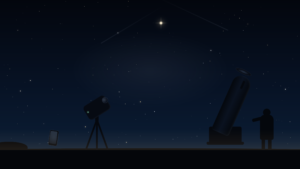
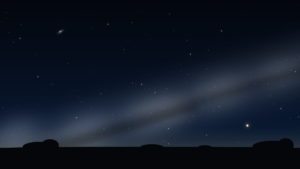
The Lyrids meteor shower in 2025 are one of the oldest known meteor showers and return every year around April 16-25. The peak falls on the night of April 21 to 22. For anyone interested in stargazing, this is a prime opportunity to see dozens of shooting stars per hour - without a telescope.
In this guide you will read all about observing the Lyrids, where to look, how many meteors to expect and why this phenomenon is so special.
Where do the Lyrids come from?
The Lyrids are dust and grit particles originating from comet C/1861 G1 Thatcher. When Earth crosses this ancient cometary orbit, these particles burn up in our atmosphere. This produces short but bright flashes of light, often with afterglow trails.
The radiant - the point in the sky where the meteors appear to come from - lies in the constellation Lyra (de Lier), near the bright star Vega. This makes the Lyrids easy to track in the eastern sky from about midnight.
When is the best time to see the Lyrids?
The peak of the Lyrids occurs on the night of 21 on April 22, 2025, with the most meteor activity between 02:00 and 05:00 local time. Then the constellation Lyra is high in the sky, enhancing visibility.
In optimal conditions, you can 15 to 20 meteors per hour expect. During a rare outburst, even 100 meteors per hour are possible, although that is exceptional for the Lyrids.
The conditions in 2025 are beneficial, because the moon is in the last quarter (April 20) and rises early, so the sky is still mostly dark during the peak moment.
Where to look in the sky?
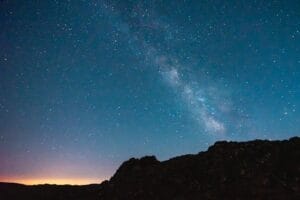
Although the radiant lies in Lyra, meteors can appear anywhere in the sky. Most can be seen at the eastern to southern sky, depending on your location.
You don't need a telescope - bare eyes are better because of the wide field of view. Choose a location:
✓ with as little light pollution as possible
✓ with an unobstructed view of the horizon
✓ where you can lie comfortably or sit back
Use a star chart or an app such as Stellarium to find Lyra and Vega as landmarks.
Tips for observing the Lyrids
✓ Get your eyes used to the dark (at least 20 minutes)
✓ Do not use a telephone light - or use a red filter
✓ Bring a warm blanket or sleeping bag - it can be chilly in April
✓ If necessary, take a deck chair for optimum comfort
✓ Be patient - meteors come in fits and starts, sometimes with breaks in between
Want to capture it? Use a DSLR or astro camera with wide-angle lens and long exposure (10-30 sec) aimed at a dark sky. Use a tripod and focus manually at infinity.
Why are the Lyrids special?
The Lyrids are one of the oldest observed meteor showers; Chinese sources report observations from as early as 687 B.C.. Although the activity is less spectacular than, say, the Perseids, the Lyrids are known for their relatively bright, fast meteors and afterglow trails that can linger for several seconds.
Moreover, the Lyrids come at a time when the weather often begins to improve - April is the beginning of the spring season for stargazers. That makes this meteor shower an ideal event for exploring the night sky.
Conclusion: Lyrids meteor shower 2025 will be an observational highlight
With favorable moon phase, highly visible radiant and a rich history, the Lyrids 2025 one of the best times of spring to take in the sky.
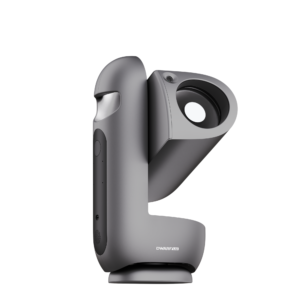
Want to be optimally prepared for stargazing? Check out our stargazing guide april or discover the best binoculars and smart telescopes such as the Seestar S50 and DWARF 3 For broader astro experience.
Whether watching shooting stars with family or seeking the quiet of the night by yourself, the Lyrids always bring magic to the sky.