The question “Is the Moon a planet?” is surprisingly often asked. Certainly by children, but also by adults just starting out in astronomy. And it's understandable: the Moon is round, has a surface full of craters, and rotates in the sky like a planet would. Yet the answer is clear: no, the Moon is not a planet. In this blog, we explain why not and why that answer is more interesting than you might think.
What makes something a planet?
According to the International Astronomical Union (IAU) an object must meet three conditions to be considered a planet:
- It orbits directly around a star (like the sun).
- It is spherical by its own gravity.
- It swept its orbit clean of other objects.
Earth meets all these conditions; the Moon does not, and that is mainly because it is orbiting the Earth, and not directly around the sun. This makes it not a planet, but a natural satellite.
What is a natural satellite?
A natural satellite is an object that orbits a planet. In our solar system, there are more than 400 moons discovered. Some examples:
- Ganymede (Jupiter's moon) is the largest moon in the solar system, even larger than Mercury, and may have an underground ocean.
- Titan (moon of Saturn) is the only moon with a dense atmosphere and has lakes of liquid methane. In 2028 it will launch NASA the Dragonfly mission: a flying drone that will explore Titan in 2034 for traces of life and organic chemistry.
- Europe (moon of Jupiter) has an ice crust beneath which lurks an ocean possibly suitable for life.
- Enceladus (moon of Saturn) spews out water and organic matter through active geysers. Beneath the ice surface there is almost certainly a liquid ocean with the right ingredients for life.
Earth's Moon is not the biggest, but unique: it is by far the largest moon relative to the planet it circles.
But the Moon is big, isn't it?
Yes, that's right. The Moon has:
- A diameter of 3,474 km (over a quarter of the Earth)
- A mass 80 times smaller than that of the Earth
- A surface with craters, seas and mountains
That makes him large enough to be spherical, one of the planetary criteria, but that is not enough. Its orbit determines its classification.
The center of mass: why the Moon is not a double planet
The Earth and Moon do not technically rotate exactly around each other, but around a common center of gravity: the center of mass. That is about 1,700 km below the Earth's surface.
Had the barycenter fallen outside the Earth, we could speak of a double planet system. But because it is still ín the Earth, the Moon remains a satellite.
Does the Moon have planet-like properties?
Absolutely. The Moon:
- Has a core, mantle and crust
- Has moonquakes (moonquakes), as well as earthquakes
- Was created from a collision between young Earth and a planet-like object (Theia)
- Has a stable orbit and predictable rotation
But despite these characteristics he misses the independent orbit around the sun, and that is decisive.
Is the Moon moving away from us?
Yes. The Moon is moving away each year by about 3.8 centimeters From Earth. Once, it was only about 22,500 km from us. Now, the average distance is 384,000 km.
In billions of years, that effect will:
- Making eclipses rarer
- Making tides less strong
- Extending our days
Yet that process will likely be overtaken by another cosmic fate: the Sun will engulf the Earth and Moon in about 5 billion years.
How did the Moon come into existence?
The most widely accepted theory is the Theia impact hypothesis. About 4.5 billion years ago, Shortly after the Earth formed, an object the size of Mars collided with it, which we know today as a Mars-sized object. Theia call out, with the young Earth.
Was the Earth fully formed by then?
No, the Earth was still developing at the time:
- Not yet cooled
- No stable atmosphere yet
- Much smaller than now
- And with a lower gravity than today's planet
Yet the Earth had already sufficient mass to pull huge amounts of material into orbit after impact. This debris, mostly from Theia as well as Earth itself, formed a disk around our planet over the course of several thousand years.
Gravity caused this material to clump together into one large object: the Moon.
Why is the Moon now orbiting the Earth?
The rotation of the Earth as well as the speed at which the debris was hurled into space after the collision caused the clumped object to in a stable job came. Compare it to a satellite launched around the Earth at just the right speed.
What's important:
- The resulting object had a track and speed which did not lead to relapse or escape.
- The mass of the Earth was already sufficient at that time to bind this object by gravity.
Since then, the Moon has been continuously orbiting the Earth, while tidal action and rotational acceleration have further affected our systems.
As a young planet, why could we hold a moon after all?
While this is a valid point, there are a few things to be aware of:
- Even a smaller planet has a gravitational field, especially when an impact of this scale occurs. Objects in space are really very large, even though they are called ‘small’.
- The debris was already relatively close to Earth after the impact.
- There was no need to don an external moon; the Moon formed from local material, within the Earth's gravitational field.
This makes our Moon different from most moons in the solar system, many of which are trapped (such as Mars’ moons Phobos and Deimos).
What makes our Moon special?
- The Moon is actively studied: by such missions as Apollo, Lunar Reconnaissance Orbiter, and Artemis.
- He is the only celestial body beyond the Earth that humans once walked on.
- His presence stabilizes the rotation axis of the Earth, and thus is essential for a stable climate.
- Without the Moon, the the tides much weaker its (the sun also causes tides, but about half as strong), and our nights would be much darker.
What can you see with a telescope?
Even with a entry-level you can see many details on the lunar surface:
- Craters like Tycho and Copernicus
- Lunar seas such as Mare Tranquillitatis
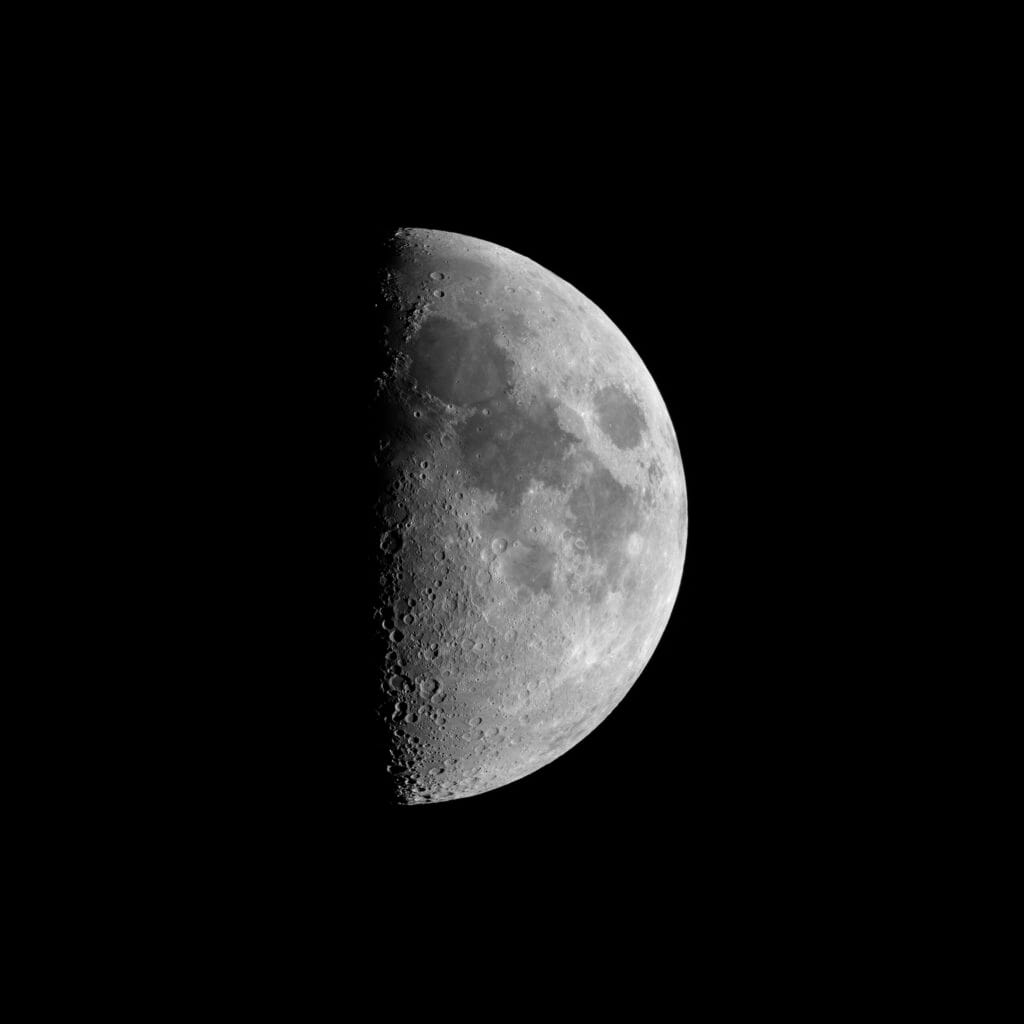
- Shadows along the terminator (the boundary between light and dark)
Preferably use a moon filter To increase contrast and prevent glare.
🔗 Also read: Which moon filter fits your telescope
Conclusion: is the Moon a planet?
No. The Moon is a natural satellite of Earth. It does not orbit the sun, and therefore does not meet the official planet definition. Nevertheless, she is planetary in properties and invaluable to life on Earth.
Want to see the Moon for yourself? Then visit our: