At a planetary alignment, Also known as the planet parade, several planets are visible in the sky at the same time, approximately in a line. On this page you can read when the next planet parade from the Netherlands and Belgium will be visible, which planets will participate, what time you have to go outside and what you can see with the naked eye, a telescope, binoculars or a camera. binoculars or a telescope. We will update this page as soon as a new parade arrives.
When is the next planetary parade?
The next planetary parade falls in the second half of November 2026, in the morning. Mercury, Venus, Mars and Jupiter will then be together in the southeast, well before sunrise. All four can be seen with the naked eye. The best period runs from about November 10 to 25. Mercury will be highest above the horizon around November 21; according to hemel.waarnemen.com, this is a very favorable morning apparition, which is rare for Mercury.
What time to go outside: between 06:45 and 07:15. The sun rises around 08:00. During that half hour, it is still dark enough for Jupiter and Mars, while Venus and Mercury have just climbed above the horizon. If you wait longer, the two lowest planets will disappear into the morning light.
How to find the four planets in November 2026
- Jupiterthe brightest point high in the south to southeast, in the constellation Leo. Jupiter has been above the horizon since midnight and is impossible to miss.
- Mars: near Jupiter, recognizable by its orange-red color. Mars will become increasingly bright in the coming months, heading towards its opposition in February 2027.
- Venuslow in the southeast, bright white and, after the moon, the brightest object in the sky. Venus returned as a morning star in early November and climbs a little higher each week.
- Mercury: the lowest of the four, just above the southeastern horizon. You need an unobstructed view without trees or buildings. Binoculars will help to find it in the twilight.
Saturn is not visible in the morning, but is due south the entire previous evening: its opposition was on October 4, 2026. Anyone who counts the entire night will therefore see five planets with the naked eye in November.
Planet parades in 2026, 2027 and 2028
International calendars count all planets that are above the horizon at the same time, even if a planet is right next to the sun and invisible in practice. The table below therefore shows what you can actually see from the Netherlands and Belgium for each parade.
| Period | Morning or evening | Planets | Visibility from the Netherlands and Belgium |
|---|---|---|---|
| November 10 to 25, 2026 | Morning | Mercury, Venus, Mars, Jupiter | Good: all four with the naked eye |
| Around April 18, 2027 | Morning | Mercury, Venus, Saturn, Neptune | Mediocre: only Venus is clearly visible, the rest are too close to the sun |
| Around July 2, 2027 | Morning | Mercury, Venus, Saturn, Uranus, Neptune | Bad: Venus and Mercury are hidden in the sunlight, only Saturn is truly visible |
| Around September 18, 2027 | Evening | Mercury, Venus, Mars | Mediocre: all three low in the evening twilight |
| Late December 2027 to mid-January 2028 | Evening | Mercury, Venus, Mars, Saturn, Uranus, Neptune | Good: the most beautiful parade of the coming years |
December 2027 and January 2028: the parade to look forward to
Around the turn of the year from 2027 to 2028, six planets will be visible in the evening sky after sunset, and at a time when you don't need to set your alarm. Venus shines as the evening star in the southwest, Saturn is higher in the south with Neptune not far away, Uranus is high in the southeast, and Mars is low in the southwest. Mercury joins them in early January, low above the southwestern horizon; around January 17, 2028, it reaches its highest point. Look between 5:30 PM and 7:00 PM. Those who go outside later in the evening will also see Jupiter rising in the east. You need binoculars for Uranus and a telescope for Neptune.
What is a planetary alignment?
All planets orbit the sun in almost the same plane. Viewed from Earth, they therefore all move along the same imaginary line in the sky: the ecliptic, the path that the sun also follows during the day. If multiple planets are on the same side of the sun at the same time, you see them scattered along that line, from low on one horizon high up in the sky. That is a planetary alignment. The smaller the patch of sky in which the planets are grouped together, the more magnificent the parade.
The word planet parade is not an official astronomical term. It is usually used as soon as three or more planets can be seen at the same time. Small parades with three or four planets occur almost every year. Large parades with five or six planets are rarer, and whether you see them well depends heavily on where you are on Earth.
Are the planets really aligning?
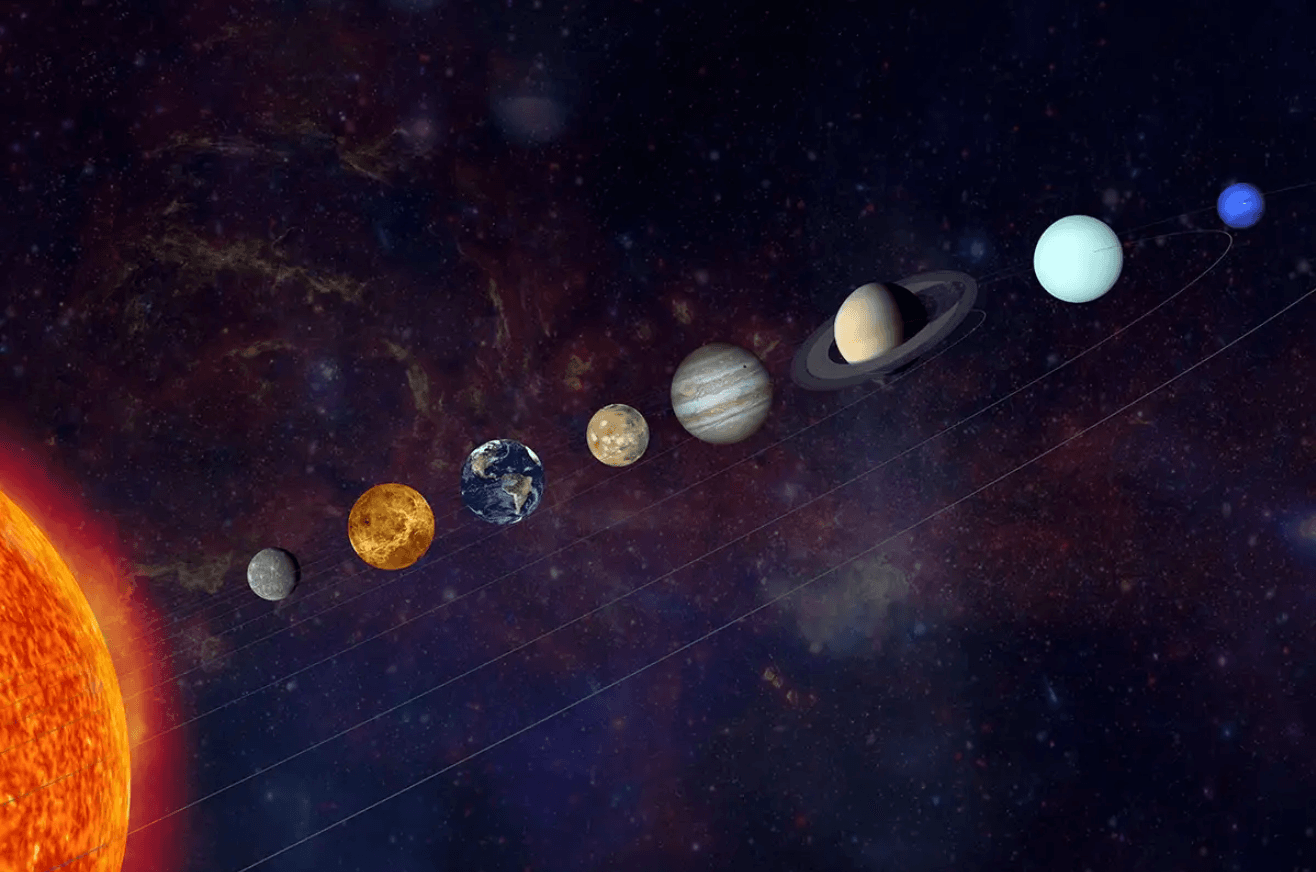
No. From Earth, the planets appear to be lined up in a row, but in space they are hundreds of millions of kilometers apart and at different distances from the Sun. There is no true straight line through all the planets, because their orbits do not lie exactly in the same plane. What we see is a perspective effect: the orbits lie roughly in a single plane, so from Earth they appear to align along the ecliptic. A planetary alignment also has no effect whatsoever on Earth. The gravitational pull of the planets is negligible at these distances; only the Moon and the Sun have a measurable influence, for example on the tides.
Which planets can you see with the naked eye, binoculars, or a telescope?
- Venus, Jupiter, Mars and Saturn visible to the naked eye, even from the city. Venus and Jupiter are so bright that they stand out even in the twilight.
- Mercury can also be seen with the naked eye, but is always low and close to the sun. You need a low horizon and the right moment. Read more about Mercury through a telescope.
- Uranus can be seen with the naked eye under a truly dark sky, but you will find it much easier with binoculars. Through a telescope, you will see a small greenish-blue disc. Read more about Uranus through a telescope.
- Neptune always requires a telescope. It is too faint for the naked eye and difficult to distinguish from a star in binoculars. Read more about Neptune through a telescope.
So a telescope is not necessary to see a planet parade, but it does make it a lot more fun. With a Dobson telescope you can see Saturn's rings, Jupiter's cloud belts and four large moons, and, around the February 2027 opposition, Mars's polar ice cap. A refractor telescope delivers sharp, high-contrast planetary images and is quick to set up on a cold morning. A smart telescope finds the planets itself via the app and is particularly suitable for the moon and deep-sky objects; for planetary details, a classic telescope with an eyepiece remains the better choice. Are you in doubt? Our guide for beginners helps you choose.
How do you view a planetary parade?
- Look for an open horizon. At a morning parade you look to the east and southeast, at an evening parade to the west and southwest. The lowest planets (Mercury and often Venus) are only a few degrees above the horizon. A dike, beach, meadow, or high-rise apartment works better than a garden between houses.
- Choose the right moment. Start about an hour before sunrise or half an hour after sunset. Too early and it is still too dark to have the low planets above the horizon, too late and they disappear into the daylight. The exact rise and set times for the Netherlands and Belgium can be found at hemel.waarnemen.com.
- Use a star chart. A free app like Stellarium or Sky Tonight shows exactly where every planet is at that moment. That way you can be sure that the bright dot is Venus and not an airplane.
- Plan multiple days. A parade usually lasts a week or two. If it is cloudy one morning, you just try again a day later. The planets shift only a little bit each day.
- Watch the moon. A narrow crescent moon next to Venus or Jupiter makes the image extra beautiful, whereas a full moon outshines the weaker planets. In our lunar calendar Do you see what moon phase it is?.
- Dress warmly. The most beautiful parades of the coming years fall in November, December and January. Standing still in the freezing cold for half an hour is longer than you think.
Earlier planetary parades
In recent years, there have been several highly visible parades. In January and February 2025, six and later seven planets were in the evening sky, in August 2025 was there a morning parade with six planets and end February 2026 six planets stood above the western horizon after sunset, four of which could be seen with the naked eye. What you can see in the sky during a given month can be read in our monthly starry sky articles.
Frequently Asked Questions
When is the next planetary parade in the Netherlands?
In the second half of November 2026, in the morning between 06:45 and 07:15. Mercury, Venus, Mars, and Jupiter will then be in the southeast, all four visible to the naked eye. Around November 21, Mercury will be most visible.
When will there be five or six planets in a row again?
From late December 2027 to mid-January 2028, six planets will be visible in the evening sky after sunset: Mercury, Venus, Mars, Saturn, Uranus, and Neptune. From the Netherlands and Belgium, that is the finest parade of the coming years.
When will all seven planets be in the sky at the same time?
The next time all seven planets are above the horizon at the same time is on February 3, 2034. On September 8, 2040, the five bright planets (Mercury, Venus, Mars, Jupiter, and Saturn) will be close together after sunset, along with a crescent moon. That will be one of the most beautiful parades of this century.
How often does a planetary parade occur?
Small parades with three or four planets occur almost every year. Large parades with five or six planets happen every few years. Whether you see anything depends on the time (morning or evening) and how high the planets rise above the horizon from the Netherlands and Belgium.
Do I need a telescope to see a planet parade?
No. Mercury, Venus, Mars, Jupiter, and Saturn can be seen with the naked eye. You need binoculars for Uranus and a telescope for Neptune. With a telescope, you can also see details such as Saturn's rings and Jupiter's moons.
Does a planetary alignment affect the Earth?
No. The planets are so far away that their gravitational pull on Earth is not noticeable, even when they are aligned. Stories about earthquakes or tidal waves caused by a planetary alignment are nonsense. Only the Moon and the Sun have a measurable influence, such as on the tides.