
Refractors
Showing all 7 resultsSorted by popularity


Showing all 7 resultsSorted by popularity
More about refractor telescopes
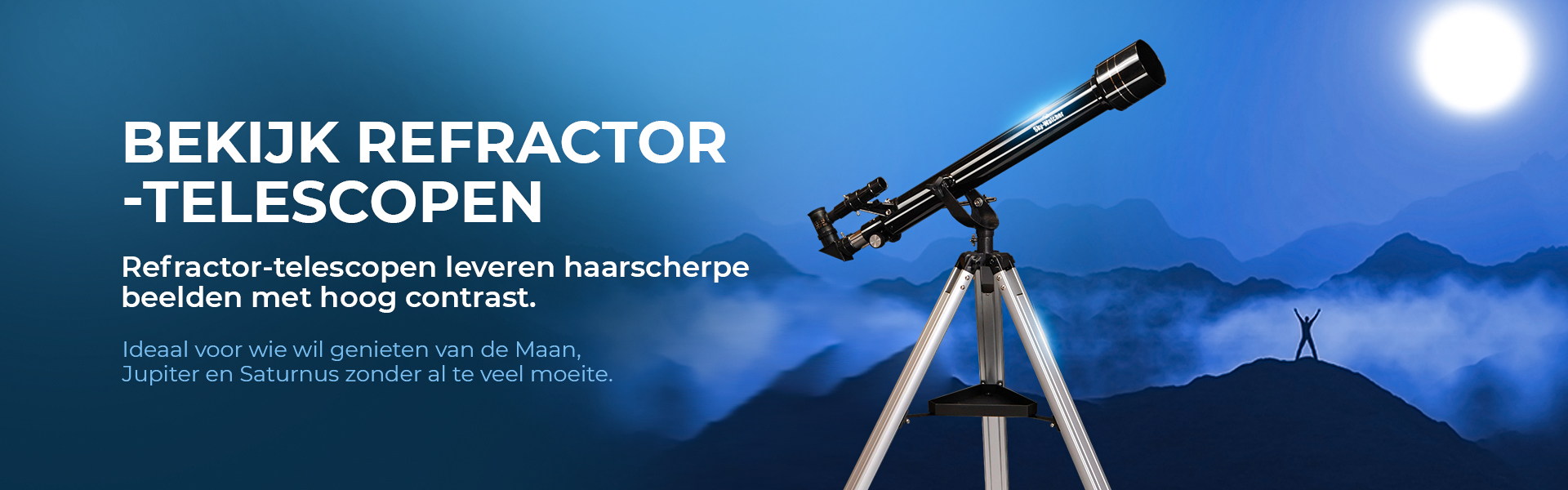
Modern refractor telescopes are available in two main types: achromatic and apochromatic refractors. Both designs reduce chromatic aberration, the color fringing that can occur on bright objects, but do so in different ways. Achromats typically use two lens elements and are affordable and lightweight. Apochromats (also called APOs called) use three or more lenses and almost completely correct color aberrations, making them ideal for astrophotography.
Refractors can be placed on both equatorial as alt-azimuth mounts, depending on the application. The first is suitable for photography thanks to automatic tracking capabilities, the second is simple and user-friendly for visual observation.
Examples for each level
For Beginners
The Celestron StarSense Explorer LT 80AZ is an excellent entry-level refractor. Thanks to StarSense technology and smartphone support, you can easily find celestial objects via the app. The kit includes two eyepieces (25 mm and 10 mm), a 2× Barlow lens, a moon filter, a red flashlight and a lens pen, everything you need to get started right away.
For advanced students
The Explore Scientific FirstLight 102 mm Doublet Refractor with EXOS Nano mount combines precision with classic optics. With a 1000 mm focal length and f/9.8 ratio, it delivers sharp images at magnifications above 200×, ideal for planetary observations or photography. The equatorial EXOS mount with slow-motion control makes precise tracking easy.
Compact powerhouse
The Apertura 72EDR with Ohara FPL-53 glass is a popular travel refractor. Only 12 inches long and 2 kg light, but with excellent color correction and high contrast. With a pull-out dew hood, internal light baffles and Petzval-like image quality, it is perfect for astrophotography on the go.
Professional astrophotographers
The William Optics RedCat 51 WIFD shows how far modern refractors can go. The internal focuser (WIFD design) keeps the optical tube balanced and prevents vignetting. The quadruplet construction with FPL-53 glass delivers a flat 45 mm field of view, ideal for full-frame cameras. The fast f/4.9 optical system and minimal chromatic aberration put the RedCat at the top of its class.
Universal all-rounder
The Celestron Inspire 100AZ is a versatile refractor for beginners who want to view the Moon, Jupiter or distant landscapes. The 100 mm aperture and short 430 mm focal length provide a clear, wide image. The straight angle of view also makes it suitable for daytime observations.
What to look out for when buying a refractor telescope
Aperture (lens diameter)
The aperture determines how much light the telescope captures. Larger apertures show more detail, but make the telescope heavier. For beginners, 70-100 mm is ideal; for advanced observers, 100-150 mm offers more options.
Focal length and f-ratio
The focal length determines the magnification and field of view. A longer focal length and higher f-value (e.g., f/9 - f/11) are ideal for planets. A shorter f-value (f/5 - f/6) is better for deep-sky objects and astrophotography.
Optical design
Achromatic refractors are light and affordable. Apochromatic refractors provide the highest image quality and color neutrality, but cost more.
Portability and storage
Refractors are closed systems and require little maintenance. They are compact, robust and quick to deploy, ideal for those who often observe outdoors.
Mount
Alt-azimuth mounts are easy to use and perfect for beginners. Equatorial mounts track celestial objects automatically and thus are more suitable for photography.
Accessories
A good eyepiece, decent viewfinder and filters (such as a moon or color filter) greatly improve viewing comfort and contrast. Check if accessories are included or sold separately.
Why choose a refractor telescope?
Refractors deliver razor-sharp, high-contrast images of planets, star clusters and double stars. Thanks to their fixed optics, they require little maintenance and are quickly ready for use. Professional astrophotographers appreciate apochromats for their flat field of view and colorfast results, while beginners benefit from the simplicity and reliability of achromatic models.
Whether you want to study the Moon, track Jupiter's bands or photograph wide star fields, a refractor provides a stable, durable and versatile base for years of viewing pleasure.
 Dutch
Dutch English