
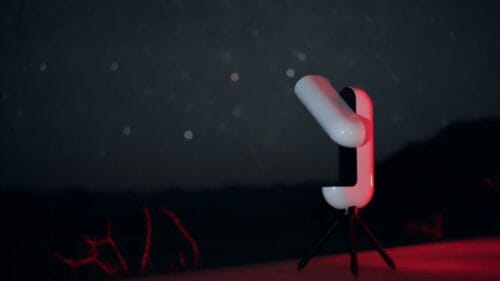
A smart telescope for beginners choosing seems simple, but the market has quickly become flooded with models with varying features, price levels and performance. Whether you are a child interested in the moon, a parent looking for something educational, or an adult looking to start astrophotography - not every smart telescope is right for you. In this article, we explain exactly what a smart telescope is, what to look for as a beginner, and which models really make a difference.
What is a smart telescope anyway?
A smart telescope combines optics with electronics. These telescopes automatically locate celestial objects via GPS, an app or built-in AI recognition. So you don't have to manually align yourself or do complicated settings.
Modern smart telescopes such as the Seestar S30 and DWARF 3 use stacking technology: they combine dozens or hundreds of images to reduce noise and make details visible. This means that even a relatively small lens can give impressive results - provided you know what you're doing.
Why are smart telescopes ideal for beginners?
✓ No alignment required - They automatically focus themselves on the right object.
✓ Operation via app - Everything works through a smartphone or tablet.
✓ Instant results - You can often see the moon, planets or nebulae within 1 minute.
✓ Saving and sharing astrophotos - Many models automatically store images.
✓ Compact and portable - No lugging heavy equipment around.
But: this does not mean that every smart telescope is right for you.
The three best smart telescopes for beginners
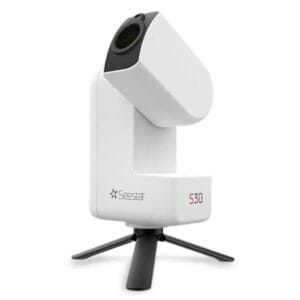
1. Seestar S30 - Ideal entry-level model for €500-600

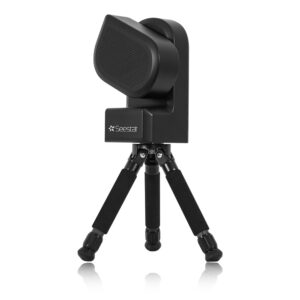
The Seestar S30 is currently the most popular model among beginners worldwide. This compact telescope is fully automated, has a built-in sensor, automatic focusing, and works through an app that does almost everything for you. The results are impressive, especially for the price.
What do you see with it?
✓ Deep-sky objects such as the Orion Nebula
✓ Galaxies such as Andromeda
Why beginners choose these:
- Ready to use in 2 minutes
- Works even from the city (light pollution is software compensated)
- Ideal for astrophotos via smartphone
→ View the Seestar S30 in our webshop
2. DWARF 3 - More control for tech-savvy beginners

The DWARF 3 is more compact, but offers more manual settings: exposure, gain, stacking. Ideal for those who want to get serious about astrophotography from the beginning. It has a wider field of view and is perfect for objects like Andromeda or the Pleiades.
Notice: This telescope is more powerful, but also more prone to errors. It requires just a little more technical feeling than the Seestar.
3. Seestar S50 - Smarter and more powerful than the S30

The Seestar S50 is the big brother of the S30: same usability, but more powerful optics and an improved sensor. The telescope is still fully automated, but has a longer focal length and narrower field of view - perfect for smaller deep-sky objects such as the Ring Nebula or planetary nebulae.
What makes the S50 special?
- Higher resolution thanks to more advanced sensor
- Suitable for detailed shooting of smaller objects
- More zoom, but therefore slightly less suitable for wide sky areas
Why beginners choose these:
- Comes with tripod and carrying case
- Same simple operation as the S30
- More detail in planetary and deep-sky shots
| Model | Ease of use | Image angle | Strength | Sensor | For whom. | Price (indicative) |
|---|---|---|---|---|---|---|
| Seestar S30 | ★★★★★ | Wider (0.7° x 1.3°) | Average | IMX462 | Complete beginners | €549 |
| Seestar S50 | ★★★★★ | Smaller (more zoom) | Strong | IMX462 (enhanced) | Beginners who want more details | €719 |
| DWARF 3 | ★★★★☆ | Very wide (2.9° x 1.6°) | Advanced | IMX678 (8.3 MP) | Technically minded startups | €589 |
What should you pay attention to when purchasing?
- Want to take astrophotos directly? → Choose a model with automatic stacking such as the Seestar S30/S50.
- Want to learn more about settings? → Then the DWARF 3 is a good step.
- Is ease of use most important? → Choose a fully automated telescope with fixed app integration.
- Are you buying this for a child or classroom? → Look for stability, usability as well as educational content.
Conclusion: this is the best smart telescope for beginners
For 95% of beginners, the Seestar S30 the best choice. It combines simplicity, powerful optical performance and an excellent price tag. Those who want more control can switch to the DWARF 3 - but for fast results and a great first experience, the Seestar is unbeatable.
📦 Order directly or learn more?
- Take a look at the Seestar S30
- Read our selection guide smart telescopes
- Compare the DWARF 3 and Seestar S50
Do you have questions or want personal advice? Contact us via chat, email or phone - our specialists will be happy to help you.



 Dutch
Dutch English