
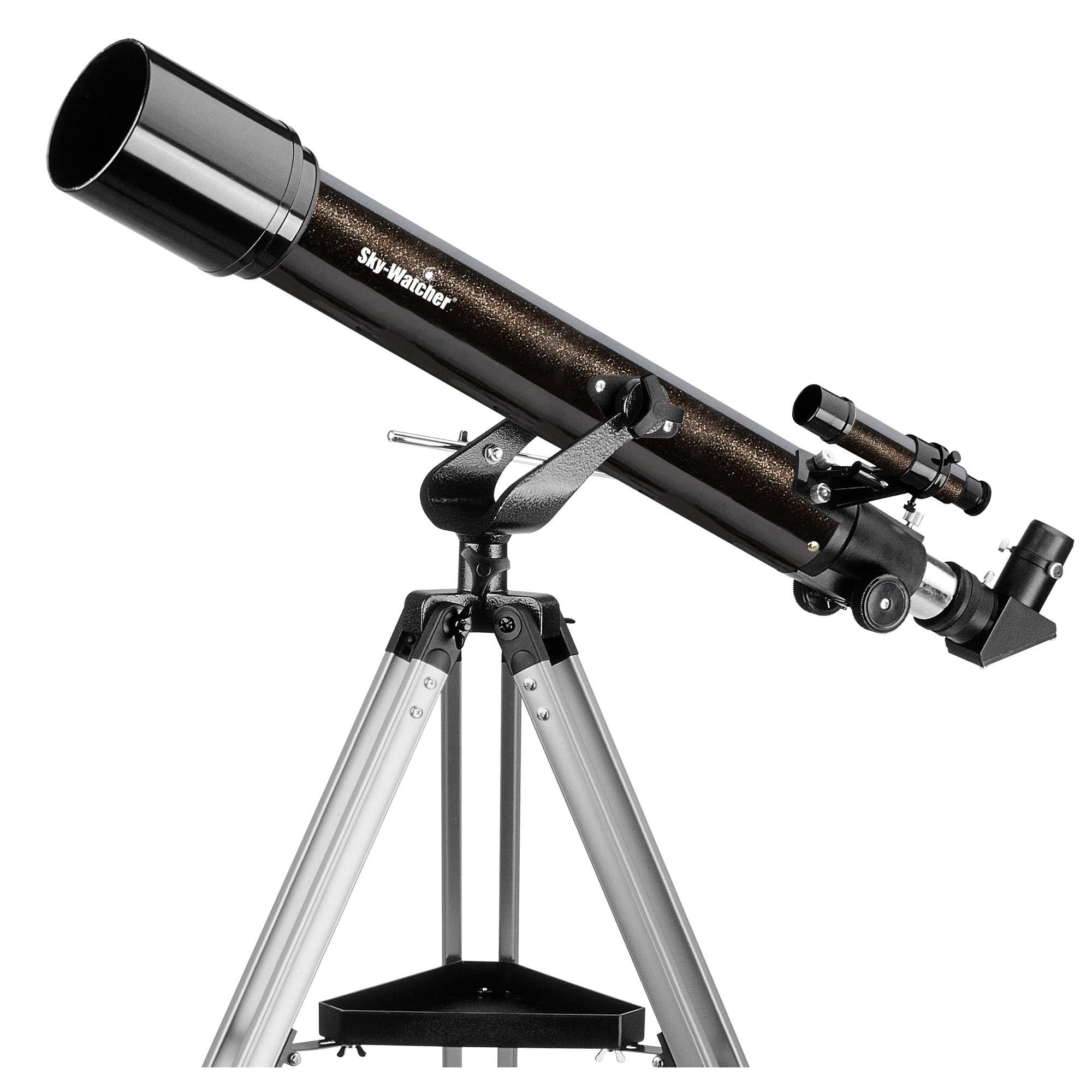
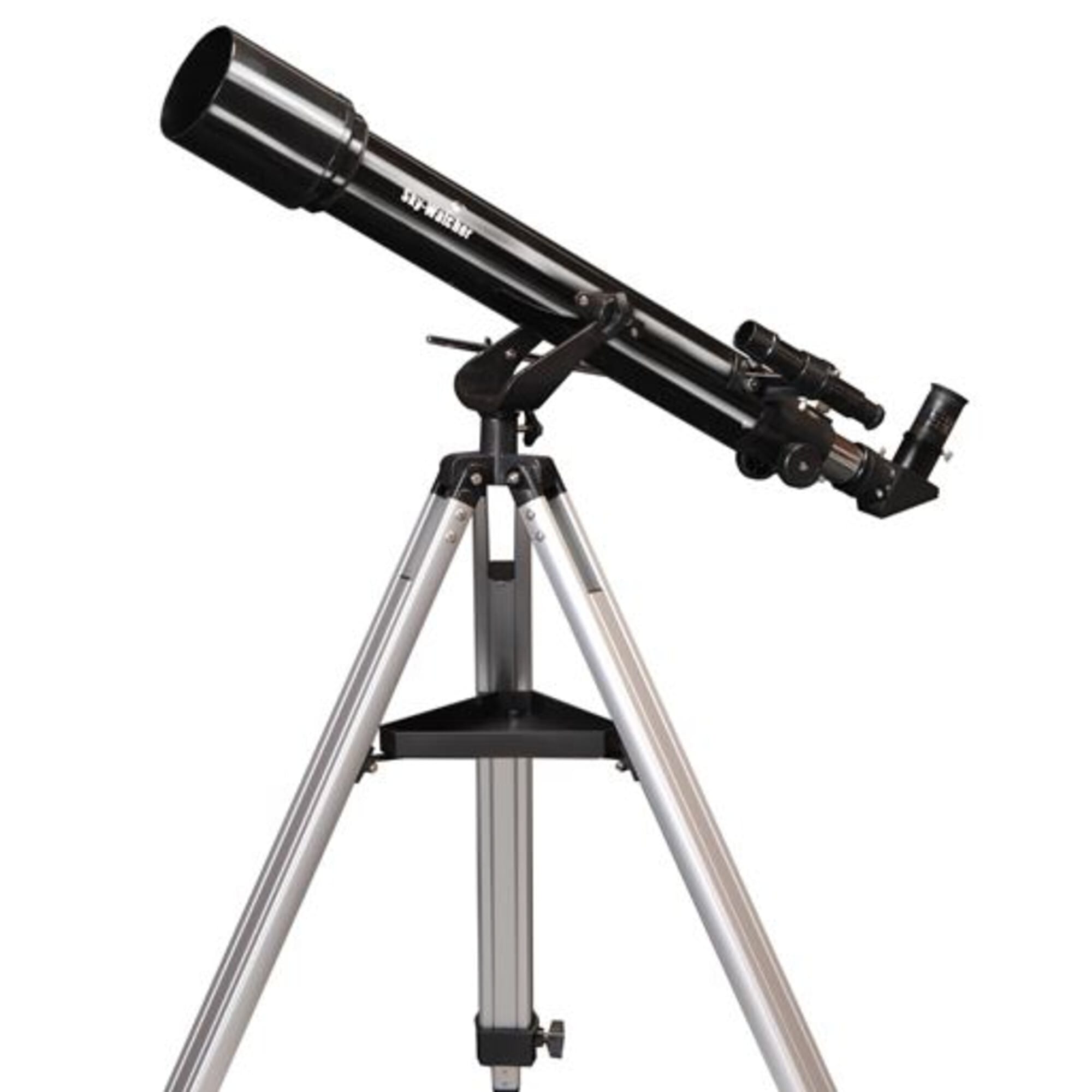


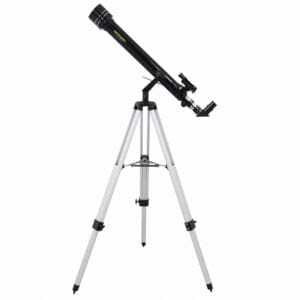
Skywatcher Telescope AC 70/700 Mercury AZ-2 is an ideal beginner's scope for exploring the moon and the brightest planets. The 70 mm diameter lenses collect about 100 times more light than the naked eye and deliver a bright, high-contrast image. At a maximum useful magnification of 140x, Jupiter's moons become visible and you can see Saturn's rings as a sharp, outlined oval.
The telescope uses classic achromatic refractor optics with a focal length of 700 mm (f/10). Thanks to the rack-and-pinion focuser, you focus smoothly and accurately without shifting the image. The included 90° zenith mirror provides comfortable viewing, while the 2x Barlow lens offers additional magnification capabilities for planetary observations.
The AZ-2 mount is an azimuth mount with smooth manual control of height and direction. You point the telescope intuitively like a photo tripod, without complicated settings. The lightweight aluminum tripod is height adjustable and features an accessory tray for eyepieces or filters.
Application
The Skywatcher Telescope AC 70/700 Mercury AZ-2 Is designed for beginners and young observers. Perfect for:
- viewing lunar craters and mountains
- tracking the rings of Saturn
- distinguishing the cloud bands on Jupiter
- observing bright star clusters such as the Pleiades
Not suitable for deep-sky astrophotography or faint nebulae - a larger mirror or lens telescope is needed for that. Thanks to the reversing prisms, the telescope can also be used for nature observation during the day.
Specifications
Optics
Type: Refractor (Achromat)
Opening: 70 mm
Focal length: 700 mm
Aperture ratio: f/10
Resolution: 1.64 arc second
Boundary magnitude: 11 mag
Maximum useful magnification: 140x
Focuser: rack and pinion 1.25″
Mount
Type: Azimuthal (AZ-2)
Material tripod: Aluminum
Stand height: 71-121 cm
Accessory tray: yes
Included accessories
Eyepieces: 25 mm and 10 mm (1.25″)
Barlow lens: 2x (1.25″)
Zenith mirror: 90° (1.25″)
Viewfinder: 6×24
General
Total weight: about 4 kg
Recommended age: 10 years and up
Uses: moon, planets, earth observation
 Dutch
Dutch English
Reviews
There are no reviews yet.