
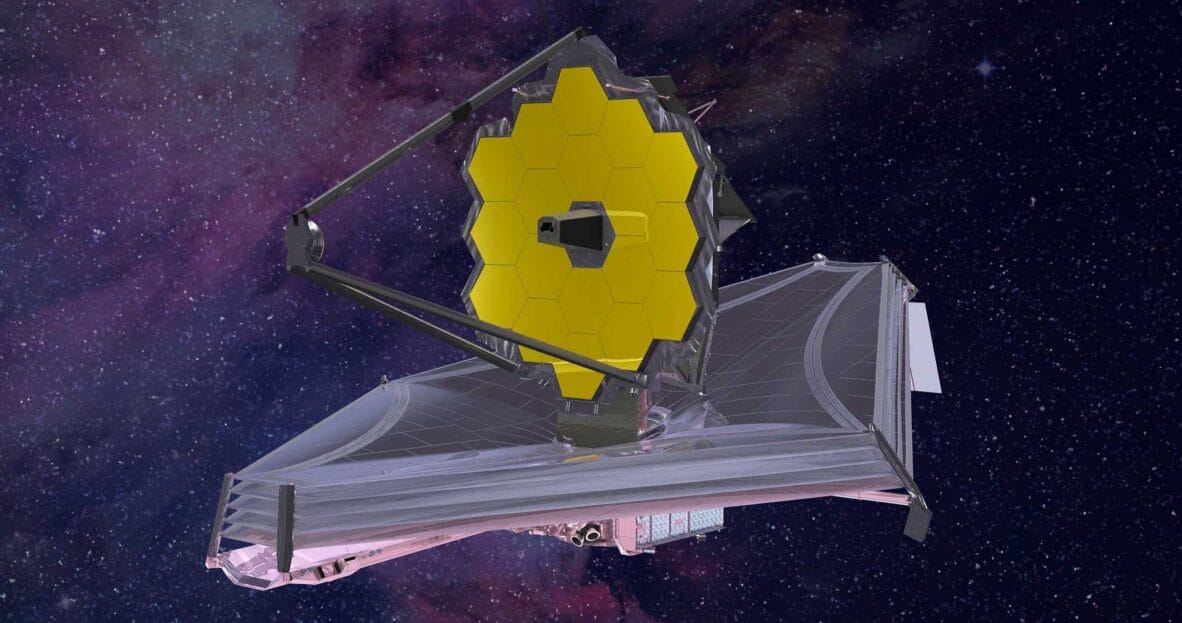
It is the most expensive, powerful and sensitive observation instrument man has ever sent into space: the James Webb Space Telescope. But what exactly does the James Webb telescope do? And why is it so much more important than previous telescopes like Hubble?
In this comprehensive blog, we dive into Webb's technology, mission, discoveries and significance to our understanding of the universe. Whether you're just starting out in stargazing or have been fascinated by cosmology for years, this is the story of a telescope that changes everything.

From Hubble to Webb: what does the James Webb telescope do differently?
The Hubble Space Telescope has revolutionized astronomy since 1990. It showed us thousands of galaxies where we previously saw only darkness. But Hubble looks primarily in visible and ultraviolet light.
The James Webb telescope looks deeper, farther and ... in the infrared. And that is precisely what makes the difference. Infrared light can penetrate dust clouds, travel further through the expanding universe, revealing structures hidden from other telescopes. If Hubble was our eyes, Webb is our X-ray machine and thermal scanner at the same time.
What does the James Webb telescope technically do?
To keep it simple: Webb captures infrared light from objects billions of light years away. That light comes from the early universe - from galaxies that formed when the universe was only a few hundred million years old.
It succeeds thanks to:
- A 6.5-meter main mirror (three times larger than Hubble's)
- A tennis court-sized sun shield to keep him cool
- Five layers of Kapton film that reflect heat from the sun, earth and moon
- Instruments such as NIRCam, MIRI, NIRSpec and FGS/NIRISS that analyze light
Webb is orbiting the second Lagrange point (L2), 1.5 million kilometers from Earth. There it is stable, dark and cold: ideal for infrared observations.
What does the James Webb telescope do that is unique?
Webb's strength lies in the combination of infrared sensitivity, resolution and stability. This allows him to:
- Observing the first galaxies ever formed
- Analyze planets around other stars for atmospheres and chemical composition
- Star formation tracking in dusty areas
- Studying supernovas, black holes and dark matter
A good example is Webb's first “deep field” image, which showed thousands of galaxies in a seemingly empty patch of sky. Some of those points of light are so far away that their light has been traveling for 13 billion years.
What does the James Webb telescope do according to initial discoveries?
Since the first images in July 2022, the results have been overwhelming:
- Discovery of carbon dioxide in the atmosphere of an exoplanet (WASP-39b)
- Observations of young galaxies older and larger than expected
- Insight into early universe challenging earlier models
- Images of the Carina Nebula, Southern Ring Nebula and Stephan's Quintet
New papers based on Webb data appear every month. What does the James Webb telescope do? Simply put: it rewrites what we thought we knew about the universe.
What does the James Webb telescope do for exoplanets?
One of Webb's most exciting applications is studying exoplanets: planets outside our solar system. With its infrared sensitivity, Webb can measure small changes in starlight as a planet moves in front of it. This is called transmission spectroscopy.
As a result, we can:
- See what gases are in the atmosphere (such as CO2, methane, water vapor)
- Estimating the temperature of the planet
- Possibly even detect signs of biological activity
In fact, Webb is our first real instrument to look for signs of life beyond Earth. Not by photographs, but by dissecting light.
Why is infrared important for what the James Webb telescope does?
Infrared light has longer wavelengths than visible light. As a result:
- Can it see through dust clouds
- Does it become less scattered by matter
- Does it extend further in time due to the expansion of the universe (redshift)
Many objects in the early universe are so far away that their original visible light has now become infrared. Only a telescope built on them, such as Webb, can still observe them.
How long will the James Webb telescope serve?
Webb's mission is designed for at least 10 years, but thanks to a particularly economical launch by ESA's Ariane 5 rocket, it is likely to last 20 years. As long as its coolants and gyroscopes work, Webb will continue to collect new data.
What does the James Webb telescope do for astronomy?
Webb not only brings pretty pictures, but changes our models. Consider:
- New estimates of when the first galaxies formed
- Understanding how fast the universe is expanding
- Confirmation or disconfirmation of theories of dark energy and matter
He is a “time machine” that takes us back to the origins. But also a chemical lab, a climate detector, and a galactic cartographer all in one.
What are upcoming research missions from the James Webb telescope?
Although Webb has already made numerous discoveries, many new research projects are also planned. In the coming years, astronomers will include:
- Conduct deeper gravitational lensing surveys, such as at cluster Abell S1063(image at top of blog post), to better understand early galaxies
- Analyze complex atmospheres of exoplanets to search for traces of life
- Investigating the structure and evolution of dark matter
- Mapping colliding galaxies and their effect on star formation
- Study stellar nurseries in our galaxy to understand the life cycle of stars
The James Webb telescope can also be used for rapid observations of unexpected events, such as supernovas or the appearance of new comets. Thanks to its flexibility and sensitivity, Webb will remain the observing instrument for groundbreaking space research in the years to come.
What can we do with what the James Webb telescope does?
Webb's images are freely available. You can view them for yourself at the official NASA page or ESA's Webb Science Portal. In addition, many results appear in accessible news articles.
And do you want to see something for yourself in the universe? Then you don't have to launch a billion-dollar project. At Telescoop.nl you will find telescopes with which you can discover the moon, planets and galaxies for yourself. And with AstroBob to help, you'll know exactly what suits you.


 Dutch
Dutch English