

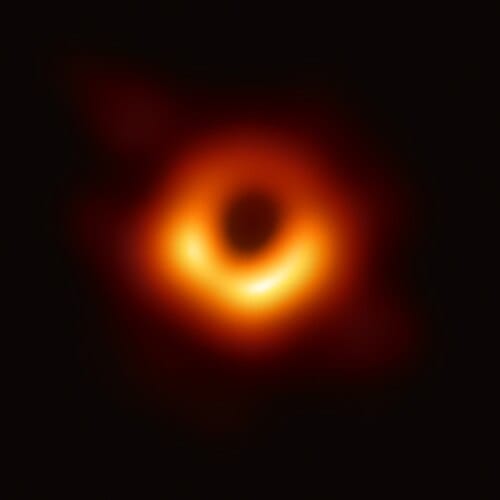
A roving black hole of a million solar masses: In a galaxy some 600 million light years away, astronomers have discovered something rare: a supermassive black hole that is is not where it should be. Instead of resting neatly in the center of its galaxy - like almost all known black holes of this type - this cosmic monster wanders around, as if it has been ejected from the center. And this is the first time we have observed such a thing in visible light.
The discovery began with a so-called tidal disruption event, or TDE. This happens when a star gets too close to a black hole. The gravity there is so strong that the star becomes completely torn apart - a process known in science as ‘spaghettification. The star's gas is then heated and starts to glow brightly, making it visible with space and radio telescopes.
Thus it came about that telescopes such as Hubble, Chandra and the Very Large Array noticed the signal from this event. The source of the light turned out to be not the galaxy's large, central black hole (which is there, by the way), but a second, smaller giant of a million solar masses - and it sat a good 2,600 light years away from the center. That's incredibly close on a cosmic scale, but still far enough to be noticeable. In our galaxy, that would correspond roughly to the distance from the Sun to the center of our system.
How does a black hole get there?
This is the question that is now occupying researchers. There are two possible explanations. The first is that this wandering black hole once formed the heart of a smaller galaxy that was swallowed up by the larger galaxy it now sits in. The black hole then came along as a remnant and has been roaming around ever since.
The second possibility is perhaps even more exciting: the black hole is swung away from the center of the galaxy by a kind of cosmic push game between three black holes. In such a triangular interaction, often the lightest of the pair is literally catapulted into the universe. This process has been described in theories before, but not previously observed with this precision.
What also comes into play: the central black hole is active and spitting out energy. But this ‘roving’ counterpart is silent - until it encounters a star. Then it makes itself heard through a burst like AT2024tvd. According to scientists, this happens once every tens of thousands of years.
Why this is more than a fluke
A discovery like this does not happen overnight. Optical sky surveys nowadays scan large areas of the sky on a daily basis. That this particular black hole engulfed a star just at the right moment and was picked up by several telescopes is partly a coincidence - but also a consequence of better technology.
Indeed, this observation suggests that there are many more such ‘invisible’ black holes exist, who become visible only when they encounter an unlucky star. Until then, they remain silent, unnoticed, and wandering. This makes them difficult to find, but also immensely interesting.
For future astronomers, this opens up new hunting grounds. If we discover such offset TDEs more often, we will learn how galaxies grow, collide, and change. And in the long run: how black holes influence each other, merge, or just push away.
🔭 Tip: Curious about other extreme events in the universe? Sign up for our newsletter and stay up to date with the most extraordinary space news every month, visible from your balcony or garden.




 Dutch
Dutch English