
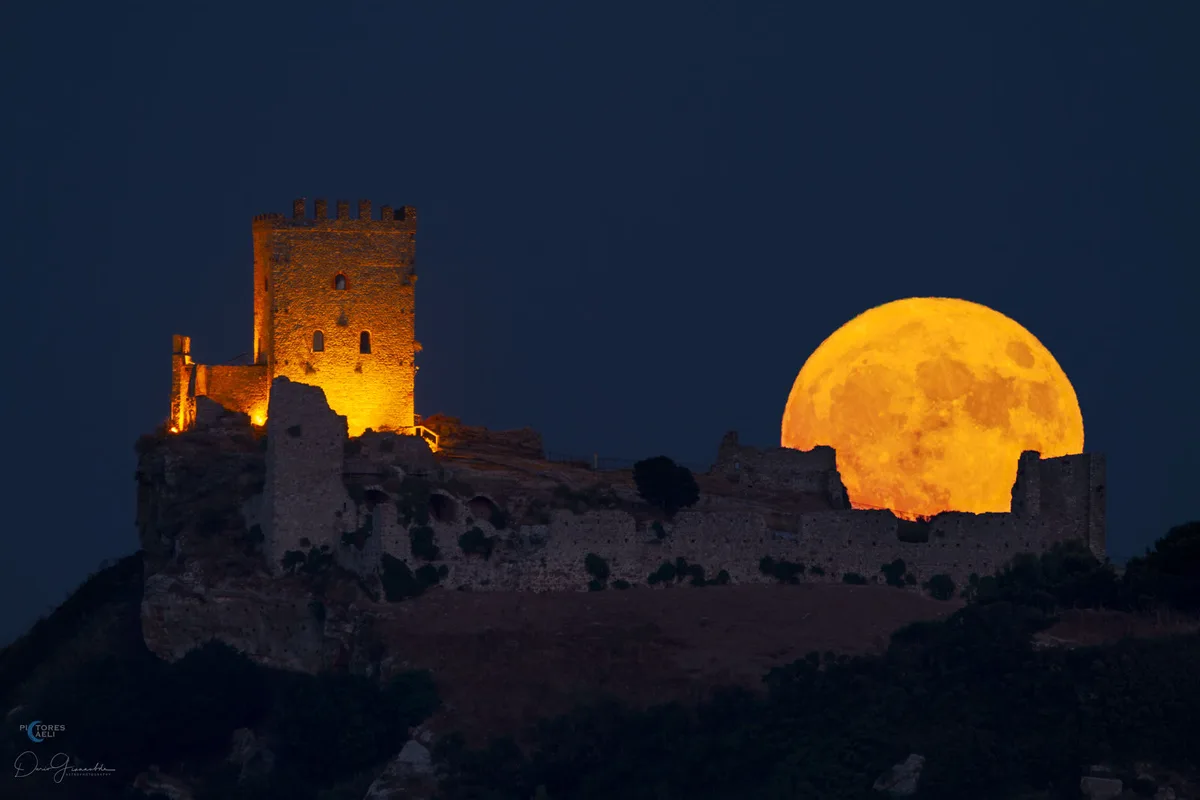
The full moon August 2025 is one of the most spectacular celestial phenomena of the year. Not only does the moon grace the night in all its glory, it coincides with a unique planetary alignment as well as the annual meteor shower of the Perseids. Those who plan the night of Aug. 8-9 properly can experience three astronomical highlights simultaneously.
When is the full moon August 2025?
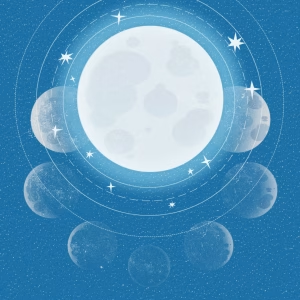
The moon reaches its full phase on Saturday, August 9 at 07:55 GMT, or 09:55 Dutch time. Although that is during the day, the moon is the night before, friday, august 8, perfectly visible. Even the evening of Aug. 9 you can still see her almost fully illuminated as long as it is clear.
Traditionally, the August full moon is the Sturgeonman called. Native North American peoples gave this name because sturgeon were most commonly caught during this period. Other names include the Grain Moon, Fruit Moon or Red Moon, each referring to harvest, nature or seasonal changes. Learned something again 🙂
In which constellation is the moon?
In 2025, the August full moon is in the constellation Capricorn. This means it appears low in the southern sky, with a warm, yellow glow at dawn. This is no accident - in August, the moon often hangs low in the sky, making it appear optically larger: an effect known as the lunar illusion.
A rare alignment of six planets
What makes the full moon August 2025 really special is the alignment of six planets. In the early morning hours of Aug. 9, just before sunrise, you can see the following planets in the sky at the same time:
- Saturn, bright near the moon in the constellation of Pisces. On Aug. 12, it approaches the moon to just 3°33′ away (use a app To find Saturn).
- Jupiter and Venus, together in the constellation Gemini. A close conjunction occurs on Aug. 12: the two planets come to within one degree of each other.
- Mercury, low on the horizon in Cancer. Difficult to see, but can be found with clear skies and binoculars.
- Uranus and Neptune, visible to the advanced with a telescope from about 80x magnification.
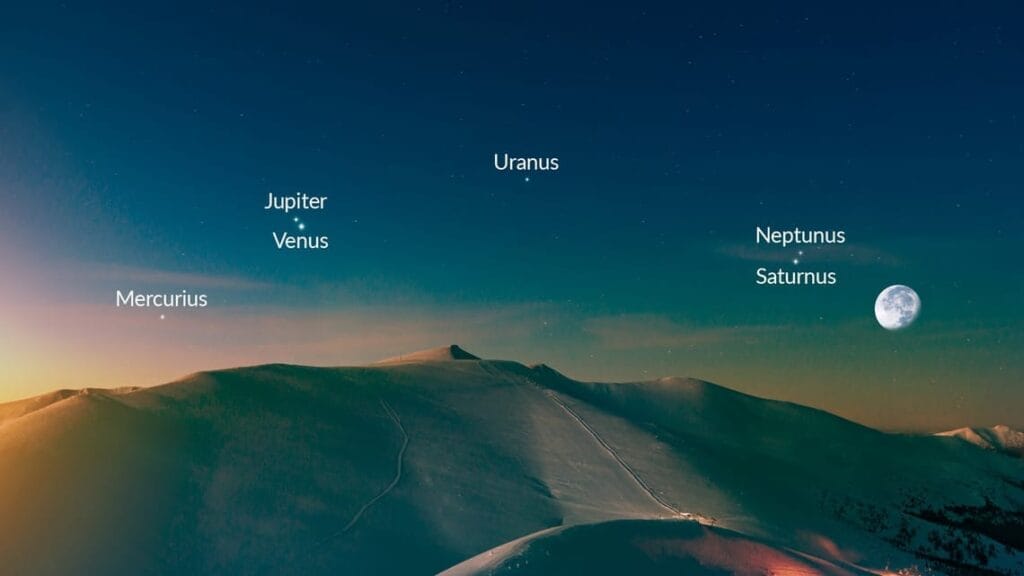
It is rare to be able to see so many planets at once, especially when combined with a full moon. This unique conjunction makes August 2025 a top month for visual astronomy as well as astrophotography.
Full moon and the Perseids
At the same time, another sky topper is taking place: the Perseids meteor shower, which reaches its peak on the night of Aug. 11 to 12. The Perseids are known for their high frequency and bright ‘shooting stars.
Yet this year is less favorable than usual: during the peak, the moon is still illuminated before 92%. That means faint meteors are largely overshadowed. But there is good news:
- Brighter bolides remain visible even with moonlight.
- By planning smartly - for example, looking after moonset or with obstacles (such as trees or buildings) shielding the moon - you can still see a lot.
- Early birds can spot the moon and Saturn simultaneously on Aug. 12, and then see the meteors increase in number toward dawn.
Is it a Supermoon?
Although it may seem so: no, the full moon August 2025 is not a Supermoon. It is at an average distance from Earth (about 384,000 km) and thus falls outside the official criteria for a Supermoon. Still, she can look extra large, especially during the rise, due to the lunar illusion which arises when you look at her low on the horizon.
The next true Supermoon is the Harvest Moon on Oct. 7, 2025. It will be about 6.6% larger and 13% brighter than a normal full moon.
What is the best way to view the full moon August 2025?
For the best view of the moon and planets, there are a few things you can do:
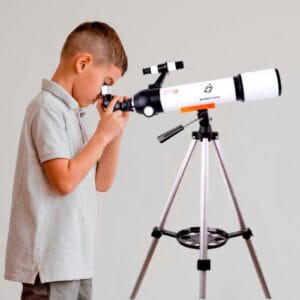
- Use a telescope with a wide field of view
With a 25 mm eyepiece on a telescope of 500-650 mm focal length, you can get the moon fully in focus, along with Saturn or stars in the background. - Place a moon filter
The moon is blindingly bright, especially through a telescope. A filter (e.g., 13% transmission or variable gray) decreases light intensity and increases contrast. - Adjust your magnification properly
Use 30x to 80x for a wide viewing experience. Want to see Saturn or Neptune in detail? Then go to 100x or higher, but be aware of seeing conditions. We explain this in our blog. - Use a smartphone adapter or smart telescope
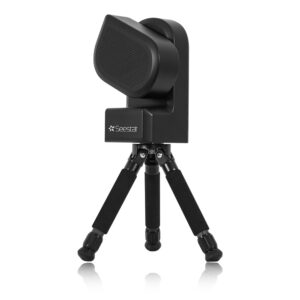
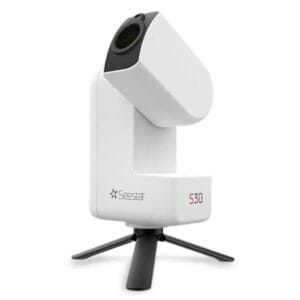
Smart telescopes such as the Seestar S30 or Dwarf 3 track objects automatically and enable live stacking. Perfect for capturing moon and planets without experience. - Choose a suitable location
Find a spot with low obstruction-free visibility toward the south (for the moon) and east (for the planets). Use an app like Sky Tonight or Stellarium to know exactly where to look.
Why this is the perfect time to start stargazing
The full moon August 2025 is the perfect time to start stargazing. Why?
✓ You see immediate results: the moon is bright and easy to find
✓ Multiple objects are visible at the same time
✓ Smart telescopes lower the entry threshold, but are not needed for the moon (though they are needed for photography)
✓ It is vacation time - many people are outside and have time
View the Telescope selection guide from Telescoop.co.uk If you're not sure which scopes are right for you. From simple beginner models to fully automatic smart scopes, there is something for everyone.
Interesting for photographers and enthusiasts
Those who like to take pictures will be in the right place in August. The moon is easily captured with a smartphone and adapter. Want to go further? Then you can:
- Photographing Saturn and its rings with a camera on a telescope
- Capturing the alignment of planets as a wide-angle panorama with a 35 mm lens
- Moon and Perseids combine in time-lapse or long exposure
Provide a stable tripod, focus manually and experiment with shutter speeds between 1/125s and 1s, depending on the subject.
Summary: Full moon August 2025
✓ Date: Saturday, August 9, 2025
✓ Time full phase: 07:55 GMT, so 09:55 Dutch time. It will not be visible then, which is why you need to look during the night of August 8-9!
✓ Constellation: Capricorn
✓ Particulars: Rare alignment of 6 planets + Perseids meteor shower
✓ Visibility: Best time is the night of Aug. 8-9
✓ Ideal for: Beginners, photographers, families, children and experienced observers
Plan your session, prepare your telescope or camera, and don't miss this cosmic convergence. Next time the moon, six planets AND meteors are visible at the same time? That could be years from now.

 Dutch
Dutch English